
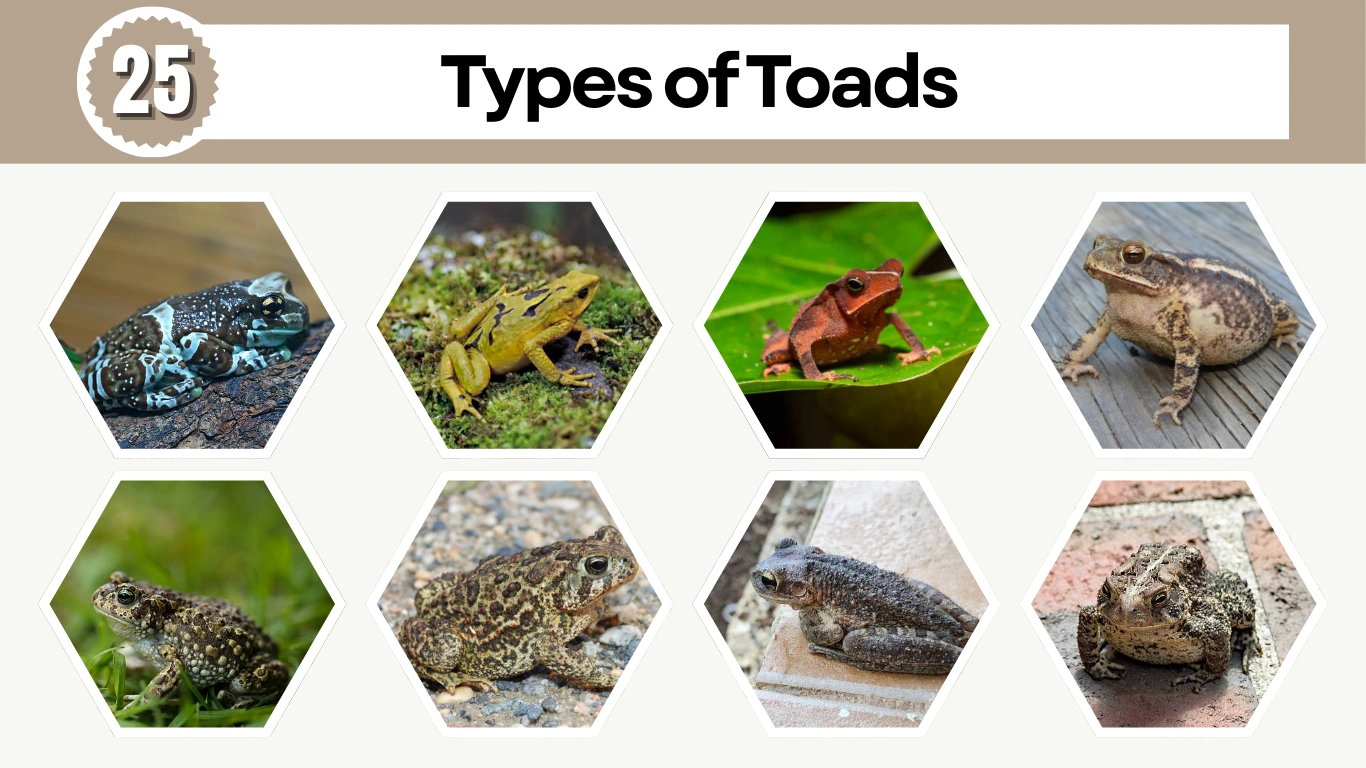
Toads are diverse amphibians found across forests, deserts, mountains, wetlands, and even cities. With their warty skin, unique calls, and fascinating behaviors, each species plays an important role in the ecosystem. This collection highlights 25 different toad species from around the world, offering quick insights into their appearance, habitats, and lifestyles. Whether you’re studying wildlife or exploring curiosity, these toads reveal the amazing variety within the amphibian world.
1. American Toad

The American toad is one of the most widespread species in North America, known for its bumpy skin, earthy coloration, and distinctive long trill call. It thrives in forests, gardens, and wetlands, adapting well to human-altered environments.
Identification
- Thick, bumpy skin with dark spots
- One or two large warts inside each dark spot
- Parotoid glands behind eyes, oval and raised
- Color ranges from brown to tan, sometimes reddish
- Short legs and stocky body
Habitat
American toads inhabit woodlands, meadows, suburban yards, and areas near ponds. They require moist soil but can tolerate drier conditions as long as shelter is available. Breeding usually occurs in shallow, calm water sources.
Behavior
They are mostly nocturnal, spending daytime under logs, leaf litter, or rocks. Their defense includes releasing mild toxins from parotoid glands. Males produce a long, musical trill during breeding season that can last up to 30 seconds.
Diet
American toads feed on insects, worms, slugs, and small invertebrates. They are opportunistic feeders and help control garden pests, making them beneficial for ecosystems and backyard environments.
2. Fowler’s Toad

Fowler’s toad is a common North American species recognized for its pale coloration, clustered warts, and preference for sandy or loose soils. It is frequently found near rivers, woodlands, and human settlements.
Identification
- Light gray, tan, or brown body with small dark patches
- Warts are grouped in clusters (usually 3+ per dark spot)
- Pale mid-dorsal stripe often present
- Parotoid glands oval and touching or nearly touching the cranial ridges
- Rough-textured skin but less bumpy than some related species
Habitat
Fowler’s toads prefer sandy or loamy soils near rivers, floodplains, woodlands, and dunes. They are adaptable and often found in agricultural fields, suburban gardens, and campgrounds.
Behavior
These toads are primarily nocturnal, hiding during the day under vegetation, debris, or shallow burrows. Their call is a short, nasal “waah” sound. When threatened, they may play dead, release toxins, or bury themselves in loose soil.
Diet
Their diet consists of ants, beetles, spiders, moth larvae, and other small invertebrates. As opportunistic feeders, they help regulate insect populations in their habitat.
3. Southern Toad

The Southern toad is a medium-sized species native to the southeastern United States, easily recognized by the prominent cranial crests on its head. It thrives in warm, humid environments and is often seen in sandy coastal regions.
Identification
- Brown, reddish-brown, or gray body with scattered warts
- Distinctive cranial crests ending in large knobs behind the eyes
- Parotoid glands present but smaller than in some related species
- Short limbs with slightly webbed toes
- Light mid-dorsal stripe may appear on some individuals
Habitat
Southern toads inhabit pine forests, coastal plains, sandy scrublands, and suburban yards. They prefer loose soil for burrowing and often emerge after rain. Breeding occurs in shallow ponds, roadside ditches, and temporary pools.
Behavior
They are mostly nocturnal and spend daylight hours burrowed underground or hidden beneath debris. Their call is a loud, high-pitched trill lasting up to 10 seconds. They may burrow rapidly when alarmed or rely on mild skin toxins for defense.
Diet
The Southern toad feeds on ants, beetles, crickets, worms, and a variety of soft-bodied invertebrates. It is an active forager and plays a role in controlling insect populations throughout its range.
4. Cane Toad

The cane toad is a large, robust species originally native to Central and South America but now widespread in many tropical regions. Known for its powerful toxins and rapid reproduction, it is considered one of the world’s most invasive amphibians.
Identification
- Very large, stout body with dry, warty skin
- Broad head with massive, oval parotoid glands
- Color ranges from brown to gray, sometimes yellowish
- Short limbs and thick, muscular appearance
- Juveniles are darker and more patterned than adults
Habitat
Cane toads inhabit tropical forests, grasslands, farmlands, and urban areas. They thrive in warm climates and breed in nearly any freshwater source, including ponds, drainage canals, and roadside ditches. Their adaptability contributes to their invasive success.
Behavior
They are primarily nocturnal, emerging at night to feed and travel long distances. When threatened, they secrete potent toxins from their parotoid glands. Cane toads show bold behavior, often sitting in open areas and tolerating human disturbance.
Diet
Cane toads consume insects, worms, small reptiles, small mammals, and even pet food when available. Their strong appetite and wide diet make them effective predators but also harmful to ecosystems where they are introduced.
5. Colorado River Toad

The Colorado River toad, also known as the Sonoran Desert toad, is one of the largest native toads in North America. Known for its smooth skin, imposing size, and potent defensive secretions, it inhabits desert and semi-arid regions of the Southwest.
Identification
- Smooth, olive-green or brown skin with scattered white warts
- Very large parotoid glands (kidney-shaped)
- Pale throat and belly, often with a smooth texture
- Large, robust body with relatively small legs
- Copper or golden iris with horizontal pupils
Habitat
This species prefers deserts, scrublands, grasslands, and areas near springs or irrigation canals. It seeks moist retreats such as rodent burrows during the day and emerges during monsoon seasons to breed in temporary pools.
Behavior
Largely nocturnal, the Colorado River toad becomes active during warm, humid nights. When threatened, it secretes powerful toxins from its parotoid glands. It is known for its deep, low-pitched call produced during the breeding season.
Diet
Its diet includes beetles, ants, spiders, crickets, and small vertebrates. As opportunistic hunters, they may consume small rodents or other amphibians when available, contributing to their role as dominant predators in their habitat.
6. Western Toad

The Western toad is a widespread species found across the western United States and parts of Canada. It is known for its distinctive pale dorsal stripe and preference for cool, moist environments such as forests and mountain meadows.
Identification
- Prominent pale or white stripe running down the back
- Rough, warty skin varying from greenish to brown
- Parotoid glands oval and well-defined
- Stocky body with short limbs
- Dark blotches may appear on the back and sides
Habitat
Western toads inhabit forests, grasslands, meadows, and mountainous regions. They prefer cool climates and are often found near lakes, ponds, and streams. Breeding occurs in shallow water bodies with little vegetation.
Behavior
They are mostly nocturnal but may be active during the day in cooler temperatures. Western toads migrate to breeding sites in large numbers and produce a soft chirping call. When threatened, they rely on toxic skin secretions and camouflage.
Diet
Their diet consists of beetles, ants, moths, worms, and other small invertebrates. Western toads forage on the ground and play an important role in maintaining insect balance within their ecosystems.
7. European Common Toad

The European common toad is one of the most familiar amphibians across Europe, known for its sturdy build, warty skin, and long migratory journeys to breeding ponds each spring. It adapts well to forests, gardens, and farmlands.
Identification
- Brown, olive, or gray warty skin with a dry texture
- Horizontal pupils with golden or copper-colored eyes
- Parotoid glands large and oval, positioned behind the eyes
- Broad body with short, strong legs
- Females significantly larger than males
Habitat
European common toads inhabit woodlands, grasslands, gardens, parks, and agricultural areas. They prefer damp environments with available shelter such as logs, stones, or leaf litter. Breeding occurs in ponds, lakes, and slow-moving waters.
Behavior
Mainly nocturnal, they spend daylight hours hidden in burrows or under natural debris. They migrate long distances to reach breeding sites, often crossing roads in large numbers. Their call is a soft, low-pitched chirring sound.
Diet
Their diet includes slugs, worms, beetles, ants, spiders, and various insects. They are active hunters and play a vital role in controlling pest populations across their wide range.
8. Natterjack Toad

The Natterjack toad is a distinctive European species known for its loud, fast-paced call and the yellow stripe running along its back. It thrives in sandy, open habitats and is considered rare in many parts of its range.
Identification
- Prominent yellow dorsal stripe from head to tail
- Warty skin with green, brown, or sandy coloration
- Short legs that give it a characteristic running, not hopping, movement
- Parotoid glands small and slightly raised
- Horizontal pupils with golden or yellowish eyes
Habitat
Natterjack toads prefer sandy heaths, dunes, coastal grasslands, and open moorlands. They require shallow, warm pools for breeding and often use temporary water bodies created by rain. Conservation efforts support their declining habitats.
Behavior
They are mainly nocturnal and highly active during warm nights. Unlike most toads, they run quickly rather than hop. Their call is one of the loudest among European amphibians, carrying long distances across open landscapes.
Diet
The Natterjack toad feeds primarily on ants, beetles, spiders, and small insects. Juveniles often consume tiny invertebrates and exhibit fast growth, especially in warm, resource-rich environments.
9. Asian Common Toad

The Asian common toad is one of the most widespread amphibians in South and Southeast Asia. Recognizable by its bumpy skin and bold coloration, it is highly adaptable and thrives in both wild and urban environments.
Identification
- Rough, warty skin with brown, reddish, or yellowish tones
- Large, raised parotoid glands behind the eyes
- Dark spots and irregular patches across the body
- Stocky build with short legs
- Golden or coppery eyes with horizontal pupils
Habitat
This species inhabits forests, gardens, rice fields, urban areas, and roadside ditches. It is highly tolerant of human activity and can be found near houses, streetlights, and temporary water sources used for breeding.
Behavior
Asian common toads are nocturnal and emerge at dusk to forage. During the breeding season, males produce a loud, repetitive trill. When threatened, they inflate their bodies and secrete toxins from their parotoid glands.
Diet
Their diet includes insects, worms, beetles, ants, termites, and small invertebrates. They often forage near artificial lights where insects gather, making them common in towns and villages.
10. Fire-bellied Toad

The fire-bellied toad is a small, brightly colored amphibian known for its striking red or orange belly, which serves as a warning to predators. Found across parts of Europe and Asia, it favors wet, marshy environments.
Identification
- Bright red, orange, or yellow belly with black blotches
- Green or brown back with dark patches and a bumpy texture
- Small body with smooth limbs and rounded toes
- Parotoid glands less pronounced than in many true toads
- Eyes set high on the head with horizontal pupils
Habitat
Fire-bellied toads inhabit wetlands, ponds, marshes, slow-moving streams, and boggy areas. They prefer shallow waters with abundant vegetation and often spend most of their time swimming or floating near the surface.
Behavior
They are diurnal or crepuscular, active during both day and dusk. When threatened, they display a defensive “unken reflex,” arching their bodies to show their bright belly colors. Their call is a soft, melodic “boo” sound.
Diet
Fire-bellied toads feed on insects, small worms, aquatic invertebrates, and tiny crustaceans. In the wild, they forage both on land and underwater, taking advantage of their semi-aquatic lifestyle.
11. Green Toad

The green toad is a colorful and variable species distributed across Europe, the Middle East, and parts of Asia. It is well known for its bright green patches and adaptability to a range of climates, from deserts to grasslands.
Identification
- Distinct green patches or blotches on a pale background
- Warty, rough skin with irregular dark spots
- Oval parotoid glands positioned behind the eyes
- Slender limbs compared to many other toad species
- Light-colored underside, often white or cream
Habitat
Green toads inhabit deserts, steppes, grasslands, woodlands, and even urban environments. They favor dry, open areas but require temporary or permanent water bodies for breeding. Their wide range reflects strong environmental tolerance.
Behavior
Primarily nocturnal, they hide during the day in burrows, under stones, or within vegetation. Their call is a high-pitched, melodic trill. They can survive in harsh, arid regions by retreating deep into burrows during extreme heat.
Diet
Their diet includes beetles, ants, moths, worms, and various small insects. Green toads forage actively on warm nights, taking advantage of abundant invertebrate prey in their diverse habitats.
12. Spadefoot Toad

Spadefoot toads are a unique group of amphibians known for the hardened, spade-like structures on their hind feet, which they use for rapid burrowing. They inhabit arid and semi-arid regions and are famous for their explosive breeding cycles.
Identification
- Smooth or slightly warty skin, often sandy or grayish
- Distinct keratinized “spade” on each hind foot
- Vertically elliptical pupils (cat-like)
- Compact body with short limbs
- Subtle patterning, sometimes with faint stripes or spots
Habitat
Spadefoot toads inhabit deserts, scrublands, grasslands, and sandy plains. They spend most of the year underground, emerging after heavy rains to feed and breed. Temporary rain pools are essential for their rapid larval development.
Behavior
Highly fossorial, they burrow backward into the soil using their specialized spades. They remain dormant for long periods, emerging at night during wet conditions. Their calls vary by species but are generally nasal or low-pitched.
Diet
Spadefoot toads feed on insects, beetles, termites, worms, and small invertebrates. They often take advantage of sudden insect activity following rains, making the most of brief periods above ground.
13. Oak Toad

The oak toad is the smallest species of true toad in North America. Known for its tiny size, high-pitched chirping call, and striking mid-dorsal stripe, it inhabits the sandy habitats of the southeastern United States.
Identification
- Very small body size (often under 1 inch)
- Bright white or yellowish dorsal stripe down the back
- Black or dark brown body with scattered warts
- Parotoid glands small and narrow
- Slender limbs with small, rounded toes
Habitat
Oak toads live in pine forests, sandy scrublands, and open woodlands. They prefer dry, well-drained soils and often hide beneath leaf litter or vegetation. Breeding occurs in shallow rain-filled pools and ditches.
Behavior
They are primarily active during the day—unusual for true toads—and produce a rapid, high-pitched chirping call during breeding season. Oak toads often move in short bursts and rely on camouflage due to their tiny size.
Diet
Their diet consists mostly of ants, termites, small beetles, and tiny invertebrates. Because of their small size, oak toads feed on prey much smaller than those eaten by most other toad species.
14. Yosemite Toad

The Yosemite toad is an alpine species native to the Sierra Nevada of California. Known for its striking coloration and preference for high-elevation meadows, it is considered vulnerable due to habitat loss and environmental changes.
Identification
- Males: bright yellow or green with dark blotches
- Females: brown or tan with numerous black spots
- Warty skin with irregular patterns
- Large, oval parotoid glands
- Stocky body adapted to cold, high-altitude climates
Habitat
Yosemite toads inhabit wet mountain meadows, ponds, and slow streams at high elevations. They depend on snowmelt pools for breeding and spend much of the year near moist vegetation in alpine ecosystems.
Behavior
They are diurnal during the breeding season, often seen calling or basking near water. Outside of breeding, they shelter in rodent burrows or under vegetation. Their call is a soft, musical trill lasting a few seconds.
Diet
Their diet includes beetles, ants, flies, spiders, and small invertebrates. Young toads primarily feed on tiny insects found in meadow vegetation, while adults forage more broadly in moist alpine areas.
15. Eastern American Toad

The Eastern American toad is a widespread species found throughout the eastern United States and southeastern Canada. It is known for its distinctive call, adaptable nature, and ability to thrive in both wild and suburban environments.
Identification
- Warty skin ranging from brown to gray or reddish
- One or two large warts inside each dark dorsal spot
- Prominent parotoid glands behind the eyes
- Stocky build with short legs
- Lighter underside with dark speckles
Habitat
This species occupies forests, fields, gardens, wetlands, and suburban yards. It prefers moist environments with abundant ground cover. Breeding occurs in ponds, streams, vernal pools, and even roadside ditches.
Behavior
Eastern American toads are mostly nocturnal but may be active on rainy days. Males produce a long, musical trill lasting up to 30 seconds during breeding. They use mild toxins for defense and hide under logs, rocks, or leaf litter during the day.
Diet
Their diet includes beetles, ants, moths, slugs, worms, and other small invertebrates. As insect predators, Eastern American toads play an important role in maintaining ecological balance in their habitats.
16. Canadian Toad

The Canadian toad is a hardy amphibian native to central Canada and parts of the northern United States. Known for its distinctive cranial crests and adaptability to cooler climates, it typically inhabits prairies, woodlands, and wetlands.
Identification
- Brown, gray, or olive skin with dark patches
- Well-defined cranial crests that join to form a central “boss”
- Warty texture with small red or orange-tinted warts
- Oval parotoid glands positioned close to the crests
- Pale underside with scattered speckles
Habitat
Canadian toads live in prairies, forests, meadows, and areas near ponds or marshes. They thrive in cooler climates and often burrow into loose soil for shelter. Breeding occurs in shallow wetlands formed by snowmelt or rain.
Behavior
They are mainly nocturnal but may be active during cool, wet days. Canadian toads migrate short distances to breeding sites and produce a short, high-pitched trill. They burrow to avoid temperature extremes and predators.
Diet
Their diet includes ants, beetles, worms, spiders, and other small invertebrates. They forage near vegetation and moist soils, helping to control insect populations across their northern range.
17. Great Plains Toad

The Great Plains toad is a robust amphibian native to the central regions of North America. Known for its loud, machine-like call and strong burrowing ability, it thrives in grasslands and agricultural landscapes.
Identification
- Gray, brown, or greenish skin with large dark blotches
- Each blotch outlined by light borders
- Stout body with short, strong limbs
- Oval parotoid glands large and well-defined
- Warty skin with medium to large raised bumps
Habitat
Great Plains toads inhabit prairies, grasslands, agricultural fields, and semi-arid plains. They favor loose soil for burrowing and rely on temporary ponds and rain-filled ditches for breeding.
Behavior
They are primarily nocturnal and emerge after heavy rains to feed and breed. Males produce an extremely loud, long buzzing call that can be heard from great distances. When disturbed, they may inflate their bodies or burrow quickly into the ground.
Diet
Their diet includes beetles, grasshoppers, ants, moths, and various small invertebrates. Great Plains toads help regulate insect populations in the prairies and farmlands they inhabit.
18. Gulf Coast Toad

The Gulf Coast toad is a resilient species found along the Gulf of Mexico, from Texas to Central America. It is known for its distinctive head ridges and ability to thrive in both natural and urban environments.
Identification
- Dark brown, gray, or blackish skin with scattered warts
- Sharp cranial ridges forming a deep V-shape between the eyes
- Parotoid glands long and narrow
- Light stripe may run along the back
- Flattened body shape suited for warm, humid regions
Habitat
Gulf Coast toads inhabit coastal marshes, forests, grasslands, suburban yards, and city parks. They breed in ditches, ponds, and temporary pools formed by rainfall. They easily adapt to human-altered environments.
Behavior
Primarily nocturnal, they emerge at dusk and are often seen near streetlights where insects gather. Their call is a short, nasal trill. When threatened, they may hop quickly, burrow shallowly, or secrete mild toxins.
Diet
Their diet includes ants, beetles, crickets, spiders, moths, and other small invertebrates. They help manage insect populations in both natural and urban habitats along the Gulf Coast.
19. African Common Toad

The African common toad is a widespread species found throughout sub-Saharan Africa. Known for its adaptability and wide habitat tolerance, it is often seen in villages, forests, savannas, and agricultural areas.
Identification
- Brown, gray, or olive skin with numerous small warts
- Prominent parotoid glands behind the eyes
- Dark patches or spots across the back
- Stocky body with short, sturdy limbs
- Pale underside, sometimes mottled
Habitat
African common toads live in forests, savannas, grasslands, wetlands, and urban settlements. They breed in temporary ponds, puddles, and slow-moving water sources formed during the rainy season.
Behavior
They are mainly nocturnal, hiding during the day under logs, stones, or burrows. Males produce a loud, pulsed call during breeding. When threatened, they rely on camouflage and defensive skin secretions.
Diet
Their diet includes termites, ants, beetles, worms, spiders, and a variety of small invertebrates. They play an important role in controlling insect populations across diverse African landscapes.
20. Malagasy Rainforest Toad

The Malagasy rainforest toad is a species native to Madagascar’s lush tropical forests. Known for its earthy coloration and secretive lifestyle, it thrives in moist, shaded environments with abundant leaf litter.
Identification
- Brown or dark reddish skin with uneven warts
- Subtle patterns that blend with forest floor debris
- Small to medium-sized body with slender limbs
- Round parotoid glands moderately raised
- Pale or lightly speckled underside
Habitat
This species inhabits humid rainforests, moist lowland forests, and dense vegetation near streams. It relies on damp soil and shaded areas, spending much of its time hidden under logs, moss, and forest litter.
Behavior
Malagasy rainforest toads are primarily nocturnal, emerging at night to forage. They remain well camouflaged and move slowly to avoid detection. Their calls are soft and often difficult to hear over rainforest sounds.
Diet
Their diet consists of ants, beetles, small worms, and other forest-dwelling invertebrates. They help maintain ecological balance in Madagascar’s rainforest ecosystems.
21. Surinam Toad

The Surinam toad is one of the most unusual amphibians in the world, known for its flattened body and unique reproductive method where eggs develop in pockets on the female’s back. It inhabits slow-moving waters in South America.
Identification
- Extremely flat, leaf-like body shape
- Brown or gray mottled skin that blends with muddy water
- Triangular head with tiny, lidless eyes
- No tongue and no teeth
- Unusual star-shaped fingertips
Habitat
Surinam toads live in slow-moving rivers, swamps, ponds, and flooded forests. They prefer muddy, debris-rich waters where they can remain camouflaged on the bottom. They are fully aquatic and rarely come onto land.
Behavior
They are slow-moving and rely heavily on camouflage. During breeding, males perform a complex underwater dance with females. Eggs become embedded in the female’s back, where they develop into froglets before emerging.
Diet
Their diet consists of worms, small fish, aquatic insects, and crustaceans. They use suction feeding by rapidly opening their wide, flat mouths to capture prey in the water.
22. Harlequin Toad

The harlequin toad is a brightly colored and visually striking amphibian found in Central and South America. Known for its vivid patterns and high-altitude habitats, many species within this group are endangered due to habitat loss and disease.
Identification
- Vibrant patterns in yellow, orange, red, or green
- Smooth skin with sharply contrasting black markings
- Slender limbs and small body size
- Narrow parotoid glands, less prominent than in many toads
- Distinctive, highly variable coloration between species
Habitat
Harlequin toads inhabit tropical forests, cloud forests, and mountainous regions near fast-flowing streams. They rely on moist, cool environments and often live at higher elevations where humidity remains high.
Behavior
They are mostly diurnal, unlike many other toads. Harlequin toads move carefully along rocks and vegetation near streams. Their calls are soft and chirping, and some species exhibit territorial behavior.
Diet
Their diet includes ants, beetles, small flies, spiders, and other tiny invertebrates. They forage actively on rocks, leaves, and mossy surfaces within their humid mountain habitats.
23. Panamanian Golden Toad

The Panamanian golden toad, also known as the golden frog (though biologically a toad), is one of the most iconic amphibians of Central America. Famous for its brilliant coloration, it is critically endangered and possibly extinct in the wild.
Identification
- Bright yellow or golden body in males
- Females more patterned with green, black, or brown markings
- Smooth skin with small, subtle warts
- Slender limbs and pointed snout
- Distinctive, vivid coloration used for warning predators
Habitat
This species inhabits cloud forests and moist highland regions of Panama, typically near fast-flowing streams. It relies on clean, cool, highly humid environments and dense vegetation for shelter and breeding.
Behavior
Panamanian golden toads are primarily diurnal, often seen perching on rocks or vegetation. They communicate using hand-waving signals known as semaphoring, especially near loud streams where vocal calls are less effective.
Diet
Their diet includes ants, beetles, small flies, and other tiny invertebrates found on forest floors and vegetation. They hunt actively during the day within their humid mountain habitats.
24. Sonoran Desert Toad

The Sonoran desert toad, closely related to the Colorado River toad, is a large, robust species native to the southwestern United States and northern Mexico. It thrives in hot, arid environments and is known for its potent defensive toxins.
Identification
- Smooth, olive-green or grayish skin with scattered white warts
- Very large, kidney-shaped parotoid glands
- Pale underside with smooth texture
- Thick, sturdy body with relatively short legs
- Copper or golden eyes with horizontal pupils
Habitat
Sonoran desert toads inhabit deserts, scrublands, grasslands, and areas near irrigation ditches, streams, and springs. They spend much of the year in underground burrows and emerge during warm, rainy periods.
Behavior
These toads are primarily nocturnal, becoming active on hot nights or during monsoon seasons. When threatened, they produce strong toxins that deter predators. Males call with a low, resonant sound during breeding.
Diet
Their diet consists of beetles, ants, spiders, small reptiles, and occasionally other amphibians. They are opportunistic predators and play an important role in desert ecosystems by controlling insect populations.
25. Cuban Toad

The Cuban toad is a resilient amphibian native to Cuba and surrounding Caribbean regions. Known for its adaptability and moderate size, it inhabits a wide range of environments, from forests to human-populated areas.
Identification
- Brown, gray, or tan warty skin with small dark patches
- Moderately sized oval parotoid glands
- Stocky body with short, sturdy limbs
- Light underside, sometimes faintly speckled
- Subtle mid-dorsal markings may be present
Habitat
Cuban toads live in forests, grasslands, plantations, and suburban areas. They tolerate warm, humid conditions and often breed in temporary pools, ponds, and roadside ditches. Their adaptability allows them to thrive near human activity.
Behavior
Mostly nocturnal, they hide during the day under stones, logs, or vegetation. Males produce a distinctive, short call during breeding season. Their skin secretions provide mild chemical defense against predators.
Diet
Their diet includes ants, beetles, worms, spiders, and small insects. Cuban toads forage actively at night and play an important ecological role by reducing insect populations in their habitats.
