
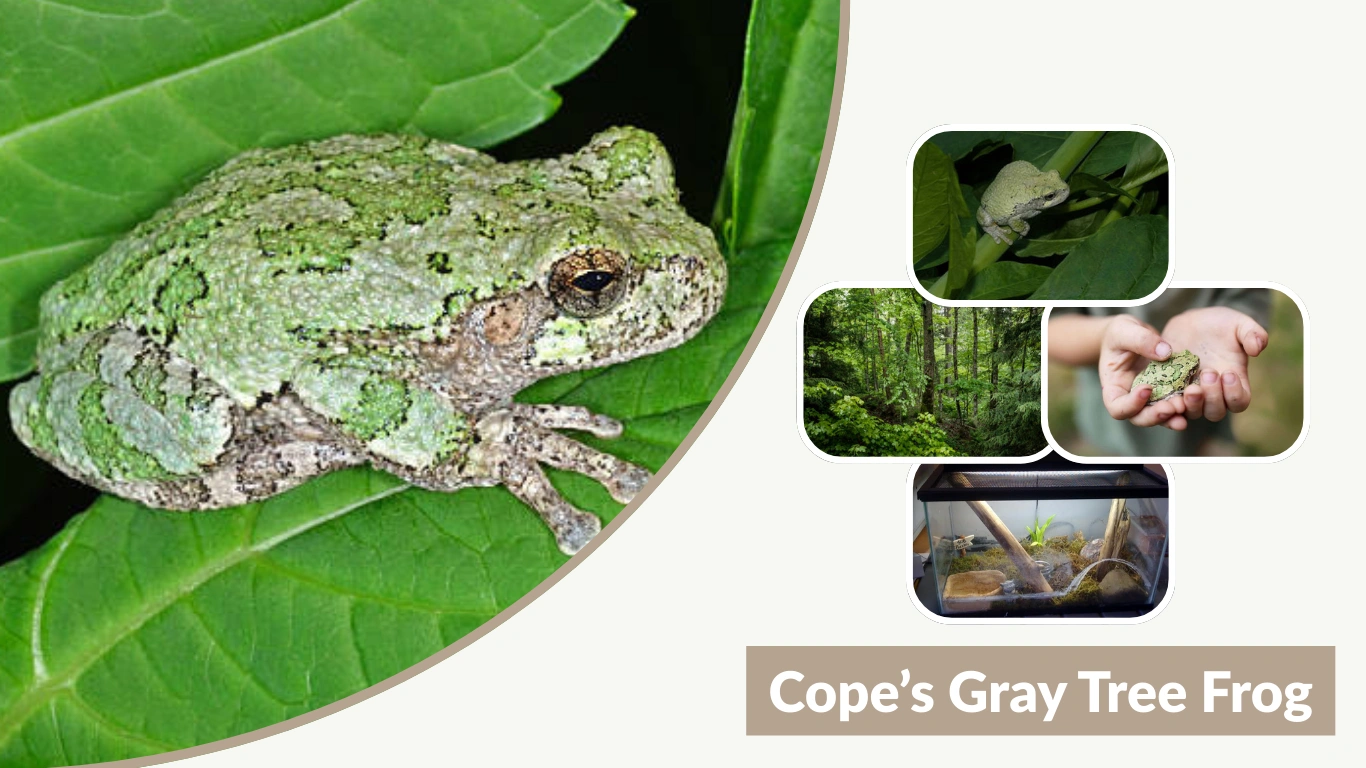
Cope’s gray tree frog (Hyla chrysoscelis) is one of North America’s most commonly encountered woodland frogs, often seen clinging to siding, porch lights, and trees on warm summer nights. Although nearly identical to the eastern gray tree frog, this species can be identified by its faster, higher-pitched call. Found across the Midwest, South, and Great Lakes states, Cope’s gray tree frogs are harmless, well-camouflaged, and important insect predators in their ecosystems.
Overview of Cope’s Gray Tree Frog
Cope’s gray tree frog is a small, arboreal amphibian known for its chameleon-like color shifts from gray to green. Many people first encounter them when males call loudly near ponds or rain-filled ditches in early summer. Despite widespread myth, they are not poisonous—at most, their skin secretions may cause mild irritation for sensitive individuals.
They belong to the genus Hyla, and the species is remarkable for being visually indistinguishable from the eastern gray tree frog. The only reliable differences are call speed and chromosome count.
Identification

- Size: Typically 1.25–2 inches (3–5 cm) long.
- Skin texture: Warty or lumpy, not smooth like other tree frogs.
- Color variations: Gray, green, or brown depending on mood and temperature.
- Markings: Dark blotches on the back; pale spot beneath each eye.
- Hidden coloration: Vivid orange inner thighs with black speckling.
- Juveniles: Smaller, often brighter green with faint markings.
- Tadpoles: Rounded bodies with mottled tails, often reddish around the tail base.
- Metamorphs: Tiny froglets resembling mini adults but greener.
- Eggs: Small, jellylike clusters attached to vegetation; typically tan or light brown.
This list also covers identification needs for searches like juvenile, baby, tadpole, egg, egg color, and leucistic Cope’s gray tree frogs.
Cope’s Gray Tree Frog vs Eastern Gray Tree Frog

The two gray tree frog species overlap across much of the eastern U.S., leading to frequent confusion. Visually, they cannot be reliably distinguished. Their calls, however, are different.
Comparison Table
| Feature | Cope’s Gray Tree Frog (H. chrysoscelis) | Eastern Gray Tree Frog (H. versicolor) |
| Call | Fast, high-speed trill | Slower, more musical trill |
| Pitch | Higher | Lower |
| Chromosomes | Diploid | Tetraploid |
| Range | Broad | Broad |
| Appearance | Identical | Identical |
Range & Distribution
Cope’s gray tree frogs occupy a wide swath of the U.S. and parts of Canada. Their range includes:
- Midwest: Illinois, Indiana, Iowa, Ohio, Michigan, Wisconsin, Minnesota, Nebraska.
- South: Kentucky, Tennessee, Arkansas, Oklahoma, South Carolina, North Georgia, Florida (northern regions).
- Mid-Atlantic: Pennsylvania, New Jersey, Maryland, Delaware.
- Great Lakes & Canada: Ontario and Manitoba.
This regional variety aligns with searches such as Cope’s gray tree frog Michigan, Minnesota, Wisconsin, Indiana, Ohio, NJ, and more. A typical range map shows the species spread across the central/eastern U.S., avoiding only far northern and coastal extremes.
Habitat

Cope’s gray tree frogs inhabit:
- Moist woodlands
- Forest edges
- Suburban yards with trees
- Temporary and permanent ponds for breeding
- Shrubby areas and gardens
They climb expertly using adhesive toe pads and spend most of their lives above ground, descending primarily during mating season or rain events.
Call & Sound
The male’s call is a rapid, cricket-like trill lasting 0.5–1 second, repeated in quick bursts. It becomes faster in warmer temperatures. This is the key way to distinguish them from their eastern cousin.
This section addresses:
cope’s gray tree frog call, sound, call download, ringtone, and mic recording searches.
Diet & Feeding

Cope’s gray tree frogs consume ants, moths, beetles, flies, and other small invertebrates. Tadpoles feed on algae, detritus, and biofilm. In captivity, they eat small crickets, fruit flies, and the occasional soft-bodied worm. Their opportunistic diet helps control insect populations around homes and woodlands.
Life Cycle
Cope’s gray tree frogs begin breeding after warm rains in late spring. Females deposit eggs on vegetation. Tadpoles hatch within days, metamorphose in 6–8 weeks, and juveniles disperse into trees. Adults live an average of 2–4 years in the wild but may reach 7+ years in captivity.
Behavior
Cope’s gray tree frogs are primarily nocturnal, becoming active after dusk when humidity rises. They climb high into trees during the day and rest in bark crevices, birdhouses, gutters, porch railings, and even behind window shutters. Their camouflage allows them to blend seamlessly into surroundings, shifting from gray to green depending on temperature and stress. During breeding season, males gather near water and produce rapid trills to attract females. In winter, they survive by entering a semi-frozen state—thanks to natural antifreeze compounds in their bodies.
These frogs are generally solitary except during the mating season. They avoid predators through camouflage, sudden leaps, and by remaining motionless when threatened.
Predators
Common predators include snakes, larger frogs, owls, raccoons, opossums, and some fish species (which may consume their tadpoles). Urban predators such as cats also pose risks. Tadpoles experience high predation rates from aquatic insects, fish, and wading birds. Their orange thigh patches serve as a “flash” defense—momentarily confusing predators when the frog jumps.
Care & Pet Considerations

Although often encountered around homes, Cope’s gray tree frogs are wild native species, and keeping them as pets is restricted or illegal in many states. Always check local wildlife regulations before attempting captive care or purchasing individuals “for sale.” Even when legal, responsible husbandry is essential.
They require a vertically oriented terrarium with ample climbing surfaces, live plants, and hiding spots. Humidity should remain moderate to high, with a daily misting schedule and a clean, shallow water dish. A nighttime temperature range of 70–78°F is appropriate.
Wild-caught frogs may carry parasites, stress easily, and exhibit health issues such as mouth irritation or sores if not kept in proper humidity. Captive-bred individuals—where legal—fare better but remain uncommon.
Cope’s Gray Tree Frog as a Pet
These frogs can adapt to captivity, but they are best suited for experienced keepers. Their natural behaviors—nocturnal activity, sudden jumping, and preference for high perches—require secure enclosures. Handling should be minimal due to their delicate skin. When properly cared for, they may live 5–7 years in captivity.
Diet consists of gut-loaded insects such as crickets, roaches, small worms, and fruit flies. UVB lighting is not mandatory but may enhance long-term health. Most keepers maintain them with seasonal cues mimicking natural light cycles.
Tadpoles & Eggs
Females lay small clusters of 10–40 eggs attached to vegetation near the surface of temporary ponds, flooded fields, or woodland pools. The eggs are usually light tan and hatch within days. Tadpoles grow rapidly, especially in warm water with ample sunlight.
They feed on algae, plant debris, and microorganisms. As metamorphosis approaches, tadpoles develop speckled patterns and stronger tail muscles. Metamorphs (tiny froglets) leave the water after absorbing their tails and seek humid shelter near leaf litter.
Raising tadpoles at home is often regulated; many states prohibit removing frog eggs from the wild.
Regional Wildlife Context
Because Cope’s gray tree frogs appear in so many states, they often show up when people search for local frog identification. They are commonly included in lists such as:
- Common small Kentucky frogs
- North Georgia frogs
- Frogs of Wisconsin
- Minnesota, Michigan, Illinois, and Indiana frogs
- Frogs of Ohio, Pennsylvania, New Jersey, and Delaware
- Ontario and Manitoba amphibians
They share habitats with green frogs, American toads, chorus frogs, spring peepers, and cricket frogs. In many regions, their recognizable call helps surveyors determine species presence even when the frogs stay hidden.
Interesting Facts
- They can survive partially frozen during winter due to cryoprotectant chemicals in their tissues.
- Their bright orange thigh patches are revealed only during jumping or display.
- Despite identical appearance, they and eastern gray tree frogs differ genetically.
- They play an important ecological role by controlling insect populations.
- Their call speed changes with temperature—faster on hot nights, slower on cool ones.
FAQ
Is a Cope’s gray tree frog poisonous?
No. Cope’s gray tree frogs are not poisonous to humans, pets, or livestock. Their skin produces mild defensive secretions, which may cause slight irritation if rubbed into eyes or mouth, but they pose no serious threat. Gentle handling or avoiding handling prevents irritation.
What do Cope’s gray tree frogs eat?
They feed on insects such as moths, beetles, ants, spiders, and flies. Tadpoles consume algae and organic debris. In captivity, they thrive on gut-loaded crickets, fruit flies, and small worms. A varied diet helps maintain their health and supports natural behaviors.
How long do Cope’s gray tree frogs live?
Wild individuals typically live 2–4 years due to predators and environmental stressors. In captivity, with proper care, regulated humidity, and consistent feeding, they can live 5–7 years or longer. Stable temperatures and reduced stress contribute to increased longevity.
How can you tell Cope’s and eastern gray tree frogs apart?
Their calls are the only reliable field distinction: Cope’s has a rapid, high-pitched trill, while the eastern species calls more slowly and musically. Genetic testing also differentiates them. Visual traits—color, size, markings—are too similar to separate confidently.
Can you keep a Cope’s gray tree frog as a pet?
In many states, keeping native frogs requires permits or is prohibited entirely. Where legal, they need specialized enclosures, careful humidity control, and minimal handling. They are best suited for experienced amphibian keepers rather than beginners.
