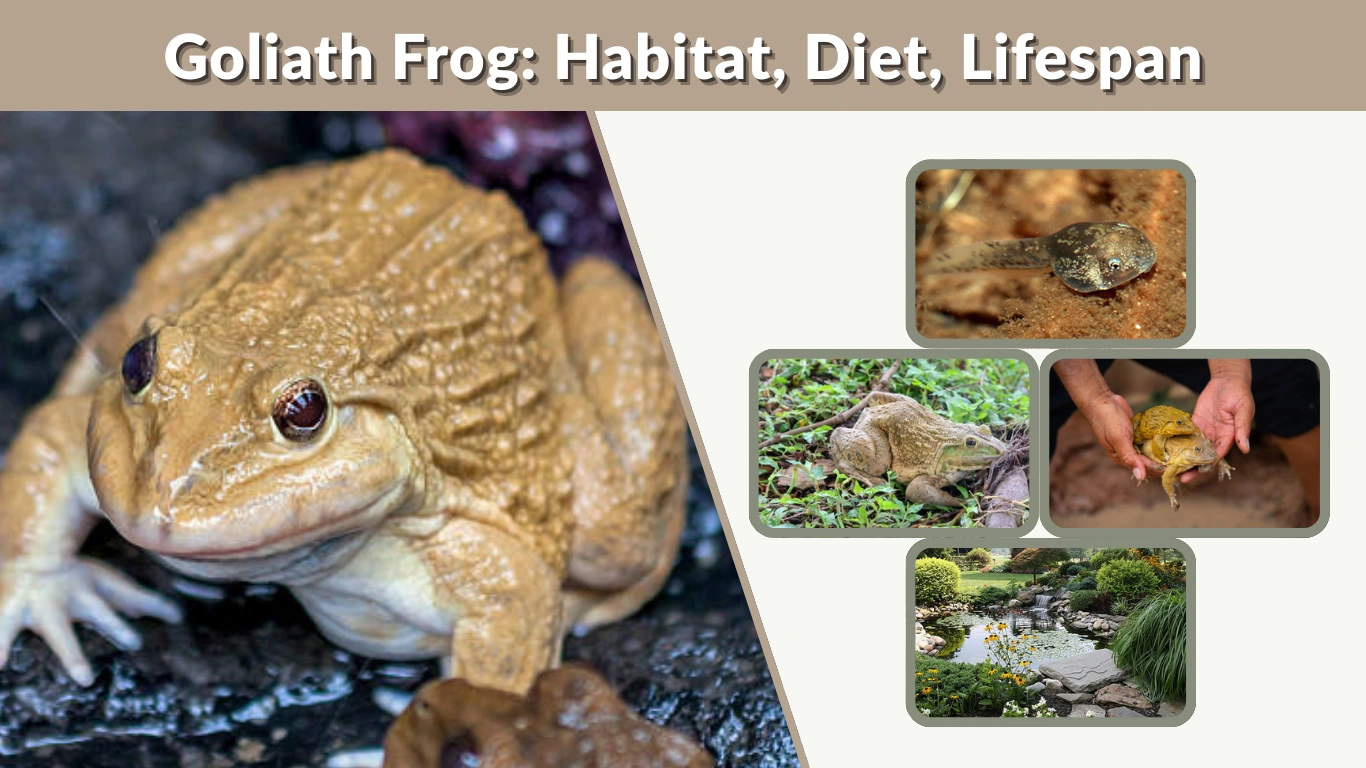
The goliath frog (Conraua goliath) is the largest frog in the world and one of the most fascinating amphibians on Earth. Native to parts of West-Central Africa, this giant frog can grow to astonishing sizes that surprise even experienced wildlife researchers. Despite its impressive appearance, the goliath frog lives a quiet life along remote rivers and waterfalls. In this guide, you’ll learn where goliath frogs live, what they eat, how long they live, and how their life cycle unfolds in the wild.
What Is a Goliath Frog?
Scientific Classification and Species Background
The goliath frog belongs to the class Amphibia and the species Conraua goliath. It is part of the family Conrauidae, a group of frogs adapted to fast-flowing river environments. First described in the late 19th century, this species quickly gained attention because of its enormous size.
Unlike many common frogs found in ponds and wetlands, the goliath frog is specially adapted to powerful river currents. Its muscular body, strong limbs, and streamlined shape help it survive in challenging aquatic environments. Because of its limited geographic range and specific habitat needs, it is considered one of the most unique amphibians in Africa.
Why Is It Called the Goliath Frog?
The name “goliath” comes from the biblical giant Goliath, and the frog truly lives up to that title. Adult goliath frogs can grow up to 12–13 inches (30–32 cm) in length from snout to vent. When fully extended, including their legs, they appear even larger.
They can weigh more than 7 pounds (over 3 kilograms), making them significantly heavier than most frog species. In comparison, a typical backyard frog weighs only a few ounces. This extreme size makes the goliath frog the undisputed heavyweight champion of the frog world.
Where Do Goliath Frogs Live? (Habitat)

Geographic Range
If you’re wondering where goliath frogs live, the answer is very specific. They are found only in parts of Cameroon and Equatorial Guinea in West-Central Africa. Their distribution is limited, meaning they do not naturally occur anywhere else in the world.
Because their range is so restricted, environmental changes in this region have a direct impact on their survival. The health of local river systems plays a critical role in maintaining stable populations.
Natural Habitat Characteristics
The goliath frog habitat consists mainly of fast-flowing rivers and streams within dense tropical rainforests. These frogs prefer areas near waterfalls and rocky riverbanks, where the water is clean, cool, and rich in oxygen.
Unlike frogs that live in calm ponds, goliath frogs depend on strong currents. The rocks along river edges provide shelter and protection from predators. The surrounding rainforest offers high humidity, which is essential for amphibians since they absorb moisture through their skin.
Environmental Conditions They Need to Survive
Goliath frogs require very specific environmental conditions. They thrive in:
- Clean, unpolluted water
- Stable tropical temperatures
- High humidity levels
- Minimal human disturbance
Because amphibians have sensitive skin, they are especially vulnerable to pollution and habitat destruction. Even small changes in water quality can threaten their survival.
What Do Goliath Frogs Eat? (Diet)

Diet of Adult Goliath Frogs
So, what do goliath frogs eat? Adult goliath frogs are carnivores. Their diet mainly includes:
- Insects
- Crabs and other crustaceans
- Small fish
- Other amphibians
- Occasionally small reptiles
Thanks to their powerful jaws and large mouths, they can capture relatively large prey compared to other frogs. Their size allows them to consume food that smaller frog species cannot handle.
What Do Goliath Frog Tadpoles Eat?
Interestingly, the goliath frog diet changes during its life cycle. While adults are carnivorous, tadpoles are mostly herbivorous. They feed on aquatic plants and algae found in river environments.
Some research suggests that goliath frog tadpoles may rely on specific plant species that grow near waterfalls. This specialized feeding behavior makes them even more dependent on healthy river ecosystems.
Hunting and Feeding Behavior
Goliath frogs are primarily nocturnal hunters. They are most active at night when they search for food along riverbanks. Using an ambush strategy, they remain still and wait for prey to come within reach.
With a sudden leap and snap of their jaws, they capture their target quickly. Their strong hind legs also allow them to make powerful jumps, helping them move efficiently across rocky surfaces.
Goliath Frog Lifespan

Average Lifespan in the Wild
The goliath frog lifespan in the wild is estimated to be around 10 to 15 years, although exact data is limited due to the difficulty of studying them in remote rainforest habitats.
Like many amphibians, their lifespan depends heavily on environmental conditions. Access to clean water, sufficient food, and safe breeding areas all influence how long they survive.
Factors That Affect Their Lifespan
Several factors can impact the longevity of goliath frogs:
- Natural predators
- Habitat destruction
- Hunting for food
- Water pollution
- Climate changes
In some regions, goliath frogs are hunted for bushmeat, which reduces population numbers. Habitat loss caused by deforestation and agriculture also poses serious risks.
Goliath Frog Life Cycle

Like all amphibians, the goliath frog goes through a fascinating life cycle that includes several distinct stages: egg, tadpole, metamorphosis, and adult. Each stage plays a critical role in the survival of the species.
Egg Stage
The life cycle begins when female goliath frogs lay their eggs near fast-flowing rivers. Unlike many frogs that lay eggs in still ponds, goliath frogs depend on clean, oxygen-rich river water. In some cases, adults have been observed moving small rocks to create safer nesting areas where eggs are protected from strong currents.
A female can lay hundreds of eggs at once. These eggs are usually attached to vegetation or placed in shallow pools along river edges. The surrounding environment must remain stable for successful development.
Tadpole Stage
After hatching, the young frogs enter the tadpole stage. At this point, they live entirely in water and breathe using gills. Goliath frog tadpoles are mostly herbivorous, feeding on aquatic plants and algae.
This stage can last several weeks to months, depending on environmental conditions. During this time, tadpoles grow rapidly. Their bodies are adapted to survive in strong currents, which is unusual compared to many pond-dwelling frog species.
Because they rely on specific river plants for food, any disruption to their habitat can greatly reduce survival rates.
Metamorphosis
Metamorphosis is the transformation from tadpole to frog. During this stage, the tadpole gradually develops hind legs, followed by front legs. Its tail slowly shrinks and is eventually absorbed into the body.
At the same time, lungs develop, allowing the young frog to breathe air. This transition marks a major shift from a fully aquatic lifestyle to one that includes both land and water.
Once metamorphosis is complete, the juvenile frog begins exploring rocky riverbanks and nearby forest areas.
Adult Stage
As adults, goliath frogs become powerful and fully carnivorous predators. They reach sexual maturity after several years. Adult frogs return to rivers to breed, continuing the life cycle.
Their strong legs, large bodies, and camouflage coloring help them survive in demanding rainforest environments. However, reaching adulthood is challenging, as many eggs and tadpoles do not survive natural threats.
Physical Characteristics and Adaptations

The goliath frog is best known for its size, but it also has several unique adaptations that allow it to survive in fast-moving river systems.
Size and Weight
The most striking feature of the goliath frog is its enormous size. Adults can measure up to 12–13 inches (30–32 cm) in body length and weigh more than 7 pounds (3 kilograms). When their legs are fully extended, they appear even larger.
This size gives them strength and dominance in their environment, but it also requires a consistent food supply to maintain energy levels.
Skin Color and Camouflage
Goliath frogs typically have greenish-brown skin with darker patterns. This natural coloring helps them blend into rocks, riverbanks, and surrounding vegetation.
Camouflage is essential for avoiding predators and ambushing prey. Their undersides are usually lighter in color, which helps them remain less visible from below when in water.
Unique Adaptations for River Life
Living in fast-flowing rivers requires specialized traits. Goliath frogs have:
- Extremely powerful hind legs for jumping across rocks
- Strong swimming abilities
- Large webbed feet for stability in water
- Excellent hearing to detect movement
These adaptations allow them to thrive in environments where many other frog species could not survive.
Is the Goliath Frog Endangered?
Conservation Status
The goliath frog is currently classified as Endangered by the International Union for Conservation of Nature (IUCN). Its population has declined significantly over recent decades.
Because it exists only in limited regions of Africa, any environmental disruption has a major impact on the species as a whole.
Major Threats
Several threats contribute to the decline of goliath frogs:
- Hunting for food (bushmeat)
- Illegal pet trade
- Deforestation
- River pollution
- Agricultural expansion
Habitat destruction is one of the most serious problems. When forests are cleared or rivers become polluted, breeding grounds are damaged.
Conservation Efforts
Efforts are being made to protect remaining populations. Some river habitats are now under protection, and conservation organizations are working to raise awareness about the importance of preserving rainforest ecosystems.
Local education and sustainable environmental practices are key to ensuring the long-term survival of this giant amphibian.
Interesting Facts About the Goliath Frog
- It is the largest frog species in the world.
- It can leap impressive distances using its powerful hind legs.
- Some adults move rocks to create safer nesting pools for eggs.
- It plays an important role in controlling insect and small animal populations.
- It is rarely seen in zoos due to its specialized habitat needs.
FAQs
Where do goliath frogs live?
Goliath frogs live in parts of Cameroon and Equatorial Guinea in West-Central Africa. They inhabit fast-flowing rivers and waterfalls within dense tropical rainforests. These frogs depend on clean, oxygen-rich water and humid environments to survive.
What do goliath frogs eat?
Adult goliath frogs eat insects, crabs, fish, smaller amphibians, and occasionally small reptiles. Tadpoles, however, are mostly herbivorous and feed on aquatic plants and algae found in river habitats.
How long do goliath frogs live?
Goliath frogs are estimated to live around 10 to 15 years in the wild. Their lifespan depends on habitat quality, food availability, and protection from threats like hunting and pollution.
How big can a goliath frog grow?
A goliath frog can grow up to 12–13 inches in body length and weigh more than 7 pounds. When fully extended, including its legs, it appears even larger, making it the biggest frog species on Earth.
Are goliath frogs endangered?
Yes, goliath frogs are classified as Endangered. Their populations are declining due to habitat destruction, hunting, pollution, and the illegal pet trade. Conservation efforts are ongoing to protect their remaining habitats.
Conclusion
The goliath frog is a remarkable amphibian known for its massive size, unique river habitat, and complex life cycle. Found only in limited regions of West-Central Africa, it depends heavily on clean rivers and healthy rainforest ecosystems. From herbivorous tadpoles to powerful carnivorous adults, every stage of its life highlights the importance of environmental balance. Protecting the goliath frog means preserving one of nature’s most extraordinary species for future generations.
