
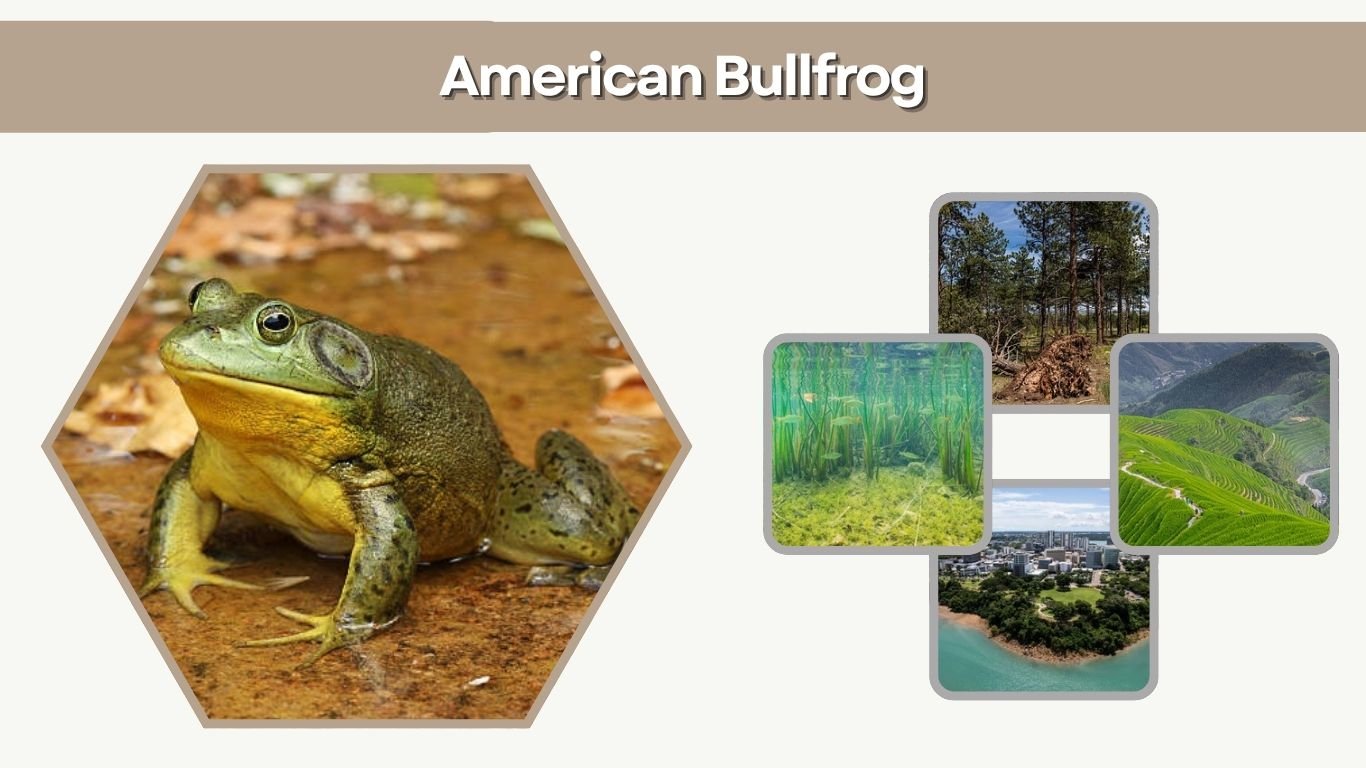
The American bullfrog is one of the most recognizable amphibians in North America. Known for its deep, booming call and impressive size, this species has captured the attention of scientists, nature enthusiasts, and casual observers alike. Its scientific name, Lithobates catesbeianus, reflects its classification within the true frog family.
Native to eastern North America, the American bullfrog has expanded far beyond its original range and is now found in many parts of the world. This widespread presence is largely due to human activities, including farming and the pet trade. Today, it is often discussed not only for its fascinating biology but also for its ecological impact, especially as an invasive species in some regions.
American Bullfrog Identification & Characteristics

Recognizing an American bullfrog is relatively easy once you know what to look for. These frogs are large, powerful, and have several distinctive features that set them apart from other species.
Physical Appearance
American bullfrogs typically have smooth, moist skin that ranges in color from olive green to brown. Some individuals may have darker mottling or spots, which help them blend into their surroundings. Their underside is usually lighter, often pale or cream-colored.
One of the most important identifying features is the absence of dorsolateral ridges (raised folds of skin running down the back), which are present in many other frog species. Instead, bullfrogs have a prominent tympanum (external eardrum) located just behind each eye. In males, this tympanum is often noticeably larger than the eye itself.
Size and Weight
The American bullfrog is the largest frog species in North America. Adults typically measure between 3.6 and 6 inches (9–15 cm) in body length. However, when including their powerful hind legs, they appear even larger.
In terms of weight, bullfrogs can reach up to 1.5 pounds (around 680 grams). Females are generally larger than males, although males tend to have larger tympanums and more pronounced throats, especially during the breeding season.
Distinctive Features
Aside from size, the bullfrog is famous for its deep, resonant call, often described as sounding like “jug-o-rum.” This call can travel long distances across water and is most commonly heard during warm evenings.
Their large mouths are another defining trait. Bullfrogs are capable of consuming surprisingly large prey, making them formidable predators in their environment.
Habitat of the American Bullfrog

The American bullfrog thrives in a variety of freshwater environments. Its adaptability is one of the key reasons for its success both in native and introduced regions.
Preferred Habitats
Bullfrogs are most commonly found in permanent freshwater bodies such as ponds, lakes, marshes, and slow-moving streams. They prefer calm or still water rather than fast-flowing rivers.
These environments provide the essential resources they need: water for breeding, vegetation for cover, and abundant prey. Bullfrogs are rarely found far from water, as they rely on moist conditions to survive.
Environmental Conditions
Warm temperatures are crucial for bullfrogs, as they are ectothermic (cold-blooded) animals. They are most active during late spring and summer when temperatures are higher.
Vegetation plays an important role in their habitat. Aquatic plants and shoreline vegetation offer hiding spots from predators and ideal ambush points for hunting. Additionally, these areas support a diverse range of prey species.
Urban vs Natural Habitats
One remarkable trait of the American bullfrog is its ability to adapt to human-altered environments. They are frequently found in artificial ponds, reservoirs, and even drainage systems.
This adaptability has contributed significantly to their spread across new regions. In many cases, bullfrogs thrive better in disturbed habitats than native amphibian species, giving them a competitive advantage.
Geographic Range and Distribution
The distribution of the American bullfrog has expanded dramatically over time, making it one of the most widespread amphibians in the world.
Native Range
Originally, the American bullfrog was native to eastern North America. Its natural range includes much of the eastern United States and extends into southern Canada. In these regions, it plays a natural role in the ecosystem as both predator and prey.
Introduced Range
Due to human activities, the bullfrog has been introduced to many other parts of North America, including the western United States. Beyond North America, it can now be found in Europe, Asia, and South America.
These introductions were often intentional, driven by the demand for frog legs as food or for use in scientific research. In some cases, individuals released from the pet trade established wild populations.
Range Expansion Insights
The spread of the American bullfrog is closely tied to its adaptability and generalist diet. Unlike many amphibians that require specific conditions, bullfrogs can survive in a wide range of environments.
This flexibility has allowed them to establish populations in areas where native amphibians struggle. As a result, their range continues to expand, raising concerns among conservationists about their ecological impact.
Diet and Feeding Behavior
The American bullfrog is an opportunistic and highly efficient predator. Its feeding habits are one of the main reasons it has become so successful in diverse environments.
What Do American Bullfrogs Eat?
Bullfrogs have a remarkably varied diet. They consume insects, spiders, fish, small reptiles, birds, and even small mammals. They are also known to eat other frogs, including members of their own species.
This wide-ranging diet allows them to survive in different habitats and adapt to changing food availability. Essentially, if it fits in their mouth, it is potential prey.
Hunting Strategy
Bullfrogs are sit-and-wait predators. They remain still for long periods, often partially submerged in water, waiting for prey to come within striking distance.
When an opportunity arises, they use their powerful hind legs to lunge forward and their sticky tongues to capture prey with incredible speed. Their quick reflexes and strong jaws make escape unlikely for most victims.
Life Cycle and Lifespan

The life cycle of the American bullfrog is closely tied to water and seasonal changes. Like most amphibians, they undergo a fascinating transformation from aquatic larvae to fully developed adults.
Reproduction
Breeding typically occurs from late spring through summer, depending on the climate. During this time, males become highly vocal, producing their signature deep calls to attract females and establish territory.
Females lay thousands of eggs in large floating clusters on the surface of the water. These eggs hatch within a few days, depending on temperature and environmental conditions.
Egg and Tadpole Stage
After hatching, the young enter the tadpole stage, where they live entirely in water. Bullfrog tadpoles are larger than those of many other species and can take significantly longer to develop.
Unlike most frogs, which metamorphose within months, bullfrog tadpoles may take 1 to 3 years to become adults. During this time, they feed primarily on algae and plant material, gradually developing legs and lungs.
Adult Lifespan
Once they reach adulthood, American bullfrogs can live between 7 and 10 years in the wild. In captivity, where threats are reduced, they may live even longer.
Their relatively long lifespan, combined with high reproductive output, contributes to their ability to establish and maintain large populations.
American Bullfrog Behavior and Sounds
The behavior of the American bullfrog is shaped by its need to survive, reproduce, and dominate its environment.
Bullfrog Call
The bullfrog’s call is one of its most iconic features. Often described as a deep “jug-o-rum” sound, it is used primarily by males during the breeding season.
This call serves two main purposes: attracting females and warning other males to stay away. It can be heard over long distances, especially on warm summer nights near water bodies.
Territorial Behavior
Male bullfrogs are highly territorial, especially during breeding season. They defend specific areas of water where females are likely to visit.
If another male enters their territory, they may respond with aggressive calls or physical confrontations. This behavior ensures better mating opportunities for dominant individuals.
Activity Patterns
American bullfrogs are mostly nocturnal, meaning they are most active at night. This helps them avoid predators and hunt more effectively.
They are also highly sensitive to temperature and are most active during warm months. In colder regions, they may hibernate underwater during winter.
American Bullfrog as an Invasive Species
While the American bullfrog is a fascinating species, it is also considered one of the most problematic invasive amphibians in the world.
Why It’s Invasive
Bullfrogs possess several traits that make them highly invasive:
- Broad diet (they eat almost anything)
- High reproductive rate
- Ability to adapt to various environments
These characteristics allow them to outcompete native species for food and habitat.
Environmental Impact
The presence of bullfrogs can have serious ecological consequences. They prey on native amphibians, fish, and even birds, reducing local biodiversity.
Additionally, they are known carriers of diseases such as the chytrid fungus, which has devastated amphibian populations worldwide. Their introduction often disrupts fragile ecosystems that are not adapted to such dominant predators.
Control Measures
Managing bullfrog populations is challenging. Efforts typically include monitoring, habitat management, and sometimes removal programs.
Preventing their spread is the most effective strategy, especially by regulating trade and discouraging the release of captive individuals into the wild.
Interesting American Bullfrog Facts
The American bullfrog is full of surprising traits that make it unique among amphibians.
- It is the largest frog in North America
- It can leap distances of over 3 feet (1 meter)
- It is known to exhibit cannibalistic behavior
- It has been introduced worldwide for food production
- Its call can be heard from over half a mile away in ideal conditions
These facts highlight both its impressive abilities and its ecological impact.
American Bullfrog vs Green Frog

The American bullfrog is often confused with the green frog due to their similar habitats and appearances. However, there are clear differences.
Key Differences
- Size: Bullfrogs are significantly larger than green frogs
- Call: Bullfrogs produce a deep booming sound, while green frogs make a “plucked string” sound
- Behavior: Bullfrogs are generally more aggressive predators
Identification Tips
One of the easiest ways to distinguish them is by looking for dorsolateral ridges. Green frogs have these ridges running along their backs, while bullfrogs do not.
Additionally, bullfrogs tend to have a bulkier body and a more pronounced tympanum.
Conservation Status and Human Interaction
Despite being invasive in many areas, the American bullfrog is not considered endangered. In fact, its populations are stable or increasing in most parts of its range.
Humans interact with bullfrogs in several ways. They are farmed for food, particularly for frog legs, and are also used in scientific research.
However, habitat destruction, pollution, and climate change can still affect local populations. In some regions, conservation efforts focus on protecting native species from bullfrog expansion rather than protecting the bullfrogs themselves.
FAQs
What is the scientific name of the American bullfrog?
The scientific name is Lithobates catesbeianus. It was previously classified under the genus Rana, but taxonomic revisions placed it in the Lithobates group. This species is widely studied due to its size, adaptability, and ecological impact.
How big can an American bullfrog get?
American bullfrogs can grow up to 6 inches (15 cm) in body length and weigh more than 1.5 pounds (680 grams). Their large size makes them the biggest frog species in North America, with females typically larger than males.
Why are American bullfrogs considered invasive?
They are considered invasive because they consume a wide variety of native species, reproduce rapidly, and adapt easily to new environments. Their presence often disrupts ecosystems and reduces biodiversity, especially in regions where native amphibians are already vulnerable.
What do American bullfrogs eat?
They are opportunistic predators that eat insects, fish, birds, reptiles, and even small mammals. Their large mouths allow them to consume prey nearly half their size, making them dominant predators in freshwater ecosystems.
Where do American bullfrogs live?
American bullfrogs live in freshwater habitats such as ponds, lakes, marshes, and slow-moving streams. They prefer warm, permanent water bodies with plenty of vegetation and are commonly found in both natural and human-made environments.
