
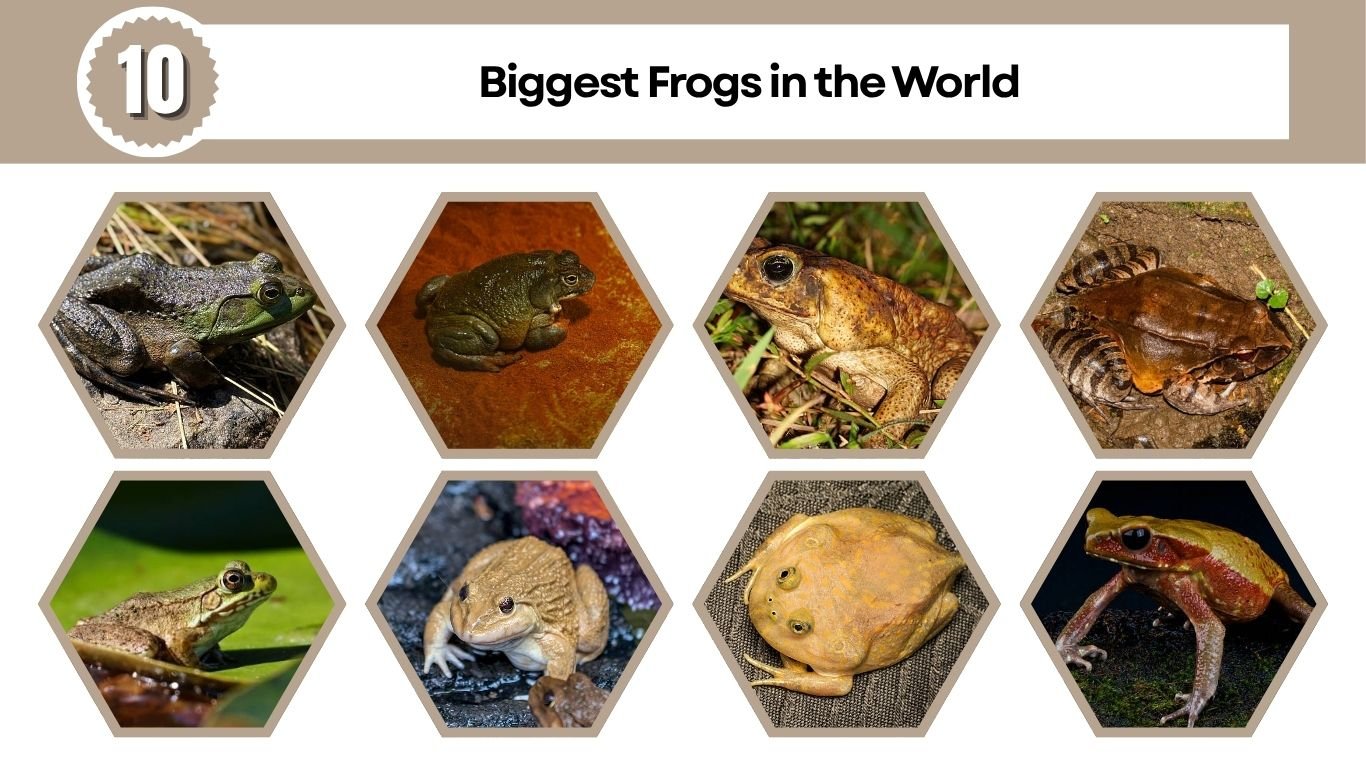
Frogs come in an incredible range of sizes, but some species grow far larger than most people expect. From the massive Goliath Frog to surprisingly bulky tropical species, these giants stand out for their size, strength, and unique adaptations. In this list, we explore the 10 biggest frogs in the world, ranked by size, highlighting their key features, habitats, and behaviors.
1. Goliath Frog

The Goliath Frog (Conraua goliath) is the largest frog in the world, native to the rainforests of West Africa. Known for its massive size and powerful build, it lives near fast-flowing rivers and waterfalls. Despite its intimidating appearance, it is a shy species that relies on camouflage and quick movement to avoid predators.
Size
The Goliath Frog can grow up to about 32 cm (12.6 inches) in body length and weigh as much as 3.3 kg (7.3 pounds). Including its legs, its full length can exceed 80 cm (over 2.5 feet). This makes it significantly larger than any other frog species on Earth.
Identification
- Large, muscular body with a broad head
- Smooth, greenish-brown skin that blends with rocks and vegetation
- Strong hind legs built for powerful jumping
- No vocal sac, unlike many other frogs
- Bulging eyes positioned high on the head
Habitat
Goliath Frogs are found mainly in Cameroon and Equatorial Guinea. They prefer clean, oxygen-rich rivers with rocky surroundings. These frogs are highly dependent on stable freshwater ecosystems, often staying close to waterfalls where they build small pools for their eggs.
Behavior
Unlike many frogs, Goliath Frogs do not croak loudly. They are mostly nocturnal and spend much of their time resting on rocks. When threatened, they leap quickly into the water. They feed on insects, crustaceans, fish, and even smaller amphibians, using their strong jaws to capture prey.
2. African Bullfrog

The African Bullfrog (Pyxicephalus adspersus) is one of the largest and most aggressive frog species in the world. Native to sub-Saharan Africa, it is famous for its powerful bite and defensive nature. It thrives in seasonal environments where water availability changes throughout the year.
Size
This frog can grow up to 24 cm (9.4 inches) in length and weigh over 2 kg (4.4 pounds). Males are significantly larger than females, making them one of the most sexually dimorphic frog species.
Identification
- Stocky, round body with a large head
- Olive-green to brown coloration
- Wide mouth with strong jaws and tooth-like structures
- Thick skin with folds along the sides
- Short but powerful legs
Habitat
African Bullfrogs are commonly found in savannas, grasslands, and seasonal floodplains. They spend much of their life buried underground to survive dry periods, emerging during rains to breed and feed.
Behavior
This species is highly territorial and aggressive, even toward predators. It feeds on insects, small mammals, reptiles, and other amphibians. During droughts, it enters a state of dormancy called estivation, surviving underground for months until rain returns.
3. Cane Toad

The Cane Toad (Rhinella marina) is a large, heavy-bodied amphibian originally from Central and South America. It has been introduced to many other regions, where it often becomes invasive due to its adaptability and toxic defenses.
Size
Cane Toads can reach lengths of up to 23 cm (9 inches) and weigh around 1.5–2 kg (3.3–4.4 pounds). Some individuals grow even larger in favorable environments.
Identification
- Broad, flattened body with dry, warty skin
- Brown or gray coloration with darker patches
- Large poison glands behind the eyes (parotoid glands)
- Short legs compared to body size
- Prominent ridges above the eyes
Habitat
They are highly adaptable and can live in forests, grasslands, urban areas, and agricultural fields. Cane Toads prefer warm, humid environments and are often found near water sources.
Behavior
Cane Toads are mostly nocturnal and are known for their toxic secretions, which deter predators. They feed on insects, small animals, and even pet food in urban areas. Their invasive nature has caused ecological problems in many regions outside their native range.
4. American Bullfrog

The American Bullfrog (Lithobates catesbeianus) is one of the largest frogs in North America and is well known for its deep, resonant call. It is highly adaptable and has been introduced to many parts of the world, where it often thrives in a variety of aquatic environments.
Size
This species can grow up to 20 cm (8 inches) in body length and weigh around 0.5–0.75 kg (1.1–1.6 pounds). Its long hind legs make it appear even larger when fully extended.
Identification
- Large body with smooth, green to olive skin
- Distinct tympanum (eardrum) behind the eye
- No dorsal ridges along the back
- Long, powerful hind legs
- Males have yellow throats during breeding season
Habitat
American Bullfrogs are commonly found in ponds, lakes, marshes, and slow-moving rivers. They prefer warm, still waters with abundant vegetation where they can hide and hunt.
Behavior
They are opportunistic predators, feeding on insects, fish, birds, and even small mammals. Their loud, deep calls are often heard at night. They are mostly aquatic and will quickly dive into water when disturbed.
5. Smoky Jungle Frog

The Smoky Jungle Frog (Leptodactylus pentadactylus) is a large tropical frog found in Central and South America. It is known for its strong build and distinctive defensive behavior when threatened.
Size
This frog can reach lengths of up to 18 cm (7 inches) and weigh around 0.5 kg (1.1 pounds). It is one of the largest frogs in the Neotropical region.
Identification
- Robust body with rough, brown or grayish skin
- Dark markings and stripes along the back
- Large head with a wide mouth
- Strong limbs adapted for digging and jumping
- Noticeable folds along the sides of the body
Habitat
Smoky Jungle Frogs inhabit tropical rainforests, often near streams, swamps, and forest floors. They prefer moist environments with plenty of cover such as leaf litter and logs.
Behavior
When threatened, this frog can produce a loud scream-like call to startle predators. It is mostly nocturnal and feeds on insects, small reptiles, and other amphibians. It also burrows into the ground to escape dry conditions or danger.
6. Blyth’s River Frog

Blyth’s River Frog (Limnonectes blythii) is one of the largest frogs in Southeast Asia, commonly found near fast-flowing streams. It is known for its long legs and strong swimming ability, making it well adapted to riverine habitats.
Size
This species can grow up to 17 cm (6.7 inches) in body length and weigh around 0.5 kg (1.1 pounds). Its long limbs give it an even larger appearance when fully stretched.
Identification
- Slender but muscular body
- Brown to olive coloration with darker spots
- Long, powerful hind legs
- Smooth skin with slight texture
- Males may have enlarged heads
Habitat
Blyth’s River Frog lives in tropical forests across Southeast Asia, especially near rivers and streams. It prefers clean, flowing water and often stays close to rocky riverbanks.
Behavior
It is mostly nocturnal and an excellent swimmer. This frog feeds on insects, small fish, and other amphibians. When threatened, it quickly jumps into water and escapes with strong, rapid swimming.
7. Giant River Frog

The Giant River Frog (Limnonectes leporinus) is another large Southeast Asian species, closely related to other river frogs. It is less well-known but notable for its size and semi-aquatic lifestyle.
Size
This frog can reach up to 16–17 cm (about 6.5 inches) in length and has a solid, heavy build. Its weight varies depending on habitat and food availability.
Identification
- Large, sturdy body with a broad head
- Brownish or gray skin with irregular patterns
- Strong hind legs for jumping and swimming
- Rough skin texture compared to smoother species
- Wide mouth suited for large prey
Habitat
Giant River Frogs inhabit forest streams and river edges in Southeast Asia. They prefer humid, shaded environments with plenty of water access and hiding spots.
Behavior
These frogs are primarily nocturnal and spend much of their time near water. They are opportunistic feeders, eating insects, crustaceans, and small vertebrates. When disturbed, they quickly retreat into water or dense vegetation for protection.
8. African Giant Puddle Frog

The African Giant Puddle Frog (Phrynobatrachus spp.) is among the larger members of its group, found across parts of sub-Saharan Africa. Despite its name, it is less massive than the top giants but still notable within puddle frog species.
Size
It can grow up to around 12–13 cm (5 inches) in length, which is large compared to other puddle frogs. Its body is compact but relatively robust.
Identification
- Small but chunky body compared to true giants
- Brown or reddish coloration with darker markings
- Smooth to slightly rough skin
- Short limbs relative to body size
- Rounded snout and small head
Habitat
These frogs are commonly found in temporary pools, marshes, and wet grasslands. They thrive in seasonal water bodies formed during rains and are well adapted to fluctuating environments.
Behavior
African Giant Puddle Frogs are active during rainy periods and breed in temporary pools. They feed mainly on insects and small invertebrates. During dry conditions, they hide in moist soil or vegetation to survive until water returns.
9. Surinam Horned Frog

The Surinam Horned Frog (Ceratophrys cornuta), also known as the Amazonian Horned Frog, is a large, heavy-bodied species famous for its wide mouth and ambush hunting style.
Size
This frog can reach up to 15–16 cm (6–6.3 inches) in length and has a thick, heavy build. Its weight is relatively high for its size due to its dense body structure.
Identification
- Round, bulky body with a very large mouth
- Horn-like projections above the eyes
- Green and brown camouflage pattern
- Short legs but strong bite
- Rough, textured skin
Habitat
It lives in the Amazon rainforest, especially in leaf litter on the forest floor. It prefers humid environments with plenty of cover and nearby water sources.
Behavior
This frog is an ambush predator, often remaining still and waiting for prey to come close. It can eat insects, rodents, and even other frogs. It is known for its aggressive nature and powerful bite when threatened or feeding.
10. Budgett’s Frog

Budgett’s Frog (Lepidobatrachus laevis) is a unique and large amphibian native to South America, particularly in Paraguay, Argentina, and Bolivia. It is well known for its flattened body, wide mouth, and unusual defensive behavior, often compared to a “grumpy” appearance.
Size
This frog can grow up to about 11–12 cm (4.3–4.7 inches) in length. While not as heavy as larger species, its broad, flattened body makes it appear quite large and distinctive.
Identification
- Flat, wide body with a large head
- Greenish-gray coloration with darker mottled patterns
- Extremely wide mouth stretching across the face
- Small eyes positioned on top of the head
- Loose, slightly wrinkled skin
Habitat
Budgett’s Frogs inhabit shallow wetlands, swamps, and slow-moving waters in tropical and subtropical regions. They prefer muddy, low-oxygen environments and often remain partially submerged.
Behavior
This species is highly aquatic and spends most of its time in water. It is an aggressive feeder, consuming insects, fish, and other amphibians. When threatened, it may lunge or produce defensive movements rather than fleeing, showing a bold and unusual temperament for a frog.
FAQs
What is the largest frog in the world?
The Goliath Frog is the largest frog in the world. It can grow over 32 cm in body length and weigh more than 3 kg. Native to West Africa, it lives near fast-flowing rivers and is known for its massive size and powerful legs.
Are large frogs dangerous to humans?
Most large frogs are not dangerous to humans. While some, like the Cane Toad, produce toxins that can be harmful if handled improperly, they generally do not attack people. However, a few species can bite if threatened.
Where do the biggest frogs usually live?
The largest frogs are mostly found in tropical regions such as Africa, South America, and Southeast Asia. They prefer warm, humid environments with access to freshwater like rivers, swamps, and rainforests.
What do giant frogs eat?
Giant frogs are carnivorous and have a varied diet. They typically eat insects, small fish, reptiles, birds, and even other amphibians. Larger species can consume surprisingly big prey due to their wide mouths and strong jaws.
Why are some frogs so large?
Frog size depends on factors like habitat, food availability, and evolution. In stable, resource-rich environments, frogs can grow larger over time. Their size often helps them hunt bigger prey and avoid certain predators.
