
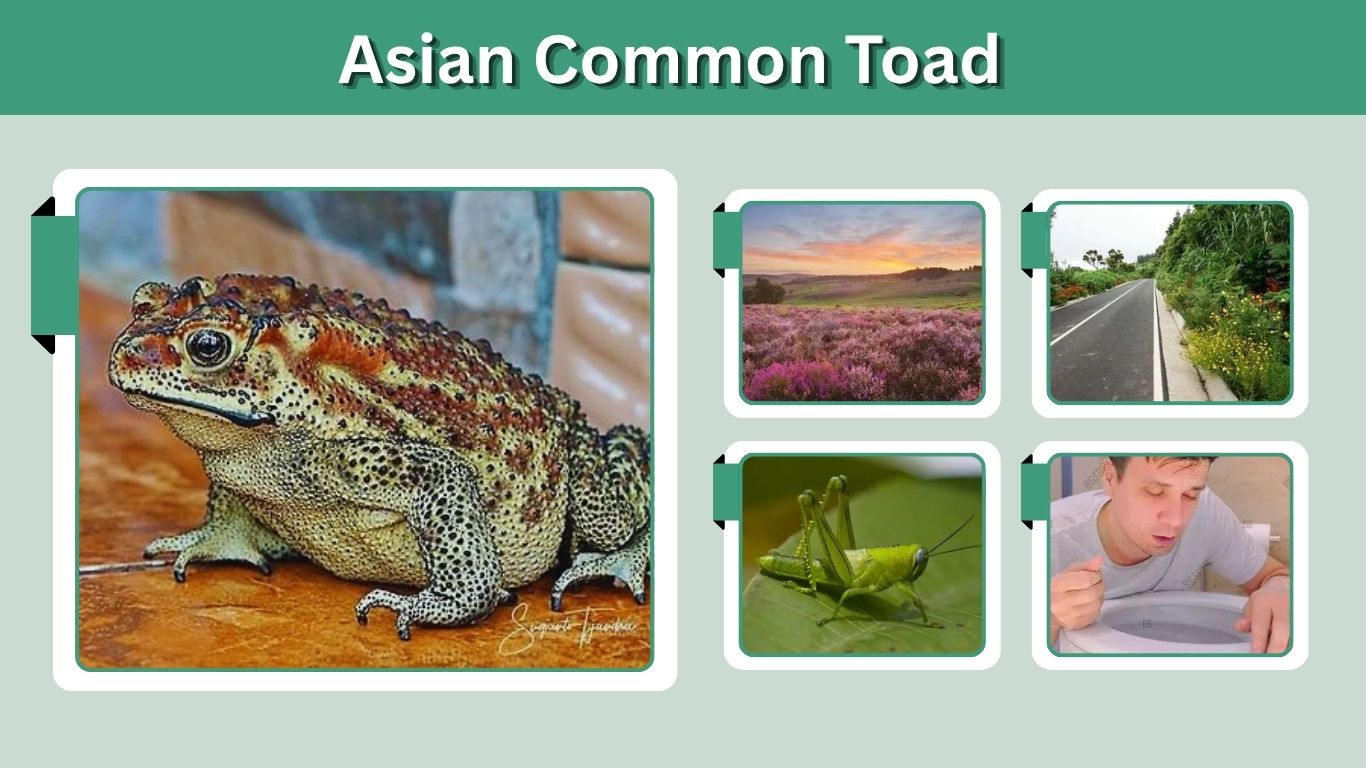
The Asian common toad is one of the most widespread and recognizable amphibians in South and Southeast Asia. Known scientifically as Duttaphrynus melanostictus, it is frequently seen in gardens, farms, roadsides, villages, and cities, especially after rainfall. Its rough skin, dark head ridges, and prominent poison glands make it easy to distinguish from many frogs. This adaptable nocturnal toad feeds on insects and other small animals, making it an important natural pest controller. However, it can become invasive and ecologically harmful when introduced outside its native range.
What Is an Asian Common Toad?
The Asian common toad belongs to the family Bufonidae, which contains the animals commonly called true toads. Its accepted scientific name is Duttaphrynus melanostictus, although it was formerly classified as Bufo melanostictus. Other common names include the Asian black-spined toad, black-spectacled toad, common Indian toad, and Southeast Asian toad.
This species is especially successful because it can tolerate heavily modified environments. While many amphibians require relatively undisturbed forests or wetlands, the Asian common toad frequently lives close to humans. It may appear beneath outdoor lights, around drains, beside houses, or in agricultural fields where insects are plentiful.
Recent genetic research suggests that populations traditionally treated as one widespread species may actually represent two deeply separated evolutionary lineages: one associated mainly with the Indian subcontinent and another with Southeast Asia. However, Duttaphrynus melanostictus remains the widely used name for the Asian common toad.
Asian Common Toad Size
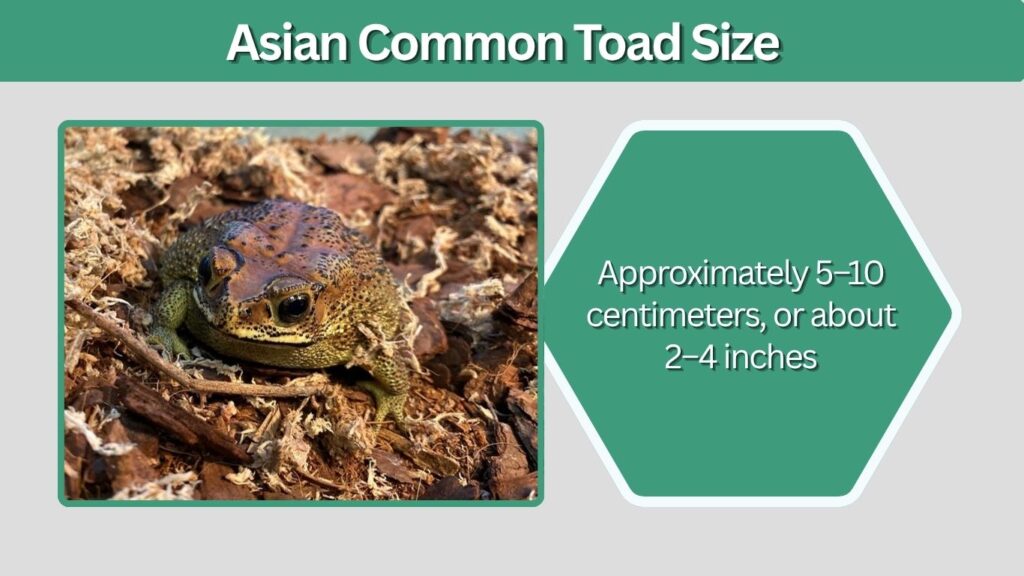
Asian common toads are medium-sized, strongly built amphibians. Their exact size varies according to sex, age, geographic population, climate, and food availability.
Adult males are generally smaller and more slender than adult females. Many adults measure approximately 5–10 centimeters, or about 2–4 inches, from the tip of the snout to the rear of the body. Particularly large individuals may grow beyond this range.
| Life stage | Approximate size |
|---|---|
| Newly transformed toadlet | Around 1 cm |
| Adult male | Commonly 5–8 cm |
| Adult female | Commonly 7–12 cm |
| Exceptionally large adult | Potentially larger than 12 cm |
Females tend to develop broader, heavier bodies because they must carry large numbers of eggs. Research also indicates that body size can vary significantly among populations and may increase with age.
The Asian common toad has relatively short legs compared with many frogs. Rather than making long, powerful jumps, it usually walks, crawls, or performs a series of short hops.
Color and Identification
The Asian common toad has a highly variable body color. Most individuals are gray, olive, yellowish brown, reddish brown, or dark brown. Their color helps them blend into soil, dead leaves, tree bark, rocks, and other parts of their environment.
Distinctive Physical Features
Several characteristics can help identify this toad:
- Rough, dry-looking skin covered with bumps
- Dark-tipped warts or spines on the back
- Prominent bony ridges around the eyes
- Large poison glands behind the eyes
- Broad head and rounded snout
- Horizontal pupils
- Pale underside with darker spots
- Short, sturdy legs
The dark raised ridges around the eyes sometimes resemble the outline of spectacles or a mask, explaining names such as black-spectacled toad and masked toad.
Behind each eye is an elongated parotoid gland. These glands produce defensive chemicals that discourage predators. The skin’s bumps are natural structures and do not cause human warts.
Young toads are usually darker than adults and may appear almost black shortly after completing metamorphosis. Their coloration gradually becomes lighter and more patterned as they grow.
Asian Common Toad Habitat
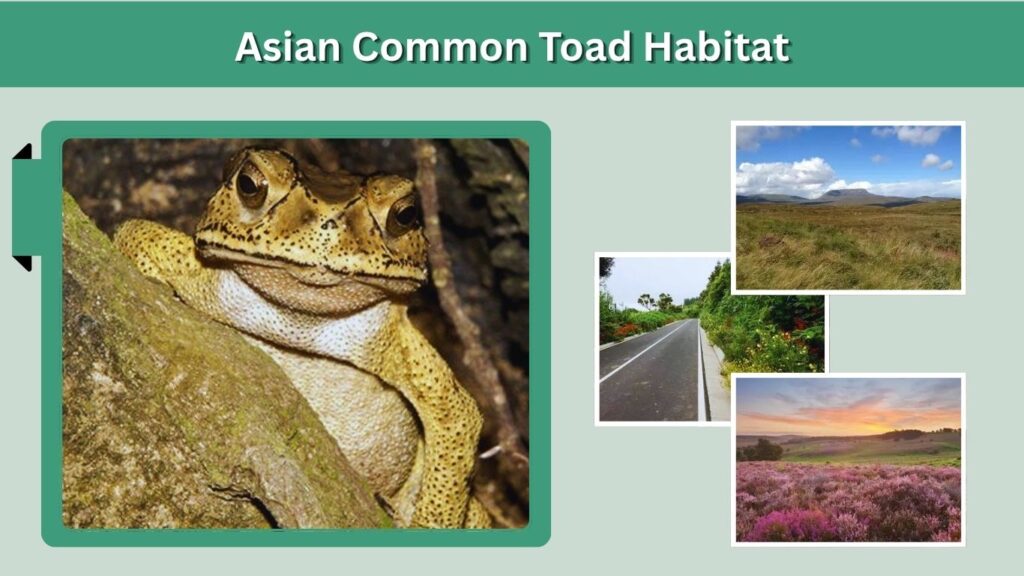
The Asian common toad occupies a remarkably broad range of habitats. Its natural distribution extends across much of South and Southeast Asia, including areas of Pakistan, Nepal, India, Bangladesh, Sri Lanka, southern China, Myanmar, Thailand, Laos, Cambodia, Vietnam, Malaysia, Singapore, and parts of Indonesia.
Common Habitats
Asian common toads may live in:
- Tropical and subtropical forests
- Farmland and plantations
- Grasslands
- Gardens and parks
- Villages and towns
- Urban neighborhoods
- Roadside vegetation
- Wetlands and pond edges
- Ditches, canals, and drainage areas
They are often more common around disturbed environments and human settlements than inside dense, undisturbed forests. Artificial lighting attracts moths, beetles, and other insects, providing convenient feeding areas for the toads.
During the day, an Asian common toad normally hides in a cool, protected location. It may shelter under stones, logs, plant pots, boards, leaf litter, piles of debris, or inside cracks and burrows. It becomes active after sunset, particularly during warm and humid weather.
Rainfall strongly affects its activity. Large numbers may emerge during monsoon showers, when the ground is moist and breeding pools become available.
What Do Asian Common Toads Eat?
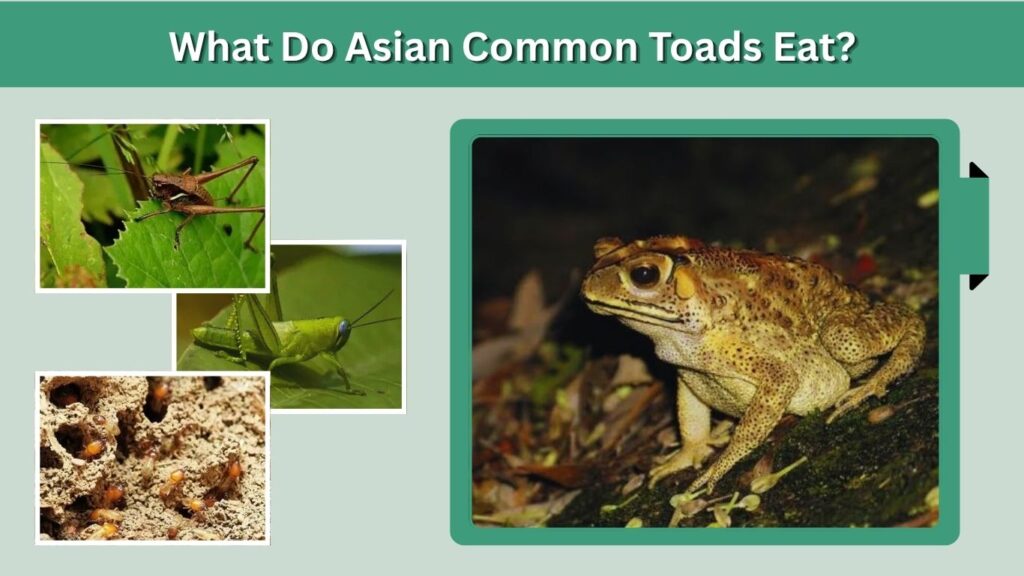
The Asian common toad is an opportunistic carnivore. Adults mainly eat insects and other small invertebrates that they find on the ground.
Common Food Items
Its diet may include:
- Ants
- Beetles
- Cockroaches
- Crickets
- Termites
- Grasshoppers
- Moths
- Caterpillars
- Flies
- Spiders
- Earthworms
- Slugs
- Small snails
- Centipedes and millipedes
Large adults may occasionally capture very small vertebrates, although insects and other invertebrates make up most of their regular diet.
Asian common toads generally hunt at night. One may sit motionless near a light, drain, path, or insect-rich patch of soil and wait for prey to move within reach. It then lunges forward or extends its sticky tongue to capture the animal.
Because toads do not chew their food, prey is swallowed whole. Their eyes may press downward while swallowing, helping push food toward the throat.
By consuming numerous insects, these toads can help control agricultural and household pests. Nevertheless, people should not introduce them to new locations because they may become invasive.
Behavior and Daily Activity
Asian common toads are primarily nocturnal. During hot daylight hours, they remain hidden to avoid overheating and excessive water loss. They become most active in the evening and at night.
They are usually solitary outside the breeding season. Several toads may gather in the same area when abundant food is available, but they do not form permanent social groups.
A frightened toad may crouch low, inflate its body, or raise itself on its legs to appear larger. It may also angle its poison glands toward a predator. Its muted coloration serves as the first line of defense by helping it remain unnoticed.
Although toads can absorb moisture through their skin, they do not usually spend all their time in water. They are predominantly terrestrial and enter ponds, puddles, and other water bodies mainly for breeding.
Lifecycle and Reproduction
Breeding is closely associated with rainfall and warm temperatures. In many regions, reproduction peaks during the monsoon season, although local breeding periods can differ according to climate and water availability.
Mating and Egg Laying
Male toads gather near shallow water and produce repeated calls to attract females. A successful male climbs onto a female’s back and grips her behind the front legs. This mating position is called amplexus.
The female releases eggs into the water while the male fertilizes them externally. Unlike many frogs that lay round masses of eggs, Asian common toads typically deposit eggs in long gelatinous strings.
A single female can produce thousands of eggs. The strings may become wrapped around aquatic vegetation or lie across the bottom of a shallow pool.
Tadpole Development
The eggs hatch into small, dark tadpoles. They initially feed on algae, microorganisms, plant material, and decaying organic matter.
As the tadpoles develop, hind legs appear first, followed by the front legs. The tail gradually shrinks, lungs develop, and the mouth and digestive system change in preparation for life on land.
After metamorphosis, tiny dark toadlets leave the water. Large numbers may appear around ponds after seasonal rains. However, many are eaten by birds, fish, reptiles, insects, and other predators before reaching adulthood.
Those that survive continue growing on land and eventually return to water when mature enough to reproduce.
Are Asian Common Toads Poisonous?
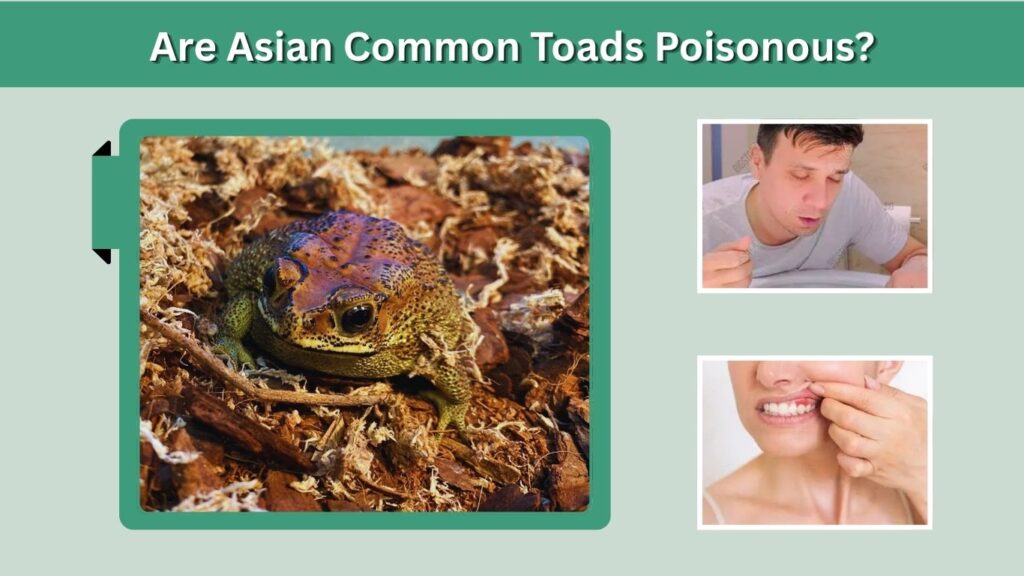
Asian common toads produce toxic defensive secretions in their parotoid glands and skin. These chemicals help protect them from snakes, mammals, birds, and other predators.
They are not venomous because they do not inject toxins through fangs or stingers. Instead, they are considered poisonous because toxins may be released when the toad is bitten, squeezed, or severely threatened.
Simply seeing or being near one is not dangerous. However, its secretion can irritate the eyes, mouth, or broken skin. People should wash their hands thoroughly after handling a toad and avoid touching their face.
Dogs and cats may become ill after biting or licking one. Possible signs include:
- Excessive drooling
- Pawing at the mouth
- Vomiting
- Red or irritated gums
- Weakness
- Abnormal heart rhythm
- Tremors or seizures in serious cases
A pet exposed to toad secretion should have its mouth gently rinsed with clean water while keeping the animal’s head angled downward. Immediate veterinary advice is recommended, particularly if symptoms develop.
Invasive Range and Environmental Concerns
Although the Asian common toad is native to much of Asia, it has been transported to areas outside its natural range. Introduced populations have become established in parts of Indonesia, New Guinea, East Timor, and Madagascar.
In introduced regions, the toad may compete with native amphibians for food and breeding habitat. Its toxins can also kill predators that have not evolved resistance to them.
The species has caused particular concern in Madagascar, where native snakes, birds, mammals, and other animals may be vulnerable to its chemical defenses. Its adaptability, high reproductive output, broad diet, and close association with human environments allow it to spread rapidly.
People should never deliberately move these toads between regions.
Interesting Asian Common Toad Facts
- It was formerly called Bufo melanostictus. Modern classification places it in the genus Duttaphrynus.
- It thrives around humans. The species frequently occupies cities, gardens, farms, and villages.
- Its head looks masked. Dark bony ridges around its eyes create a spectacle-like pattern.
- Females are usually larger. Their larger bodies provide space for thousands of eggs.
- It is mainly nocturnal. The toad rests during the day and feeds after sunset.
- Rain triggers activity. Breeding and movement increase dramatically during monsoon conditions.
- It helps control insects. Ants, termites, beetles, cockroaches, and other pests form part of its diet.
- Its toxins are defensive. The toad does not chase or attack people to deliver poison.
- It can live in disturbed habitats. This adaptability has helped it survive while many other amphibians decline.
- It can become invasive. Outside its native range, it may threaten local predators and amphibians.
FAQs
Where does the Asian common toad live?
The Asian common toad occurs widely across South and Southeast Asia. It inhabits forests, gardens, farms, wetlands, villages, parks, and cities. During the day, it hides beneath vegetation, stones, logs, or debris and emerges at night to feed.
How big does an Asian common toad grow?
Most adults measure approximately 5–12 centimeters in body length, although size varies among populations. Females are generally larger and heavier than males because their bodies must accommodate thousands of developing eggs during the breeding season.
What does an Asian common toad eat?
Asian common toads eat ants, termites, beetles, cockroaches, crickets, moths, worms, spiders, slugs, and other small animals. They usually hunt at night by waiting quietly and quickly capturing prey with their sticky tongues.
Can an Asian common toad harm humans?
The toad does not normally pose a threat when left alone. However, its skin and parotoid glands produce irritating toxins. Avoid touching the eyes or mouth after handling one, and wash the hands thoroughly with soap and water.
Is the Asian common toad good for gardens?
Within its native range, it can benefit gardens by eating numerous insects, slugs, and other potential pests. Gardeners should avoid pesticides and provide natural shelter, but they should never transport the toad to places where it is not native.
