
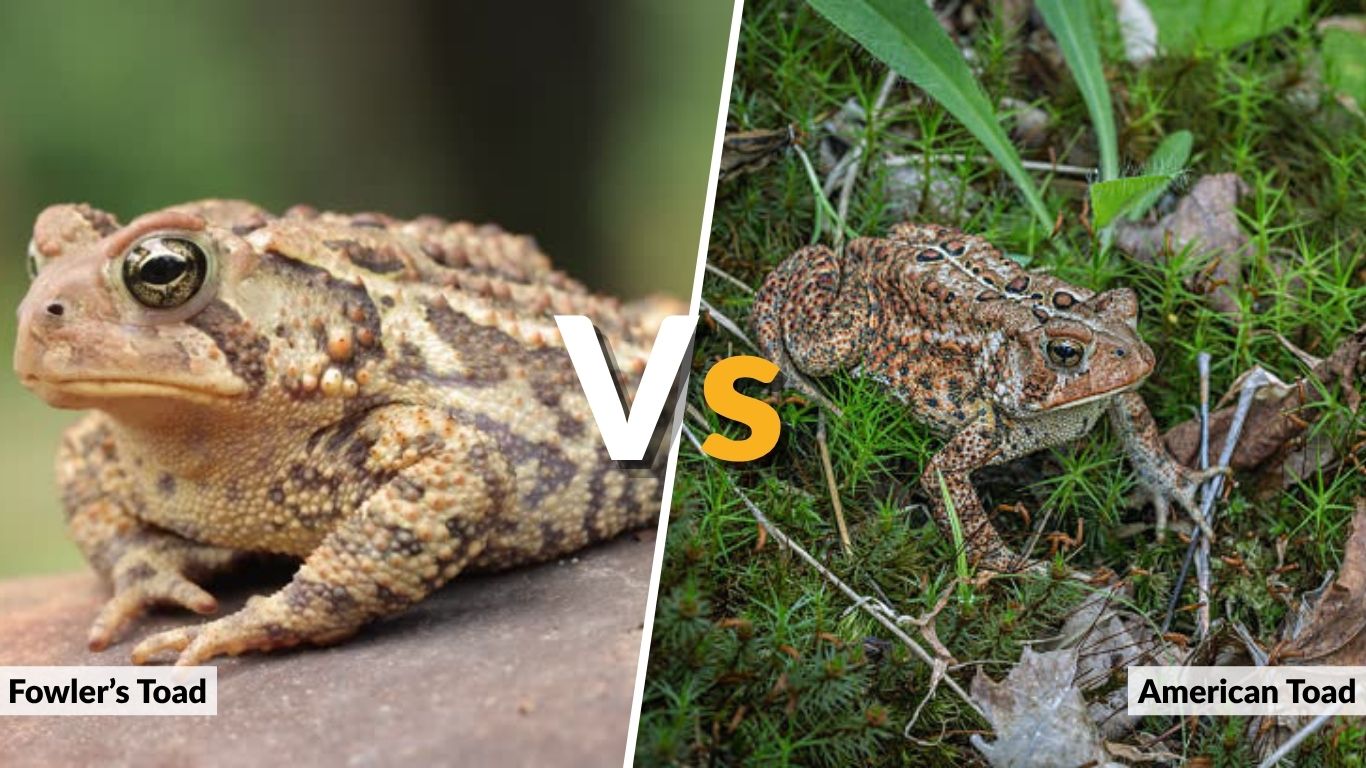
Fowler’s toads and American toads look so similar that many people mistake one for the other, especially in the eastern United States where their ranges overlap. Both are warty, brownish, ground-dwelling amphibians that emerge around spring and summer nights. However, their body markings, calls, habitat preferences, and even belly patterns can help you tell them apart with more confidence.
Fowler’s Toad vs American Toad: Quick Comparison
Fowler’s toad and American toad belong to the same genus, Anaxyrus, and share many classic toad features: dry skin, short legs, poison glands, and a preference for moist hiding places. The easiest differences usually involve the number of warts inside each dark back spot, the belly pattern, and the sound of the breeding call.
| Feature | Fowler’s Toad | American Toad |
|---|---|---|
| Scientific name | Anaxyrus fowleri | Anaxyrus americanus |
| Average size | Small to medium, usually about 2–3 inches | Medium to large, often about 2–4.25 inches |
| Back spots | Usually 3 or more warts in each dark spot | Usually 1–2 warts in each dark spot |
| Belly | Usually plain or lightly marked | Often spotted or mottled |
| Call | Short nasal bleat or scream-like call | Long musical trill |
| Habitat preference | Sandy soils, open woods, dunes, meadows, floodplains | Woods, gardens, fields, wetlands, suburban yards |
| Range | Much of the eastern U.S. and nearby Canada | Broadly across eastern North America |
| Best field clue | Multiple warts per dark spot | Spotted belly and long trill |
What Is a Fowler’s Toad?
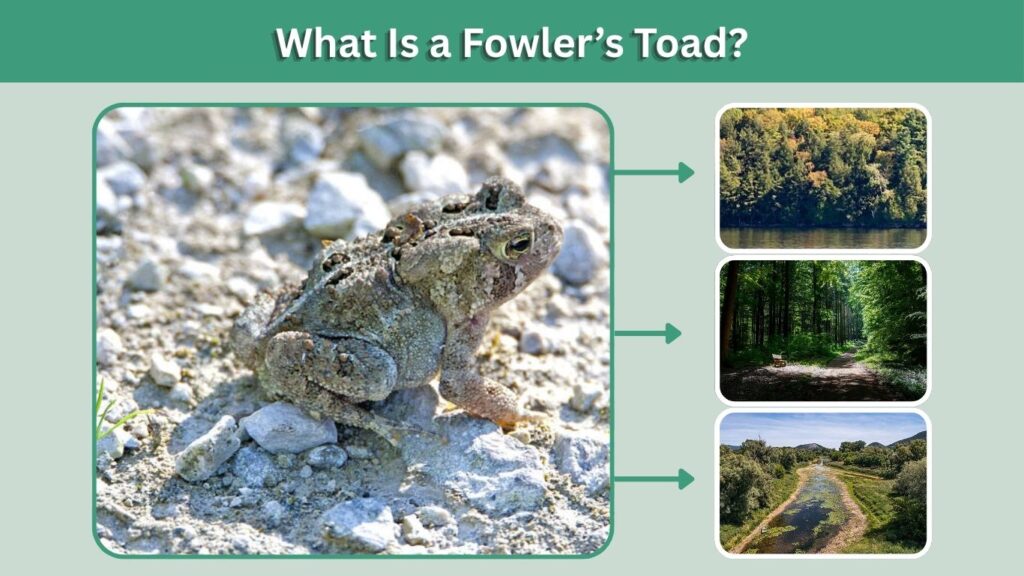
Fowler’s toad is a small to medium-sized North American toad commonly found in parts of the eastern United States and southern Canada. It is often associated with sandy or loose soils, river valleys, open woodlands, beaches, meadows, and floodplain areas.
Appearance
Fowler’s toads usually have brown, gray, olive, or slightly reddish skin. Like most toads, they have dry, bumpy skin and short legs made more for hopping than long jumping. A pale stripe may run down the middle of the back, although this feature is not always obvious.
The most important identification clue is the pattern of warts inside the dark blotches on the back. Fowler’s toads typically have three or more warts within each dark spot. This is one of the most commonly used field marks when separating them from American toads.
Habitat
Fowler’s toads often prefer loose, sandy, or friable soils where they can burrow easily. You may find them in:
- Open woods
- Sandy prairies
- Dunes and beaches
- River valleys and floodplains
- Meadows and fields
- Edges of wetlands and ponds
They breed in shallow water, including temporary pools, pond edges, marshy areas, and slow-moving water. Outside the breeding season, they may wander away from water and hide beneath logs, vegetation, rocks, or loose soil.
Call
The Fowler’s toad call is often described as a nasal bleat, scream, or sheep-like “waaa.” It is usually much shorter than the American toad’s call. Instead of a long musical trill, Fowler’s toad gives a rougher, more abrupt sound that may last only a few seconds.
What Is an American Toad?
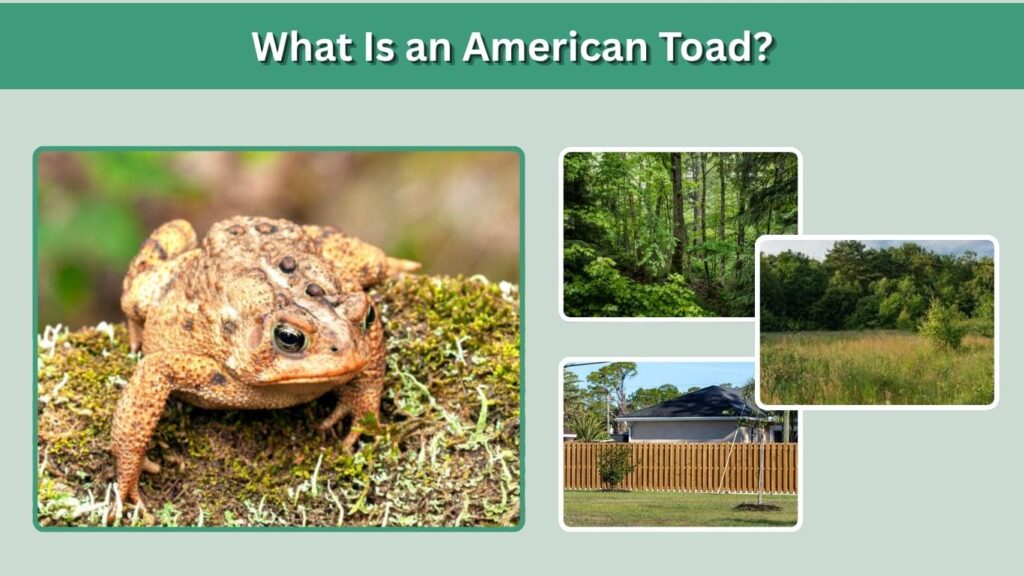
The American toad is one of the most familiar toads in eastern North America. It is common in forests, gardens, fields, parks, and suburban yards. Many people encounter it around porch lights at night, where it feeds on insects attracted to the light.
Appearance
American toads are usually brown, gray, olive, reddish, or tan. Their colors can vary depending on age, sex, environment, and local conditions. Some individuals have a pale line down the back, while others appear more uniformly colored.
A key identification feature is the number of warts inside each dark back spot. American toads usually have one or two warts per spot, while Fowler’s toads usually have three or more. American toads also often have darker spotting or mottling on the belly, which helps separate them from Fowler’s toads.
Habitat
American toads are flexible and adaptable. They can live in many moist environments as long as they have shelter, food, and nearby breeding water. Common habitats include:
- Deciduous and mixed forests
- Gardens and yards
- Grasslands and fields
- Pond and wetland edges
- Farmland and woodland borders
- Suburban parks
American toads spend much of their time on land, hiding during the day and becoming more active at night. During cold weather or dry periods, they burrow into soil or shelter under cover.
Call
The American toad’s breeding call is one of the easiest ways to identify it. Males produce a long, high, musical trill that may last several seconds. In spring, groups of calling males can create a steady chorus around ponds, ditches, marshes, and temporary pools.
Appearance Differences
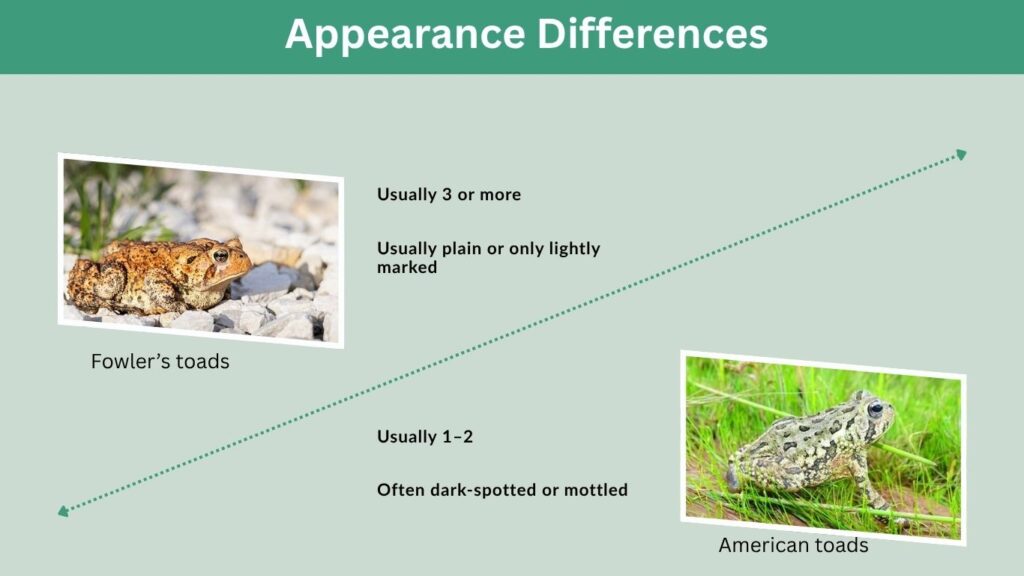
At first glance, Fowler’s toads and American toads both look like “ordinary brown toads.” A closer look reveals several helpful details. The wart pattern is usually the most practical feature, but belly markings, leg warts, and head ridges can also help.
| Body Feature | Fowler’s Toad | American Toad |
|---|---|---|
| Warts in dark back spots | Usually 3 or more | Usually 1–2 |
| Belly pattern | Usually plain or only lightly marked | Often dark-spotted or mottled |
| Hind leg warts | Usually less enlarged | Often more enlarged and spiny |
| Overall build | Slightly flatter, often smaller | Often stockier and larger |
| Color | Brown, gray, olive, reddish, or sandy | Brown, gray, olive, brick red, or tan |
| Back stripe | May be present | May be present |
| Parotoid glands | Present behind eyes | Present behind eyes |
Wart Pattern
The wart pattern is the classic difference. Fowler’s toads usually have at least three warts inside each dark dorsal blotch. American toads usually have one or two. This is not perfect in every individual, but it is one of the strongest visual clues.
Belly Markings
If you can observe the belly without harming the animal, American toads often show dark spots or mottling underneath. Fowler’s toads usually have a cleaner, plainer underside. However, avoid handling wild toads unless necessary, and always wet your hands first if you must move one.
Size and Shape
American toads are often larger and heavier-bodied than Fowler’s toads. Fowler’s toads tend to look slightly smaller, flatter, and more sandy-colored, especially in coastal or open habitats. Size alone is not reliable because young American toads may be smaller than adult Fowler’s toads.
Range and Habitat Differences
Their ranges overlap in many eastern and central areas, which is why people often compare them. Still, habitat can provide a useful clue. Fowler’s toad is more strongly associated with sandy, open, or floodplain environments. American toad is more widespread and adaptable.
| Category | Fowler’s Toad | American Toad |
|---|---|---|
| Main range | Eastern U.S. and parts of nearby Canada | Much of eastern North America |
| Strong habitat link | Sandy soil, dunes, floodplains, open woods | Forests, yards, fields, wetlands |
| Common near homes? | Sometimes, especially near sandy areas | Very common in gardens and yards |
| Breeding sites | Temporary pools, shallow ponds, marshy edges | Ponds, ditches, marshes, temporary pools |
| Soil preference | Loose or sandy soil is common | More flexible, but still needs shelter |
| Tolerance of suburbs | Moderate | High |
Fowler’s Toad Habitat
Fowler’s toads are often found in places with loose soil that allows burrowing. They may occur near rivers, dunes, sandy meadows, open woodland, and coastal or inland sandy habitats. They can also appear in agricultural or residential areas when suitable breeding pools and cover are nearby.
American Toad Habitat
American toads are generalists. They often thrive in backyards, gardens, forest edges, and fields. They need moisture and breeding water, but they do not require sandy soil as strongly as Fowler’s toads. This adaptability makes the American toad one of the more commonly noticed backyard amphibians.
Behavior, Diet, and Breeding
Both species are mostly nocturnal and spend much of the day hidden. They become more visible during warm, damp weather and during the breeding season.
Activity
Fowler’s toads and American toads are most active at night. During the day, they hide beneath leaves, logs, rocks, vegetation, or loose soil. In dry weather, they may burrow underground to avoid dehydration. In winter, they retreat below the frost line or shelter underground until temperatures rise.
Diet
Both toads eat many small invertebrates. Their diet may include:
- Beetles
- Ants
- Moths
- Flies
- Spiders
- Small larvae
- Other soft-bodied invertebrates
American toads are well known as helpful garden animals because they eat many insects. Fowler’s toads also feed on insects and other small invertebrates, especially in open sandy areas, fields, and woodland edges.
Breeding
Both species breed in shallow freshwater. Males gather near ponds, pools, marshes, ditches, or temporary wetlands and call to attract females. Eggs are laid in long strings, and the tadpoles develop in water before transforming into tiny toadlets.
The call is one of the best breeding-season clues. Fowler’s toad gives a shorter, rougher, nasal bleat. American toad gives a longer, musical trill. If you hear the call clearly, it may be easier to identify the species by sound than by sight.
Which Toad Is More Common?
The American toad is generally more familiar to many homeowners because it adapts well to gardens, yards, parks, and woodland edges. Fowler’s toad can be common in the right habitat, but it is more habitat-specific. In sandy regions, dunes, river valleys, and open woodland areas, Fowler’s toads may be locally abundant.
In areas where both species occur, identification can become tricky. Some individuals may show mixed-looking features, and natural variation can make field marks less obvious. For casual identification, use a combination of clues rather than relying on a single trait.
The best combination is:
- Count the warts inside dark back spots.
- Look for belly spotting if safely visible.
- Listen to the breeding call.
- Consider habitat type.
- Note overall size and shape.
Fowler’s Toad vs American Toad: Which One Is in Your Yard?
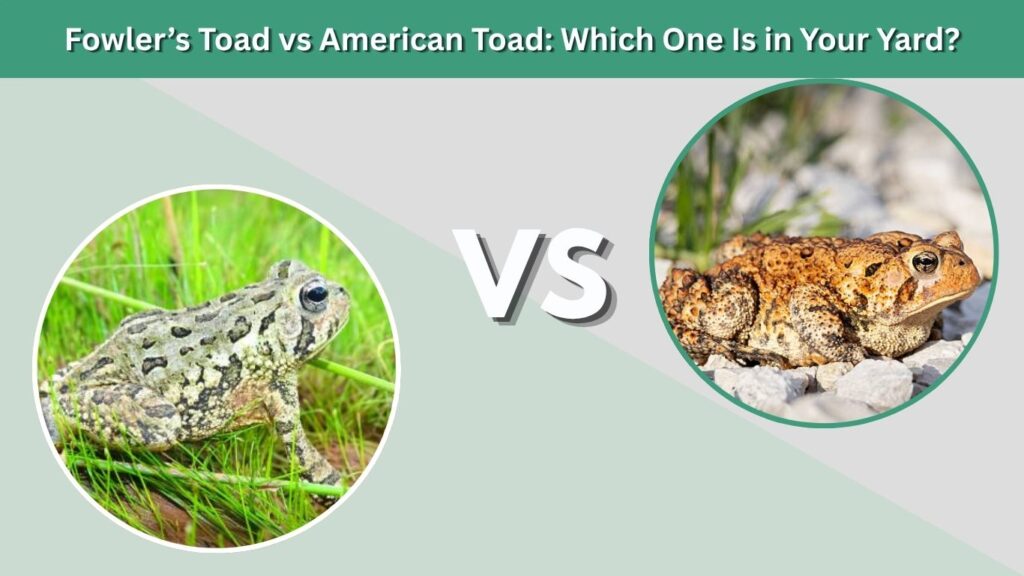
If you found a toad in a typical backyard, garden, or wooded neighborhood, it may be an American toad, especially if it has a spotted belly and only one or two warts in each dark spot. If you live near sandy soil, dunes, open woodland, or floodplain habitat, Fowler’s toad becomes more likely.
A backyard toad with a long musical trill in spring is probably an American toad. A toad making a shorter nasal bleat near sandy or open habitat may be a Fowler’s toad.
Avoid picking up toads unnecessarily. Their skin absorbs chemicals easily, and sunscreen, soap, insect repellent, or lotion on human hands can harm them. If you must move one from a road or unsafe place, wet your hands first and move it only a short distance in the direction it was already traveling.
Are Fowler’s Toads and American Toads Poisonous?
Both species have parotoid glands behind the eyes that produce defensive secretions. These secretions help protect them from predators and can taste unpleasant or irritating. They are not dangerous to people under normal observation, but you should not rub your eyes or mouth after handling a toad.
Pets are more likely to have problems if they bite or mouth a toad. Dogs may drool, paw at the mouth, or show irritation after grabbing one. Rinse the pet’s mouth gently and contact a veterinarian if symptoms continue or seem severe.
FAQs
How do I tell a Fowler’s toad from an American toad?
The easiest clue is the wart pattern. Fowler’s toads usually have three or more warts in each dark back spot, while American toads usually have one or two. American toads also often have a spotted belly, and their call is a long musical trill.
Which is bigger, Fowler’s toad or American toad?
American toads are usually larger and stockier. Fowler’s toads are generally small to medium-sized and may look flatter or more sandy-colored. Size alone is not enough for identification because young American toads and adult Fowler’s toads can overlap in size.
Do Fowler’s toads and American toads live in the same places?
Yes, their ranges overlap in parts of eastern North America. However, Fowler’s toads are more linked with sandy soils, open woods, dunes, and floodplains. American toads are more adaptable and commonly live in forests, gardens, fields, and suburban yards.
What does a Fowler’s toad sound like?
A Fowler’s toad usually makes a short, nasal, bleating call that can sound rough or scream-like. It is much less musical than the American toad’s call. The American toad produces a longer, high trill during the breeding season.
Are these toads good for gardens?
Yes. Both species eat insects and other small invertebrates, making them helpful in gardens and yards. To support them, avoid pesticides, provide leaf litter or natural cover, keep shallow water sources safe, and avoid handling them unless necessary.
