
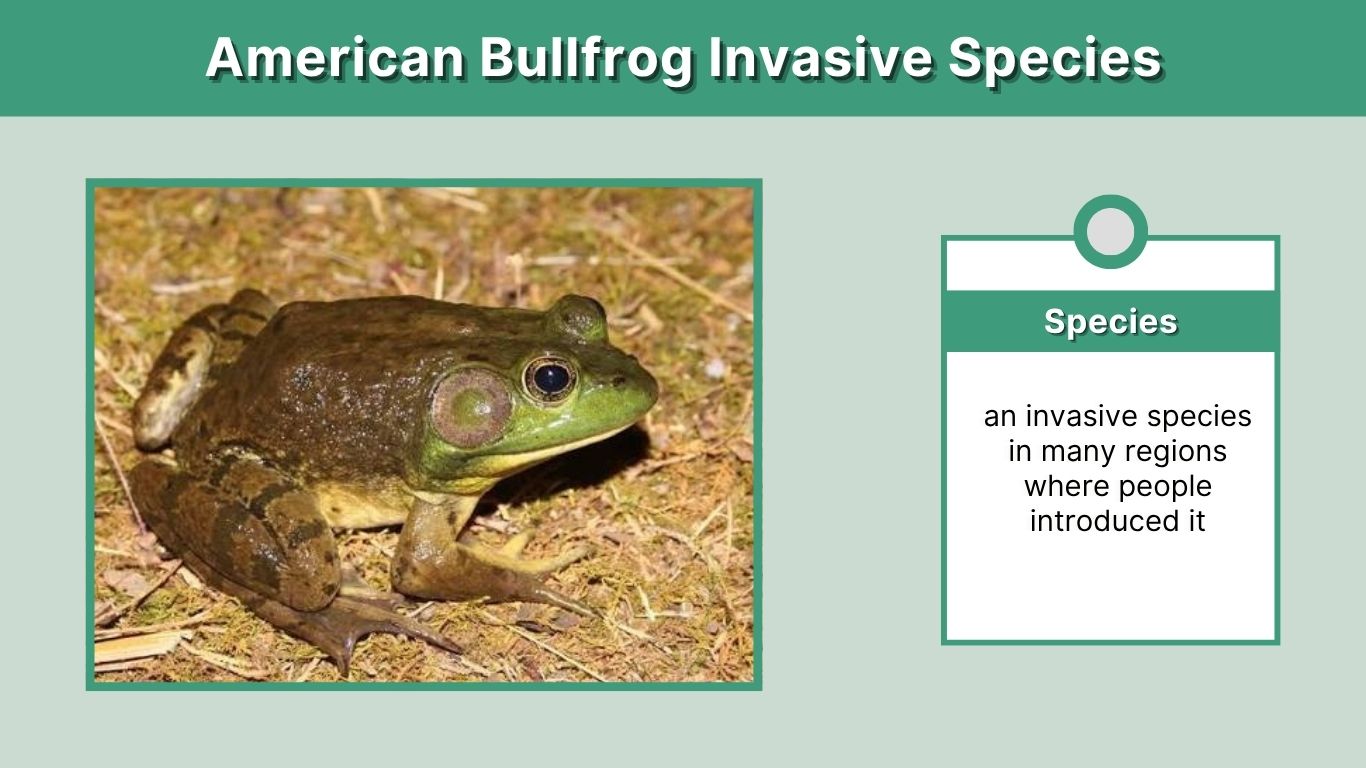
The American bullfrog is native to parts of eastern and central North America, but it has become an invasive species in many regions where people introduced it. This large frog eats many kinds of animals, reproduces in high numbers, survives in disturbed wetlands, and can spread diseases to native amphibians. In places such as the western United States, British Columbia, and parts of Asia, invasive American bullfrogs are a serious conservation concern.
Are American Bullfrogs Invasive?
American bullfrogs are not invasive everywhere. They are native in much of eastern North America, but they are considered invasive when they live outside their natural range and harm native ecosystems.
Washington Department of Fish & Wildlife says American bullfrogs are native to the eastern United States, were introduced throughout the West starting in the early 1900s, and are now considered an invasive problematic species in Washington.
| Question | Answer |
| Are American bullfrogs native? | Yes, in eastern/central North America |
| Are they invasive everywhere? | No |
| Where are they invasive? | Many western U.S. areas, British Columbia, Europe, Asia, South America, and other introduced regions |
| Why are they invasive? | They eat native wildlife, compete with native frogs, reproduce quickly, and spread disease |
| Should you release pet bullfrogs? | No, never release bullfrogs or tadpoles into the wild |
Native vs Invasive Range
In their native range, American bullfrogs are part of the natural food web. Predators, competitors, diseases, climate, and habitat conditions help keep populations balanced.
Outside their native range, the situation changes. Native frogs, salamanders, fish, snakes, and turtles may not be adapted to avoid such a large, aggressive amphibian predator. This gives bullfrogs an advantage.
North American Bullfrog Invasive Species
The name “North American bullfrog” can be confusing. The American bullfrog is North American, but that does not mean it belongs in every North American wetland.
It is native to eastern and central areas, but invasive in many western regions. Oregon Sea Grant’s bullfrog guide states that the species is native to the eastern U.S. and invasive in much of the western U.S. and on several other continents.
Where Is the American Bullfrog Invasive?
The American bullfrog has been introduced far beyond its native range. It is now established in many areas where it did not naturally occur.
Oregon Sea Grant notes that bullfrogs have been introduced to Oregon, Washington, and California and have spread through the western U.S. because of frog-leg harvesting, pet releases, and school-project releases.
Invasive in the Western United States
In the western U.S., American bullfrogs are a major problem in ponds, reservoirs, wetlands, canals, backwaters, and slow-moving waterways. They often do well in human-altered habitats.
The U.S. Fish & Wildlife Service describes non-native American bullfrogs as highly successful invaders of aquatic systems in the western United States. It also notes that permanent waters and human-modified habitats can favor bullfrog colonization and spread.
American Bullfrog Invasive in California
In California, American bullfrogs are treated as an invasive species. California Department of Fish and Wildlife asks people to report bullfrog sightings to its Invasive Species Program.
The species is especially concerning in California because it can prey on native amphibians and compete with rare species. A 2024 legal update from the National Sea Grant Law Center also notes that California voted in December 2023 to ban the importation and sale of American bullfrogs.
American Bullfrog Invasive in Washington and Oregon
Washington considers the American bullfrog an invasive problematic species. The state also identifies it as exotic, meaning non-native, in Washington.
Oregon also treats bullfrogs as a concern. Oregon Sea Grant’s guide lists bullfrogs as invasive in much of the western U.S. and explains that they were introduced as a food source and through aquaculture escape.
American Bullfrog Invasive in BC
American bullfrogs are also invasive in parts of British Columbia. Metro Vancouver’s best management practices guide says American bullfrogs are native to eastern North America but have become well established on British Columbia’s south coast. It also says they were introduced to British Columbia starting in the 1930s as a delicacy for human consumption.
American Bullfrog Invasive in Korea
The American bullfrog has also become invasive in Korea. A scientific paper notes that the species was listed as invasive by the Korean Ministry of Environment in 1998.
This shows that the issue is not limited to North America. Bullfrogs have become a global invasive amphibian problem in many suitable wetland environments.
Why Are American Bullfrogs Invasive?
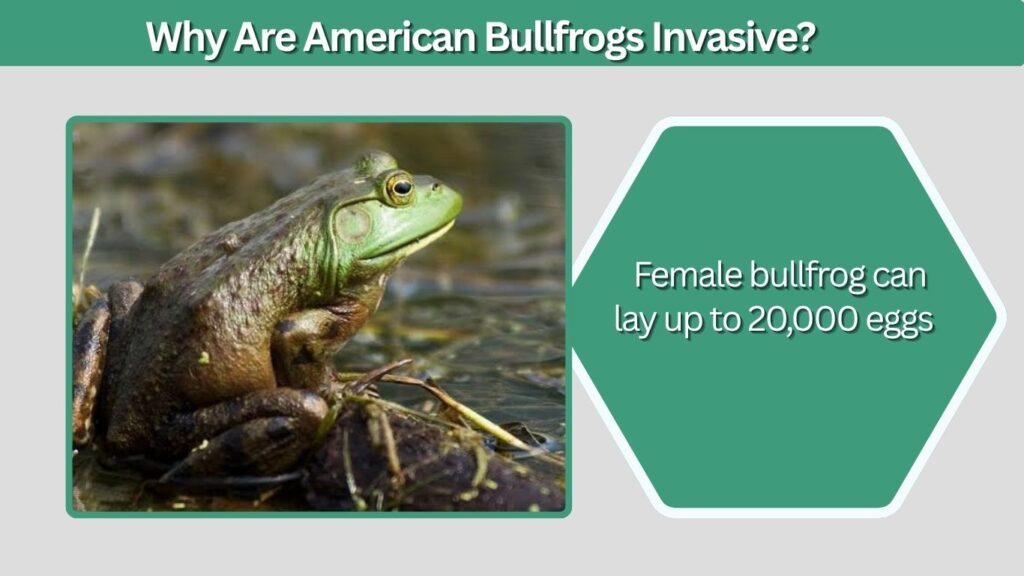
American bullfrogs become invasive because they have several traits that help them survive, spread, and dominate new habitats.
They are large, adaptable, aggressive feeders, and highly reproductive. They can use many types of permanent water and often thrive in places disturbed by people.
They Eat Almost Anything
Adult American bullfrogs are powerful predators. They eat insects, crayfish, fish, frogs, snakes, turtles, small birds, small mammals, and even other bullfrogs.
Oregon Sea Grant states that bullfrogs will eat anything that fits in their mouths, including baby turtles, birds, and their own young.
This broad diet makes them dangerous to native species that share the same wetland habitat.
They Reproduce Quickly
Female bullfrogs can lay very large numbers of eggs. Oregon Sea Grant says a female bullfrog can lay up to 20,000 eggs at one time, while many native frogs lay far fewer eggs.
This high reproductive rate helps invasive populations grow quickly once they become established.
They Use Permanent Water
American bullfrog tadpoles often need a long time to develop, so permanent ponds, reservoirs, ditches, and wetlands help them survive.
Human-made water bodies can create perfect bullfrog habitat. Irrigation ponds, golf-course ponds, canals, and reservoirs may allow bullfrogs to spread in dry or altered landscapes.
How Did the American Bullfrog Become Invasive?
American bullfrogs were moved by people for food, aquaculture, bait, pets, and education. Some were intentionally released, while others escaped.
The U.S. Geological Survey says bullfrogs are often introduced into new habitats through human activities such as the pet trade and bait for recreational fishing.
Food and Frog-Leg Trade
Bullfrogs were moved to new regions because people used them for frog legs. In some places, they were raised or imported as a food animal.
Oregon Sea Grant says bullfrogs were introduced as a food source in the 1900s and also spread through escape or release.
Pet and Classroom Releases
Pet bullfrogs, tadpoles, and classroom animals are another pathway. When people no longer want them, they may release them into ponds. This can start a new invasive population.
This is why captive bullfrogs and tadpoles should never be released outdoors, even if they were collected nearby.
Fish Stocking and Aquaculture Escape
Bullfrogs may also move accidentally with fish stocking or aquaculture. Eggs, tadpoles, or young frogs can be transported with water, aquatic plants, or fish.
Once introduced, they can move through connected wetlands, ditches, ponds, and streams.
What Damage Do Invasive American Bullfrogs Cause?
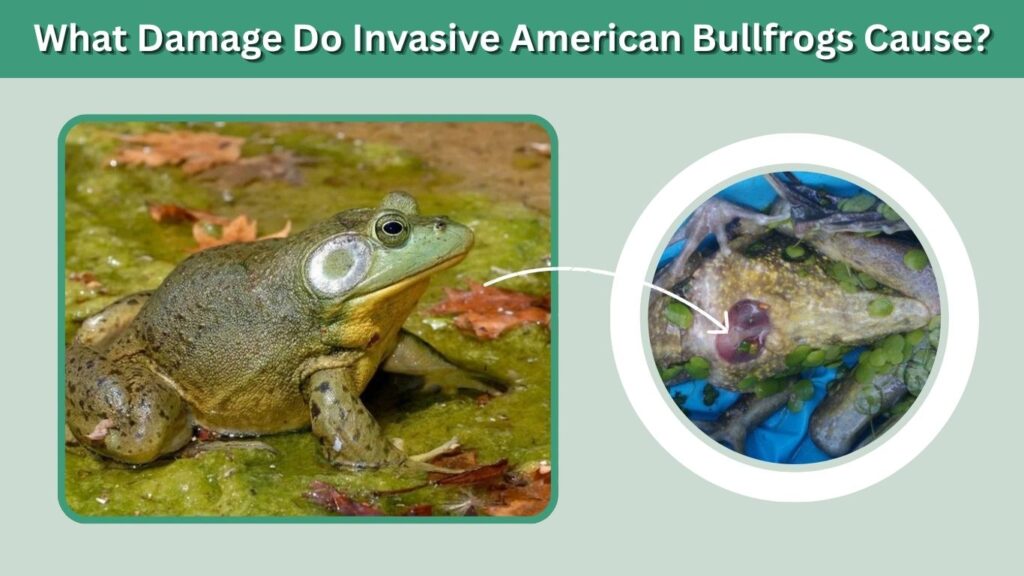
Invasive American bullfrogs can harm ecosystems in several ways. They prey on native animals, compete with native frogs, spread pathogens, and change wetland food webs.
USGS lists American bullfrog impacts including predation, competition, disease/parasites, food-web effects, and habitat alteration.
Predation on Native Wildlife
Bullfrogs eat many native animals. Their large mouths allow them to swallow prey that smaller frogs cannot eat.
Native frogs, salamanders, small turtles, snakes, fish, insects, and young birds may all become prey. In areas with rare amphibians, this can be especially serious.
Competition With Native Frogs
Bullfrogs also compete with native frogs for food, space, breeding sites, and shelter. Native amphibians may decline when bullfrogs dominate a pond or wetland.
USGS research in the southwestern U.S. found that threatened Chiricahua leopard frogs and western tiger salamanders were less likely to occur at sites where bullfrogs were present.
Disease Spread
Invasive bullfrogs may carry amphibian pathogens such as ranaviruses and chytrid fungus. These diseases can be deadly to native amphibians.
A USGS-led study found ranaviruses were 10 times more likely and Bd, the amphibian chytrid fungus, was 2.5 times more likely to be present at sites with bullfrogs than without bullfrogs.
Why Are American Bullfrogs Hard to Control?
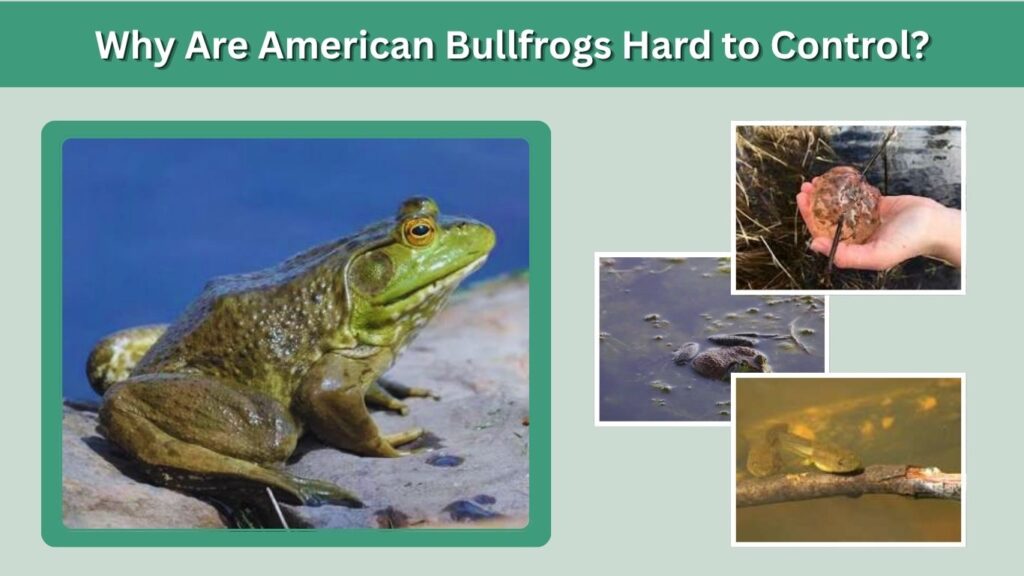
American bullfrogs are difficult to remove once established. Their eggs, tadpoles, juveniles, and adults all use aquatic habitats, and they can reproduce in large numbers.
Metro Vancouver’s best management practices guide says eradication is considered cost prohibitive and likely impossible in the Metro Vancouver region, so efforts focus on preventing new introductions, limiting spread, and reducing impacts.
Different Life Stages
Control is hard because bullfrogs have multiple life stages:
- Eggs float in large masses
- Tadpoles live underwater
- Froglets move between water and land
- Adults hide in vegetation and deep water
- Adults may breed repeatedly
Removing only adults may not solve the problem if eggs and tadpoles remain.
Human-Made Habitat
Bullfrogs often thrive in ponds and reservoirs created by people. Permanent water, few predators, warm temperatures, and abundant prey can support large populations.
This means habitat management is often part of bullfrog control.
What Should You Do If You Find an Invasive Bullfrog?
The correct action depends on your location. In some places, people are asked to report sightings. In other places, rules may control possession, transport, or removal.
California asks people to report American bullfrog sightings to the CDFW Invasive Species Program. Washington also treats American bullfrogs as an invasive problematic species, so local rules should be checked before moving or handling them.
Do Not Release Bullfrogs
Never release pet bullfrogs, tadpoles, froglets, or classroom animals into the wild. Releasing them can spread disease and create new invasive populations.
This rule is important even if bullfrogs already live in the area.
Report Sightings
If you live where bullfrogs are invasive, report sightings to your state, province, or local invasive species program. Include photos, location, date, and habitat details when possible.
Do not move bullfrogs from one pond to another.
FAQs
Are American bullfrogs invasive?
American bullfrogs are invasive outside their native range. They are native to eastern and central North America, but invasive in many western U.S. states, parts of Canada, Europe, Asia, South America, and other introduced regions.
Why are American bullfrogs invasive?
American bullfrogs are invasive because they eat many native animals, compete with native frogs, reproduce in large numbers, spread diseases, and survive well in permanent human-made water bodies.
Where is the American bullfrog invasive?
The American bullfrog is invasive in much of the western United States, including places such as California, Oregon, and Washington. It is also invasive in parts of British Columbia, Europe, Asia, and South America.
How did American bullfrogs become invasive?
People introduced American bullfrogs for frog legs, aquaculture, bait, pets, classroom projects, and sometimes accidental fish-stocking contamination. Escaped or released animals then spread into natural wetlands.
Are American bullfrogs one of the world’s worst invasive species?
Yes, the bullfrog was included in the IUCN/ISSG publication “100 of the World’s Worst Invasive Alien Species,” under the older scientific name Rana catesbeiana.
