
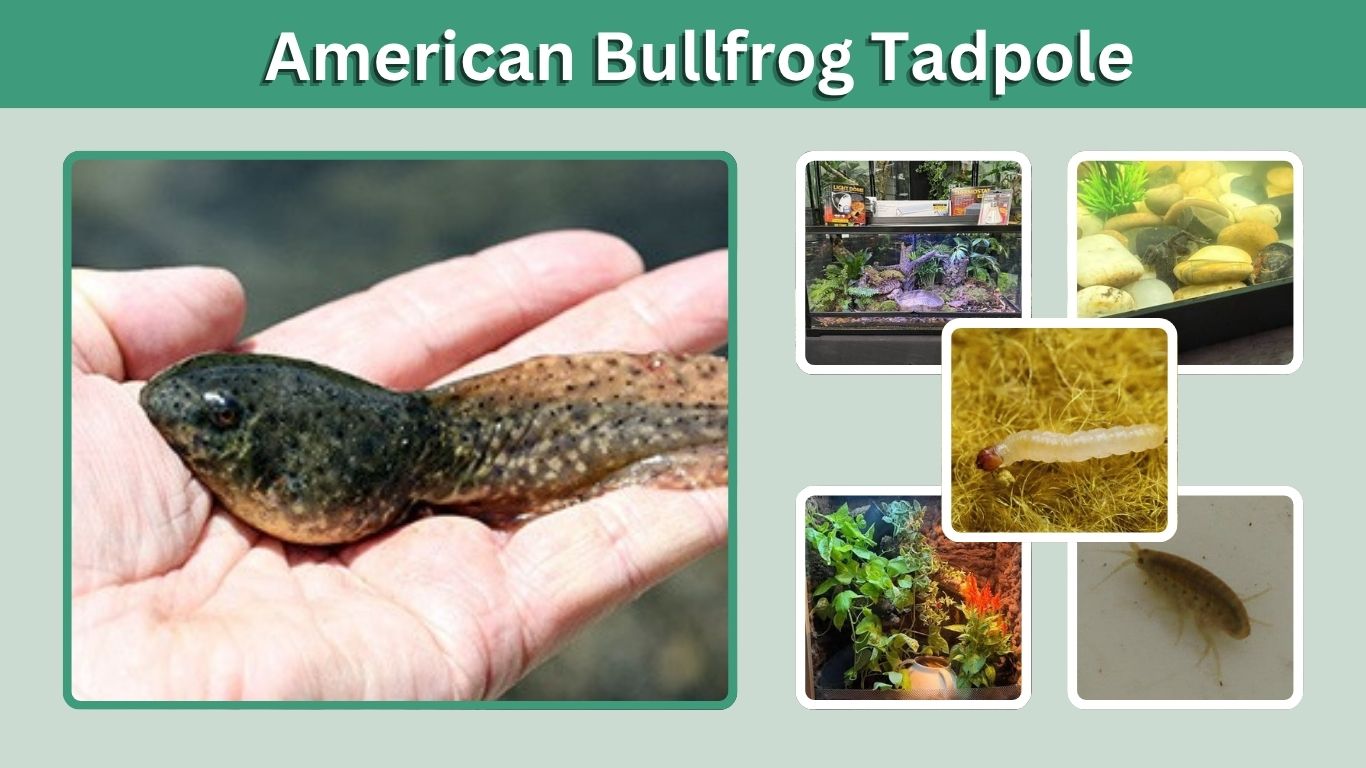
An American bullfrog tadpole is the aquatic larval stage of the American bullfrog, one of the largest frogs in North America. These tadpoles are bigger than many common frog tadpoles, may stay in water for a long time, and can take months or even years to become frogs. They are interesting to observe, but they also require responsible care because bullfrogs can become invasive outside their native range.
What Is an American Bullfrog Tadpole?
An American bullfrog tadpole is the young, water-living stage of the American bullfrog, scientifically known as Lithobates catesbeianus. Older sources may also use the name Rana catesbeiana.
American bullfrog tadpoles live in ponds, lakes, marshes, and slow-moving streams. The American Museum of Natural History lists their habitat as ponds, lakes, and slow-moving streams and notes that bullfrog tadpoles may take up to two years to metamorphose.
| Quick Facts | American Bullfrog Tadpole |
| Species | American bullfrog |
| Scientific name | Lithobates catesbeianus |
| Tadpole size | Often 4–6 inches |
| Main food | Algae, plant material, organic matter, insect larvae |
| Habitat | Ponds, lakes, marshes, slow streams |
| Metamorphosis time | A few months to 2–3 years depending on climate |
| Care warning | Never release captive tadpoles into the wild |
American Bullfrog Tadpole Identification
American bullfrog tadpoles are usually olive, greenish-brown, brown, or dark gray. They often have a rounded body, a long muscular tail, and small dark speckles across the body and tail.
They are usually much larger than many backyard frog tadpoles. AMNH lists American bullfrog tadpoles at about 4 to 6 inches, which makes them easy to notice in ponds when they are near full size.
North American Bullfrog Tadpoles
The American bullfrog is native to eastern and central parts of North America, but it has been introduced in many western areas. AMNH describes its range as eastern and central United States, with introduced populations in the western United States.
This matters because bullfrogs are beneficial native wildlife in some regions but invasive in others. Before buying, raising, moving, or releasing bullfrog tadpoles, always check local wildlife laws.
American Bullfrog Tadpole Size
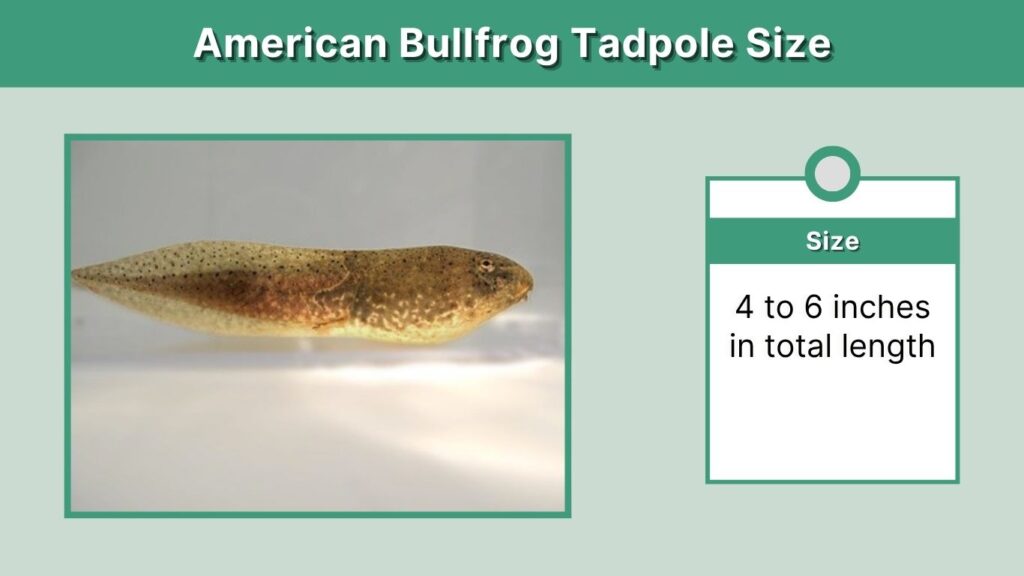
American bullfrog tadpoles are known for their large size. They can look “massive” compared with small treefrog or toad tadpoles.
The tadpole stage can also last longer than many people expect. In warm regions, development may be faster, but in cooler regions, tadpoles can overwinter and continue growing the next year.
How Big Do American Bullfrog Tadpoles Get?
A developed American bullfrog tadpole may reach 4 to 6 inches in total length, including the tail. The body is thick, rounded, and often heavier-looking than smaller frog tadpoles.
Size can vary based on:
- Water temperature
- Food availability
- Pond quality
- Population density
- Predator pressure
- Season and climate
- Age of the tadpole
Large size does not always mean the tadpole is ready to become a frog. Some bullfrog tadpoles grow large and remain aquatic for a long time before legs appear.
Why They Stay Tadpoles So Long
American bullfrog tadpoles often have a long larval period. The Virginia Herpetological Society notes that metamorphosis may vary from a few months in the South to three years in places such as Michigan and Nova Scotia.
This long tadpole stage helps them grow large before becoming froglets. However, it also means they need stable water that does not dry out quickly.
American Bullfrog Tadpole Stages
The American bullfrog life cycle includes eggs, tadpoles, froglets, and adults. The tadpole stage is only one part of this process, but it can be the longest early stage.
Like other frogs, bullfrogs go through metamorphosis, which means the body changes from an aquatic larva into a young frog.
| Stage | What Happens |
| Egg | Eggs are laid in water in large masses |
| Young tadpole | Tadpole hatches and feeds in water |
| Growing tadpole | Body grows larger, tail strengthens, diet expands |
| Hind-leg stage | Back legs appear first |
| Front-leg stage | Front legs appear, body shape changes |
| Froglet | Tail shrinks, lungs become more important |
| Juvenile frog | Young frog leaves water edges more often |
Egg to Tadpole
Female bullfrogs can lay very large numbers of eggs. Oregon Sea Grant notes that a female bullfrog can lay up to 20,000 eggs at one time, floating on the water surface in a cluster.
After hatching, the young tadpoles begin feeding and growing in the water. At this stage, they are vulnerable to fish, birds, turtles, insects, and even other frogs.
Tadpole to Froglet
During metamorphosis, hind legs appear first. Later, front legs emerge, the mouth changes, the tail begins to shrink, and the young frog starts breathing air more actively.
The Washington Department of Fish & Wildlife explains that frogs start life as aquatic larvae with gills and a tail fin; over time, legs develop, the tail and gills are absorbed, and the frog becomes a terrestrial, air-breathing animal.
Froglet Stage
A froglet looks like a small frog with a short remaining tail. This is a sensitive stage because the animal is changing how it breathes, moves, and eats.
If you are raising tadpoles in a controlled setup, the froglet stage is when the enclosure must include easy access to land. A froglet can drown if it cannot climb out of the water.
What Do American Bullfrog Tadpoles Eat?
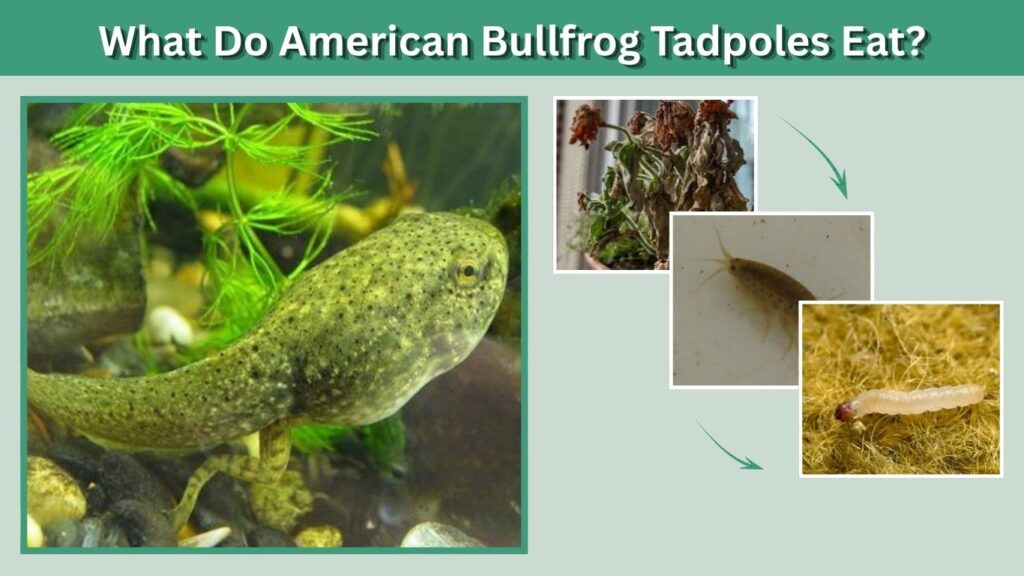
American bullfrog tadpoles are mostly plant and detritus feeders, but they are not strictly herbivores. They graze on algae, plant matter, organic material, and small aquatic organisms.
California Department of Fish and Wildlife states that bullfrog tadpoles mainly eat algae, aquatic plant material, and invertebrates, and may also eat tadpoles of other frog species.
Wild Tadpole Diet
In the wild, American bullfrog tadpoles may eat:
- Algae
- Aquatic plant material
- Decaying organic matter
- Biofilm on rocks and plants
- Insect larvae
- Tiny invertebrates
- Dead plant particles
- Occasionally other tadpoles
The Virginia Herpetological Society also describes larval food as mainly algae, aquatic plant material, and some invertebrates.
Captive Tadpole Food
For captive care, American bullfrog tadpoles can be offered a plant-based diet with occasional protein sources. The goal is to keep the water clean while providing enough food for growth.
Common captive foods include:
- Algae wafers
- Boiled romaine lettuce
- Blanched spinach in small amounts
- Soft aquatic plants
- Spirulina-based fish food
- Small amounts of tadpole food
- Occasional insect-based aquatic food
Remove uneaten food before it rots. Dirty water can quickly harm tadpoles.
American Bullfrog Tadpole Care
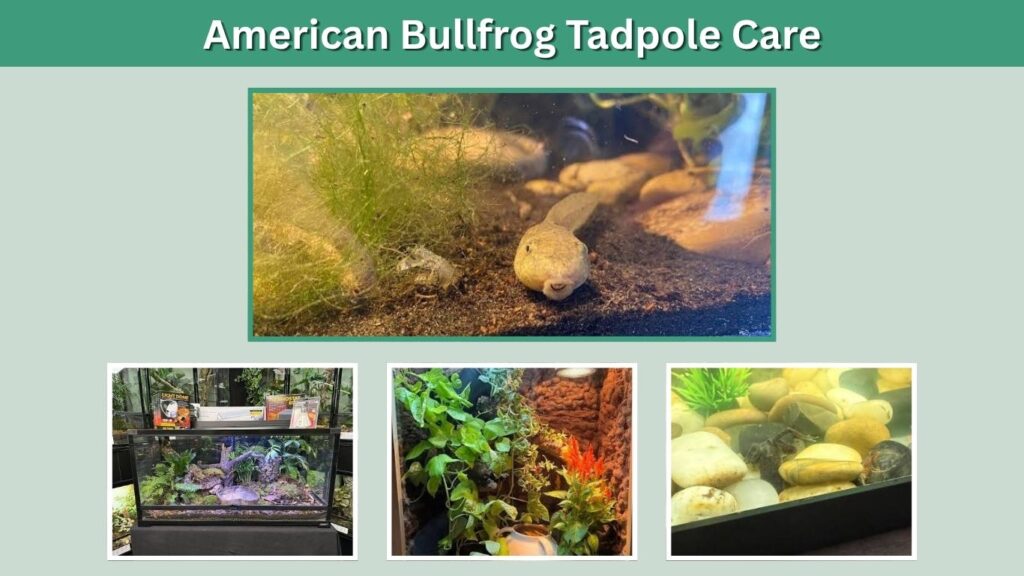
American bullfrog tadpole care is not just about feeding. They need clean water, stable temperature, space, oxygen, and a safe transition area when legs develop.
Keeping bullfrog tadpoles may also be regulated in some places. In Washington, for example, the American bullfrog is classified as a prohibited aquatic animal species and may not be possessed, imported, purchased, sold, propagated, transported, or released into state waters except under specific rules.
Basic Care Sheet
A basic American bullfrog tadpole care sheet should include:
- Large aquarium or outdoor tub
- Dechlorinated water
- Gentle filtration or frequent partial water changes
- No strong current
- Aquatic plants or hiding areas
- Plant-based tadpole food
- Stable water temperature
- No overcrowding
- Land access when legs develop
- Secure lid for froglets
Do not use untreated tap water. Chlorine and chloramine can harm amphibians. Use a proper aquarium water conditioner or aged safe water, depending on local water treatment.
Water and Temperature
Bullfrog tadpoles prefer warm, slow water. The Virginia Herpetological Society notes that tadpoles favor warm water environments around 24–30°C.
Avoid sudden temperature changes. Cold water can slow growth, while overheated water can reduce oxygen and stress tadpoles.
Tank Setup
For a small number of tadpoles, use a spacious tank with shallow areas, hiding spots, and clean water. As they grow, they need more room.
A simple setup can include:
- Smooth rocks
- Aquatic plants
- Sponge filter
- Dechlorinated water
- Shallow ramp or floating cork
- Secure cover for later stages
Once front legs appear, prepare a land area immediately. Froglets need to leave the water easily.
American Bullfrog Tadpoles for Sale
Many people search for American bullfrog tadpoles for sale, but buying them is not always simple. These animals can be invasive, regulated, or illegal to possess in some areas.
Before buying American bullfrog tadpoles, check your local wildlife agency’s rules. Laws may differ by state, province, or country.
Buying Checklist
Before buying, ask:
- Are bullfrog tadpoles legal to own in your area?
- Are they captive-bred?
- Are they healthy and active?
- Are they being sold with care instructions?
- Can you house the adult frog later?
- Do you have a plan if several tadpoles survive?
- Is release into the wild illegal where you live?
Never buy tadpoles just for a short classroom or backyard experiment unless you have a legal and humane long-term plan.
Why You Should Never Release Them
Do not release captive bullfrog tadpoles into ponds, canals, streams, or wetlands. Even if bullfrogs live nearby, releasing captive animals can spread disease, disrupt local genetics, or introduce bullfrogs where they do not belong.
California Department of Fish and Wildlife describes American bullfrogs as invasive in California and says they can outcompete native frogs and other aquatic species. USGS also identifies the American bullfrog as a nonindigenous aquatic species with documented competitive impacts in parts of the western United States.
Common Problems When Raising Bullfrog Tadpoles
Raising American bullfrog tadpoles can be difficult if water quality or diet is poor. Many problems come from overcrowding, dirty water, or not preparing for metamorphosis.
Bullfrog tadpoles grow large, so a small jar or bowl is not suitable for long-term care.
Not Eating
A tadpole may stop eating because of cold water, poor water quality, stress, disease, or sudden diet changes. Check the water first. If the water smells bad, looks cloudy, or has uneaten food, do a partial water change with safe dechlorinated water.
Offer softer foods such as boiled lettuce or algae wafers. Avoid adding too much food at once.
Floating or Weak Tadpoles
Floating, rolling, or weak swimming can be a sign of water-quality problems, injury, stress, or illness. Remove spoiled food, check temperature, and improve oxygenation.
If several tadpoles become weak at the same time, the problem is usually environmental rather than individual.
Froglets Drowning
This is a common mistake. Once legs develop, especially when front legs appear, the tadpole must have a way to climb out. Froglets can drown if the tank has only deep water and slippery sides.
Use a gentle slope, floating cork bark, smooth rocks, or a shallow land area.
American Bullfrog Tadpole Identification vs Other Tadpoles
American bullfrog tadpoles can be confused with green frog tadpoles and other large pond tadpoles. Identification is easier when you compare size, habitat, color, and development time.
Bullfrog tadpoles are usually large, olive-brown or greenish, and found in permanent water. Temporary puddles are less likely to support bullfrog tadpoles because they often need a long time to metamorphose.
| Feature | American Bullfrog Tadpole |
| Body shape | Large, rounded, heavy-looking |
| Color | Olive, brown, gray-green, often speckled |
| Tail | Long, strong, sometimes mottled |
| Habitat | Permanent ponds, lakes, slow streams |
| Development | Often long; may overwinter |
| Size | Larger than many common frog tadpoles |
Albino American Bullfrog Tadpoles
Albino American bullfrog tadpoles may appear in the pet trade, but they need the same basic care as normal-colored tadpoles. They may be more visible to predators and may need extra protection from bright light and stress.
Albino animals should never be released into the wild.
Massive American Bullfrog Tadpoles
Large bullfrog tadpoles are normal, especially when they have had a long growing season. A “massive” tadpole is often an older individual that has not yet metamorphosed.
If a tadpole is large but has no legs, it may still be healthy. Development depends on temperature, food, season, and genetics.
FAQs
What do American bullfrog tadpoles eat?
American bullfrog tadpoles eat algae, aquatic plant material, organic matter, insect larvae, and some small invertebrates. In captivity, they can eat algae wafers, boiled lettuce, spirulina foods, and safe tadpole foods.
How big do American bullfrog tadpoles get?
American bullfrog tadpoles can reach about 4 to 6 inches in total length. They are much larger than many common frog tadpoles and can look very heavy-bodied before metamorphosis.
How long do American bullfrog tadpoles stay tadpoles?
They may stay tadpoles for a few months in warm areas, but in cooler regions they can take up to two or even three years to metamorphose. Temperature and season strongly affect development.
Can I buy American bullfrog tadpoles?
You may be able to buy them in some places, but laws vary. In some regions, American bullfrogs are restricted or considered invasive. Always check local wildlife rules before buying, possessing, or transporting them.
Can I release American bullfrog tadpoles into a pond?
No. Captive tadpoles should never be released into the wild. Releasing them can spread disease, harm native amphibians, and may be illegal, especially where bullfrogs are invasive or regulated.
