
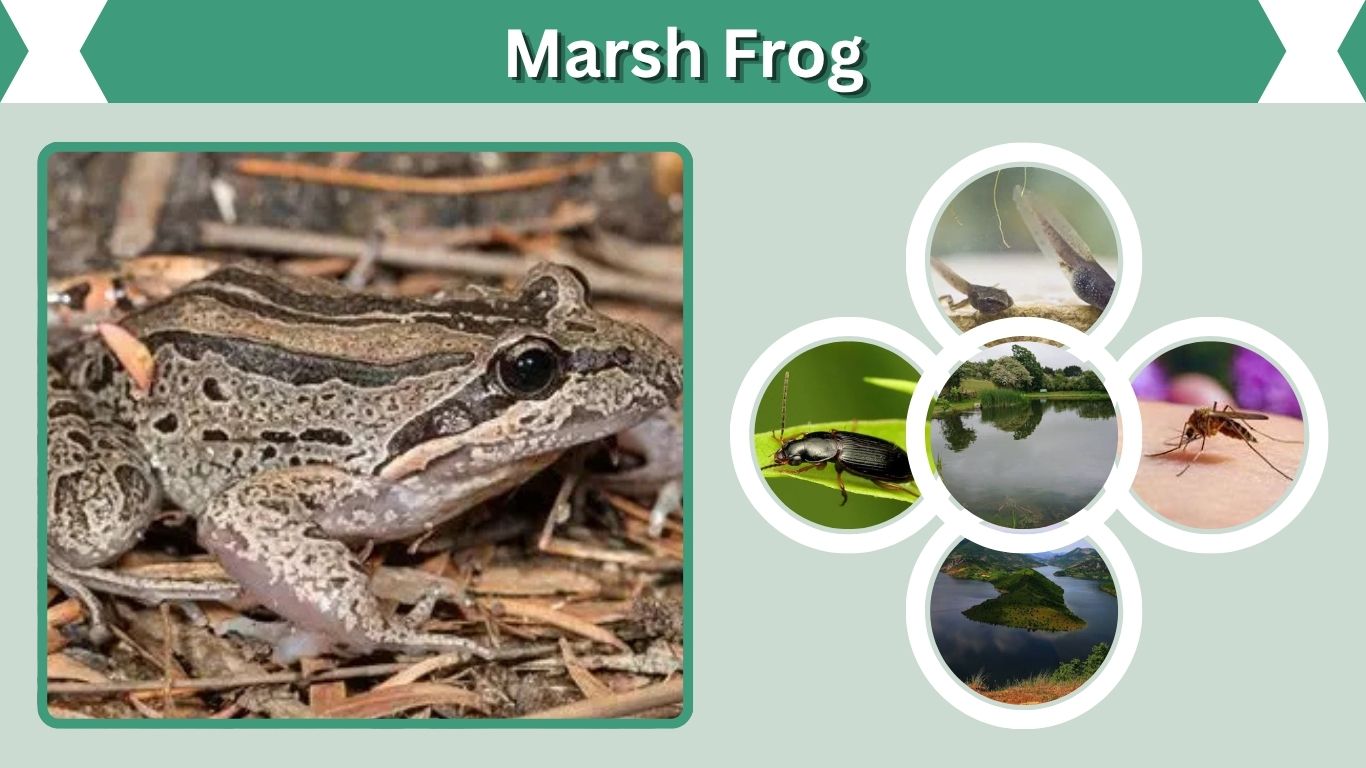
The marsh frog is a large, highly aquatic frog native to much of Europe and western Asia. Its scientific name is Pelophylax ridibundus, although older references may list it as Rana ridibunda. It is recognized by its green or brown body, dark markings, powerful hind legs, and loud laughing call. Marsh frogs spend most of their active lives in or beside freshwater, where they bask, hunt, breed, and escape predators. They are generally common across their natural range, but introduced populations can compete or breed with native water frogs.
What Is a Marsh Frog?
The marsh frog belongs to the true frog family Ranidae and the European water frog genus Pelophylax. It is closely related to the pool frog and is one of the parent species involved in the unusual hybrid origin of the edible frog.
It is native to large areas of continental Europe and parts of western Asia. Marsh frogs have also been introduced outside their original distribution, including in Britain. In the United Kingdom, they are concentrated mainly in southeastern England and are not considered native.
The name “marsh frog” can cause confusion because several Australian frogs also have marsh frog in their common names. The European marsh frog is not the same animal as the Australian striped marsh frog or spotted marsh frog.
Marsh Frog Identification
- Green, olive, gray, or brown upper body
- Dark brown or black spots on the back
- Pale green or yellow stripe sometimes running down the back
- Long, muscular hind legs
- Pointed face and prominent eyes
- Raised skin folds along both sides of the back
- Pale belly, sometimes with darker markings
- Large external vocal sacs in calling males
Body color can change with temperature, light, habitat, and individual genetics. A marsh frog may appear dark brown in cool spring weather and greener during warmer conditions.
The back stripe is useful when present, but not every individual has one. Accurate identification may require examination of body proportions, hind feet, calls, and location because marsh frogs can resemble pool frogs and edible frogs.
Marsh Frog Size
The marsh frog is the largest native European frog species. Adults commonly measure between 6 and 12 centimeters from the snout to the rear of the body, although large females may approach 13–15 centimeters. Females are usually larger and more heavily built than males.
Their long hind legs make them appear even larger when fully extended. These legs allow marsh frogs to make powerful jumps from the bank and swim rapidly through open water.
Marsh frog tadpoles can also become unusually large. Some may delay metamorphosis and overwinter in the water, allowing them to continue growing before transforming into froglets.
Marsh Frog Habitat
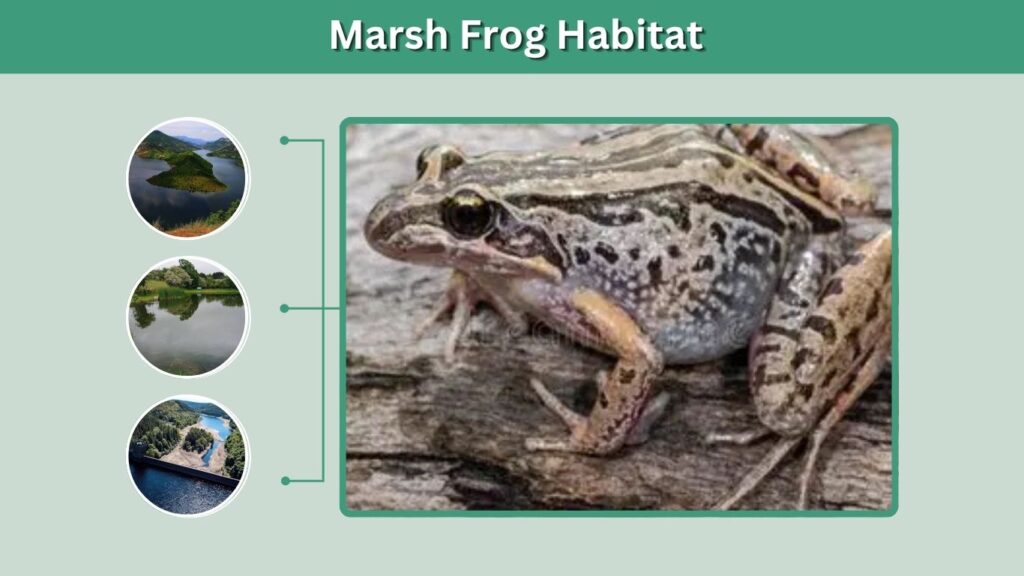
Marsh frogs are strongly associated with freshwater. They occupy a wider variety of water bodies than many more specialized amphibians and can live in both natural and human-created wetlands.
Typical habitats include:
- Marshes and swamps
- Lakes and reservoirs
- Large ponds
- Slow-moving rivers
- Canals and drainage ditches
- Flooded meadows
- Gravel and clay pits
- Farm ponds
- Urban wetlands
They usually prefer shallow freshwater with limited current, sunny banks, and abundant aquatic vegetation. Recent research on breeding sites also found a preference for shallow water with low salinity and minimal flow.
Unlike frogs that leave ponds soon after breeding, marsh frogs remain close to water throughout much of the active season. They often sit on floating vegetation, muddy banks, stones, or exposed roots.
Do Marsh Frogs Live in Salt Marshes?
Marsh frogs are primarily freshwater amphibians. They may tolerate slightly brackish conditions in some locations, but strongly salty water is unsuitable for their eggs, tadpoles, and delicate skin.
A frog found in a coastal salt marsh may therefore be another species better adapted to fluctuating salinity. Marsh frogs are more likely to occupy freshwater ditches, ponds, or low-salinity pools within the wider coastal landscape.
Marsh Frog Behavior
Marsh frogs are active during the day and evening, particularly in warm weather. They spend long periods basking near the water’s edge but quickly dive when approached.
Once underwater, a frog may hide beneath vegetation or remain submerged with only its eyes and nose exposed. Its green and brown pattern helps it blend with algae, mud, and plants.
The species can be bold around established ponds. Several frogs may share the same sunny bank, although males become territorial during the breeding season.
Marsh Frog Call and Sound
The marsh frog is famous for its loud call. A calling male produces a repeated laughing, chuckling, or cackling sound that can be heard from a considerable distance.
Males have paired gray vocal sacs positioned at the sides of the mouth. These inflate like balloons as air moves between the lungs and mouth. A group of males can create a continuous chorus around a large pond.
Calling serves two purposes. It attracts females and warns competing males that a breeding position is occupied. Calling is strongest during warm spring and summer weather and may continue during the day or night.
What Do Marsh Frogs Eat?
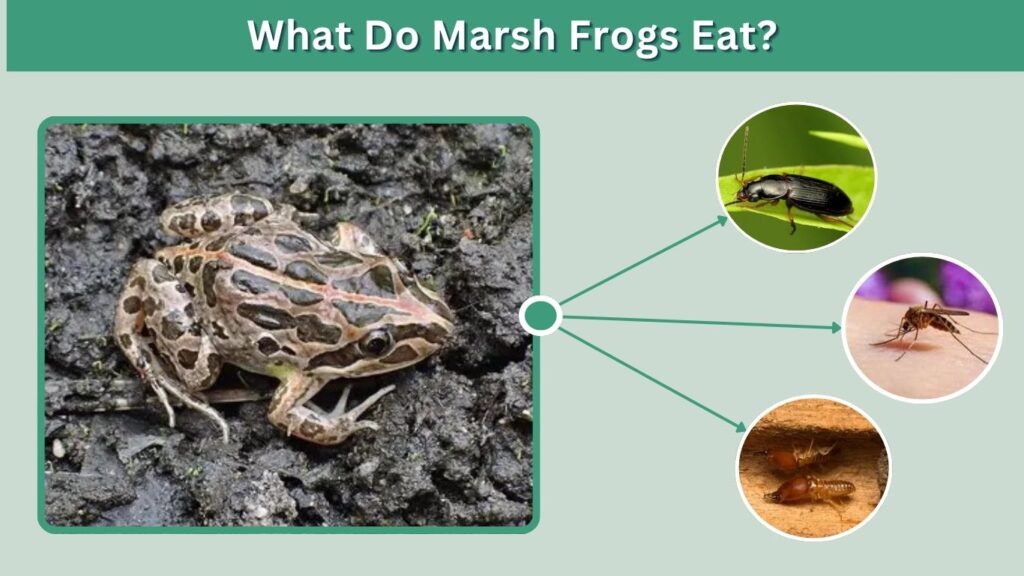
Adult marsh frogs are opportunistic carnivores. They consume whatever appropriately sized prey is abundant around their habitat.
Common foods include:
- Flies
- Mosquitoes
- Beetles
- Moths
- Caterpillars
- Grasshoppers
- Crickets
- Spiders
- Worms
- Snails
- Aquatic insects
Large marsh frogs may also capture small fish, tadpoles, young frogs, reptiles, mice, and occasionally small birds. However, insects and other invertebrates usually form the majority of their diet. One dietary study found flies and beetles to be particularly important prey.
A marsh frog hunts by sitting still and watching for movement. When prey comes close, it lunges forward and catches it with its sticky tongue or jaws.
What Do Marsh Frog Tadpoles Eat?
Tadpoles feed mainly on algae, microorganisms, decomposing vegetation, and organic debris. They scrape food from underwater plants, rocks, and pond surfaces.
Larger tadpoles may also eat tiny aquatic invertebrates, dead animals, or eggs. Their flexible diet helps them survive in ponds where available food changes during the season.
Marsh Frog Breeding
Breeding usually occurs during spring and early summer after water temperatures rise. Males gather in shallow areas and call loudly to attract females.
A male climbs onto a female and grips her behind the front legs. This mating position is known as amplexus. As the female releases her eggs, the male fertilizes them externally.
Marsh Frog Eggs
The female lays her eggs in soft clusters among submerged vegetation. One female may produce several thousand eggs during a breeding season.
Each egg has a dark developing embryo surrounded by clear jelly. The jelly protects the embryo, retains moisture, and helps the egg mass remain attached to plants.
Eggs may be eaten by fish, newts, aquatic insects, birds, and other frogs. Warm, shallow areas with dense vegetation provide better protection and can accelerate development.
Marsh Frog Tadpoles
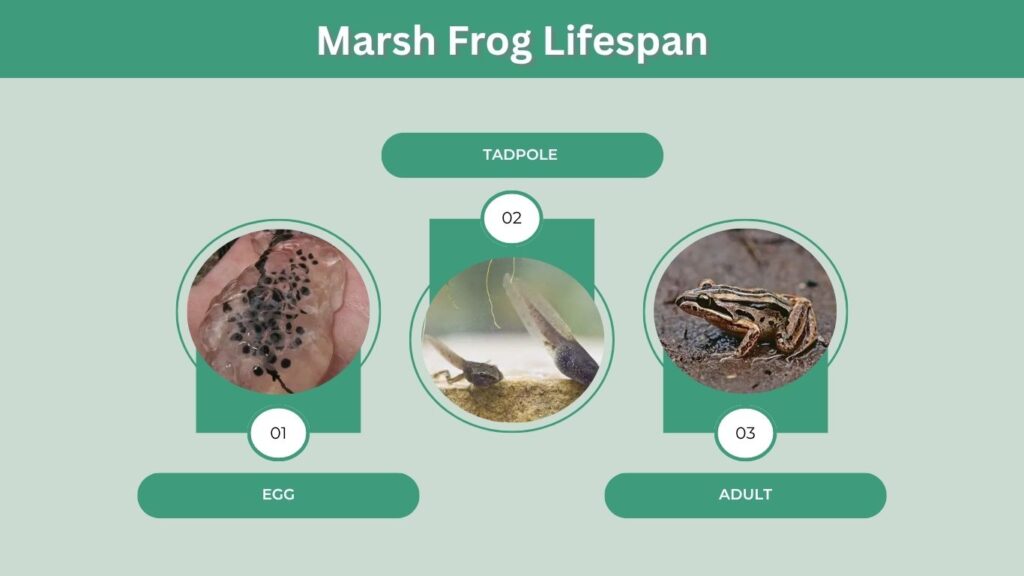
After hatching, the tadpoles remain in the water and breathe through gills. They begin as small, dark larvae but may grow to an impressive size before metamorphosis.
The main developmental stages include:
- Egg
- Newly hatched tadpole
- Growing tadpole
- Tadpole with hind legs
- Tadpole with four legs
- Froglet with a shrinking tail
- Adult frog
Water temperature strongly affects development. Tadpoles in warm ponds may transform within the same season, while those in cooler areas sometimes remain aquatic through winter and complete metamorphosis the following year.
Marsh Frog Lifespan
A marsh frog may live for approximately five to ten years in suitable natural conditions, although many individuals die much earlier from predation, disease, drought, freezing, traffic, or habitat disturbance.
Survival improves in habitats that offer permanent water, dense plants, abundant food, and safe winter shelters. Adults generally have better survival rates than eggs, tadpoles, and newly transformed froglets.
What Happens During Winter?
Marsh frogs become inactive when temperatures fall. They may overwinter underwater in mud, among submerged plants, or inside protected burrows near the pond.
Their metabolism slows considerably, allowing them to survive for long periods without feeding. They absorb some oxygen through their skin while remaining inactive.
Warm weather in spring causes them to emerge, begin feeding, and eventually return to breeding areas.
Marsh Frog Predators
Marsh frogs are eaten by many wetland predators, including:
- Herons
- Storks
- Kingfishers
- Grass snakes
- Otters
- Foxes
- Large fish
- Turtles
- Larger frogs
Eggs and tadpoles face additional threats from dragonfly larvae, diving beetles, newts, and aquatic bugs.
Adult frogs rely on powerful jumps, fast swimming, camouflage, and immediate access to deep water. Their loud distress calls may also startle a predator temporarily.
Are Marsh Frogs Poisonous?
Marsh frogs are not considered poisonous to humans or dogs. They do not possess venom, fangs, or the potent defensive toxins associated with some tropical frogs and certain toads.
Their skin produces mucus that keeps it moist and may contain mild defensive substances. Contact could irritate sensitive eyes or skin, and frogs can carry microorganisms from their aquatic environment.
A person who handles one should wash their hands afterward. Dogs should not be encouraged to bite or swallow wild frogs because the frog may cause irritation, and the animal could also carry parasites or environmental contaminants.
European vs. Australian Marsh Frogs
The European marsh frog should not be confused with similarly named Australian species.
Striped Marsh Frog
The striped marsh frog is Limnodynastes peronii. It is an Australian species with a brown back, dark longitudinal stripes, and sometimes a cream or reddish stripe along the center. It reaches approximately 7.5 centimeters and produces a distinctive repeated knocking call.
Spotted Marsh Frog
The spotted marsh frog is Limnodynastes tasmaniensis. It reaches nearly 5 centimeters and has a gray-brown or olive body covered with darker patches. Many individuals have a cream or red stripe down the center of the back.
Neither Australian species is a regional color variation of Pelophylax ridibundus. They belong to a different frog family and require separate identification.
Marsh Frog vs. Pool Frog
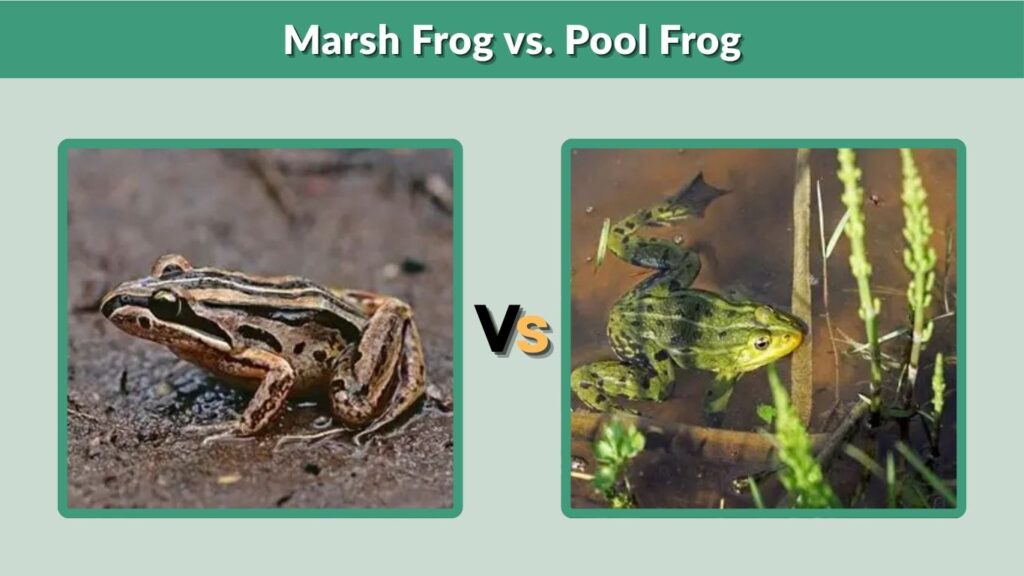
Marsh frogs and pool frogs are closely related and can look similar.
| Feature | Marsh frog | Pool frog |
|---|---|---|
| Scientific name | Pelophylax ridibundus | Pelophylax lessonae |
| Adult size | Usually larger | Usually smaller |
| Body shape | Broad and robust | More compact |
| Call | Loud laughing or cackling | Faster rattling call |
| Hind legs | Relatively long | Generally shorter |
| Typical habitat | Large ponds, lakes, canals | Warm, vegetated pools and ponds |
Color alone is unreliable because both may be green or brown. Hybrid edible frogs can further complicate identification.
Conservation and Introduced Populations
The marsh frog is broadly distributed and generally has large populations across much of its natural range. AmphibiaWeb describes it as being in a comparatively secure position among Eurasian amphibians.
Local populations can still be harmed by wetland drainage, pollution, road deaths, disease, pesticide use, drought, and the introduction of predatory fish.
Outside its native range, the species may become invasive. Introduced marsh frogs can compete with native amphibians, prey on smaller animals, and hybridize with closely related water frogs. For this reason, wild frogs should never be captured and released in another pond or region.
FAQs
How big does a marsh frog get?
Adults commonly grow between 6 and 12 centimeters, while exceptionally large females may approach 13–15 centimeters. Females are usually larger than males.
What does a marsh frog sound like?
Its call is a loud series of laughing, chuckling, or cackling notes. Large groups of males can create a powerful chorus during warm breeding weather.
Are marsh frogs dangerous to dogs?
They are not considered dangerously poisonous, but dogs should not be allowed to chew or swallow them. Skin secretions, parasites, or environmental contaminants could cause irritation or illness.
What do marsh frogs eat?
They mainly eat insects, spiders, worms, snails, and other invertebrates. Large adults may occasionally consume fish, tadpoles, small frogs, reptiles, or tiny mammals.
Is a striped marsh frog the same as a marsh frog?
No. The European marsh frog is Pelophylax ridibundus. The striped marsh frog is the Australian species Limnodynastes peronii.
