
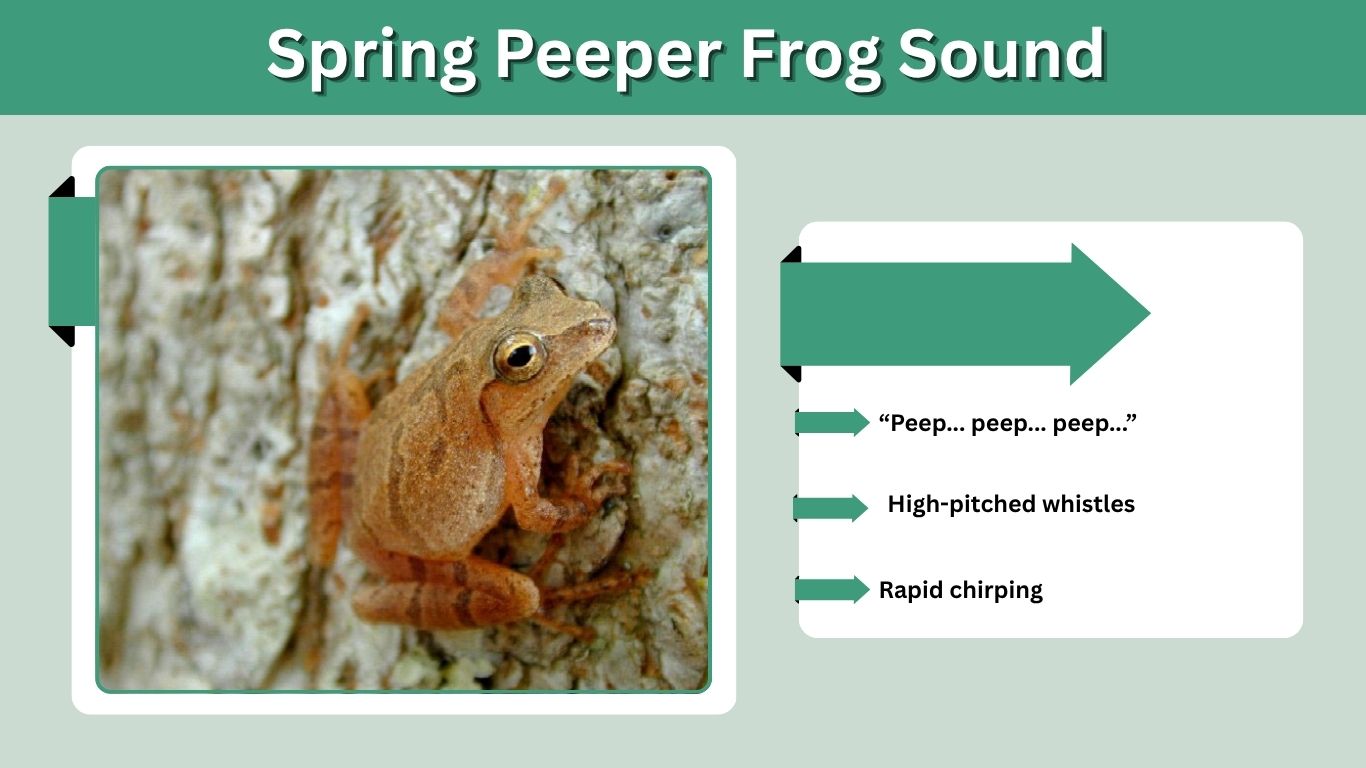
The spring peeper frog sound is one of the most recognizable noises of early spring in eastern North America. These tiny tree frogs produce a clear, high-pitched “peep” that can become surprisingly loud when hundreds of males call together near ponds, wetlands, and wooded areas. Spring peepers usually call at night to attract females during the breeding season. Their chorus is often associated with warmer weather arriving after winter, making their sound a familiar seasonal signal in many rural and suburban areas.
What Does a Spring Peeper Sound Like?
A spring peeper produces a short, sharp, high-pitched whistle that sounds much like the word “peep.” A single frog may sound simple and delicate, but a large breeding chorus can become extremely loud. The individual calls overlap repeatedly, creating a continuous wall of peeping sounds around wetlands during spring evenings.
Sound of a Single Spring Peeper
A single spring peeper usually makes a clean, repeated:
“Peep… peep… peep…”
Each call is short and relatively high in pitch. Males repeat the sound frequently while trying to attract females.
The spacing and speed of calls can change depending on temperature, competition, and the presence of nearby males.
A lone spring peeper may be difficult to locate because the frog is small and often calls while hidden among vegetation.
What Does a Group of Spring Peepers Sound Like?
When many males call together, the sound becomes much more intense.
A breeding chorus can resemble:
- High-pitched whistles
- Tiny bells ringing repeatedly
- Electronic beeping
- Rapid chirping
- A continuous wave of “peep-peep-peep” sounds
Because dozens or even hundreds of frogs may call from the same wetland, the combined volume can be surprisingly powerful.
Why Do Spring Peepers Make Sounds?
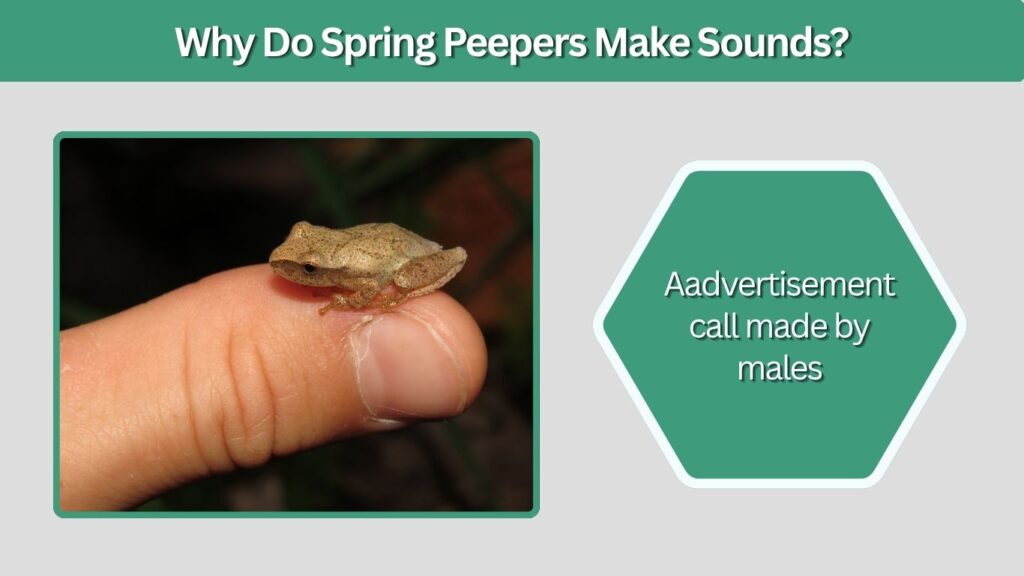
Spring peeper calls are primarily connected to reproduction. Males begin calling when temperatures become suitable and breeding wetlands become available. Their sounds allow females to locate potential mates while also helping males communicate with competitors occupying the same breeding area.
Males Call to Attract Females
The familiar peeping sound is mainly an advertisement call made by males.
A male typically selects a position close to shallow water and calls repeatedly. Females can use characteristics of these calls when choosing a mate.
A strong, consistent caller may have a better opportunity to attract attention in a crowded breeding chorus.
Males Also Respond to Other Males
Spring peepers do not call in complete isolation from one another.
Males can adjust their behavior when nearby frogs are calling. Competition may influence call timing and intensity, especially when several males occupy a small area.
This interaction helps create the rhythmic chorus people hear around ponds during spring.
What Does the Spring Peeper Sound Mean?
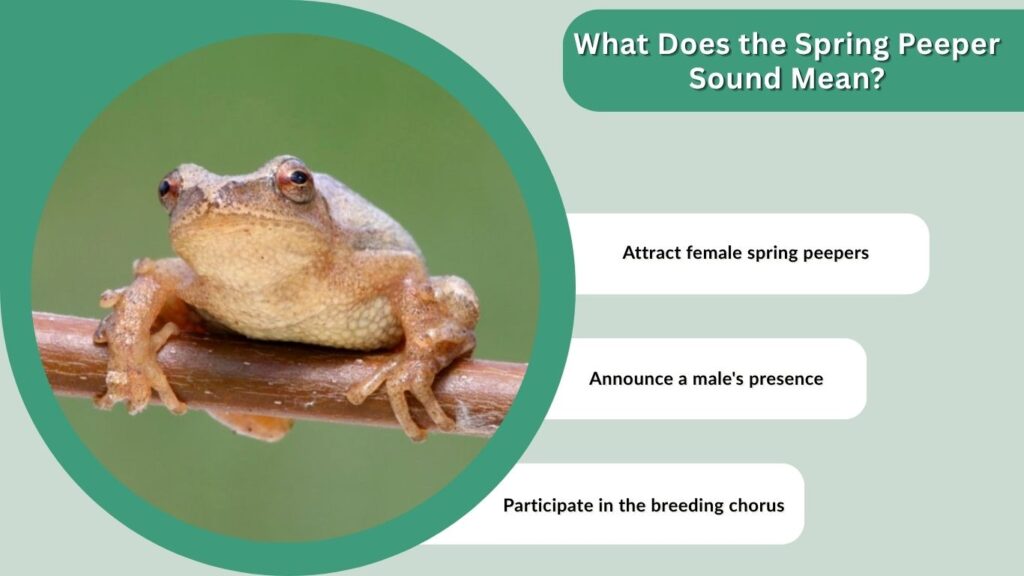
The meaning of a spring peeper sound depends largely on the situation. Most of the familiar calls heard at night are breeding calls from males. However, frogs can produce different vocalizations when interacting with rivals or when disturbed.
Advertisement Call
The advertisement call is the classic high-pitched peep.
Its main purposes are to:
- Attract female spring peepers
- Announce a male’s presence
- Establish spacing between calling males
- Participate in the breeding chorus
This is the sound most people associate with spring peeper frogs.
Aggressive or Encounter Calls
When males are very close together, their sounds can change.
A frog may produce a different call during direct interactions with another male. These calls can help discourage another frog from moving too close to its calling position.
Such sounds are less commonly noticed by people because they occur within an already loud chorus.
Why Are Spring Peepers So Loud?
Spring peepers are remarkably loud considering their small body size. Adult frogs are only a few centimeters long, yet their breeding choruses can carry across considerable distances. Their calls must compete with those of neighboring frogs, which helps explain why groups can create such an intense nighttime sound.
Their Vocal Sac Amplifies the Call
Male spring peepers have an expandable vocal sac beneath the throat.
When calling, the frog pushes air through its vocal structures and inflates the sac. The vocal sac acts as a resonating chamber that helps amplify the sound.
This allows such a tiny frog to produce a call that can be heard far beyond its immediate location.
Hundreds of Frogs May Call Together
A single peeper is noticeable, but an entire population is much louder.
During peak breeding periods, many males may gather around temporary ponds, swamps, marshes, and other shallow bodies of water.
As their calls overlap, the chorus becomes much louder than the sound of any individual frog.
When Can You Hear Spring Peepers?
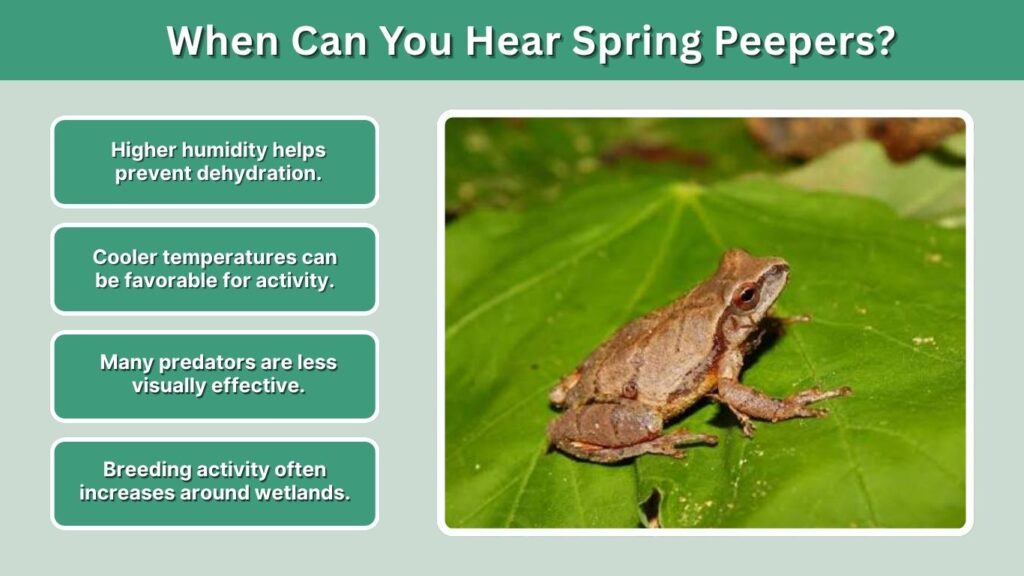
Spring peepers are most strongly associated with the beginning of spring. Their breeding activity often starts soon after temperatures rise above freezing and wetland conditions become suitable. In some regions, calling can begin surprisingly early in the year.
Spring Peeper Sounds at Night
The loudest calling usually occurs after sunset.
Night provides several advantages:
- Higher humidity helps prevent dehydration.
- Cooler temperatures can be favorable for activity.
- Many predators are less visually effective.
- Breeding activity often increases around wetlands.
- Sound carries effectively through calm nighttime environments.
On warm, damp evenings, the chorus may continue for hours.
Can Spring Peepers Call During the Day?
Yes. Spring peepers can occasionally call during daylight hours, particularly during warm, cloudy, or rainy weather.
However, nighttime calling is much more characteristic.
If breeding conditions are especially favorable, frogs may begin calling before sunset and continue well into the night.
Northern and Southern Spring Peeper Sounds
Spring peepers occur across a large portion of eastern North America. Regional populations were historically described as northern and southern forms, although modern classification generally treats the spring peeper as one species, Pseudacris crucifer.
Their basic call remains recognizable throughout the range.
Northern Spring Peeper Sound
Northern spring peepers typically produce the familiar sharp peeping call.
They may begin breeding very early, sometimes while snow or ice remains nearby. Their calls are often among the first frog sounds heard after winter in northern regions.
For many people, hearing northern spring peepers is a traditional sign that spring weather has arrived.
Southern Spring Peeper Sound
Spring peepers in southern areas produce essentially the same characteristic high-pitched call.
The timing of breeding can differ because warmer climates allow activity earlier in the year.
Local temperature, rainfall, elevation, and wetland conditions influence when the strongest choruses occur.
Spring Peeper Sound vs. Bird Sounds
A single spring peeper can sometimes be mistaken for a small bird because its call is high, clear, and whistle-like. The confusion is especially common when a frog calls from vegetation and cannot easily be seen.
Bird That Sounds Like a Spring Peeper
Some short bird whistles can resemble a spring peeper from a distance.
However, there are several clues that help distinguish them:
- Spring peepers usually repeat a simple “peep.”
- Large groups create overlapping choruses.
- Calling is strongest around wetlands.
- Peepers are especially active after dark.
- Bird songs are usually more complex and varied.
If a high-pitched sound continues from a wet area after sunset, a spring peeper is a strong possibility.
Spring Peeper Sounds for Sleeping and Relaxation
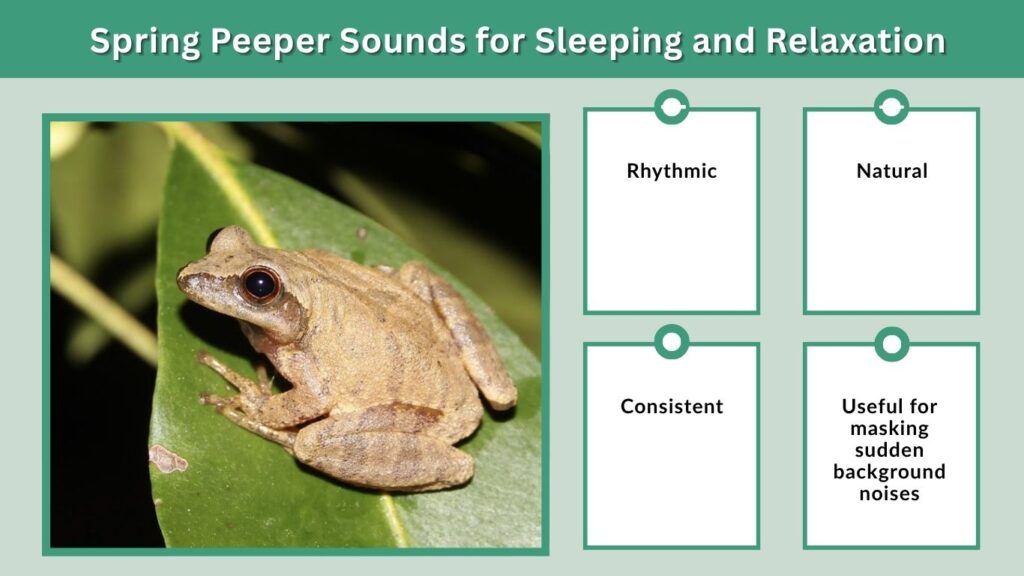
Some people find spring peeper choruses relaxing because they are associated with quiet forests, wetlands, warm evenings, and the beginning of spring. Recordings of spring peepers are commonly used as ambient nature sounds for sleeping, meditation, reading, or background noise.
Why the Sound Can Be Relaxing
Spring peeper recordings often combine repetitive frog calls with other natural nighttime sounds.
People may enjoy them because the sound is:
- Rhythmic
- Natural
- Consistent
- Associated with peaceful outdoor environments
- Useful for masking sudden background noises
However, a real breeding chorus can be very loud, so not everyone finds spring peepers relaxing when they are calling directly outside a home.
How Do You Identify a Spring Peeper by Sound?
Sound is often the easiest way to detect spring peepers because these frogs are small, well camouflaged, and difficult to locate visually. Recognizing their characteristic call can help identify them without disturbing their wetland habitat.
Key Sound Characteristics
Listen for a call that is:
- High-pitched
- Short
- Clear
- Whistle-like
- Repeated every few seconds
- Similar to the word “peep”
- Usually heard in large nighttime choruses
The combination of a simple peeping call, wetland habitat, and early spring timing makes identification relatively straightforward.
FAQs
What Sound Does a Spring Peeper Make?
A spring peeper makes a short, high-pitched whistle that sounds like “peep.” Male frogs repeat this call during the breeding season to attract females. When many males call together, their individual peeps combine into a loud chorus around ponds and wetlands.
Why Do Spring Peepers Make Noise at Night?
Male spring peepers call at night primarily to attract females during breeding season. Nighttime conditions also tend to be cooler and more humid, which helps these small amphibians remain active without losing too much moisture through their skin.
How Loud Is a Spring Peeper Frog?
A single spring peeper can be surprisingly loud for such a tiny frog, and a large breeding chorus can be intense enough to dominate the nighttime soundscape around a pond. The frogs use expandable vocal sacs to amplify their calls.
What Time of Year Do Spring Peepers Make Sounds?
Spring peepers are most vocal during late winter and spring, depending on location and weather. Calling usually begins when nighttime temperatures become mild enough for breeding activity. In warmer areas, they may begin calling earlier than populations farther north.
Does a Spring Peeper Sound Like a Bird?
A single spring peeper can sometimes resemble a short bird whistle. However, peepers usually produce a simpler repeated “peep,” often after dark and near wetlands. A large chorus of identical high-pitched calls is much more characteristic of frogs than birds.
