
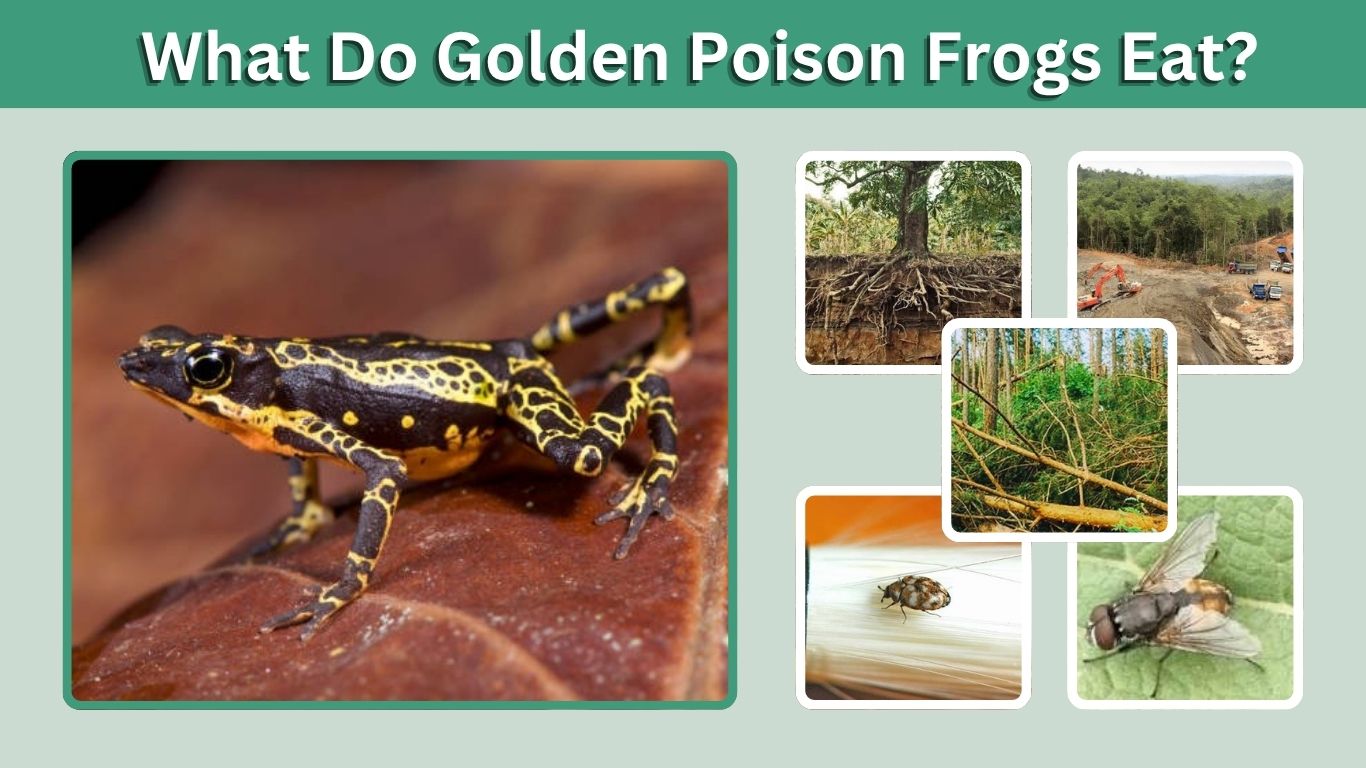
Lehmann’s poison frog is a rare Colombian amphibian recognized by its shiny black body and bright red, orange, or yellow bands. It lives within a very restricted area of humid rainforest on the western slopes of the Andes. Although small, the frog has powerful natural defenses, specialized parental care, and an important ecological role as a predator of tiny invertebrates. Habitat destruction and illegal collection have made it one of the world’s most threatened poison frogs.
What Is Lehmann’s Poison Frog?
Lehmann’s poison frog, also called the red-banded poison frog, has the scientific name Oophaga lehmanni. It belongs to the poison frog family Dendrobatidae.
The species was originally described as Dendrobates lehmanni but was later placed in the genus Oophaga. This genus currently contains 12 recognized species. Oophaga lehmanni is endemic to Colombia, meaning it does not occur naturally anywhere else.
| Feature | Description |
| Scientific name | Oophaga lehmanni |
| Family | Dendrobatidae |
| Other name | Red-banded poison frog |
| Native country | Colombia |
| Adult size | Approximately 31–36 mm |
| Diet | Small insects and other invertebrates |
| Activity | Mainly daytime |
| Conservation status | Critically Endangered |
Identification and Color
Lehmann’s poison frogs have compact bodies, smooth skin, large dark eyes, and slightly expanded toe pads. Their bright colors warn predators about potentially harmful chemicals in their skin.
Main Identification Features
- Approximately 1.2–1.4 inches long
- Glossy black or dark brown background
- Bright red, orange, or yellow bands
- One colored band behind the head
- Another band across the middle or rear of the body
- Bright markings around the legs
- Pale gray, white, or bluish fingertips
- Smooth skin and relatively slender limbs
The species occurs in red, orange, and yellow color forms. The exact width and shape of the dark and bright bands can vary among individuals. Its appearance resembles that of some harlequin poison frogs, so geographic origin and pattern details are important for reliable identification.
Where Does Lehmann’s Poison Frog Live?
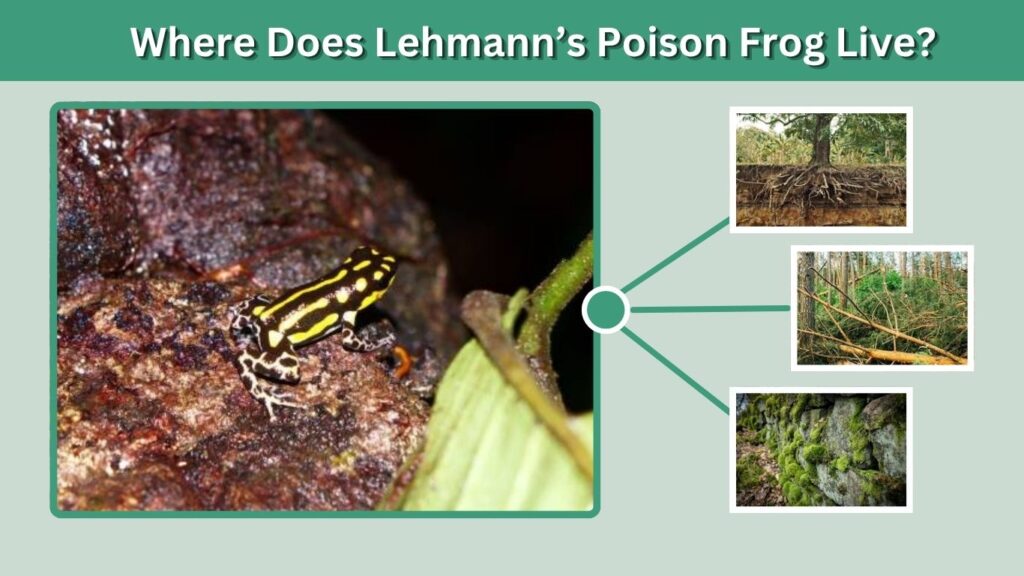
The frog has an extremely limited distribution on the western side of Colombia’s Cordillera Occidental. Its best-known populations occur near the upper Anchicayá River drainage in Valle del Cauca, particularly west of the town of Dagua.
Current taxonomic records place it mainly between approximately 600 and 1,200 meters above sea level. An isolated record from Chocó has been reported, although researchers have questioned whether that population may actually belong to the related Oophaga histrionica.
Preferred Habitat
Lehmann’s poison frogs inhabit humid tropical and submontane rainforest containing:
- Dense forest-floor leaf litter
- Bromeliads holding small pools of water
- Fallen branches and rotting wood
- Moss-covered rocks
- Damp roots and tree trunks
- Low shrubs and forest vegetation
- Consistently humid hiding places
The species is mainly terrestrial and spends considerable time on the forest floor. However, it also climbs low plants and trees, especially when calling, breeding, or caring for tadpoles.
What Does Lehmann’s Poison Frog Eat?
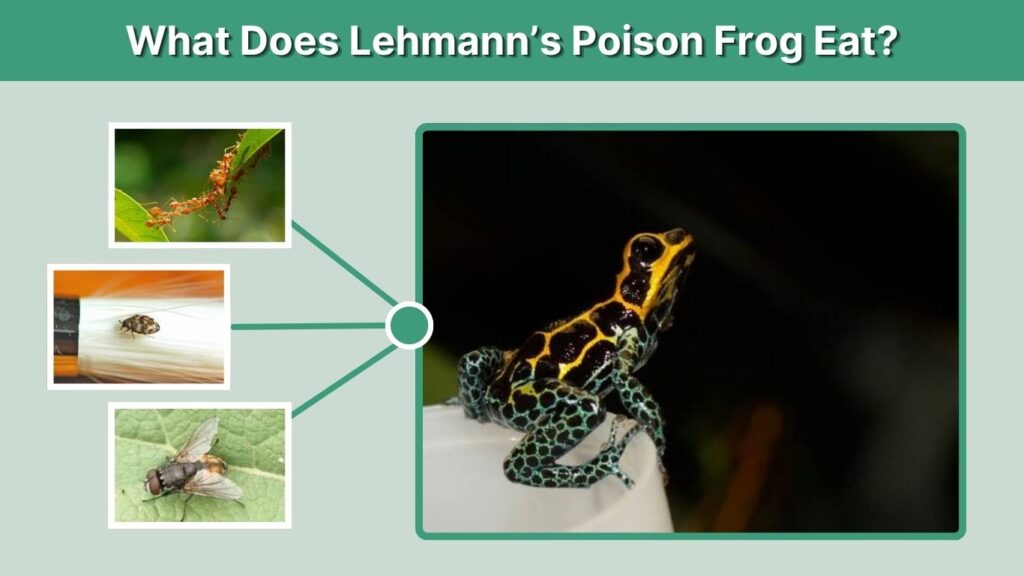
Adult Lehmann’s poison frogs are insectivores. They hunt small invertebrates moving through leaf litter, moss, and low vegetation.
Their likely natural prey includes:
- Ants
- Mites
- Springtails
- Termites
- Tiny beetles
- Small flies
- Other minute arthropods
The frog captures prey with a fast, sticky tongue. Its natural diet does more than provide nutrition: certain arthropods supply alkaloids that the frog can absorb and store in its skin.
Studies show that Oophaga lehmanni can accumulate particular toxins when they are present in its food. This supports the understanding that its chemical defenses are largely obtained through diet rather than produced entirely by the frog itself.
Is Lehmann’s Poison Frog Dangerous?
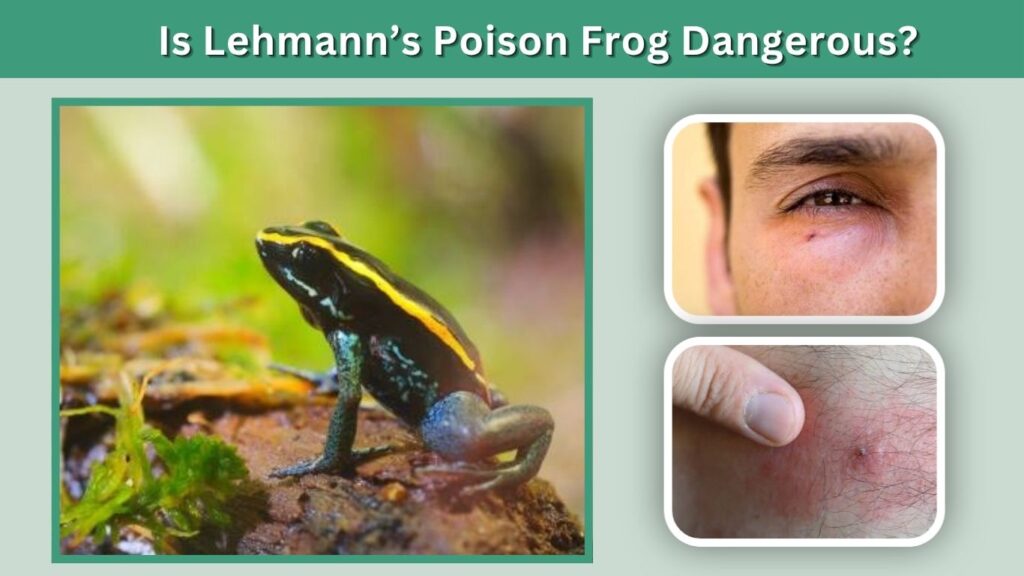
Wild Lehmann’s poison frogs possess defensive skin alkaloids that can discourage predators. They are poisonous rather than venomous because they do not inject toxins through fangs or a stinger.
Exposure becomes more concerning when secretions enter the eyes, mouth, broken skin, or another sensitive area. Wild frogs should therefore never be handled unnecessarily.
Captive-bred poison frogs generally lose most or all of their natural toxicity when fed fruit flies, springtails, and other insects that lack the necessary alkaloids. However, handling should still be avoided because chemicals, oils, salts, and soap residue on human skin can harm the frog.
Behavior and Call
Lehmann’s poison frogs are primarily active during daylight. Their warning coloration allows them to move visibly while searching for food rather than depending entirely on camouflage.
Males establish and defend small territories. They call from elevated leaves, branches, roots, or other perches to announce their presence and attract females. Encounters between males may include calling, chasing, or physical competition.
Recent research indicates that males and females use their habitat differently because of their reproductive responsibilities. Males devote more time to territorial calling, while females search for tadpoles that require feeding.
Reproduction and Parental Care
Lehmann’s poison frogs have one of the most specialized reproductive systems among amphibians. After courtship, the female lays a small number of relatively large eggs on a moist leaf or another protected surface above the forest floor.
The male fertilizes and guards the eggs, helping prevent them from drying out. After hatching, he carries the tadpoles individually on his back and places each one in a separate water-filled bromeliad or tree cavity.
Why Are Tadpoles Kept Separately?
The tadpoles can be aggressive and may consume one another if confined together. Separating them reduces competition and cannibalism.
The female later visits each tadpole and deposits unfertilized eggs as food. The tadpoles depend heavily on these nutritious eggs for development. The name Oophaga means “egg eater,” referring to this unusual feeding behavior.
Is Lehmann’s Poison Frog Cold-Blooded?
Lehmann’s poison frog is an ectotherm, sometimes informally described as cold-blooded. It does not maintain a constant internal temperature in the way mammals and birds do.
Its body temperature changes with the surrounding air, water, and surfaces. The frog can regulate its temperature behaviorally by moving between sunny, shaded, wet, and protected locations.
High humidity is also essential because amphibians have permeable skin through which water and dissolved substances can pass. Excessive heat or dry conditions can quickly cause dehydration.
Predators and Natural Defenses
The specific predators of Lehmann’s poison frog are not extensively documented. Possible attackers include snakes, birds, spiders, and small mammals capable of hunting frogs in rainforest vegetation.
Its major defenses include bright warning coloration, toxic skin secretions, rapid movement, and the ability to hide among leaf litter and roots. A predator that experiences an unpleasant taste or physical reaction may learn to avoid similarly colored frogs.
Captive frogs lacking dietary alkaloids may not possess the same chemical protection as wild individuals.
Why Is Lehmann’s Poison Frog Endangered?
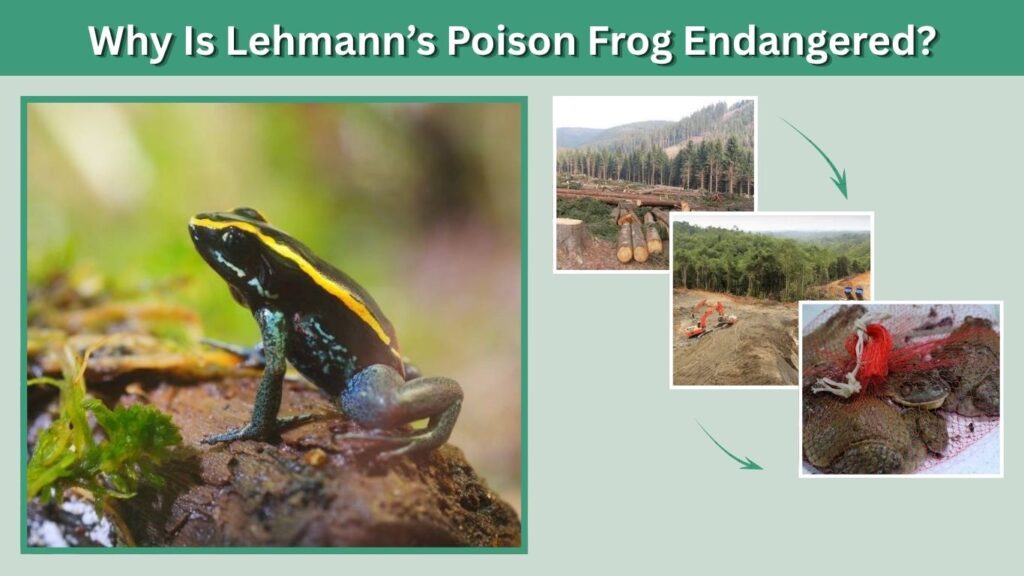
Lehmann’s poison frog is listed as Critically Endangered. Its known habitat covers a very small and fragmented area, making the entire species vulnerable to changes within a limited number of forests.
Major threats include:
- Illegal collection for the exotic-pet trade
- Clearing forests for agriculture
- Logging and vegetation removal
- Habitat fragmentation
- Pesticide contamination
- Declining forest quality
- Amphibian disease
- Climate-related changes in rainfall and humidity
Its known distribution has been estimated at less than 10 square kilometers, with remaining habitat continuing to decline. Some populations occur within or near Farallones de Cali National Natural Park, but protection and community monitoring remain essential.
Can Lehmann’s Poison Frogs Be Kept as Pets?
Lehmann’s poison frogs occasionally appear in specialized captive-breeding programs, but they are not suitable for beginners. They require a carefully maintained tropical vivarium, tiny live food, high humidity, good ventilation, bromeliads, and stable temperatures.
The species is included in CITES Appendix II, meaning international trade is regulated. Buyers should never purchase wild-caught frogs or animals without clear captive-breeding and legal documentation. Illegal demand is one of the reasons the species remains threatened.
FAQs
What is the scientific name of Lehmann’s poison frog?
Its scientific name is Oophaga lehmanni. It was formerly classified as Dendrobates lehmanni and is also commonly called the red-banded poison frog.
Where does Lehmann’s poison frog live?
It lives in a small area of humid rainforest on the western slopes of Colombia’s Cordillera Occidental, especially around the upper Anchicayá River drainage in Valle del Cauca.
What does Lehmann’s poison frog eat?
Adults eat ants, mites, springtails, termites, tiny beetles, and other small invertebrates. Tadpoles receive unfertilized eggs supplied by their mother.
Is Lehmann’s poison frog poisonous?
Wild individuals possess defensive skin alkaloids obtained through their diet. Captive-bred frogs fed ordinary cultured insects generally lose most or all of this toxicity.
Is Lehmann’s poison frog terrestrial or arboreal?
It is mainly terrestrial and frequently uses forest-floor leaf litter. However, it can climb low vegetation, trees, and bromeliads during calling, courtship, and parental care.
