
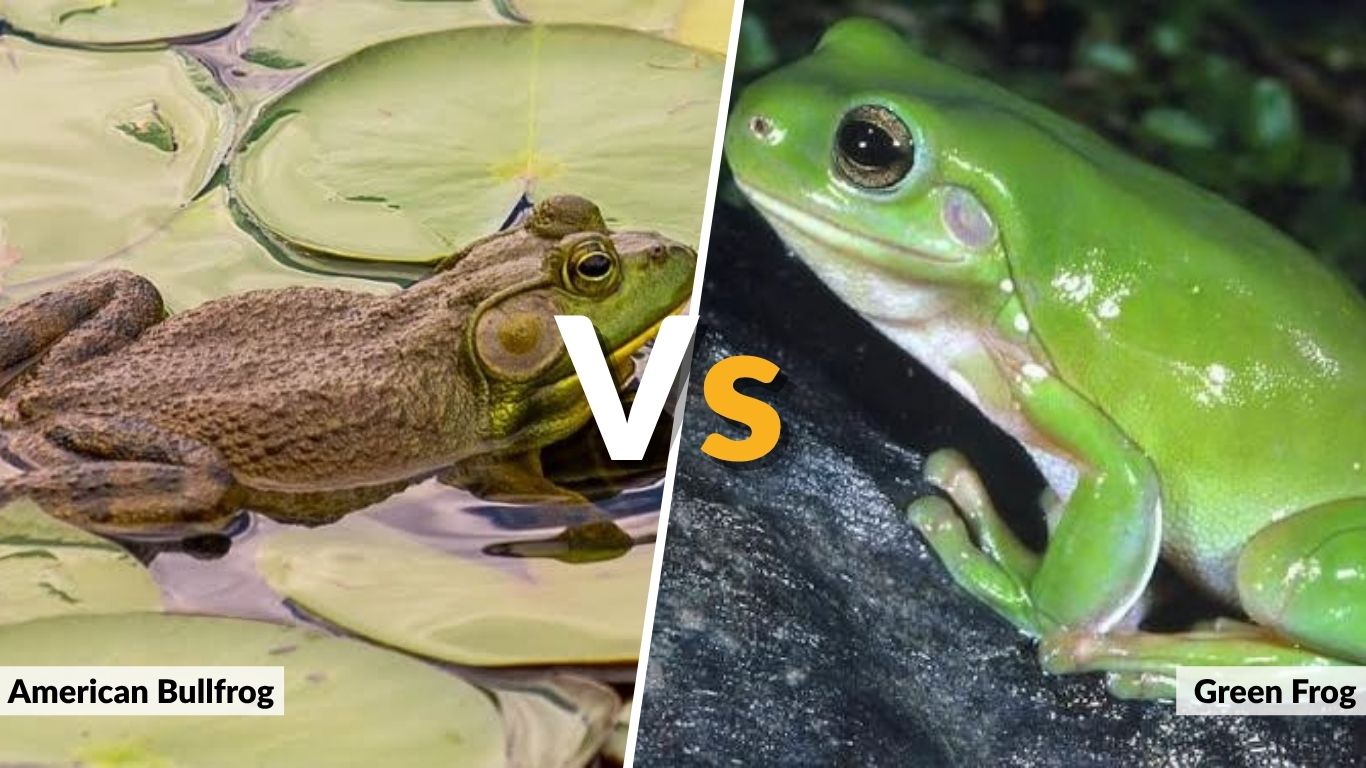
American bullfrogs and green frogs are closely related freshwater species that often occupy the same ponds, lakes, marshes, and slow-moving waterways. Their green or brown coloring can make them difficult to distinguish, especially when only the head is visible above water. However, differences in body size, skin ridges, calls, diet, and behavior make reliable identification possible. The easiest clue is the back: green frogs usually have two raised dorsolateral ridges, while American bullfrogs lack these long ridges.
American Bullfrog vs Green Frog Comparison
The American bullfrog, Lithobates catesbeianus, is North America’s largest true frog. The green frog, Lithobates clamitans, is smaller but has a similar body shape and coloration. Both belong to the family Ranidae and possess powerful hind legs, webbed feet, visible external eardrums, and smooth or slightly textured skin.
| Feature | American Bullfrog | Green Frog |
| Scientific name | Lithobates catesbeianus | Lithobates clamitans |
| Typical adult size | About 3.5–8 inches | About 2.4–3.5 inches |
| Dorsolateral ridges | Absent | Usually present |
| Call | Deep “jug-o-rum” | Short “gunk” or banjo-string note |
| Body build | Large, broad, and heavy | Smaller and more streamlined |
| Preferred habitat | Larger, warm, permanent waters | Pond edges, streams, and wetlands |
| Diet | Insects and many small vertebrates | Mainly insects and other small animals |
| Tadpole size | Very large | Smaller and more slender |
How to Identify an American Bullfrog
American bullfrogs are strongly associated with permanent freshwater habitats. Their large size is helpful for identification, but young bullfrogs may be similar in size to adult green frogs. For that reason, body markings are often more dependable than size alone.
Identification Features
Look for the following characteristics:
- No long dorsolateral ridges running down the back
- A ridge of skin curving around the tympanum
- A broad, rounded head and robust body
- Green, olive, brown, or mottled coloration
- Fully webbed hind feet
- A white, gray, or yellowish underside
- A yellow throat in breeding males
- A deep, circular tympanum behind each eye
Male bullfrogs normally have a tympanum noticeably larger than the eye. In females, the tympanum is approximately the same size as—or sometimes smaller than—the eye. Adult males may also develop a bright yellow throat during the breeding season.
How to Identify a Green Frog
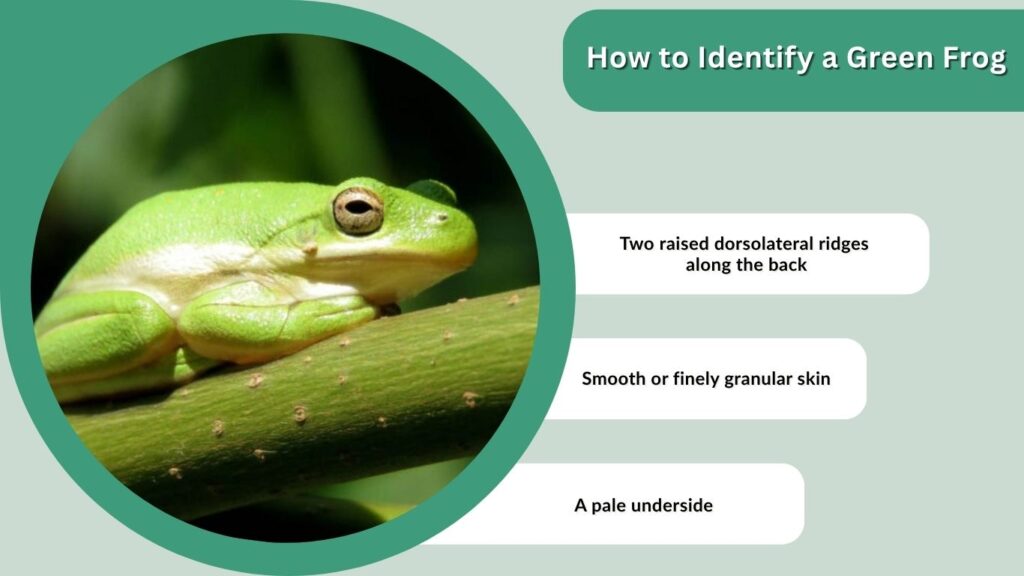
Green frogs are not always green. Depending on the individual, location, temperature, and subspecies, they may appear olive, brown, bronze, bluish, or mottled. This variability means color by itself is not a reliable identification method.
Identification Features
A green frog typically has:
- Two raised dorsolateral ridges along the back
- A relatively pointed or narrow snout
- Smooth or finely granular skin
- Green, brown, bronze, or olive coloring
- Dark bands or mottling on the hind legs
- A pale underside
- A visible round tympanum behind each eye
- A green or yellowish upper lip
The dorsolateral folds are the most useful clue. They begin behind the eyes and continue along the sides of the back, although they generally do not extend fully to the groin. American bullfrogs do not have these long back ridges.
Eight Differences Between Green Frogs and Bullfrogs
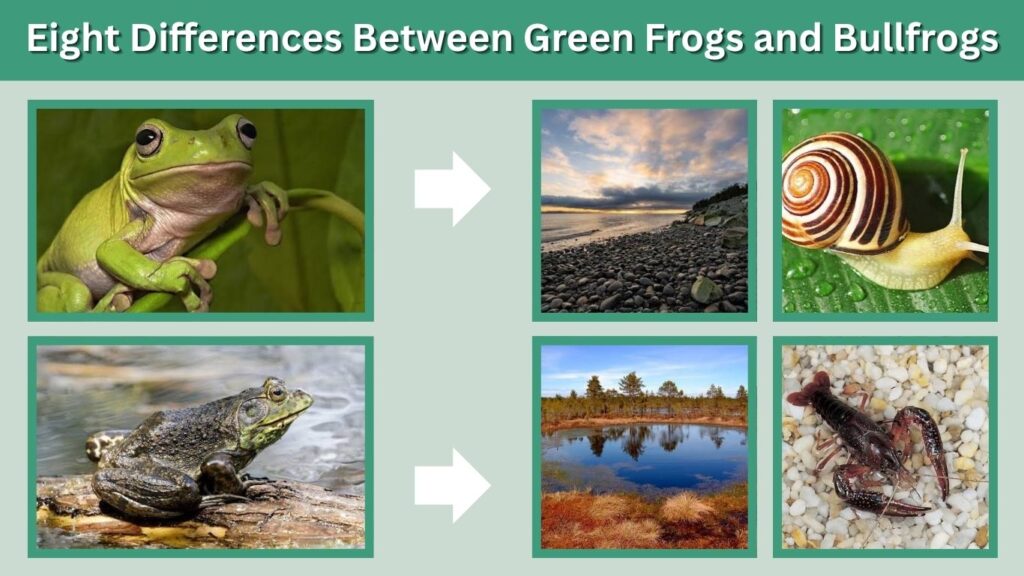
Both species can be identified without capturing or handling them. Pay attention to their back, size, voice, surroundings, and behavior.
1. Dorsolateral Ridges
The quickest way to distinguish the two frogs is to examine the back.
Green frogs possess two visible ridges extending backward from behind the eyes. Bullfrogs lack these ridges. Instead, the bullfrog has a skin fold that curves around the tympanum before ending near the shoulder.
This feature remains useful even when a young bullfrog and an adult green frog are similar in size.
2. Adult Size
American bullfrogs are significantly larger. Adults commonly measure approximately 3.5–8 inches from the snout to the end of the body. Their powerful legs can make the complete frog look even larger.
Green frogs usually measure approximately 2.4–3.5 inches. Large individuals may be fist-sized, but they rarely match the heavy build of a fully grown bullfrog.
3. Body Shape
A bullfrog generally has a wide head, rounded snout, heavy shoulders, and thick body. Its large mouth allows it to capture relatively substantial prey.
A green frog has a slimmer body and a somewhat more pointed facial profile. Its raised back folds also make the body appear more structured when viewed from above.
4. Calls
The male bullfrog produces a resonant, low-pitched call often written as “jug-o-rum” or “rrr-uum.” The call is powerful and may travel over a considerable distance across a large pond or lake.
A green frog’s call is shorter and sharper. It is frequently compared to the sound of plucking a loose banjo string and may be described as “gunk,” “boink,” or “plunk.” Green frogs may call during both the day and night.
5. Habitat
Bullfrogs favor permanent freshwater environments such as large ponds, lakes, marshes, bogs, reservoirs, and slow rivers. Warm, still, shallow water with abundant aquatic vegetation can be especially suitable.
Green frogs also occupy ponds and lakes, but they are commonly found along shallow shorelines, ditches, swamps, springs, and slow-moving streams. They frequently sit at the water’s edge and jump into deeper water when disturbed.
6. Diet
Both species are opportunistic predators, but the larger bullfrog can capture a much broader range of animals.
Bullfrogs eat insects, spiders, worms, crayfish, fish, tadpoles, salamanders, snakes, and other frogs. They are cannibalistic and may consume smaller members of their own species. Large bullfrogs are also known to prey on green frogs.
Green frogs mainly eat insects, moths, spiders, snails, worms, small fish, and other animals that fit inside their mouths. They may consume small amphibians or reptiles, but they usually take smaller prey than bullfrogs.
7. Tadpoles
Bullfrog tadpoles are large, greenish, and commonly covered with small dark spots. They can reach approximately 4.75 inches long and may remain in the larval stage for one to three years before transforming, depending on environmental conditions.
Green frog tadpoles are generally more slender. They have dark green or brownish tails with spots, pale undersides, and dark green backs. Both species primarily graze on algae and other small organic material during the tadpole stage.
8. Ecological Impact
Green frogs are native members of freshwater communities across much of eastern North America. They serve as both predators and prey, consuming small animals while supporting snakes, birds, fish, turtles, mammals, and larger frogs.
American bullfrogs are also native to eastern and central portions of North America. However, people have introduced them to many western regions and other continents. In places outside their natural range, their large size, broad diet, and reproductive success can place pressure on native amphibians and other small wildlife.
Can an American Bullfrog Eat a Green Frog?
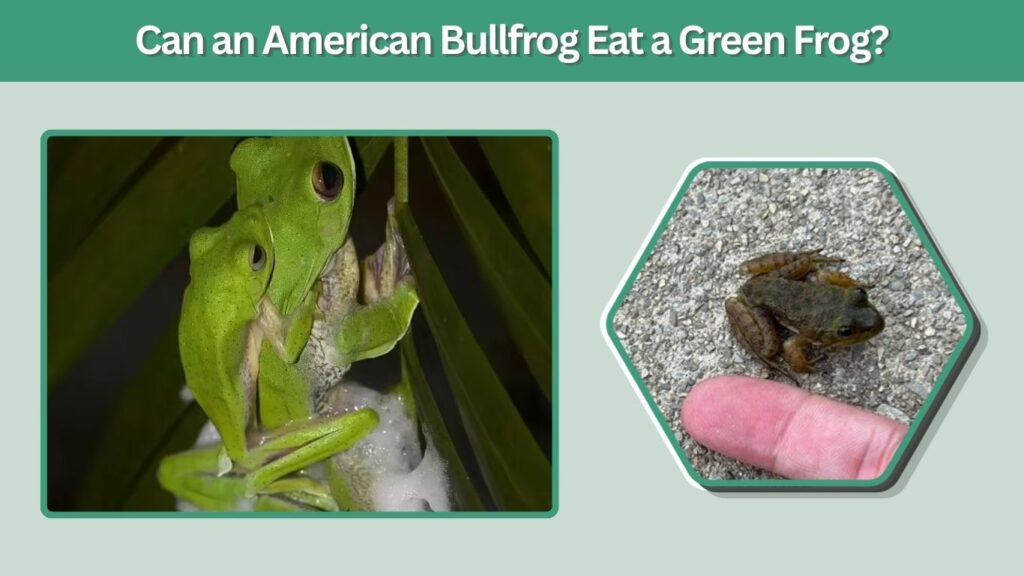
Yes. A sufficiently large American bullfrog can capture and eat a green frog. Bullfrogs are ambush predators that wait for suitable prey to approach before lunging forward and grabbing it with their mouths.
Their diet is primarily limited by what they can catch and swallow. Green frogs may consequently avoid the best shoreline habitats when bullfrogs are present, choosing less favorable areas to reduce encounters with the larger predator.
Are Green Frogs Baby Bullfrogs?
Green frogs are not young bullfrogs. They are a separate species with their own adults, eggs, tadpoles, breeding calls, and physical characteristics.
A small bullfrog may resemble a green frog, but its back still lacks the long dorsolateral ridges associated with green frogs. Checking for these ridges is more reliable than assuming that every small, green-colored frog is a juvenile bullfrog.
Which Frog Is in Your Pond?
Use this quick identification process:
- Look for two ridges running down the back. Their presence suggests a green frog.
- Check the adult’s size. A very large, heavy frog is more likely a bullfrog.
- Listen to the call. “Jug-o-rum” indicates a bullfrog; a banjo-like “gunk” indicates a green frog.
- Examine the ridge around the ear. A ridge wrapping around the tympanum without continuing down the back indicates a bullfrog.
- Avoid relying on color because either species may be green, brown, olive, or mottled.
FAQs
What Is the Easiest Way to Tell a Bullfrog From a Green Frog?
Examine the back. Green frogs usually have two raised dorsolateral ridges running behind their eyes and along their backs. Bullfrogs lack these long folds and instead have a curved ridge surrounding each tympanum.
Is a Green Frog Smaller Than an American Bullfrog?
Yes. Adult green frogs usually measure around 2.4–3.5 inches, while bullfrogs may reach approximately 8 inches. However, young bullfrogs can overlap in size with adult green frogs, making the back ridges more dependable.
Do Bullfrogs and Green Frogs Live Together?
They can occupy the same ponds, lakes, and wetlands. However, bullfrogs may compete with green frogs and sometimes eat them. Green frogs may remain in shallower or otherwise less-preferred areas when large bullfrogs are present.
Do Green Frogs and Bullfrogs Sound the Same?
No. Bullfrogs produce a deep, resonant “jug-o-rum.” Green frogs make a short metallic note commonly compared to a loose banjo string. Hearing the call is often enough to identify a hidden frog.
Are American Bullfrogs Dangerous?
American bullfrogs are not dangerous to people under ordinary circumstances. They may struggle, scratch, or attempt to escape when handled. Their greater ecological concern is their effect on native animals in places where they have been introduced.
