
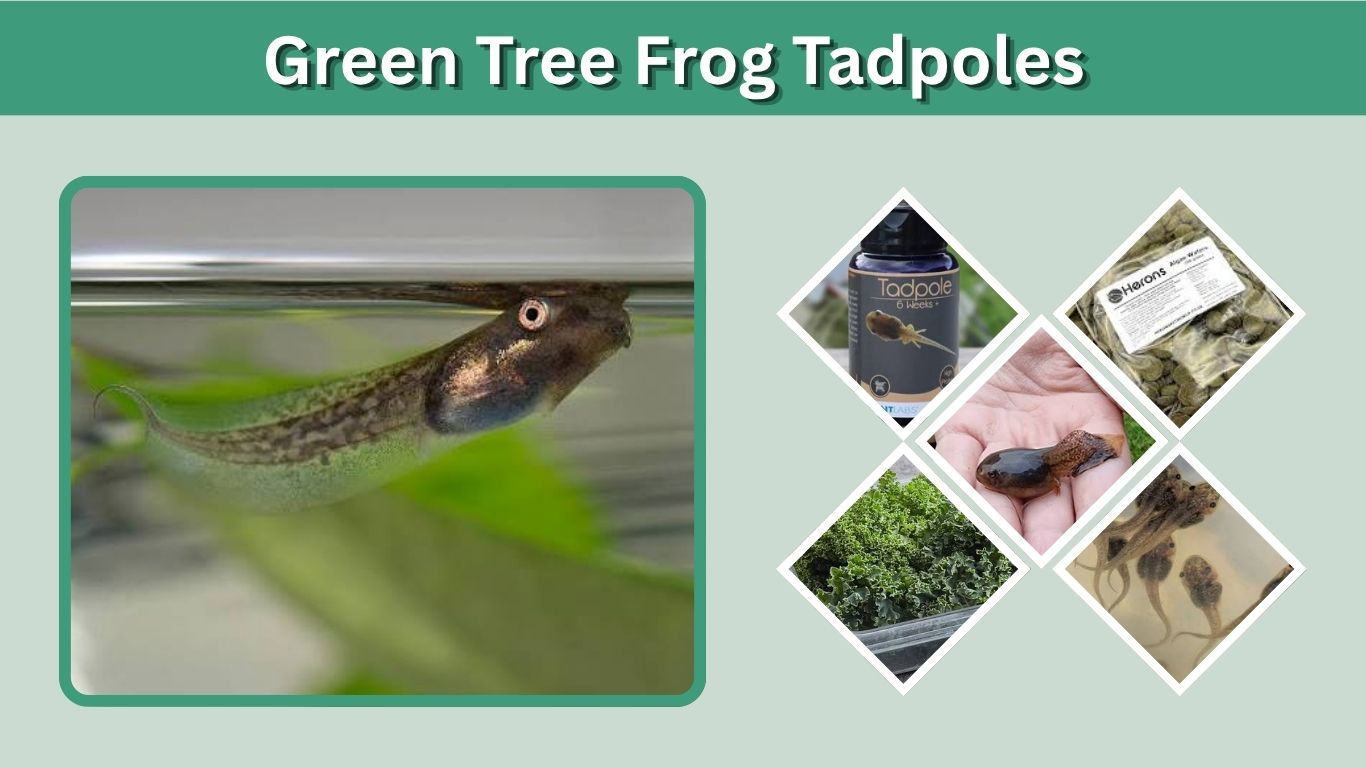
Green tree frog tadpoles are the aquatic young of tree frogs commonly found around ponds, wetlands, marshes, and temporary pools. They begin life as eggs, hatch into swimming larvae, and gradually develop legs before becoming tiny froglets. However, “green tree frog” may refer to the American green tree frog or the much larger Australian green tree frog. Their tadpoles differ slightly in appearance, size, development, and legal keeping requirements.
What Are Green Tree Frog Tadpoles?
Green tree frogs reproduce by laying eggs in freshwater. After hatching, the young remain entirely aquatic and breathe mainly through gills. They initially survive on stored yolk before beginning to graze on algae and microscopic plant material.
The term commonly describes two different species:
| Common name | Scientific name | Native range |
| American green tree frog | Hyla cinerea | Southeastern United States |
| Australian green tree frog | Ranoidea caerulea | Australia and southern New Guinea |
The Australian species is also called White’s tree frog. Adults can grow considerably larger than American green tree frogs, so correctly identifying the species is important when planning long-term care. The Australian Museum reports that adult Australian green tree frogs can reach approximately 11 centimeters in body length.
What Do Green Tree Frog Tadpoles Look Like?
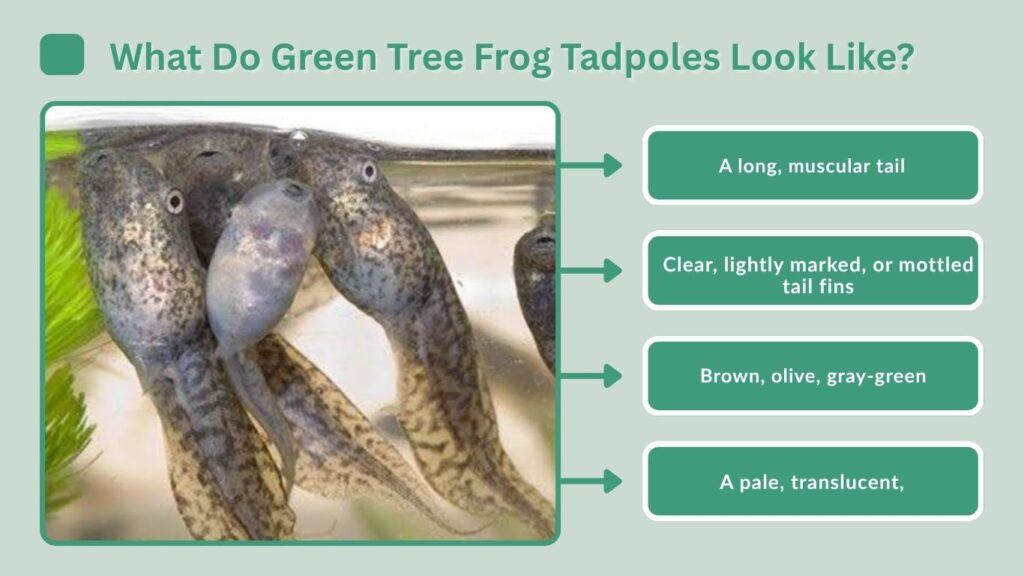
Tadpoles change significantly as they grow. Newly hatched individuals may be extremely small and difficult to identify, while older tadpoles develop more noticeable body shape, coloration, and tail markings.
Identification Features
Green tree frog tadpoles commonly have:
- A rounded or slightly oval body
- A long, muscular tail
- Clear, lightly marked, or mottled tail fins
- Brown, olive, gray-green, or dark green coloration
- Eyes positioned toward the sides of the head
- A pale, translucent, or lightly marked underside
- A tail that is often considerably longer than the body
- Developing hind legs followed by front legs
American green tree frog tadpoles can vary from olive or brown to greenish shades. Australian green tree frog tadpoles are generally described as dark green or gray-green and can become quite large before metamorphosis.
Color alone is not enough for reliable identification. Water clarity, age, lighting, diet, and surrounding vegetation can all influence how a tadpole appears.
Green Tree Frog Tadpole Life Cycle
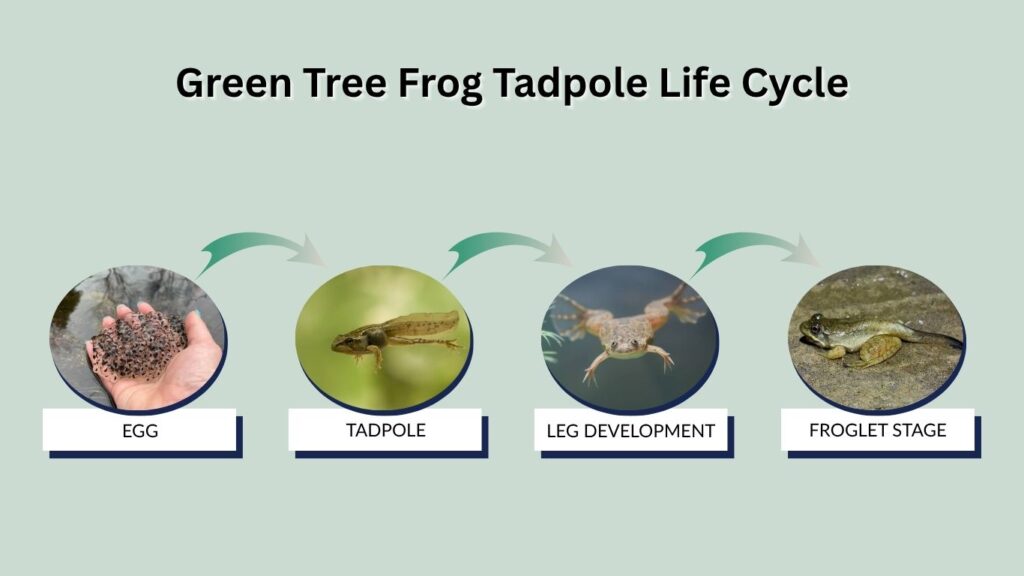
The life cycle includes the egg, tadpole, developing tadpole, froglet, and adult stages. The exact schedule depends on the species, water temperature, food supply, crowding, and environmental conditions.
Eggs and Hatching
American green tree frog eggs generally hatch within several days. One documented average is approximately five days after fertilization, although hatching may occur between four and 14 days under different conditions. Newly hatched tadpoles initially depend on their remaining yolk reserves.
Free-Swimming Tadpole
After several days, the tadpoles begin swimming actively and grazing on microscopic vegetation. Their external gills gradually disappear as an operculum forms over the gill area.
American green tree frog tadpoles rely mainly on internal gills by approximately three weeks after hatching. At this stage, they spend much of their time feeding, swimming, and resting on submerged surfaces.
Leg Development
Hind legs normally appear first. The front legs emerge later, and the tail begins shrinking as nutrients stored in it are absorbed into the developing body.
For American green tree frogs, leg development may begin around eight to ten weeks after hatching. Development can happen faster or slower depending on environmental conditions.
Froglet Stage
Once all four legs appear, the young frog needs easy access to land. Its tail gradually disappears, and its diet changes from mostly aquatic foods to small live insects.
Never forcefully remove a shrinking tail. It is naturally absorbed and provides energy during the transition from tadpole to froglet.
What Do Green Tree Frog Tadpoles Eat?
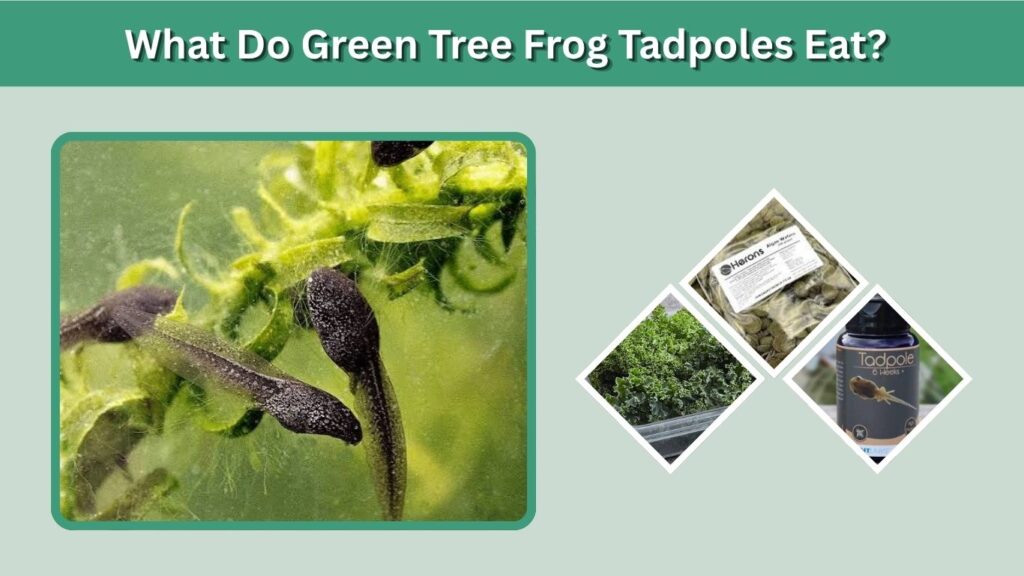
Young green tree frog tadpoles primarily graze on algae, biofilm, decomposing plant material, and microscopic organisms. Their diet may become more varied as they mature.
Suitable captive foods include:
- Commercial tadpole pellets
- Spirulina-based algae wafers
- Softened leafy greens
- Small amounts of boiled romaine lettuce
- Naturally growing algae and biofilm
- Specialized aquatic amphibian food
American green tree frog tadpoles begin grazing on microscopic vegetation shortly after their external gills become functional. During later development, especially when the legs appear, their diet can become more protein-oriented.
Feed only a small amount at one time. Remove uneaten food before it decomposes because excess food can quickly foul the water and increase harmful ammonia levels. Food should be soft enough for tadpoles to scrape or nibble easily.
How to Raise Green Tree Frog Tadpoles
Raising tadpoles successfully requires clean water, suitable food, adequate space, and a safe transition area for emerging froglets.
Prepare a Suitable Container
Use a clean aquarium, food-safe plastic tub, or outdoor pond that has not been exposed to soap, pesticide, bleach, or other chemicals. A wider container provides more surface area for oxygen exchange.
Add aquatic plants, smooth rocks, or pieces of untreated wood to create resting and grazing surfaces. Avoid sharp decorations that could damage delicate skin or tails.
Do not overcrowd the container. Crowding causes waste to accumulate faster and can interfere with normal growth.
Use Safe Water
Use rainwater from a clean collection system, conditioned aquarium water, or properly dechlorinated tap water. Even low chlorine levels can harm tadpoles, so untreated municipal water should not be added directly.
Maintain a stable water temperature and keep the container away from direct sunlight. A small container can heat rapidly and become dangerously warm.
A gentle sponge filter can provide biological filtration and oxygenation without producing a strong current. Tadpoles are not powerful swimmers and may struggle against forceful filtration.
Maintain Water Quality
Remove waste and spoiled food regularly. Perform partial water changes instead of replacing all the water at once. Sudden changes in temperature, mineral content, or water chemistry can stress tadpoles.
When adding new water, make sure it is dechlorinated and approximately the same temperature as the existing water. Never clean the container with household detergents while tadpoles are present.
Feed Small Portions
Offer a small meal once or twice daily, adjusting the amount according to the number and size of the tadpoles. The food should mostly disappear within a reasonable period rather than remaining on the bottom.
Boiled lettuce may be used as part of the diet, but it should not be the only food. A varied, species-appropriate tadpole diet generally provides better nutritional coverage.
Prepare for Metamorphosis
When front legs appear, reduce the risk of drowning by providing:
- A sloping rock or floating platform
- Shallow areas near the container’s edge
- Branches extending above the water
- A secure cover with ventilation
- Easy access to a humid land area
A newly transformed froglet may stop eating temporarily while absorbing its tail. Once the tail is mostly gone, offer tiny live foods such as flightless fruit flies, springtails, pinhead crickets, or other appropriately sized insects.
Green Tree Frog vs. Cane Toad Tadpoles
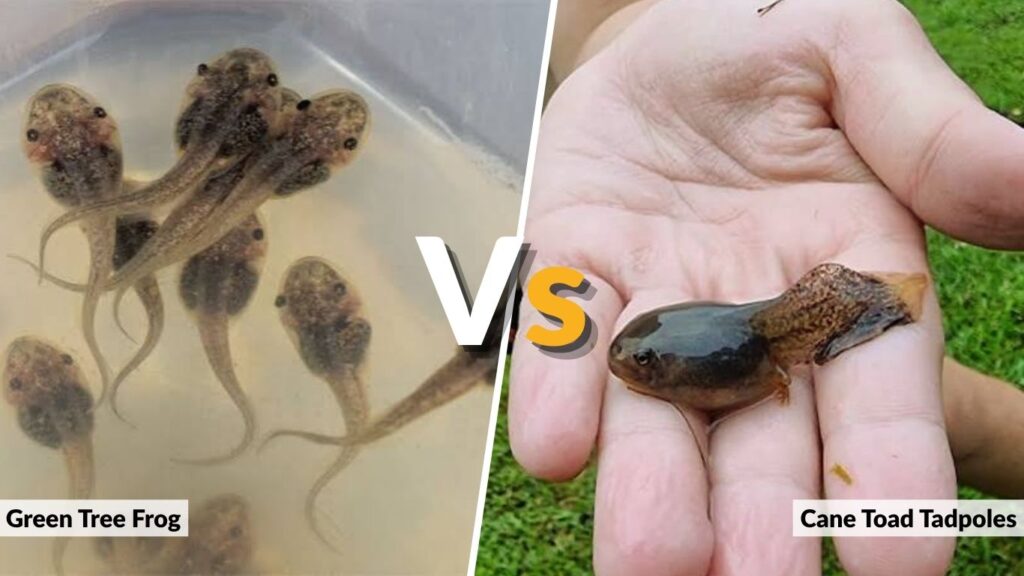
Distinguishing native Australian frog tadpoles from invasive cane toad tadpoles is important. Never destroy an unidentified tadpole based only on its dark color.
| Feature | Green tree frog tadpole | Cane toad tadpole |
| Body color | Green-gray, brown, olive, dark or mottled | Usually uniformly black |
| Underside | Often pale or translucent | Usually dark |
| Tail | Long, often around twice the body length | Shorter, generally no more than 1.5 times body length |
| Behavior | Often dispersed or in loose groups | Commonly forms dense shoals |
| Size | Can become relatively large | Usually small |
| Surface activity | May regularly rise for air | Large groups may remain below the surface |
Official Queensland guidance describes cane toad tadpoles as uniformly black, with dark tail muscles and clear fins. They often gather in tightly packed groups in shallow water. Native frog tadpoles are more variable in color and commonly have proportionally longer tails.
Ask a local wildlife authority or frog identification group to confirm the species when uncertain.
Can You Buy Green Tree Frog Tadpoles?
Green tree frog tadpoles may be available from licensed amphibian breeders in some locations. Choose captive-bred tadpoles rather than removing animals from natural ponds.
Laws differ widely by country, state, and territory. In New South Wales, for example, native frogs can generally only be obtained from appropriately licensed keepers, and commercial pet shops cannot freely trade native frogs or tadpoles.
Never release purchased, captive-bred, or unidentified tadpoles into the wild. Moving tadpoles between water bodies can spread diseases and introduce animals outside their natural range. Wild tadpoles temporarily raised under an approved program should generally be returned only to their original collection location.
FAQs
How big are green tree frog tadpoles?
Size depends on the species and developmental stage. Newly hatched tadpoles are tiny, while mature Australian green tree frog tadpoles can become relatively large. Measuring the total length from the nose to the end of the tail is more useful than measuring the body alone.
How long does it take a tadpole to become a green tree frog?
American green tree frog tadpoles may begin developing legs around eight to ten weeks after hatching. Complete metamorphosis can take longer, depending on temperature, food, water quality, genetics, and crowding. Australian green tree frog development also varies considerably with environmental conditions.
Can green tree frog tadpoles eat fish food?
Small amounts of suitable fish food may be accepted, but ordinary fish flakes should not be their only diet. Commercial tadpole food, algae wafers, natural biofilm, and softened plant foods provide a more appropriate foundation. Avoid high-protein overfeeding during the early herbivorous stages.
Do green tree frog tadpoles need a filter?
A filter is not always essential when the container is lightly stocked and maintained carefully. However, a gentle sponge filter helps control waste and improves oxygenation. Avoid powerful filters that create strong currents or have uncovered intakes capable of trapping small tadpoles.
When should green tree frog tadpoles leave the water?
They need access to land as soon as the front legs emerge and the tail starts shrinking. Provide a sloped surface rather than placing them directly into a dry enclosure. Froglets still require high humidity but must be able to leave the water easily.
