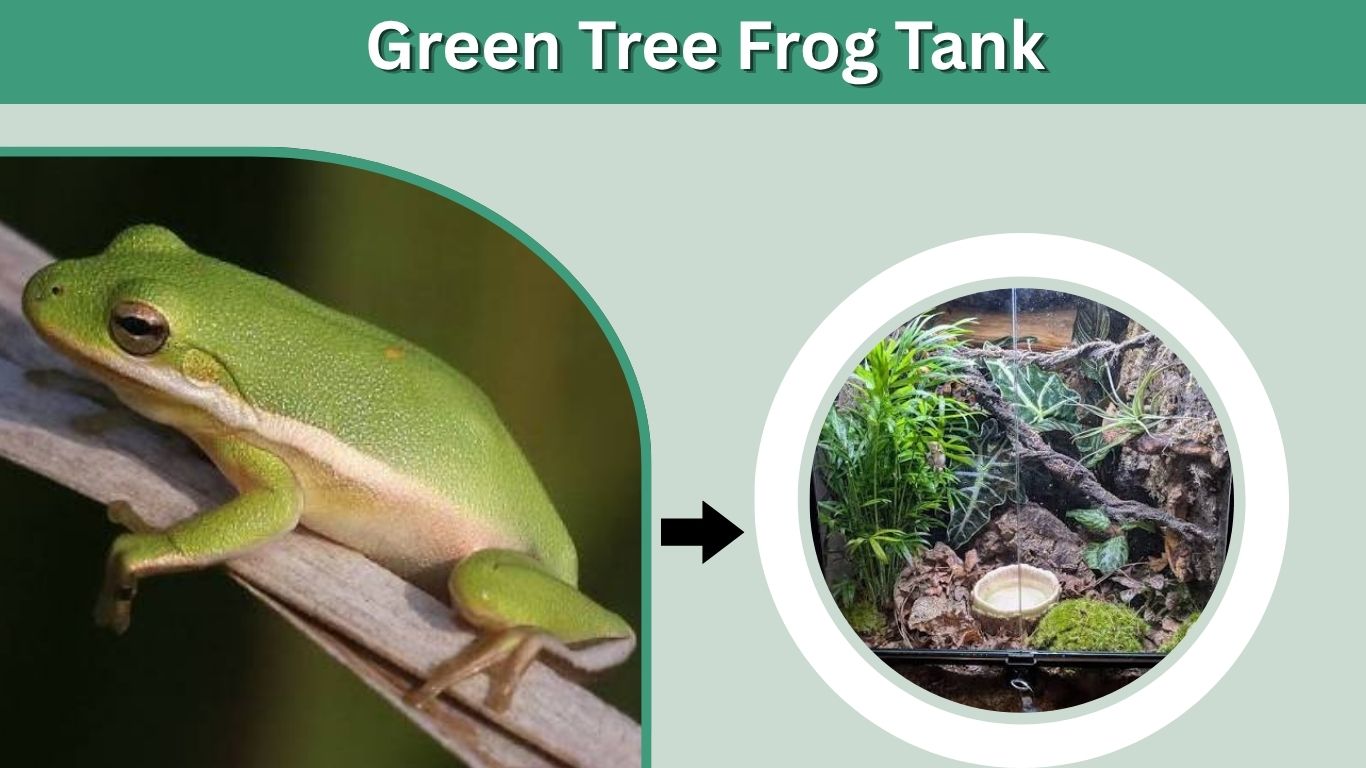
A green tree frog tank should be tall, secure, well-ventilated, and filled with branches and foliage. Because these frogs spend most of their time above the ground, vertical climbing space matters more than floor area. However, “green tree frog” may refer to the smaller American green tree frog or the larger Australian green tree frog. Identifying the species before building the enclosure is essential because their tank size, temperature, humidity, and feeding requirements differ.
Choosing the Correct Green Tree Frog Tank
Glass front-opening terrariums are usually the most convenient choice. They retain moisture better than fully screened cages while still allowing ventilation through a mesh top or built-in vents.
A front-opening enclosure also makes feeding and cleaning easier. Reaching into a tank from above can frighten a tree frog because predators commonly approach wild frogs from that direction.
Recommended Tank Sizes
| Frog species | Recommended minimum for one adult | Better long-term size |
| American green tree frog | 12 × 12 × 18 inches | 18 × 18 × 24 inches |
| Australian green tree frog | 18 × 18 × 24 inches | 24 × 18 × 24 inches or larger |
| Two compatible adults | Add substantial usable space | Choose the next enclosure size up |
Older care sheets sometimes suggest a 10-gallon tank for an American green tree frog. Although it may temporarily accommodate a juvenile, a standard horizontal 10-gallon aquarium provides limited climbing space. A taller enclosure offers better enrichment and makes it easier to create temperature and humidity gradients.
White’s tree frogs, also known as Australian green tree frogs, are larger and heavier. Their enclosure needs stronger branches, broader resting ledges, and more space than an American green tree frog tank. General amphibian guidance recommends at least a 20-gallon enclosure for White’s tree frogs, with vertical space being particularly important.
What to Put in a Green Tree Frog Tank
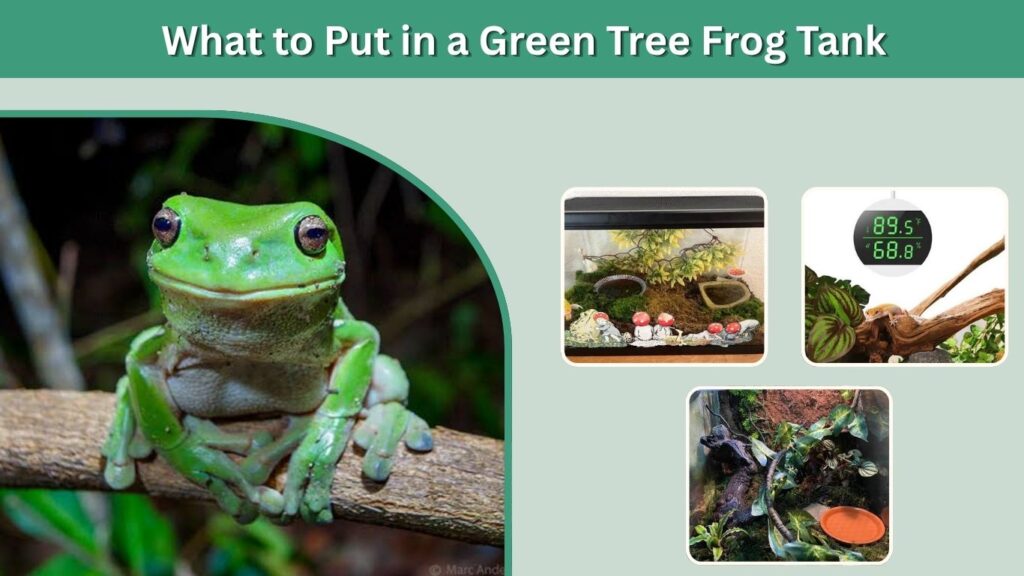
A successful setup should give the frog several places to climb, hide, sleep, drink, and hunt. Avoid leaving the enclosure mostly empty, even when the tank meets the minimum dimensions.
Essential Tank Supplies
- Secure glass or PVC terrarium
- Ventilated, escape-proof lid
- Digital thermometer
- Digital hygrometer
- Low-output UVB or daylight fixture
- Thermostat-controlled heat source when required
- Horizontal and diagonal branches
- Cork bark, vines, and elevated ledges
- Live or amphibian-safe artificial plants
- Moisture-retaining substrate
- Shallow water dish
- Dechlorinated water
- Feeding and cleaning tools
Place branches at different heights and angles. At least one broad perch should be located in a warm upper section, while shaded resting areas should remain available elsewhere.
Covering part of the back and sides can help the frog feel secure. It also reduces repeated jumping or nose rubbing against transparent glass.
How to Set Up a Green Tree Frog Tank
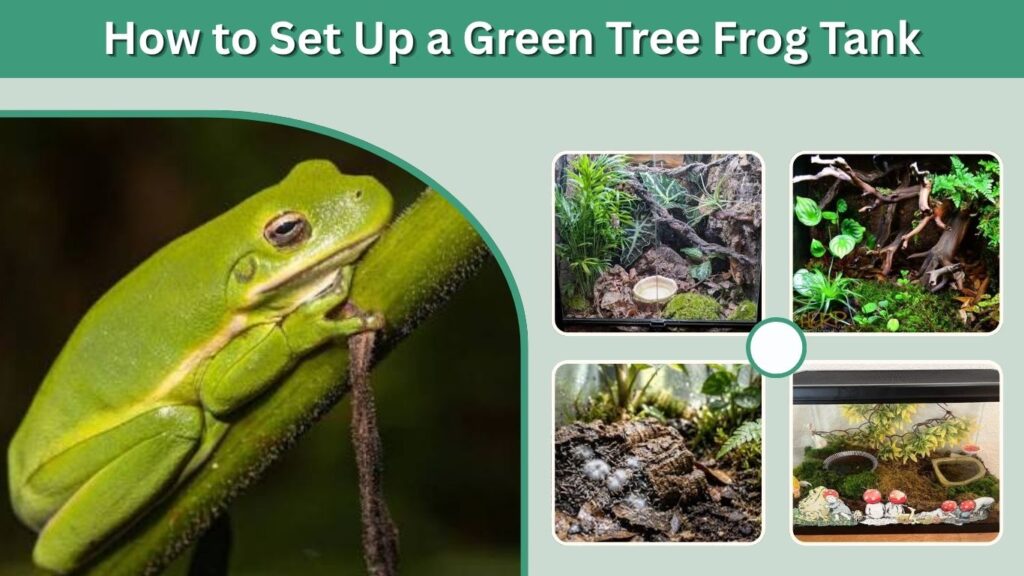
The enclosure should be completely assembled and tested before the frog arrives. Run the heating, lighting, and misting equipment for several days so you can correct unstable conditions.
1. Create a Drainage and Substrate Layer
For a simple enclosure, use damp coconut fiber, an amphibian-safe soil mixture, or moist paper towels during quarantine. Paper towels are easy to replace and make droppings, appetite, and possible health problems easier to monitor.
A planted or bioactive tank may include:
- Drainage material
- A barrier mesh
- Amphibian-safe soil
- Leaf litter
- Live plants
- Springtails and suitable cleanup organisms
Avoid loose gravel, small stones, wood chips, and sharp bark pieces. Frogs can accidentally swallow loose materials while striking at insects.
The substrate should remain slightly moist but not waterlogged. Constantly saturated soil and poor airflow encourage mold, bacteria, and unhealthy enclosure conditions.
2. Add Branches and Hiding Places
Tree frogs need climbing surfaces throughout the enclosure rather than a single branch near the bottom. Use sanitized hardwood, cork bark, bamboo, artificial vines, or commercially prepared terrarium branches.
Secure every decoration firmly. Australian green tree frogs are relatively heavy and may dislodge weak plants or unstable branches.
Dense foliage should cover portions of the upper and middle tank. Frogs commonly sleep on leaves, branches, glass, or inside cork tubes during daylight hours.
3. Choose Safe Tank Plants
Suitable live plants may include:
- Pothos
- Philodendron
- Bromeliads
- Spider plants
- Peperomia
- Dwarf umbrella plants
- Bird’s-nest ferns
Wash plants thoroughly and remove fertilizer-treated soil before introducing them. Avoid plants treated with systemic pesticides, leaf-polishing chemicals, or insecticides.
Pothos is particularly useful because it grows quickly, tolerates humid conditions, and produces broad leaves capable of supporting smaller tree frogs.
Green Tree Frog Tank Temperature and Humidity
Temperature and humidity must be adjusted for the exact species. Conditions suitable for an American green tree frog may not be ideal for an Australian green tree frog.
| Tank condition | American green tree frog | Australian green tree frog |
| Daytime temperature | 73–80°F | Approximately 68–77°F |
| Night temperature | 65–70°F | Slight nighttime reduction |
| Daytime humidity | Around 50–60% | Around 50–70% |
| Temporary nighttime humidity | Around 75–80% | May rise after misting |
| Ventilation | Moderate to good | Good |
American green tree frog guidance recommends approximately 73–80°F during the day and 65–70°F at night. Daytime humidity may remain around 50–60% before increasing at night.
Australian veterinary guidance recommends maintaining roughly 50–70% humidity for many Australian tree frogs. Persistently excessive humidity can raise the risk of bacterial and fungal problems, especially when ventilation is poor. The NSW Department of Education lists approximately 20–25°C as an ideal environmental range for Australian green tree frogs.
Heating the Tank Safely
Heat only part of the enclosure so the frog can move between warmer and cooler areas. Any heat lamp, ceramic heater, or heating panel must be controlled by a thermostat.
Do not place an unregulated heating pad beneath the entire tank. Tree frogs may move downward when attempting to cool themselves, and uncontrolled heaters can overheat or dry the enclosure.
Never position the tank in direct sunlight. Glass terrariums can heat rapidly, even when the room feels comfortable.
Maintaining Humidity
Lightly mist the foliage and enclosure walls with dechlorinated water. Allow some surfaces to dry between misting sessions rather than keeping everything constantly wet.
Use the hygrometer reading to determine when misting is needed. Guessing based on condensation can be misleading because wet glass does not always indicate suitable air humidity.
Lighting Requirements
Provide approximately 10–12 hours of light followed by 10–12 hours of darkness. Tree frogs are usually nocturnal, but they still benefit from a consistent day-and-night cycle.
A low-output UVB lamp can support vitamin D production and calcium metabolism. Position it above the mesh according to the manufacturer’s distance recommendations, and provide shaded areas where the frog can avoid the light. Current green tree frog care guidance commonly recommends a regular daylight period and low-level UVB exposure.
Turn off visible lighting and UVB at night. Colored red or blue nighttime bulbs are unnecessary and may interfere with normal behavior.
Water Dish and Hydration
Every green tree frog tank needs a shallow bowl of fresh, dechlorinated water. The frog should be able to enter and leave without struggling.
Change the water daily because frogs may soak, shed, or defecate in the bowl. Clean the dish thoroughly without leaving soap or disinfectant residue. Humidity-focused care guidance also recommends daily cleaning and refilling of soaking water.
Do not use untreated tap water containing chlorine or chloramine. Amphibians have permeable skin and are highly sensitive to chemical contaminants.
Green Tree Frog Tank Mates
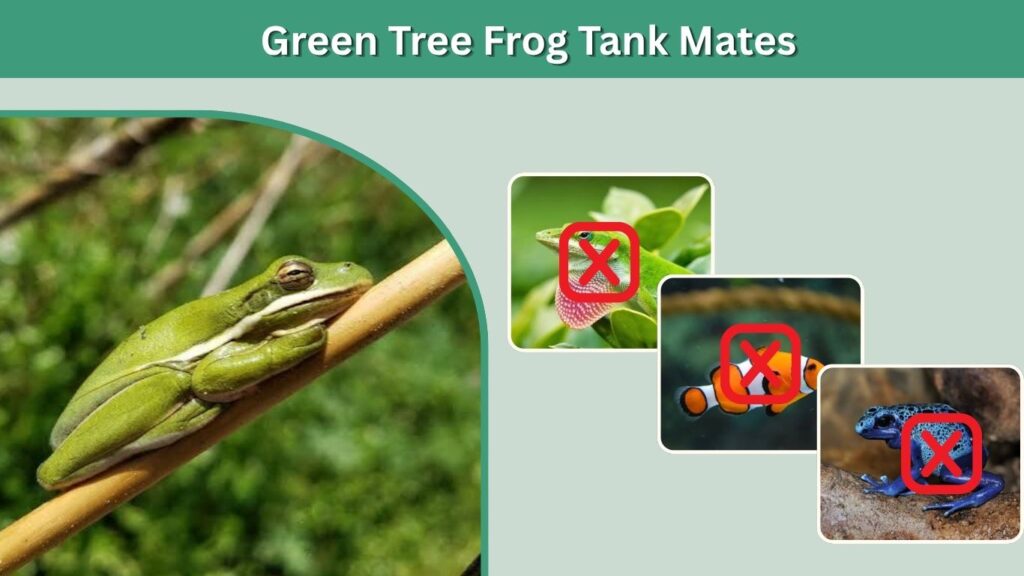
The safest choice is a species-only enclosure. Do not mix American and Australian green tree frogs, even though they share similar common names.
Avoid housing green tree frogs with:
- Anoles or other lizards
- Fish
- Toads
- Dart frogs
- Red-eyed tree frogs
- Smaller frog species
- Large predatory invertebrates
Different species may require incompatible temperatures, humidity, diets, and lighting. Mixing animals also increases competition, disease transmission, accidental injury, and predation.
Same-species frogs may sometimes live together when they are similar in size and have enough space, feeding stations, and hiding places. Quarantine every new frog separately before introducing it.
How to Clean a Green Tree Frog Tank
Remove droppings, dead insects, shed skin, and spoiled food daily. Replace the water and wash the water dish every day.
Wipe dirty glass and decorations with dechlorinated water. During a deeper cleaning, temporarily move the frog into a ventilated container lined with damp paper towels.
Never use ordinary soap, scented cleaners, glass spray, or household chemicals inside an occupied enclosure. Use an amphibian-safe disinfectant when necessary, following its exact dilution and rinsing instructions.
Bioactive tanks still require maintenance. They reduce some organic waste but do not eliminate the need to clean glass, change water, remove uneaten prey, trim plants, and monitor substrate condition.
FAQs
Is a 10-gallon tank large enough for a green tree frog?
A 10-gallon tank may temporarily house a juvenile American green tree frog, but most standard 10-gallon aquariums are too short for an ideal permanent setup. A tall 18-inch or 24-inch enclosure provides more climbing room and better environmental gradients.
Does a green tree frog tank need a heat lamp?
It depends on the frog species and room temperature. A heat source is unnecessary when the enclosure naturally remains within the correct range. When heating is needed, use a low-wattage, thermostat-controlled source that warms only part of the tank.
Should a green tree frog tank have standing water?
Green tree frogs need a shallow soaking dish, not a deep aquarium or large swimming section. Deep water increases drowning risk and makes maintenance more difficult. The frog must always be able to leave the water easily.
Can I keep a baby green tree frog in an adult tank?
Yes, provided the frog can locate food and water and cannot escape through ventilation gaps. However, a simple smaller quarantine enclosure may make it easier to monitor feeding, droppings, growth, and possible illness.
How often should I mist a green tree frog tank?
Mist according to measured humidity rather than a fixed schedule. Many enclosures need light misting once or twice daily, while naturally humid rooms may require less. Provide airflow and allow some drying between misting sessions to prevent stagnant conditions.
