
Have you ever heard a strange chirping, croaking, or barking noise coming from the trees at night? It might be a tree frog calling. Tree frogs produce a surprising variety of sounds, from gentle trills and high-pitched whistles to loud barks resembling small dogs. Each species has a distinctive call, making sound one of the easiest ways to identify them. But what does a tree frog sound like, and why do they call so loudly? Understanding their vocalizations can help you recognize these fascinating amphibians.
What Does a Tree Frog Sound Like?
A tree frog can sound like a bird, cricket, barking dog, duck, or even a squeaky door. The exact sound depends on the species, its behavior, and environmental conditions.
Most of the familiar calls are produced by males trying to attract females during breeding season. Their vocal sacs inflate and help amplify the sound.
Some tree frogs make short, repeated notes, while others produce continuous trilling calls. These distinctive sounds allow different species to communicate without confusing one another.
What Does a Tree Frog Sound Like at Night?
Tree frogs are particularly vocal at night because many species are nocturnal. Their calls often become louder during warm, humid evenings, especially after rainfall.
Near ponds, forests, and backyard gardens, several frogs may call simultaneously, creating a chorus that can sound surprisingly intense.
Common nighttime tree frog sounds include:
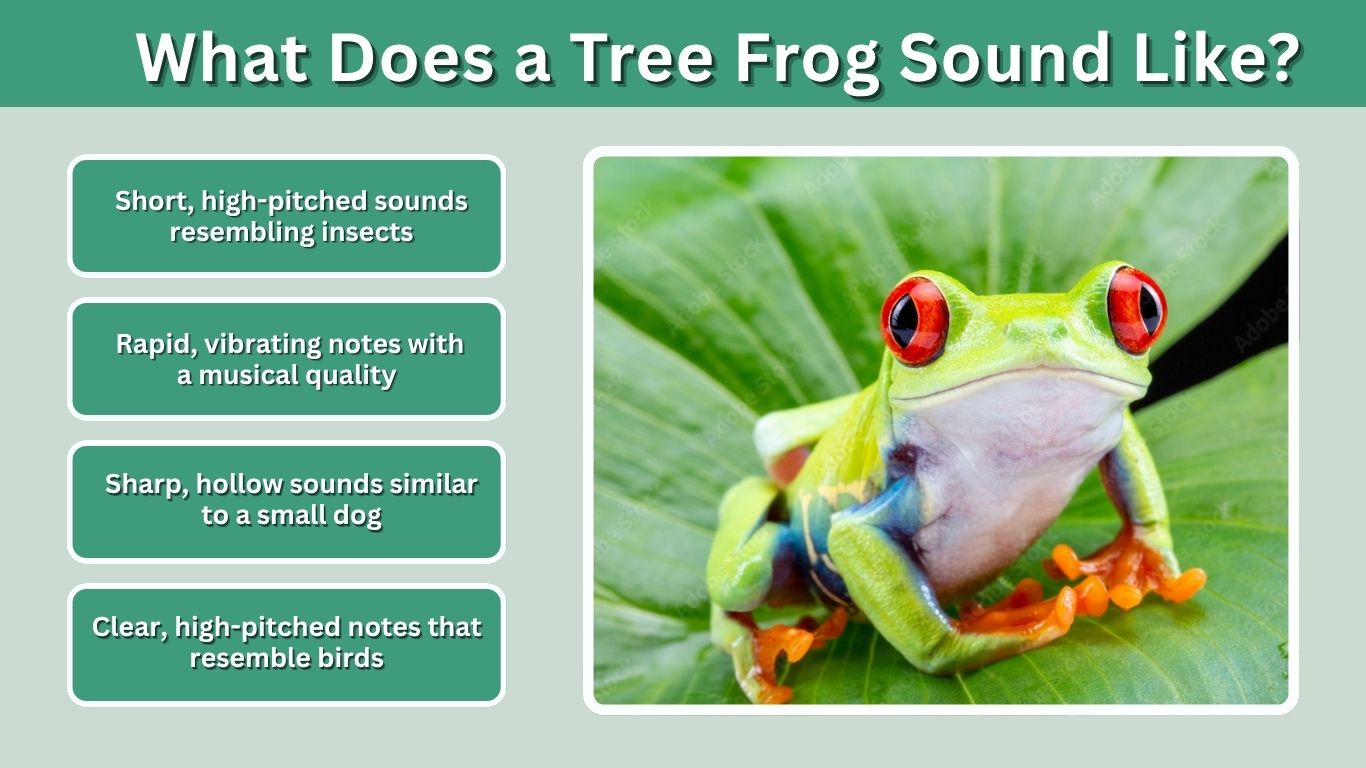
- Chirping: Short, high-pitched sounds resembling insects.
- Croaking: Deep, rough calls repeated several times.
- Trilling: Rapid, vibrating notes with a musical quality.
- Barking: Sharp, hollow sounds similar to a small dog.
- Whistling: Clear, high-pitched notes that resemble birds.
The calling usually becomes more frequent during breeding periods. However, certain species also call outside the main breeding season.
10 Types of Tree Frog Sounds and How to Identify Them
Different tree frog species produce unique vocalizations. Some are easily recognized by their pitch, while others require careful listening to distinguish similar calls.
Here are ten well-known tree frogs and the sounds they produce.
1. Gray Tree Frog Sound
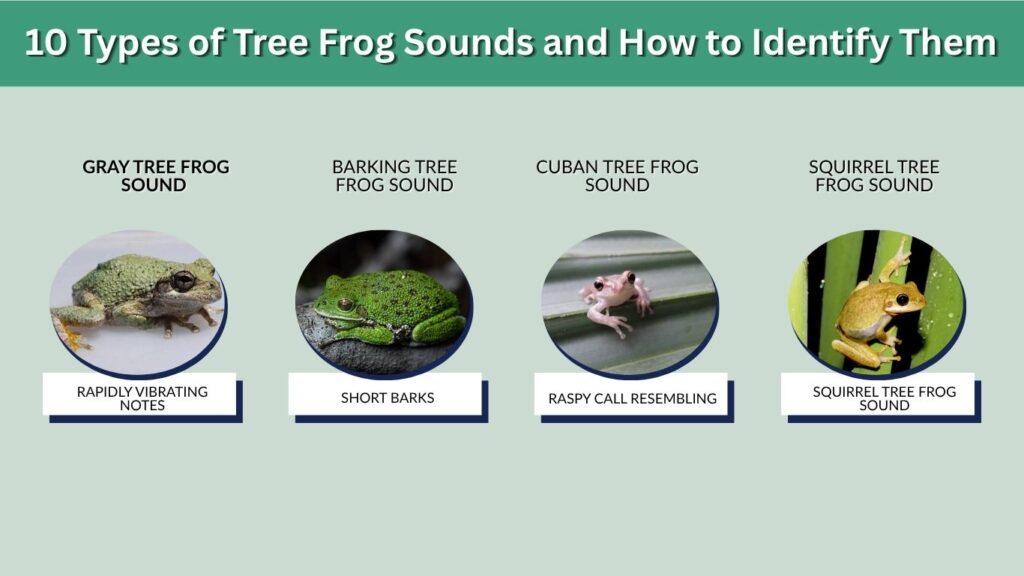
The gray treefrog (Dryophytes versicolor) produces a musical, slightly hollow trill. Its call sounds like a series of rapidly vibrating notes, often lasting about a second.
The sound is smoother and generally slower than the call of Cope’s gray treefrog.
Gray treefrogs are common across much of the eastern United States, including Ohio, Michigan, and Maryland.
Males usually call from trees or shrubs near breeding ponds. Their calls become particularly noticeable during late spring and summer.
2. Green Tree Frog Sound
The American green treefrog (Dryophytes cinereus) makes a distinctive nasal honking sound.
Its call is often compared to a duck-like quack or a small horn being sounded repeatedly.
These frogs are common in the southeastern United States, particularly around ponds, marshes, and wetlands.
Male green treefrogs frequently call during warm evenings, and large groups can create loud, rhythmic choruses. Rainfall may also trigger additional calling activity.
3. Barking Tree Frog Sound
The barking treefrog (Dryophytes gratiosus) gets its name from its unusual vocalization.
Its call resembles the hollow barking of a dog, with repeated notes that sound like short barks or honks.
When several males call together, the chorus can resemble a group of distant dogs.
Some people compare its resonant tones to short notes from a horn or muted brass instrument. However, the barking comparison is more distinctive.
These frogs inhabit sandy woodlands, swamps, and wetlands across parts of the southeastern United States.
4. Cuban Tree Frog Sound
The Cuban treefrog (Osteopilus septentrionalis) produces a rough, raspy call resembling a squeaking door.
Unlike the clear whistles of some native species, its call has a harsh, creaking quality.
Cuban treefrogs are especially common in parts of Florida, where they are invasive.
Their calls often increase after rainfall, particularly during warm weather. Large groups can become noisy enough to disturb people sleeping nearby.
5. Red-Eyed Tree Frog Sound
The red-eyed treefrog (Agalychnis callidryas) produces short, sharp sounds commonly described as chacks.
These calls are quite different from the familiar deep croaking associated with larger frogs.
Red-eyed treefrogs inhabit tropical forests in Central America and nearby regions.
Males call during the rainy breeding season, both to communicate with females and to defend territories against competing males.
6. Pacific Tree Frog Sound
The Pacific treefrog (Pseudacris regilla) produces the classic two-part ribbit sound.
Its call is loud, repetitive, and familiar to many people because similar treefrog calls have been widely used in movies.
These frogs occur along the Pacific coast of North America, particularly in Washington, Oregon, and northern California.
They often gather around temporary ponds during breeding season, creating impressive nighttime choruses.
7. Squirrel Tree Frog Sound
The squirrel treefrog (Dryophytes squirellus) has an unusual vocal repertoire.
Its breeding call resembles a duck-like quack, while its rain call sounds like a rapid, chattering squirrel.
Squirrel treefrogs are common in Florida and other southeastern states.
They often live near houses, gardens, and outdoor lights, where they hunt insects at night.
During rainy weather, their distinctive chattering sounds may come from high branches or vegetation.
8. Bleating Tree Frog Sound
The robust bleating treefrog (Litoria dentata) is known for its extremely loud, high-pitched call.
Its vocalization resembles a sharp squeal or piercing insect-like screech rather than a gentle croak.
Native to eastern Australia, this species often calls after rainfall during warmer months.
Its powerful calls can dominate the nighttime soundscape when several frogs gather to breed.
9. White’s Tree Frog Sound
White’s treefrog (Ranoidea caerulea), also called the Australian green treefrog, produces a deep, nasal barking sound.
Its call is commonly described as a repeated wark-wark-wark.
These frogs are native to Australia and parts of New Guinea. They may call during warm, wet conditions, particularly around breeding sites.
Their low-pitched vocalizations are quite different from the high-pitched chirps of smaller treefrog species.
10. Amazon Milk Frog Sound
The Amazon milk frog (Trachycephalus resinifictrix) produces a loud, resonant call that may sound like rough barking or croaking.
Male frogs call from rainforest trees, sometimes using water-filled tree cavities as breeding sites.
Their calls help attract females and communicate across tropical forest habitats.
These nocturnal frogs become particularly vocal during favorable breeding conditions.
Tree Frog Sounds Comparison Chart
The following chart summarizes the typical sounds made by these ten species.
| Tree frog species | Typical sound |
| Gray Treefrog | Smooth musical trill |
| Green Treefrog | Nasal honking or quacking |
| Barking Treefrog | Hollow dog-like barking |
| Cuban Treefrog | Raspy squeaking door |
| Red-Eyed Treefrog | Short, sharp chacks |
| Pacific Treefrog | Repeated two-part ribbit |
| Squirrel Treefrog | Duck-like quack or chatter |
| Bleating Treefrog | Piercing, high-pitched screech |
| White’s Treefrog | Deep nasal barking |
| Amazon Milk Frog | Loud, rough croaking |
The actual pitch and repetition can vary with temperature, individual frogs, and the type of call.
Why Do Tree Frogs Make Sounds?
Tree frogs use vocalizations primarily to communicate with members of their species.
Their calls serve several purposes, although the exact function depends on the sound and situation.
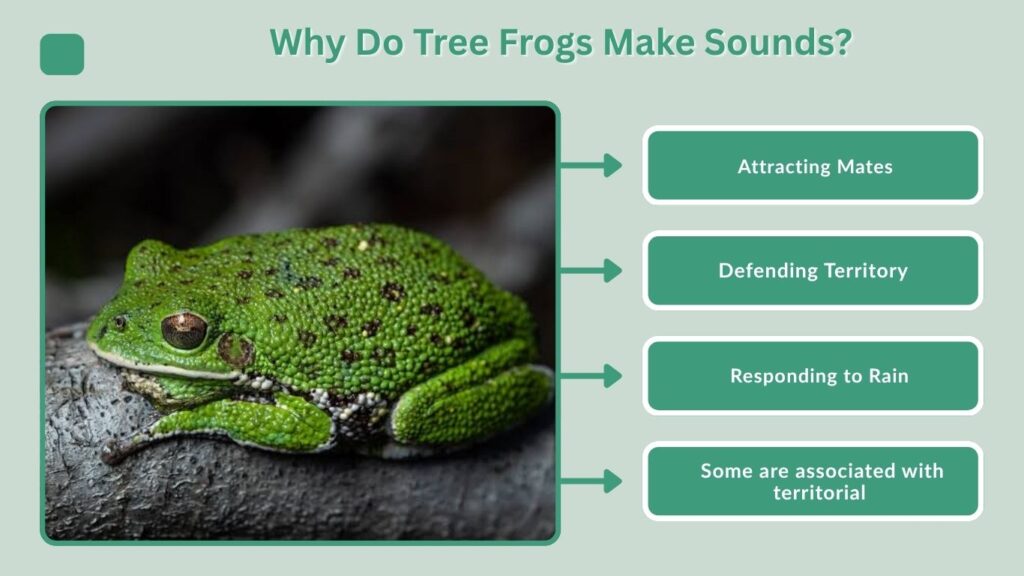
Attracting Mates
Male tree frogs produce advertisement calls to attract females. These calls are usually loudest during breeding season, when males gather near suitable water.
Defending Territory
Some frogs produce additional calls to warn competing males or communicate during close encounters. These calls can differ from their usual mating sounds.
Responding to Rain
Rainfall can stimulate calling activity in some species. Moist conditions often provide suitable opportunities for movement and reproduction.
Not every sound is a mating call; some are associated with territorial behavior or other interactions.
How to Identify Tree Frogs by Their Sounds
Identifying tree frogs by sound is often easier than spotting them because many species remain hidden among leaves and branches.
Listen carefully to the rhythm, pitch, and duration of each call.
A useful identification process includes:
- Listen to the pitch: Determine whether the sound is high, low, musical, or raspy.
- Notice the rhythm: Some frogs make single notes, while others produce repeated trills.
- Consider the location: The species found in Florida differ from those in Michigan or Minnesota.
- Observe the weather: Warm temperatures and recent rainfall can increase activity.
- Compare recordings: Use reliable regional frog-call libraries to identify likely species.
Remember that insects and birds can produce similar sounds, so a call alone may not always provide a certain identification.
FAQs
1. What tree frogs sound like birds?
Some tree frogs produce whistling or chirping calls that resemble birds. The red-eyed treefrog makes sharp chacking sounds, while other species produce musical notes. Listening to the call’s rhythm and repetition helps distinguish frogs from birds.
2. What tree frog sounds like a barking dog?
The barking treefrog is best known for its dog-like calls. Its loud, hollow vocalizations resemble repeated barks. Groups of calling males can sound like several small dogs barking in the distance.
3. What do tree frogs sound like in Florida?
Florida tree frogs produce several distinctive sounds. Green treefrogs make nasal honks, barking treefrogs produce dog-like barks, and squirrel treefrogs make quacking calls. Invasive Cuban treefrogs create rough, squeaking sounds.
4. What do tree frogs sound like in Michigan and Minnesota?
Gray treefrogs produce musical trills, while Cope’s gray treefrogs make faster, harsher trills. Both species occur in the Upper Midwest. Spring peepers, another member of the treefrog family, produce high-pitched peeping sounds during spring.
5. Do tree frogs make noise all night?
Some tree frogs call repeatedly throughout the night, especially during breeding season. However, calling activity depends on species, temperature, rainfall, and individual behavior. Frogs may become quiet when weather conditions change or breeding activity decreases.
