
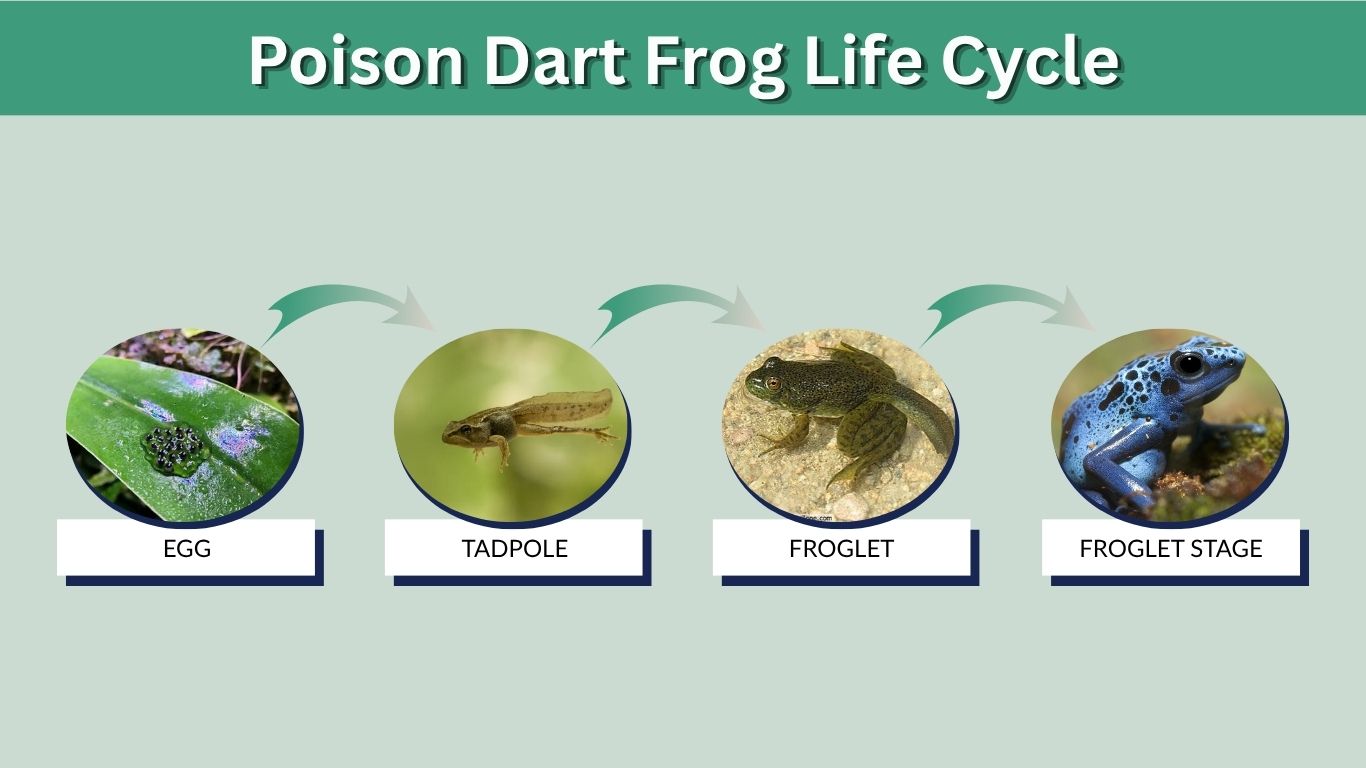
The poison dart frog life cycle begins with tiny eggs laid in a moist, protected location and continues through tadpole, froglet, and adult stages. Unlike many frogs that simply leave their eggs in water, numerous poison dart frog species provide remarkable parental care. Adults may guard eggs, carry newly hatched tadpoles on their backs, and transport them to small pools of water. Some species even return repeatedly to feed their developing young. Although details vary among species, the basic life cycle follows the same fascinating transformation from egg to fully developed frog.
Poison Dart Frog Life Cycle Stages
Poison dart frogs undergo complete metamorphosis, changing dramatically as they grow.
The four main stages are:
- Egg
- Tadpole
- Froglet
- Adult frog
| Life Stage | Typical Development |
| Egg | About 10–21 days |
| Tadpole | Several weeks to a few months |
| Froglet | Tail disappears and legs develop fully |
| Adult | Reaches breeding maturity after further growth |
Exact timing depends on species, temperature, food availability, humidity, and other environmental conditions.
Stage 1: Poison Dart Frog Eggs
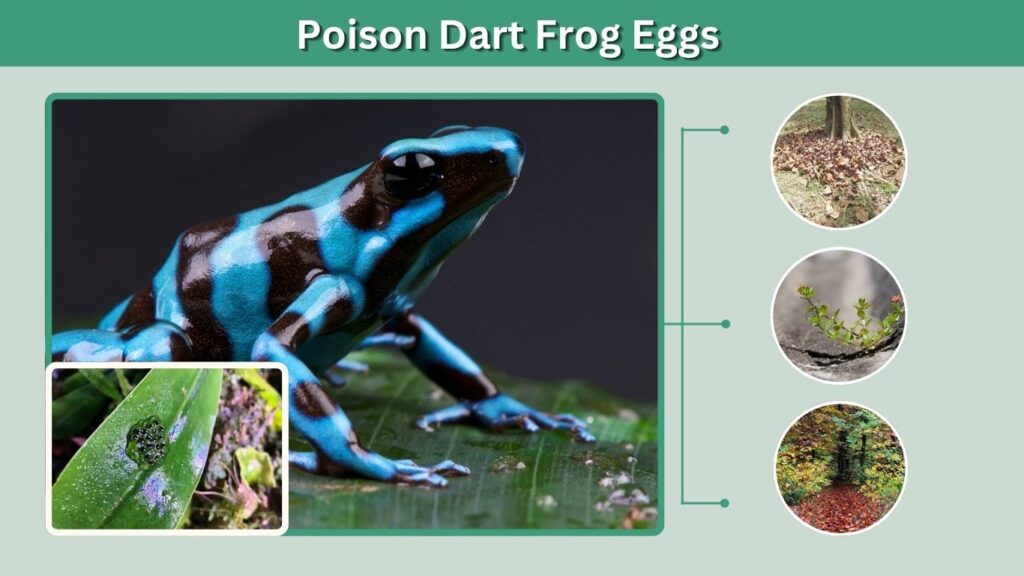
The life cycle starts when an adult female lays a small clutch of eggs.
Unlike many aquatic frogs, poison dart frogs usually deposit their eggs above water in damp places.
Common egg-laying locations include:
- Moist leaves
- Leaf litter
- Plant surfaces
- Small crevices
- Bromeliad leaves
- Other humid areas near the forest floor
The eggs are surrounded by a jelly-like coating that helps prevent them from drying out.
How Many Eggs Do Poison Dart Frogs Lay?
Clutch size varies greatly between species.
Some poison dart frogs lay only a few eggs at a time, while others may produce larger clutches containing more than a dozen eggs.
Small clutch sizes often occur in species that invest heavily in caring for individual offspring.
Parental Care of Eggs
Parental care is one of the most interesting poison dart frog life cycle behaviors.
In many species, a parent returns to the eggs regularly and keeps them moist. The male commonly guards or tends the clutch, although parental roles differ among species.
This attention increases the chances that the eggs will survive until hatching.
Stage 2: Tadpole
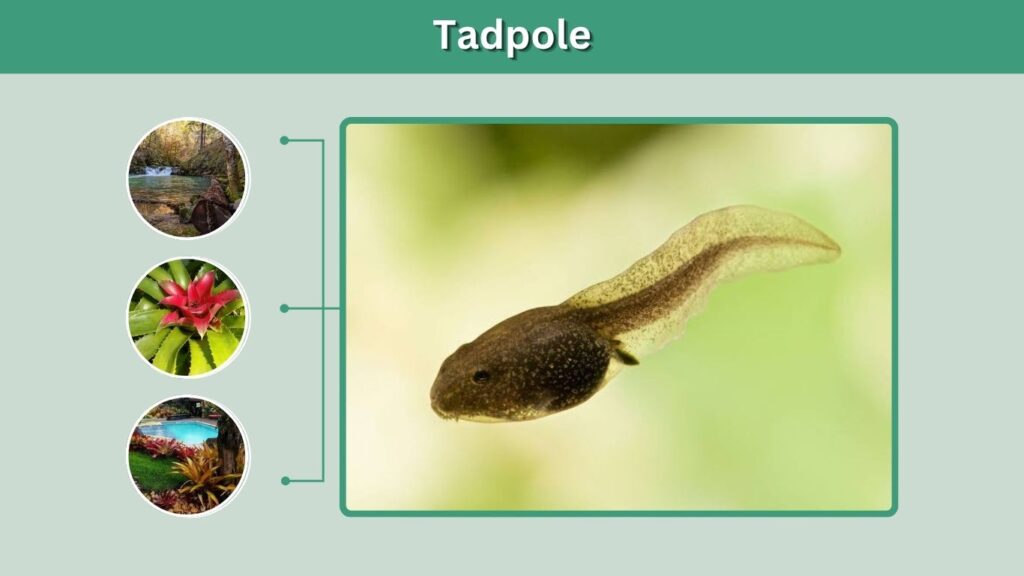
After roughly one to three weeks, depending on species and conditions, a tadpole develops enough to leave the egg.
But the young tadpole may not already be living beside suitable water.
Parents Carry Tadpoles on Their Backs
Many poison dart frogs solve this problem in a remarkable way.
The tadpole climbs onto a parent’s back, where mucus helps it remain attached. The adult then transports the tadpole to water.
Possible nursery sites include:
- Bromeliad pools
- Tree holes
- Small forest pools
- Water-filled plant structures
- Temporary puddles
Some species carry several tadpoles, while others transport them individually.
What Do Poison Dart Frog Tadpoles Eat?
Tadpole diets vary according to species.
They may consume:
- Algae
- Decaying plant material
- Microorganisms
- Insect larvae
- Other tadpoles
- Unfertilized frog eggs
One of the most extraordinary examples occurs in some Oophaga poison dart frogs.
Strawberry Poison Dart Frog Tadpole Feeding
Female strawberry poison dart frogs (Oophaga pumilio) place individual tadpoles in tiny water-filled plants.
She then returns periodically and deposits unfertilized eggs for the tadpole to eat.
These eggs are an essential source of nutrition.
This specialized parental behavior means the mother continues caring for her offspring well after they hatch.
Stage 3: Metamorphosis Into a Froglet
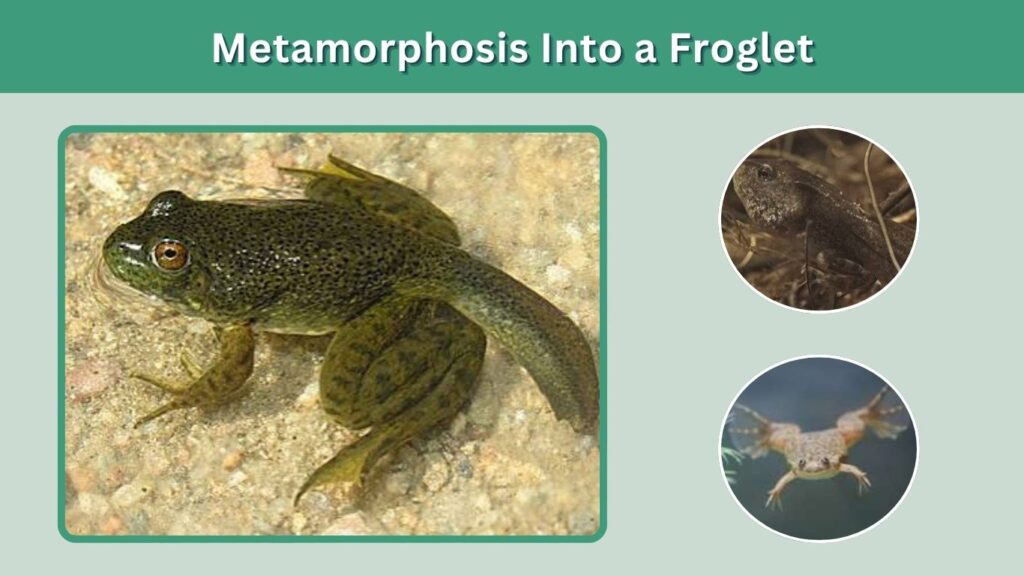
During the tadpole stage, the animal gradually undergoes metamorphosis.
Major changes include:
- Hind legs developing
- Front legs emerging
- Lungs becoming functional
- Mouth structure changing
- Digestive system changing
- Tail becoming shorter
- Body becoming increasingly frog-like
Eventually, the tadpole becomes a froglet.
What Is a Poison Dart Frog Froglet?
A froglet looks much more like an adult frog but may still retain a small tail.
As the remaining tail is absorbed, the young frog becomes increasingly adapted to life on land.
At this stage, it switches from the tadpole diet to hunting tiny terrestrial invertebrates.
Stage 4: Adult Poison Dart Frog
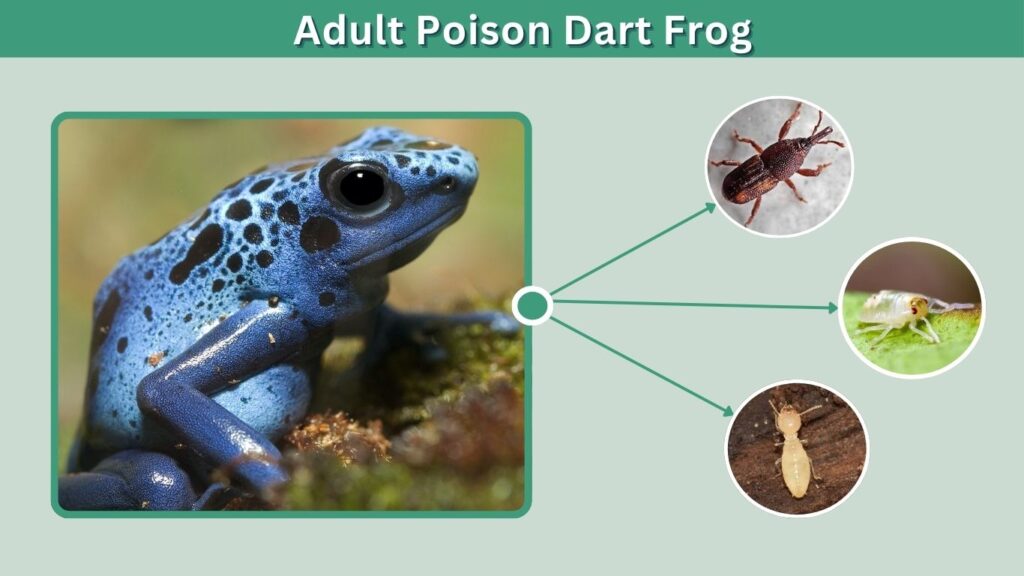
Once metamorphosis is complete, the young frog continues growing toward adulthood.
Adult poison dart frogs primarily eat small arthropods such as:
- Ants
- Mites
- Termites
- Tiny beetles
- Springtails
- Small flies
- Other small invertebrates
Their diet is particularly important because wild poison dart frogs obtain many of their defensive chemicals from prey.
Captive-bred poison dart frogs fed typical feeder insects usually do not possess the same powerful toxicity as wild individuals.
How Long Does the Poison Dart Frog Life Cycle Take?
There is no single development time for every poison dart frog.
Egg development may take approximately 10–21 days, while tadpole development can continue for several weeks or a few months.
A simplified timeline looks like this:
Days 1–21: Egg
The embryo develops inside a moist egg.
Weeks 2–12+: Tadpole
The tadpole grows in water while legs and other adult features gradually develop.
Around 2–4 Months: Froglet
Many species complete metamorphosis within several months, though conditions and species can change this substantially.
Following Months: Juvenile to Adult
The froglet grows until it reaches reproductive maturity.
Blue Poison Dart Frog Life Cycle
The blue poison dart frog, often known as Dendrobates tinctorius “Azureus,” follows the same general egg-to-tadpole-to-froglet pattern.
Adults deposit eggs in humid areas rather than directly in permanent bodies of water.
After hatching, the male may transport tadpoles to small pools where they continue developing.
Young frogs gradually develop the striking blue coloration and dark markings typical of adults.
Golden Poison Dart Frog Life Cycle
The golden poison frog (Phyllobates terribilis) is famous for being among the most toxic frogs in the wild.
Its life cycle still begins with relatively ordinary-looking eggs.
After the eggs hatch, a parent transports tadpoles to water, where they continue growing until metamorphosis.
Juveniles eventually develop the brilliant yellow, orange, or greenish coloration associated with adults.
Despite the adults’ formidable chemical defenses, their reproductive development still depends heavily on humid rainforest conditions.
Green and Black Poison Dart Frog Life Cycle
The green-and-black poison dart frog (Dendrobates auratus) also lays eggs in damp terrestrial locations.
A male commonly guards the eggs.
After they hatch, he carries tadpoles on his back to suitable water-filled locations.
The tadpoles grow and undergo metamorphosis before leaving the water as tiny froglets.
This species is especially well known in captivity because of its striking green-and-black pattern and relatively manageable breeding behavior.
Strawberry Poison Dart Frog Life Cycle
The strawberry poison dart frog has one of the most specialized reproductive systems.
After mating, females lay small clutches on moist vegetation or leaf litter.
The male typically tends the eggs.
Once tadpoles hatch, the female carries them individually to tiny pools of water, commonly within bromeliads.
She later returns to feed each tadpole unfertilized eggs.
This intensive parental investment helps the young survive in extremely small aquatic habitats where other food may be scarce.
How Long Do Poison Dart Frogs Live?
Poison dart frog lifespan varies between species and environmental conditions.
Many can live approximately 5–10 years, while some captive individuals may survive well beyond 10 years with excellent care.
Their total life cycle therefore consists of a relatively short developmental period followed by several years as an adult.
Poison Dart Frog Life Cycle for Kids
A simple way to remember the life cycle is:
Egg → Tadpole → Froglet → Adult Frog → Eggs Again
The female lays eggs in a wet place.
The eggs hatch into tadpoles.
A parent may carry the tadpoles to water.
The tadpoles grow legs and lose their tails.
They become froglets and eventually grow into adult poison dart frogs.
Adults then reproduce, beginning the cycle again.
Why Is Their Life Cycle Unique?
Poison dart frogs stand out because of the amount of care many species give their offspring.
Most frogs produce large numbers of eggs and provide little or no parental care.
Many poison dart frogs do nearly the opposite.
They may produce relatively small clutches while investing considerable time in guarding eggs, transporting tadpoles, selecting nursery pools, and even feeding young.
These behaviors improve offspring survival in the complex rainforest environment.
FAQs
1. What are the stages of a poison dart frog life cycle?
The main stages are egg, tadpole, froglet, and adult. Eggs hatch into aquatic tadpoles, tadpoles undergo metamorphosis and develop legs, and froglets eventually lose their tails and grow into reproductive adults.
2. How long does a poison dart frog take to grow?
Development from egg to froglet commonly takes several weeks to a few months. The exact duration depends on species, temperature, nutrition, humidity, and water conditions. Juvenile frogs continue growing after metamorphosis before reaching sexual maturity.
3. Where do poison dart frogs lay eggs?
Most species lay eggs in moist terrestrial locations such as leaves, leaf litter, plants, or protected surfaces. After hatching, one parent commonly transports the tadpoles to small bodies of water where development continues.
4. Do poison dart frogs take care of their babies?
Many species provide extensive parental care. Adults may guard eggs, keep them moist, carry tadpoles on their backs, and place them in suitable water. Some species even feed their tadpoles unfertilized eggs.
5. How long do poison dart frogs live?
Many poison dart frogs can live around 5–10 years, although lifespan varies between species. Captive frogs with proper temperature, humidity, nutrition, and veterinary care may sometimes live considerably longer.
