
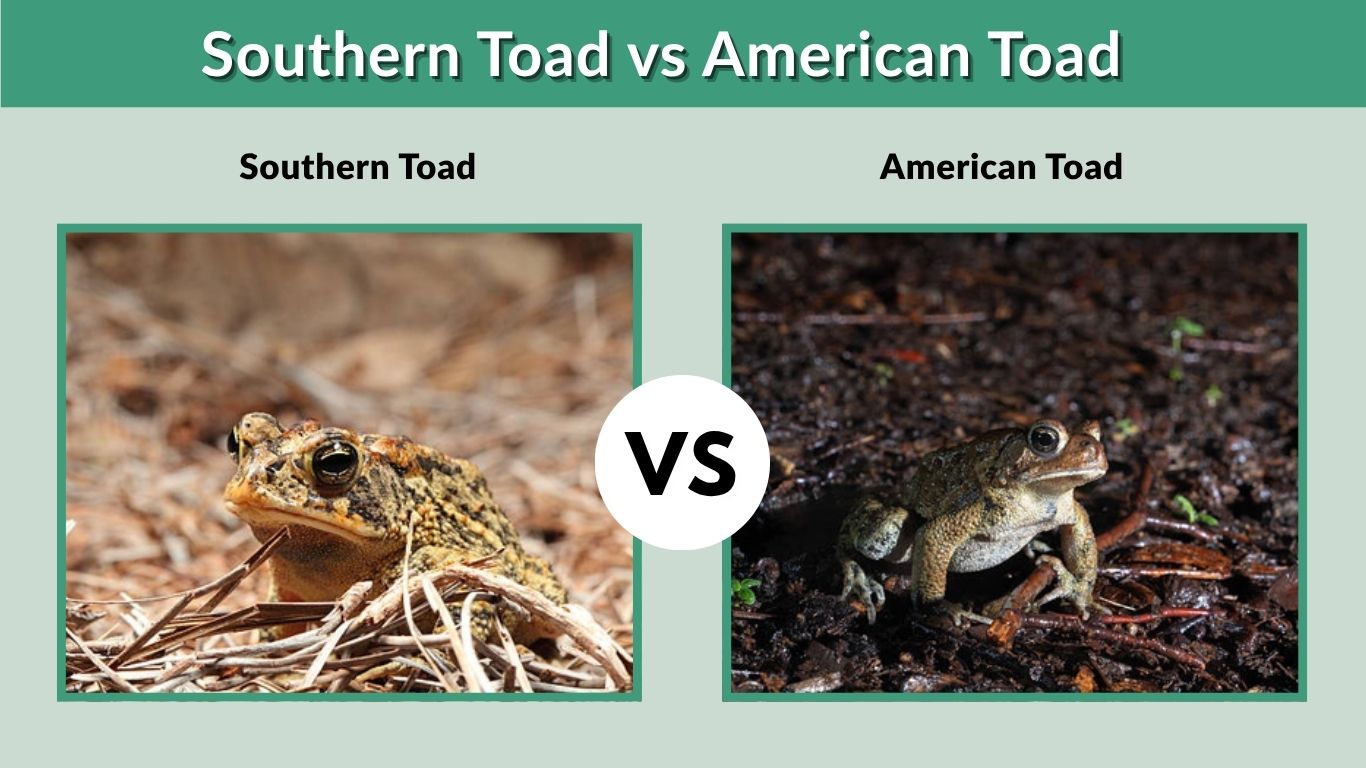
Southern toads and American toads look very similar because both are warty, brownish North American toads in the same genus. They share many habits, including nighttime activity, insect-eating diets, and breeding in shallow water. However, their range, head shape, cranial crests, calls, and habitat preferences can help you tell them apart more confidently.
Southern Toad vs American Toad: Quick Comparison
Southern toads and American toads can overlap in general appearance, but they are not equally likely everywhere. The southern toad is mostly a southeastern species, while the American toad is more widespread across eastern North America. In areas where both might be considered, range and head markings are often the best starting points.
| Feature | Southern Toad | American Toad |
|---|---|---|
| Scientific name | Anaxyrus terrestris | Anaxyrus americanus |
| Average size | About 1.5–3.5 inches | About 2–4.25 inches |
| Main range | Southeastern United States | Eastern North America |
| Best visual clue | Large knobs behind the eyes | Usually no large paired knobs |
| Cranial crests | Prominent, often ending in knobs | Present but less knob-like |
| Belly | Usually pale, sometimes lightly marked | Often spotted or mottled |
| Call | High-pitched trill or musical call | Long, clear musical trill |
| Common habitat | Sandy soils, pine woods, yards, wetlands | Forests, gardens, fields, wetlands |
| Backyard presence | Common in the Southeast | Common across much of the East |
What Is a Southern Toad?
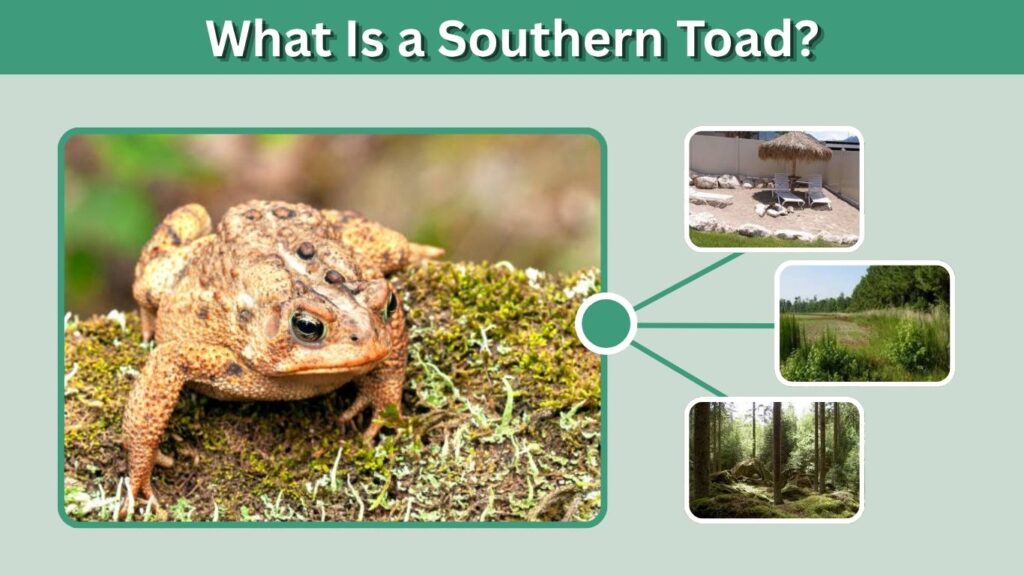
The southern toad is a common toad of the southeastern United States. It is often seen in Florida, Georgia, South Carolina, Alabama, Mississippi, Louisiana, and nearby areas. It is especially familiar in sandy yards, pine flatwoods, gardens, wooded neighborhoods, and areas near ponds or temporary pools.
Appearance
Southern toads have dry, bumpy skin with colors ranging from gray and brown to reddish brown or tan. Their pattern can vary widely, which is why color alone is not a dependable way to identify them. Some individuals look pale and sandy, while others appear darker and more heavily marked.
The most useful feature is the pair of raised knobs or enlarged crests behind the eyes. These knobs are part of the toad’s cranial crest structure and often make the head look more angular. When viewed from above, the southern toad’s head may appear more sculpted than the American toad’s.
Habitat
Southern toads are strongly associated with warm southeastern habitats. They often live in:
- Sandy backyards
- Pine flatwoods
- Hardwood hammocks
- Forest edges
- Wetland margins
- Gardens and suburban areas
- Ditches, ponds, and temporary pools
They spend much of the day hidden under leaves, logs, loose soil, mulch, or other cover. At night, they come out to feed on insects and other small invertebrates.
What Is an American Toad?
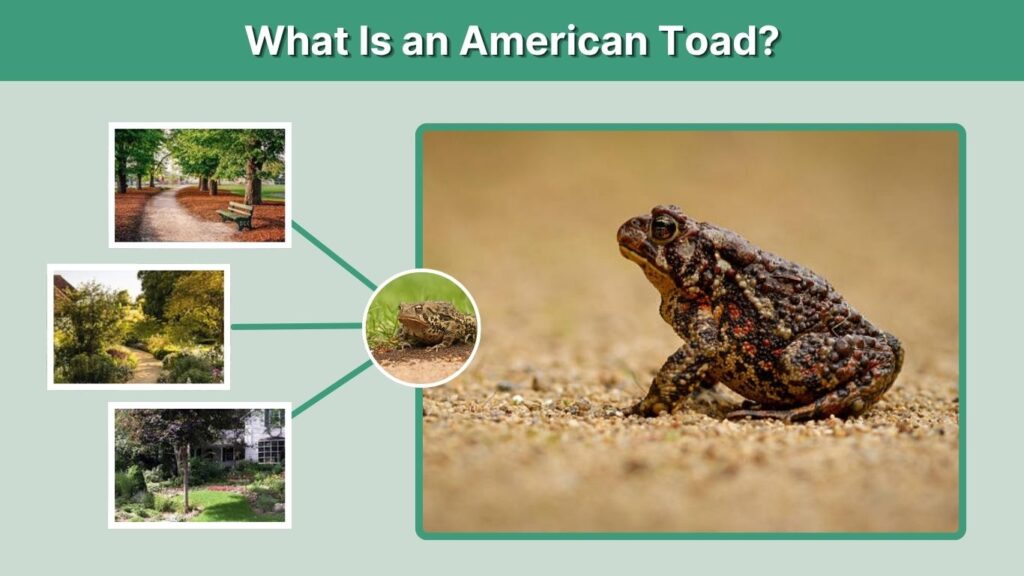
The American toad is one of the most widespread and familiar toads in eastern North America. It is common in forests, fields, gardens, parks, wetlands, and suburban neighborhoods. Many people see American toads near porch lights, where they feed on insects attracted to the glow.
Appearance
American toads are usually brown, gray, olive, tan, or reddish. Like southern toads, they have warty skin and short legs. Many American toads have dark spots on the back, and each dark spot usually contains one or two larger warts.
The belly is often spotted or mottled, which can help separate it from some similar species. American toads also have cranial crests, but they usually do not form the same large, obvious knob-like structures behind the eyes that are typical of southern toads.
Habitat
American toads are adaptable and can live in many moist environments. They commonly occur in:
They need access to moisture, shelter, and breeding water, but they do not require the same warm southeastern conditions as southern toads. Their broader range makes them the more likely species across much of the northeastern, midwestern, and Appalachian regions.
- Deciduous forests
- Mixed woodlands
- Gardens
- Parks
- Fields and meadows
- Wetland edges
- Suburban yards
- Farmland borders
Appearance Differences
At a glance, both species look like ordinary brown toads. The clearest difference is usually the head. Southern toads often have obvious raised knobs behind the eyes, while American toads have a less knobbed head profile.
| Body Feature | Southern Toad | American Toad |
|---|---|---|
| Head shape | Often angular with prominent knobs | More rounded or less sharply knobbed |
| Cranial crests | Strong, ending in raised knobs | Present but usually less pronounced |
| Back color | Gray, tan, brown, reddish, or sandy | Brown, gray, olive, reddish, or tan |
| Back warts | Numerous, variable | Usually larger warts inside dark spots |
| Belly pattern | Pale or lightly marked | Often more spotted or mottled |
| Size | Small to medium | Medium to fairly large |
| Parotoid glands | Large glands behind eyes | Large glands behind eyes |
| Overall impression | Sandy southeastern toad with knobbed head | Widespread stockier eastern toad |
Cranial Crests and Knobs
Cranial crests are raised ridges on the head. In southern toads, these ridges often end in enlarged knobs just behind the eyes. These knobs are one of the best field marks for the species.
American toads also have raised head ridges, but they usually look less dramatic. The head often appears smoother or more rounded compared with the southern toad’s more angular profile.
Belly Pattern
American toads often have a spotted or mottled underside. Southern toads may have a paler belly with lighter markings, although individual variation exists. Belly pattern can help, but it should not be the only feature used for identification.
Size and Color
American toads can grow larger than southern toads, but size is not always reliable. A young American toad may be smaller than a mature southern toad. Color is also variable in both species. Moisture, soil color, age, and local habitat can all affect how a toad looks.
Range and Habitat Differences
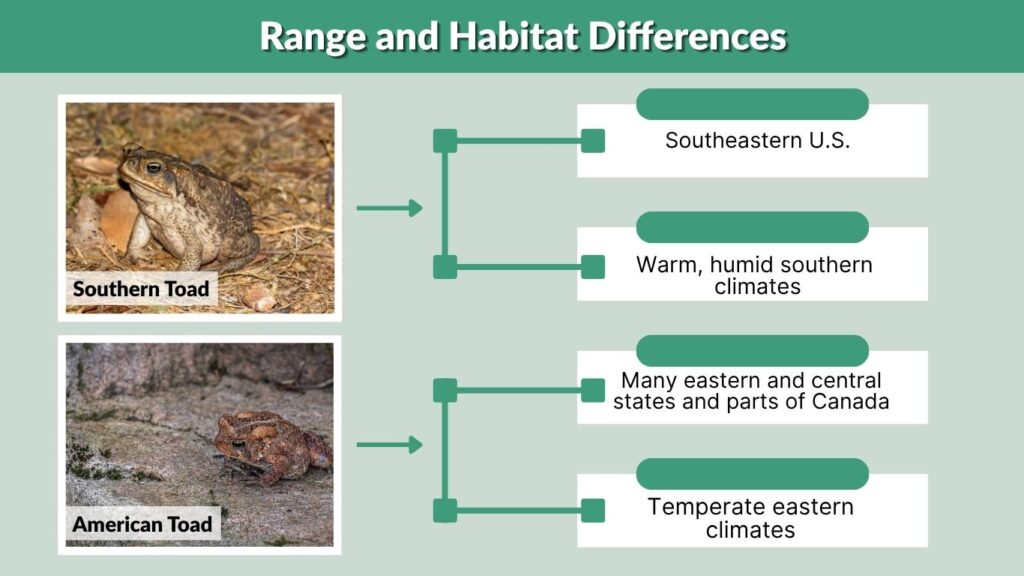
Range is one of the strongest clues. If you are in the Southeast, especially Florida or the coastal plain, a southern toad is very possible. If you are farther north or in much of the eastern United States outside the southern toad’s range, the American toad becomes more likely.
| Category | Southern Toad | American Toad |
|---|---|---|
| Primary region | Southeastern U.S. | Eastern North America |
| Common states | Florida, Georgia, South Carolina, Alabama, Mississippi, Louisiana | Many eastern and central states and parts of Canada |
| Climate preference | Warm, humid southern climates | Temperate eastern climates |
| Soil preference | Often sandy or loose soils | Flexible, but needs cover and moisture |
| Common around homes | Very common in southeastern yards | Very common in eastern yards |
| Breeding sites | Temporary pools, ditches, ponds, wetlands | Ponds, marshes, ditches, temporary pools |
| Best range clue | Found mostly in the Southeast | Found much farther north and west |
Southern Toad Range
Southern toads are mainly found in the southeastern United States. They are especially common in Florida and nearby coastal plain habitats. They do well in warm, humid places with loose soil and nearby breeding water.
In the right region, southern toads may be one of the most common backyard amphibians. They often appear after rain or near outdoor lights at night.
American Toad Range
American toads have a much broader range. They occur across large parts of eastern North America, including many northern and inland regions where southern toads are absent. This makes location a major clue. A toad in New England, the Great Lakes region, or much of the Appalachian area is much more likely to be an American toad than a southern toad.
Call Differences
Toad calls are extremely useful during breeding season. Both species produce trilling calls, but the tone, pitch, and local timing can help separate them.
Southern Toad Call
The southern toad usually gives a high-pitched trill. In warm southern areas, males may call from shallow water, ditches, ponds, flooded lawns, or temporary rain pools. Their call can sound sharp, musical, and sustained.
Because southern toads often breed after heavy rains, their choruses may suddenly become loud in neighborhoods, wetlands, and low areas that temporarily fill with water.
American Toad Call
The American toad also gives a long musical trill. Its call is often described as clear, sweet, and sustained. In spring, males gather in shallow water and call to attract females.
Since both species have trilling calls, sound alone may be confusing for beginners. However, when combined with location and head structure, the call becomes more useful.
Behavior and Diet
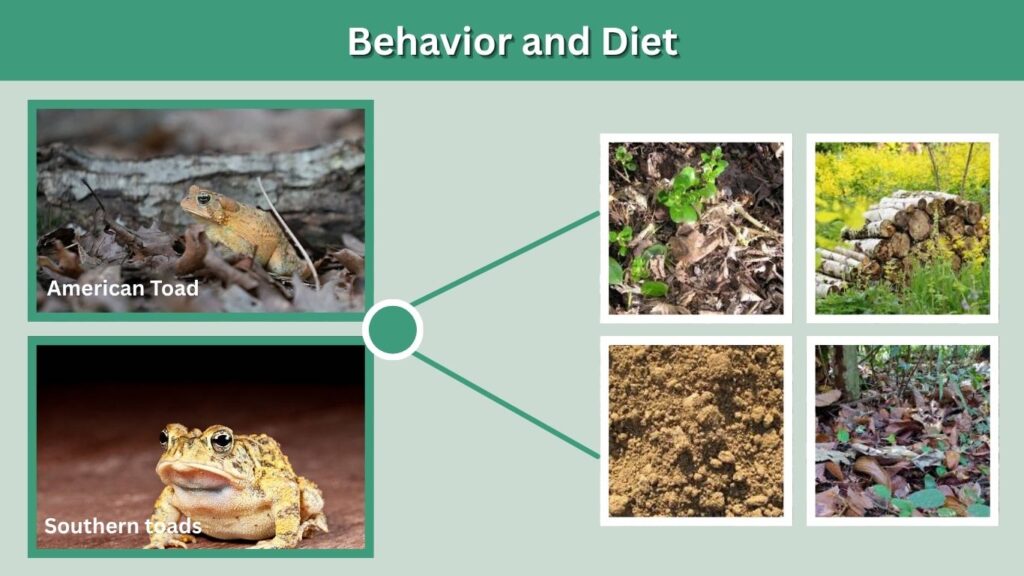
Southern toads and American toads behave in very similar ways. Both are mostly nocturnal and spend daylight hours hidden in cool, damp shelters. They are especially active after rain, when humidity is higher and insects are easier to find.
Daily Activity
During the day, both species may hide under:
- Leaf litter
- Logs
- Mulch
- Rocks
- Loose soil
- Garden debris
- Porch steps or outdoor structures
At night, they emerge to hunt. They do not chase prey over long distances. Instead, they sit and wait, snapping up insects and small invertebrates that come close.
Diet
Both toads are beneficial predators. Their diet includes many small animals found in gardens and yards, such as:
- Beetles
- Ants
- Flies
- Moths
- Crickets
- Spiders
- Small larvae
- Other soft-bodied insects
Because of this diet, both southern toads and American toads can be helpful around homes and gardens. They naturally reduce insect populations without needing chemicals.
Breeding Differences
Both species breed in freshwater, especially shallow water where eggs and tadpoles can develop. Their breeding activity often increases after rain.
Southern Toad Breeding
Southern toads often breed in temporary pools, ditches, flooded depressions, marshy areas, and pond edges. In the warm Southeast, breeding may occur over a longer season than in cooler northern areas.
Females lay eggs in long strings. The eggs hatch into tadpoles, which develop in water before transforming into tiny toadlets.
American Toad Breeding
American toads usually breed in spring, especially after temperatures rise and rain fills ponds or temporary pools. Males call from shallow water, and females lay long strings of eggs.
In colder parts of their range, breeding is more seasonal and concentrated. In milder areas, timing may vary depending on local weather.
Are Southern Toads and American Toads Poisonous?
Yes. Both southern toads and American toads have parotoid glands behind the eyes that produce defensive secretions. These secretions can irritate the mouth, eyes, and skin. They help protect the toad from predators.
For humans, normal observation is not dangerous. If you handle either species, wash your hands afterward and avoid touching your eyes or mouth. Children should be taught not to put toads near their face.
For pets, the risk is higher. Dogs and cats may drool, foam at the mouth, paw at their face, gag, or vomit after biting or licking a toad. If symptoms are severe or continue, contact a veterinarian.
Which Toad Is in Your Yard?
If you live in the southeastern United States and the toad has large knobs behind its eyes, it may be a southern toad. If you live farther north or outside the southern coastal plain, it is more likely to be an American toad.
Use a combination of clues:
- Location and range
- Knobs behind the eyes
- Belly spotting
- Overall size
- Habitat type
- Breeding call
- Season and weather
Do not rely on color alone. Both species can be brown, gray, tan, or reddish, and both can change in appearance depending on local conditions.
FAQs
How can you tell a southern toad from an American toad?
Look at the head and location. Southern toads usually have prominent raised knobs behind the eyes and are mainly found in the southeastern United States. American toads are more widespread and usually have less dramatic cranial crests, with a more spotted or mottled belly.
Are southern toads bigger than American toads?
Usually, American toads can grow larger than southern toads. Southern toads are generally small to medium-sized, while American toads may become stockier and heavier. However, size alone is not reliable because young American toads can overlap with adult southern toads.
Do southern toads and American toads sound the same?
They both make trilling calls, so beginners may confuse them. Southern toads often have a high-pitched trill, while American toads produce a long, clear musical trill. Calls are most useful when combined with range, habitat, and physical features.
Are southern toads and American toads poisonous to dogs?
Yes. Both species can release irritating toxins from glands behind the eyes. Dogs that lick or bite them may drool, foam, vomit, or paw at the mouth. Rinse or wipe the mouth carefully and call a veterinarian if symptoms are strong, unusual, or do not improve.
Are southern toads good to have in the yard?
Yes. Southern toads and American toads both eat insects and other small invertebrates, making them helpful backyard animals. Avoid pesticides, provide natural cover, and keep pets from bothering them. The best approach is to leave them alone and let them control pests naturally.
