
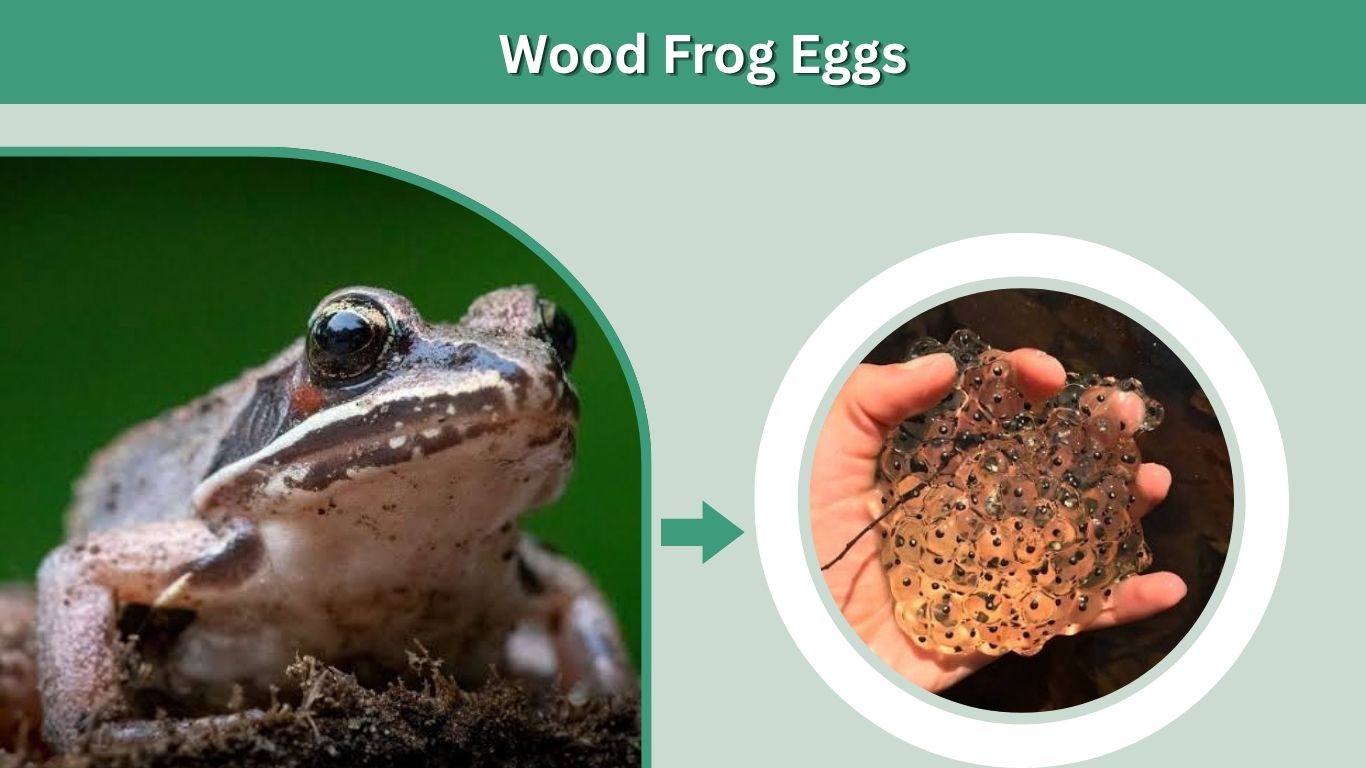
Wood frog eggs are among the first amphibian eggs to appear in woodland ponds and vernal pools each spring. Females lay hundreds to more than a thousand eggs in clear, jelly-like clusters that often gather into large communal rafts. The dark embryos inside each transparent capsule make the masses relatively easy to recognize once you know what to look for. Their development is fast, with hatching often occurring within a few weeks depending on water temperature and local conditions.
What Do Wood Frog Eggs Look Like?
Wood frog (Lithobates sylvaticus) egg masses are gelatinous clusters containing many individual dark embryos. Freshly deposited masses are fairly compact, but the surrounding jelly quickly absorbs water and expands. Multiple females frequently deposit their eggs close together, producing conspicuous collections of egg masses in shallow portions of temporary woodland pools.
Wood Frog Egg Identification
Look for these characteristics:
- Clear or nearly transparent gelatinous mass
- Numerous dark or black embryos
- Individual eggs surrounded by their own jelly capsules
- Roughly rounded, loose cluster rather than a long string
- Fresh masses that expand substantially after absorbing water
- Masses commonly attached to submerged vegetation
- Several masses frequently grouped together
- Location in shallow vernal or woodland pools
Fresh masses may begin around golf-ball size before expanding toward baseball size within approximately a day.
What Is Inside the Jelly?
Each visible black dot is a developing embryo contained within an individual gelatinous capsule. These capsules are grouped together to form the larger mass.
As development proceeds, the embryos become elongated and increasingly tadpole-like. Eventually, the larvae hatch from their jelly capsules and begin swimming in the pond.
The jelly also changes appearance as it absorbs water and ages, so a freshly laid mass may look quite different from one that is close to hatching.
Wood Frog Egg Masses
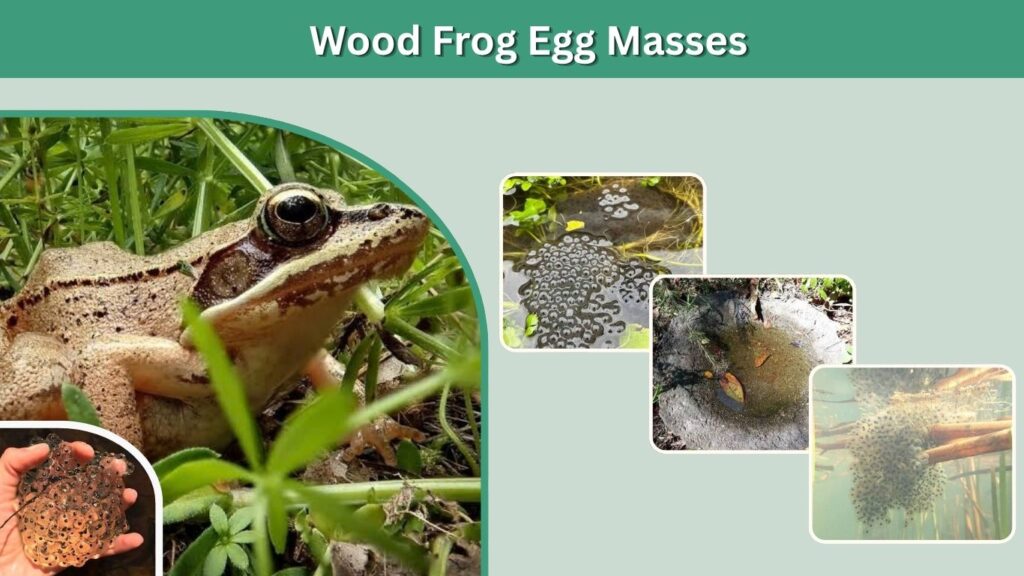
A wood frog egg mass usually contains hundreds of eggs, and females may produce more than one mass. Because many females choose the same favorable areas, dozens or even hundreds of masses can accumulate together. These communal deposits can form floating or partially submerged rafts that are especially noticeable during the short early-spring breeding season.
Why Are Egg Masses Grouped Together?
Wood frogs often choose shared laying sites with:
- Suitable underwater vegetation
- Shallow water
- Sunlight that warms the eggs
- Appropriate water depth
- Favorable temperatures
- Lower exposure to some predators
- Convenient attachment points
The Vernal Pool Association notes that communal sites may contain extremely large numbers of egg masses, with some documented rafts containing more than 1,000 individual masses.
Do Wood Frogs Lay Eggs in a String?
No. Wood frogs generally lay their eggs in rounded gelatinous clusters, not long strings.
This can help separate their eggs from those of many toads. Toads commonly produce long strings or cords containing eggs, while wood frog eggs occur in compact masses.
However, egg masses should be identified using several features because frog and salamander spawn can look similar when viewed from above.
When and Where Do Wood Frogs Lay Eggs?
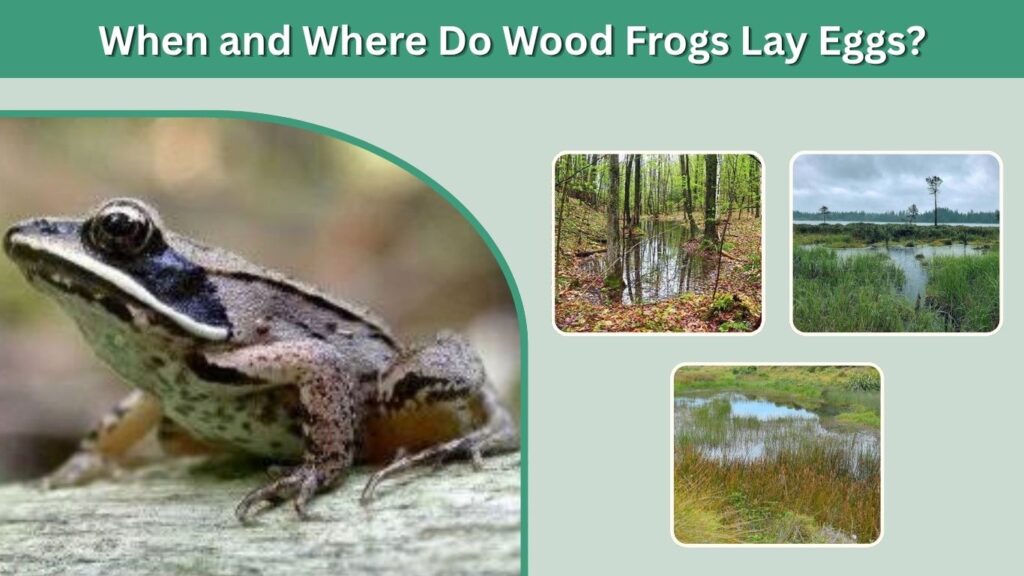
Wood frogs are among the earliest amphibians to breed in spring. Adults emerge from overwintering sites and move toward seasonal wetlands, sometimes while snow or ice is still present nearby. Breeding can occur rapidly during rainy, relatively mild periods, which is why large numbers of eggs may seem to appear almost overnight.
Where Are Wood Frog Eggs Found?
Typical breeding locations include:
- Vernal pools
- Temporary woodland ponds
- Shallow wetlands
- Fish-free seasonal pools
- Flooded forest depressions
- Vegetated shallow-water edges
The U.S. Geological Survey notes that wood frogs prefer vernal pools—temporary water bodies that hold water for only part of the year—for egg laying.
When Do Wood Frogs Lay Their Eggs?
Timing varies substantially with latitude, elevation, and spring weather.
In warmer parts of their range, breeding can begin in late winter or early spring. Farther north, including parts of Canada and Alaska, reproduction occurs later as ponds thaw.
Weather matters as well. Maine environmental guidance notes that cold springs can delay amphibian breeding by around two weeks compared with warmer, wetter years.
How Long Do Wood Frog Eggs Take to Hatch?
Wood frog eggs generally hatch in roughly one to four weeks, although temperature strongly influences development. Warm water can accelerate embryonic growth, whereas cold conditions slow it. This relatively short egg stage is useful in temporary pools because wood frog larvae need sufficient time to develop before seasonal wetlands become shallow or dry.
Wood Frog Egg Development
The general sequence is:
- A fertilized egg is deposited within jelly.
- Embryonic cells divide.
- The embryo becomes elongated.
- Head and tail regions become recognizable.
- Movement may become visible inside the capsule.
- The larva breaks free from the jelly.
- A newly hatched tadpole enters the aquatic larval stage.
Development does not occur at exactly the same rate in every pond because water temperature and local environmental conditions vary.
What Happens After Hatching?
Newly hatched larvae develop into tadpoles and continue feeding and growing within the breeding pool.
Wood frog tadpoles can initially appear very dark when viewed from above. As they mature, their appearance changes, and developing individuals may show gold-colored flecking. Eventually they develop legs, absorb their tails, and leave the water as small juvenile frogs.
Wood Frog Eggs vs Spotted Salamander Eggs
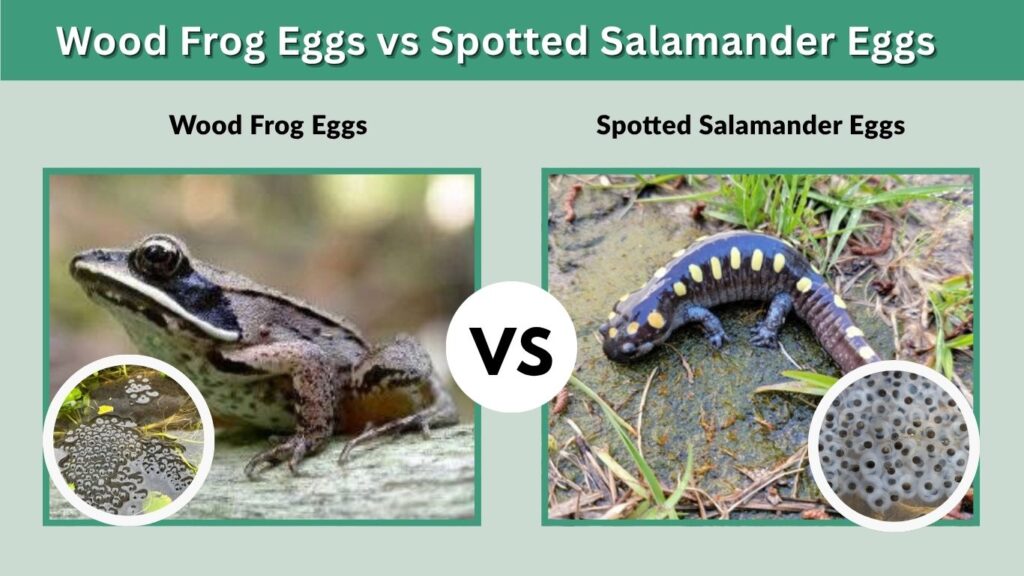
Wood frog eggs vs spotted salamander eggs can be challenging to distinguish because both species breed in vernal pools during early spring. Their breeding seasons often overlap, and their egg masses may even occur side by side. However, differences in shape, firmness, jelly structure, and appearance can help identify them without disturbing the developing embryos.
Key Identification Differences
| Feature | Wood Frog Eggs | Spotted Salamander Eggs |
| Overall mass | Looser, rounded cluster | Firm, compact mass |
| Jelly | Individual eggs clearly visible in jelly | Thick outer jelly envelope |
| Appearance | Usually clear | Clear or cloudy/milky |
| Texture | Soft-looking and irregular | Firmer, like set gelatin |
| Grouping | Often large communal rafts | Individual masses often distinct |
| Hatching | Usually 1–4 weeks | Often slower, around 4–7 weeks |
USGS monitoring guidance reports wood frog egg masses hatching in approximately one to four weeks compared with about four to seven weeks for spotted salamanders.
An Easy Visual Clue
Wood frog masses often look like many individual clear bubbles packed together, with a dark embryo visible inside each one.
Spotted salamander masses generally have a more uniform outer coating of jelly that gives the entire mass a smooth and firm appearance. Some spotted salamander masses are distinctly milky white rather than transparent.
Wood Frog Eggs vs Toad Eggs
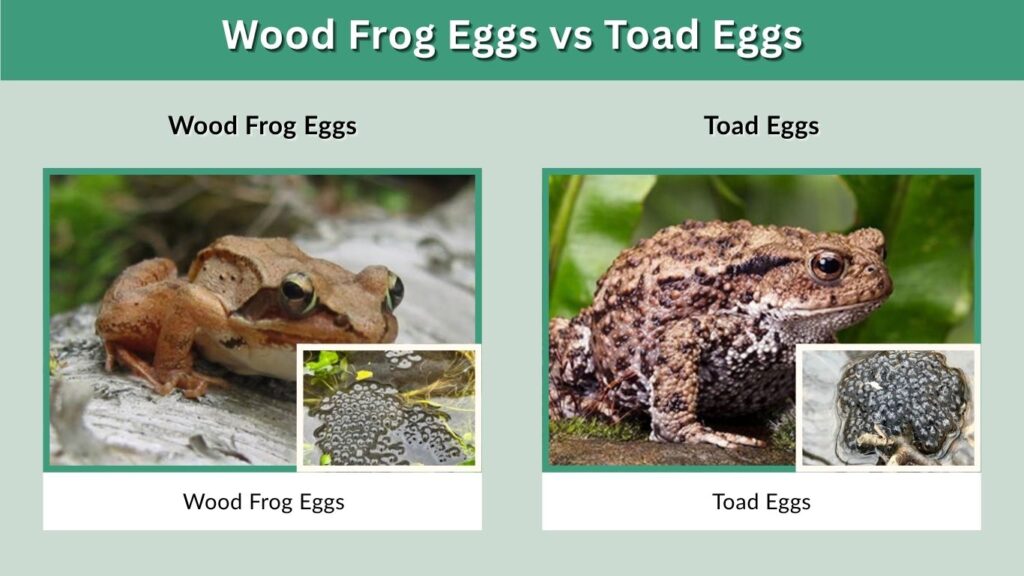
Wood frog and toad spawn are usually easier to distinguish. Wood frogs deposit eggs in rounded clusters, whereas many toads lay eggs in long gelatinous strings. The surrounding habitat can provide another clue because wood frogs strongly favor woodland and vernal-pool environments, although different amphibian species sometimes use the same wetland.
Main Differences
Wood frog eggs normally appear as:
- Large jelly clusters
- Numerous closely packed embryos
- Rounded or irregular masses
- Communal groupings in shallow water
Toad eggs are more commonly arranged as long strands containing rows of dark embryos.
Avoid lifting or separating egg masses simply to identify them. Photographs taken through the water usually provide enough information.
Should You Collect or Raise Wood Frog Eggs?
Finding a mass can make raising the eggs seem appealing, but leaving wild amphibian eggs in their natural habitat is generally the better approach. Removal may be restricted by local wildlife rules, and maintaining the correct water conditions, temperature, food, and development environment can be difficult.
Observe Without Disturbing Them
For responsible observation, photograph the eggs where they are, note their development over several visits, and avoid pulling the mass from its attachment point.
Vernal pools are important breeding habitats, and wood frog eggs can also provide evidence that a pool supports breeding amphibians.
FAQs
Wood frog eggs appear only for a relatively short period each year, so questions about identification, laying season, development, and hatching are common. Their early breeding schedule and communal egg-laying behavior make them one of the most recognizable signs that amphibian activity has returned to woodland wetlands in spring.
1. How Long Do Wood Frog Eggs Take to Hatch?
Usually about one to four weeks, although colder water can slow development considerably.
2. When Do Wood Frogs Lay Eggs?
Wood frogs breed in late winter or early spring depending on geographic location and weather. Northern populations generally breed later because ponds remain frozen longer.
3. Where Do Wood Frogs Lay Their Eggs?
They primarily use temporary woodland wetlands and vernal pools, often attaching egg masses to submerged vegetation in shallow water.
4. How Many Eggs Does a Wood Frog Lay?
A female can produce hundreds to more than 1,000 eggs. The Vernal Pool Association reports females producing up to around 1,500 eggs in one or more masses.
5. How Can I Tell Wood Frog and Salamander Eggs Apart?
Wood frog eggs form relatively loose, clear clusters in which individual jelly capsules remain obvious. Spotted salamander masses tend to be firmer, smoother, and surrounded by a thicker outer jelly layer that may be clear or cloudy.
