
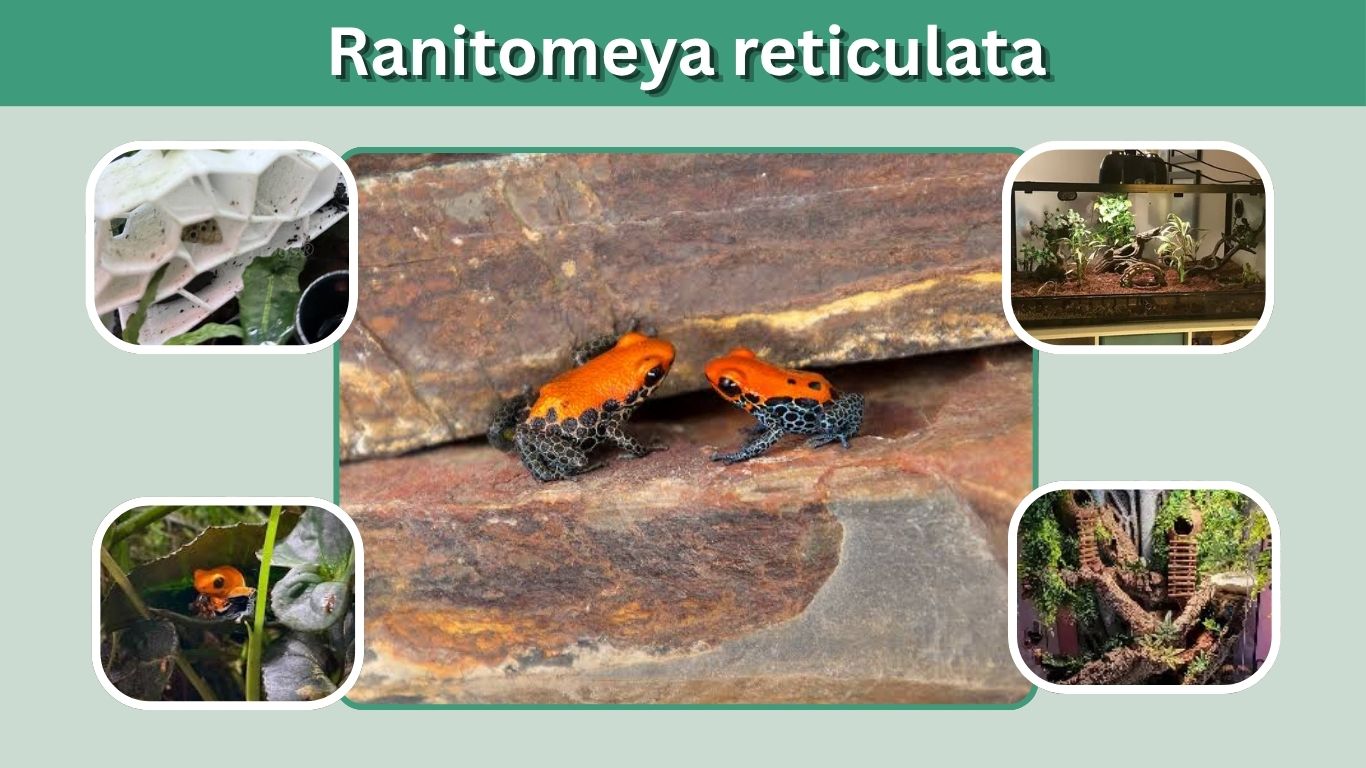
Ranitomeya reticulata is a tiny poison dart frog recognized by its fiery red or orange back and intricate blue-gray network pattern across its legs, sides, and belly. Commonly called the red-backed poison frog or reticulated poison frog, it inhabits humid Amazonian forests in Peru and Ecuador. Its beautiful coloration makes it desirable among experienced amphibian keepers, but its tiny size, specialized diet, sensitivity to heat, and breeding requirements demand careful preparation.
Ranitomeya reticulata Quick Facts
Ranitomeya reticulata belongs to the poison frog family Dendrobatidae. It is among the smallest frogs commonly maintained in tropical vivariums.
| Feature | Details |
| Scientific name | Ranitomeya reticulata |
| Common names | Red-backed poison frog, reticulated poison frog |
| Family | Dendrobatidae |
| Adult size | Approximately 13–17 mm |
| Native range | Peru and Ecuador |
| Habitat | Lowland Amazon rainforest |
| Activity | Diurnal |
| Diet | Tiny ants, mites, springtails, and other arthropods |
| Captive food | Flightless fruit flies and springtails |
| Call | Quiet buzzing or trilling sound |
| Care level | Intermediate to advanced |
| Conservation status | Least Concern |
| International trade | Regulated under CITES Appendix II |
The American Museum of Natural History currently recognizes the species from Amazonian rainforests in Peru’s Loreto region and Ecuador’s Pastaza Province. It is also listed under several common names, including red-backed poison frog and reticulated poison frog.
Appearance and Identification
The frog’s name comes from the net-like pattern covering much of its lower body. “Reticulated” means arranged like a network, accurately describing the pale blue or gray lines surrounding black spots on its legs and sides.
Identification Features
- Bright red, orange-red, or reddish-brown head and back
- Black sides covered with thin blue-gray lines
- Reticulated markings on the legs, belly, and lower body
- Large dark eyes
- Small toe pads for climbing
- Smooth or slightly granular skin
- Compact body measuring less than 2 cm
Juveniles may have more black spotting across the back. As some individuals mature, the red dorsal coloration expands and produces a more solid appearance.
How Large Does It Grow?
Adult Ranitomeya reticulata generally measures about 13–17 mm from snout to vent. Some adult males measure only around 15 mm, making this one of the smallest members of its genus.
Females may appear slightly larger or broader, especially when carrying eggs. However, size alone is not a dependable way to determine sex. Adult males are more reliably identified by their calling behavior.
Solid, Striped, and Iquitos Forms
Names such as “solid,” “striped,” “nominal,” and “Iquitos” are frequently used by breeders to describe captive lines or frogs originating from different localities. They are not formally recognized subspecies.
Solid or Nominal Form
The solid form usually has a nearly unbroken red or orange back. Black markings may remain near the shoulders or sides, while the legs and lower body display the characteristic blue-gray network.
This form is strongly associated with lowland rainforest areas around Iquitos, Peru. For that reason, it may be advertised as Iquitos, nominal, or solid red.
Striped Form
Striped frogs have darker markings running lengthwise across the red back. The exact width, shape, and intensity of the stripes vary between individuals.
Keepers should preserve documented locality lines rather than mixing solid, striped, or unrelated forms. Mixing them can produce frogs with uncertain ancestry and eliminate distinctive captive bloodlines.
Natural Habitat and Distribution
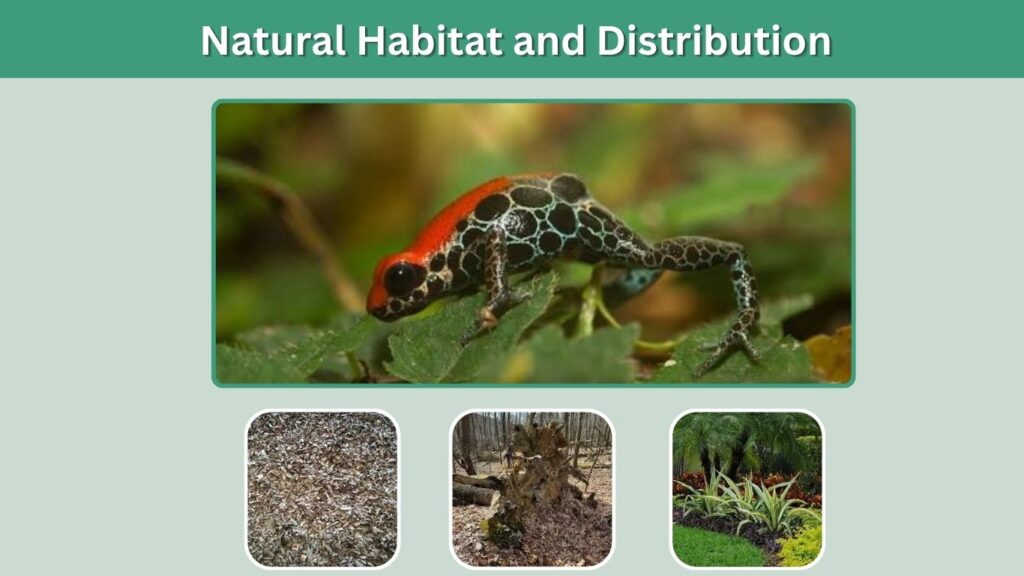
This miniature frog inhabits warm, humid Amazonian forests. It spends considerable time in leaf litter but can also climb vegetation while feeding, calling, or transporting tadpoles.
Suitable natural habitat includes:
- Moist forest floors
- Deep leaf litter
- Fallen logs and branches
- Low-growing tropical plants
- Bromeliads and water-filled plant structures
- Shaded areas with stable humidity
- Abundant populations of tiny arthropods
Although older accounts often described it as exclusively Peruvian, current taxonomic records include populations in Loreto, Peru, and Pastaza, Ecuador.
Is Ranitomeya Reticulata Poisonous?
Wild Ranitomeya reticulata is poisonous rather than venomous. It does not inject toxins through a bite. Instead, defensive alkaloids are stored in glands within its skin.
Poison frogs obtain many of these compounds from ants, mites, termites, and other arthropods consumed in nature. Captive-bred frogs fed fruit flies, springtails, and similarly non-toxic feeder insects generally lack the dangerous skin toxins found in wild individuals.
Even captive frogs should not be handled unnecessarily. Amphibian skin absorbs substances easily, so soap, lotion, salt, oils, and cleaning chemicals on human hands can harm them.
Ranitomeya reticulata Care
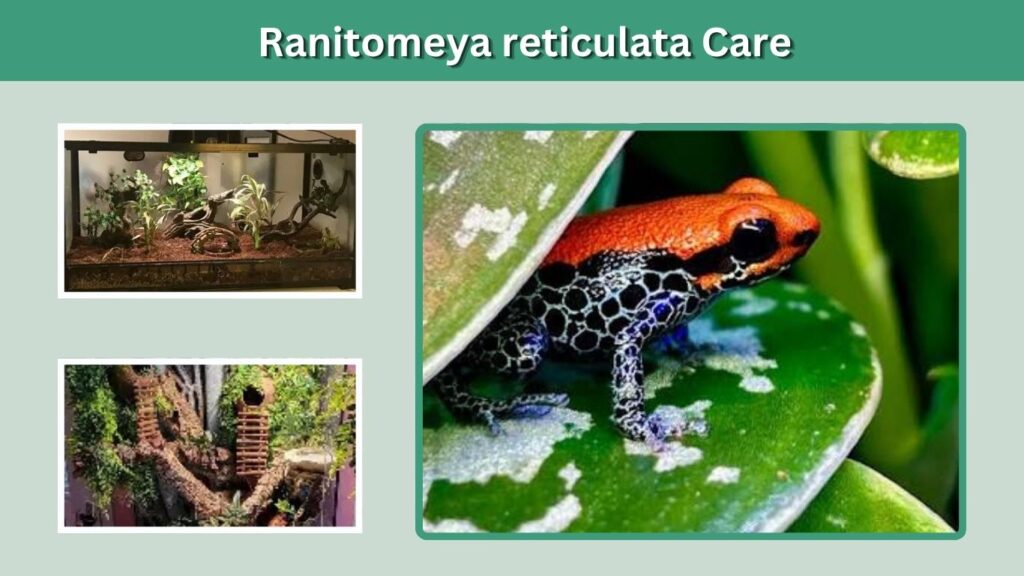
This species is best suited to keepers who already understand bioactive vivariums, feeder-insect cultures, supplementation, and amphibian health. Its tiny body makes it vulnerable to dehydration, overheating, and escape.
Terrarium Size and Design
A vertically oriented tropical vivarium measuring at least approximately 12 × 12 × 18 inches can house a compatible pair, although a larger enclosure provides more stable conditions and additional usable territory.
The enclosure should contain:
- A secure, escape-proof lid
- Good cross-ventilation
- Live tropical plants
- Cork bark and climbing branches
- A thick layer of leaf litter
- Moisture-retaining substrate
- Bromeliads or artificial tadpole-deposition sites
- Springtails and dwarf isopods as a cleanup crew
- Several visual barriers and hiding places
These frogs are extremely small and can escape through narrow gaps around doors, cables, vents, and misting tubes. Large pools and deep water features should be avoided because dart frogs are not strong swimmers.
Temperature and Humidity
A daytime temperature of approximately 70–78°F is appropriate for most captive setups. A small nighttime drop is acceptable.
Temperatures above approximately 80°F require close attention, and prolonged excessive heat can be dangerous. Never place the terrarium in direct sunlight, where the interior temperature can rise rapidly.
Humidity should generally remain around 75–100%, with natural fluctuations rather than permanently saturated conditions. It may approach 100% after misting or overnight before falling as the enclosure ventilates during the day.
Wet surfaces combined with stale air can encourage mold and bacterial growth. High humidity must therefore be balanced with effective ventilation.
Diet and Feeding
Ranitomeya reticulata requires extremely small live prey. Flightless Drosophila melanogaster fruit flies and springtails are the most practical captive foods.
Other suitable prey may include:
- Newly hatched micro-crickets
- Tiny bean beetles
- Small aphids
- Very small insect larvae
- Cultured microfauna living in the enclosure
Feed adults small portions regularly, removing excessive uneaten insects when possible. Feeder insects should be dusted according to an appropriate rotation using fresh calcium and vitamin supplements formulated for amphibians.
A keeper should establish multiple fruit-fly cultures before acquiring the frogs. Depending on a single culture is risky because mold, mites, overheating, or contamination can destroy it.
Behavior and Calling
These frogs are active during daylight, although they may initially remain hidden after being introduced to a new terrarium. Dense planting and abundant cover often help them feel secure enough to become more visible.
What Does the Call Sound Like?
The male produces a soft buzzing or trilling advertisement call. It is much quieter than the calls of many tree frogs and may be difficult to hear from another room.
Calling is used primarily to attract females and communicate with competing males. Frequent calling does not necessarily mean eggs have already been laid, but it indicates that a male is mature and comfortable enough to display reproductive behavior.
Breeding Ranitomeya reticulata
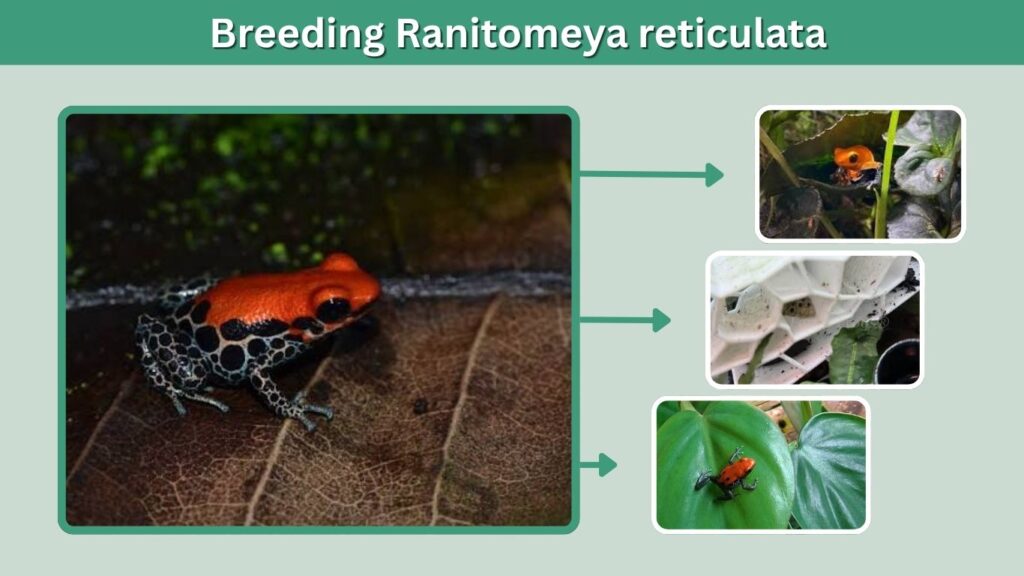
Breeding can be challenging because the eggs are tiny, deposition sites can be difficult to locate, and newly metamorphosed froglets require minute food.
Courtship and Egg Laying
A calling male leads a receptive female toward a sheltered deposition site. In captivity, pairs may use:
- Horizontal film canisters
- Small covered dishes
- Bromeliad leaves
- Curled leaves
- Dark spaces beneath bark or leaf litter
A clutch commonly contains only a few eggs. After the eggs hatch, the male carries the tadpoles on his back and deposits them individually in small bodies of water. Captive observations frequently report clutches of around two or three eggs, although clutch size can vary.
Tadpole and Froglet Care
Tadpoles may be raised individually in small containers containing treated water and appropriate tadpole food. Separate rearing reduces cannibalism and makes development easier to monitor.
Once the front legs emerge and the tail begins shrinking, the developing froglet needs a gently sloped exit from the water. Newly metamorphosed frogs require springtails and the smallest available fruit flies because ordinary feeder insects may be too large.
Finding Ranitomeya reticulata for Sale
Purchase only healthy, captive-bred frogs from a reputable specialist breeder. Ask the seller for the frog’s locality, captive line, age, feeding history, and breeding records.
Avoid sellers who cannot explain whether a frog is solid, striped, Iquitos, or another documented line. A healthy specimen should appear alert, have clear eyes, possess a rounded but not swollen body, and move normally.
All species in the genus Ranitomeya are covered by CITES Appendix II, meaning international commercial movement is regulated. Buyers should confirm local ownership rules and obtain appropriate documentation when frogs cross national borders.
Conservation
Ranitomeya reticulata is currently assessed as Least Concern, but its rainforest habitat can still be affected by clearing, development, pollution, and unregulated collection.
Choosing legally captive-bred frogs reduces pressure on wild populations while providing animals that are better adapted to terrarium conditions.
FAQs
Is Ranitomeya reticulata suitable for beginners?
It is generally better for intermediate or experienced keepers. Its tiny size, need for minute live foods, sensitivity to heat, and escape risk make it less forgiving than larger dart frog species.
How many Ranitomeya reticulata can live together?
A compatible pair is usually the simplest arrangement. Larger groups require more space, visual barriers, feeding stations, and careful monitoring for territorial aggression or competition.
Is Ranitomeya reticulata dangerous to humans?
Wild frogs may carry defensive skin toxins obtained from their diet. Captive-bred frogs fed ordinary cultured insects generally lack significant toxicity, but handling should still be minimized to protect their sensitive skin.
What is the difference between solid and striped reticulata?
Solid frogs have a mostly uninterrupted red or orange back, while striped frogs retain dark lengthwise markings. These are captive or locality labels, not officially recognized subspecies.
How long does Ranitomeya reticulata live?
A well-maintained captive frog may live for several years, and some poison frogs survive for a decade or longer. Longevity depends on genetics, temperature, nutrition, supplementation, hygiene, and veterinary care.
