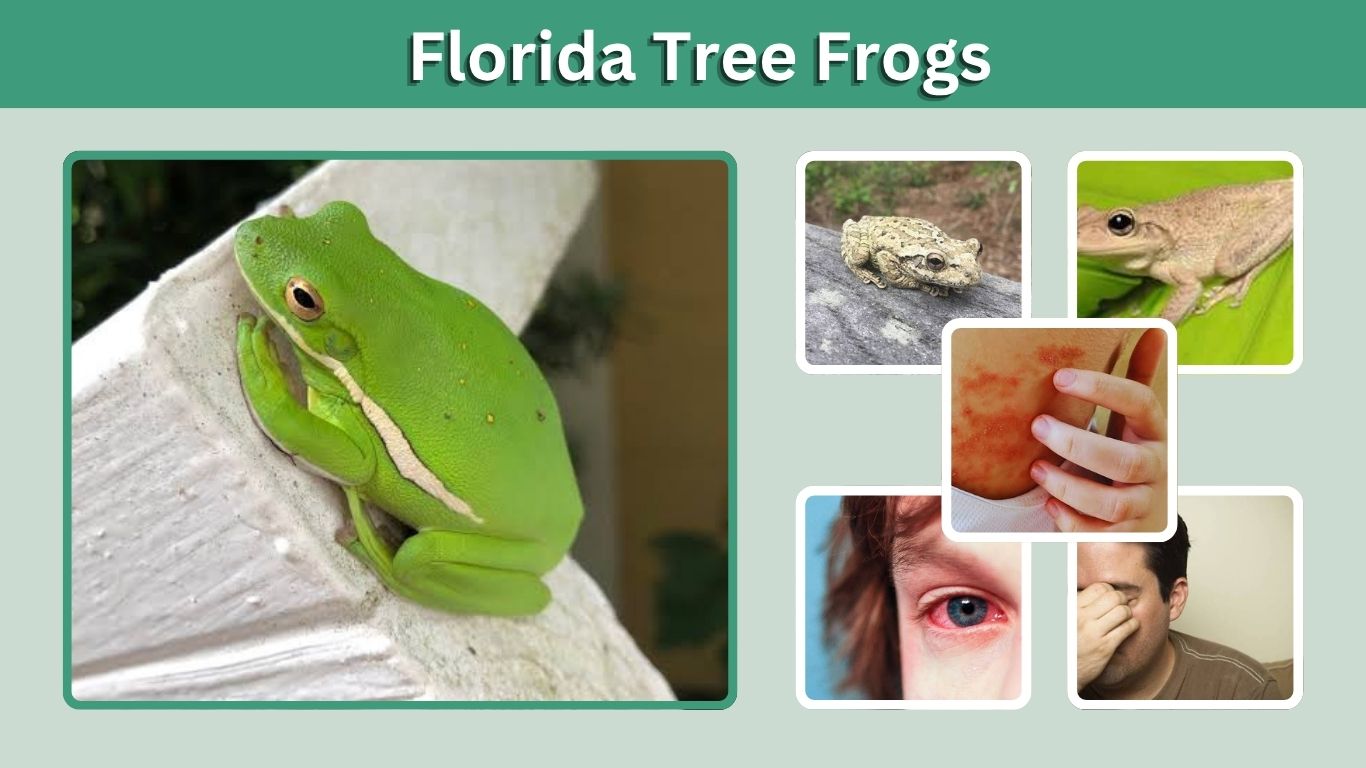
Florida’s warm climate, wetlands, forests, and heavy summer rainfall provide suitable habitat for many tree frogs. Some are bright green, while others may appear brown, gray, or cream. Although most Florida tree frogs are native and beneficial insect hunters, the state also has the invasive Cuban treefrog, which can threaten smaller native species. Learning their colors, markings, sizes, calls, and toe-pad shapes makes identification much easier.
How to Identify a Florida Tree Frog
Tree frogs are climbing amphibians that frequently rest on trees, shrubs, windows, fences, and buildings. Their most recognizable feature is a set of enlarged, rounded toe pads that helps them grip leaves and smooth surfaces.
Florida has 27 native frog species. Four native arboreal species—the barking, green, pinewoods, and squirrel treefrogs—occur widely across the state, while several additional treefrogs have more limited northern or Panhandle ranges.
Key Identification Features
When examining a Florida tree frog, look for:
- Overall body size and shape
- Smooth, grainy, or bumpy skin
- White, yellow, or dark side stripes
- Spots or blotches on the back
- Color hidden behind the thighs
- Size of the eyes and toe pads
- Geographic location
- Call or sound
- Nearby habitat and water sources
Color alone is unreliable because several species can shift among green, gray, tan, and brown shades.
Common Types of Tree Frogs in Florida
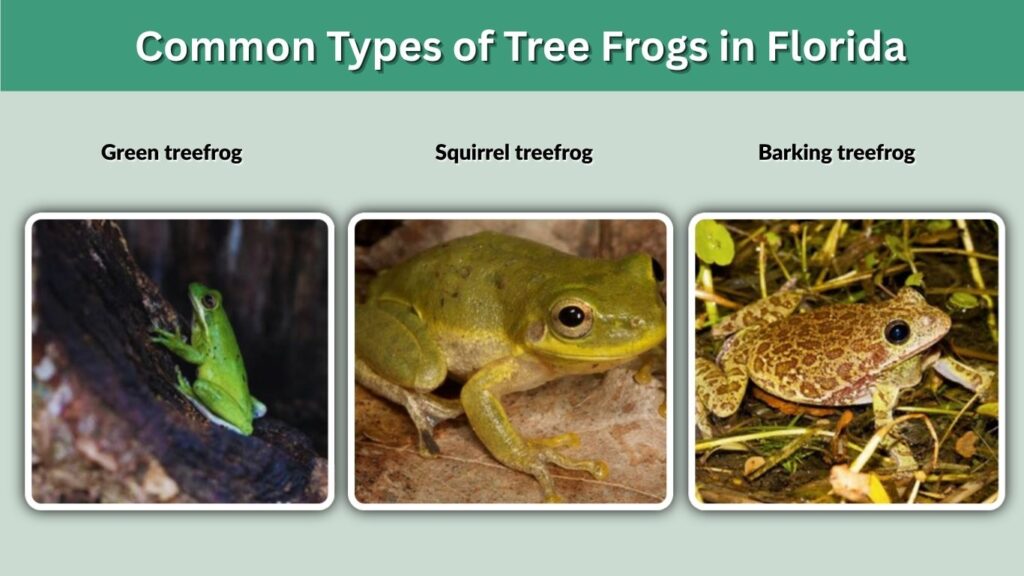
The following species represent Florida’s most recognizable native treefrogs, along with the invasive Cuban treefrog.
| Tree frog | Identification | Florida distribution |
| Green treefrog | Smooth green body and pale side stripe | Statewide |
| Squirrel treefrog | Small, smooth, variable green or brown body | Statewide |
| Barking treefrog | Plump, bumpy body with rounded dark spots | Most of Florida |
| Pinewoods treefrog | Dark facial stripe and orange or yellow thigh spots | Statewide |
| Cope’s gray treefrog | Mottled gray or green body with orange inner thighs | Mainly northern Florida |
| Bird-voiced treefrog | Gray, brown, or green body with a white mark beneath each eye | Florida Panhandle |
| Pine Barrens treefrog | Green body, brown stripe, and yellow-orange markings | Limited Panhandle range |
| Cuban treefrog | Large eyes, oversized toe pads, and irregularly warty skin | Invasive; especially peninsular Florida |
Florida Green Treefrog
The Florida green treefrog, or American green treefrog, is one of the state’s most recognizable native frogs. It is commonly seen around wetlands, gardens, porches, and homes.
Appearance and Size
Green treefrogs are generally between 1 and 2.5 inches long. Their smooth skin may be gray-green, dark green, or bright emerald green. Most have a cream or white stripe extending along each side, often bordered in black, although the stripe may be reduced or absent in some individuals. Small yellow flecks can also occur.
The frog has a slender shape, rounded toe pads, golden eyes, and a pale belly. Its smooth skin distinguishes it from the rougher Cuban treefrog.
Habitat and Diet
Green treefrogs occur statewide and prefer marshes, ponds, swamps, ditches, and vegetation around permanent water. They are nocturnal and often gather around porch lights to capture insects. Their diet consists mainly of flies, mosquitoes, and other small invertebrates.
Florida Green Treefrog Sound
Male green treefrogs produce a short, nasal call that is often described as a repeated “quonk” or “honk.” Calling becomes especially noticeable during warm, humid, and rainy weather.
Frog calls are useful for identification because several visually similar species are difficult to separate by color alone. The Florida Museum provides recordings of native species and the invasive Cuban treefrog.
Other Native Florida Tree Frogs
Florida’s smaller native species can resemble one another, particularly when their colors change.
Squirrel Treefrog
The squirrel treefrog is generally 1 to 1.5 inches long and may be green, gray, tan, or brown. Some individuals have a light side stripe, although it is usually less distinct than the stripe of a green treefrog. Green individuals commonly have a yellowish upper lip.
Squirrel treefrogs live in forests, swamps, gardens, and suburban neighborhoods. Their call resembles a rapid chattering or the sound of a squirrel.
Barking Treefrog
The barking treefrog is Florida’s largest native treefrog. It usually measures around 2 to 2.5 inches and has a rounded, heavy body with uniformly bumpy skin. Its color may be green, gray, or brown, and many individuals have dark, circular spots across their backs.
Its loud call resembles a distant barking dog. It inhabits pinelands, sandy woodlands, marshes, and swampy areas throughout most of Florida, excluding parts of the Everglades and Keys.
Pinewoods Treefrog
Pinewoods treefrogs are slender frogs measuring approximately 1 to 1.5 inches. Their colors include green, gray, tan, and brown. A dark stripe often passes through the eye, while yellow or orange spots appear on the hidden surfaces of the hind legs.
Their rapid, intermittent call is sometimes compared to Morse code. They frequently inhabit pine forests, palms, bromeliads, and vegetation around temporary pools.
Bird-Voiced Treefrog
Found mainly in the Florida Panhandle, the bird-voiced treefrog may appear green, gray, or brown. It has uneven mottling, banded legs, and a small white mark beneath each eye.
Its repeated “wit-wit-wit” call resembles a bird, making sound one of the most reliable ways to distinguish it from Cope’s gray treefrog.
Pine Barrens Treefrog
The Pine Barrens treefrog is a small, striking green frog found in limited areas of the Florida Panhandle. It has a brown band running from the nostril toward the legs, a pale belly, and yellow or orange spotting.
In Florida, it is associated with acidic seepage bogs in Holmes, Okaloosa, Santa Rosa, and Walton counties. It can reach approximately 1.5 inches in length.
Native Florida Treefrog vs. Cuban Treefrog
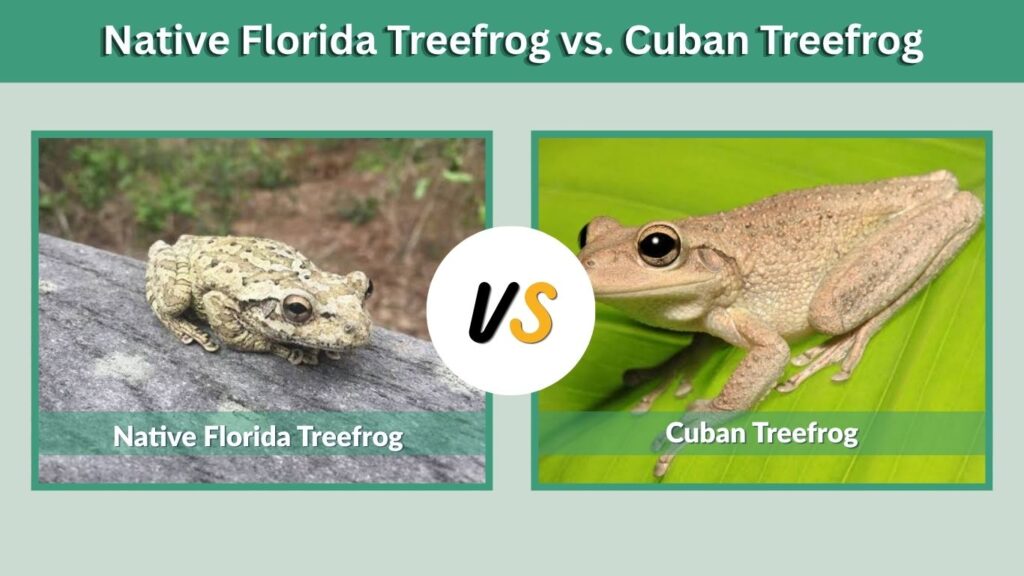
The Cuban treefrog is an invasive species that may be mistaken for a large native frog. It eats native treefrogs and can reduce their numbers around homes and other developed areas.
| Feature | Native green treefrog | Cuban treefrog |
| Skin | Smooth | Irregularly warty |
| Typical shape | Small and slender | Broad and heavy |
| Toe pads | Moderately enlarged | Exceptionally large |
| Eyes | Proportional to head | Large and “bug-eyed” |
| Side stripe | Often white or cream | Usually absent in adults |
| Color | Mainly green | White, tan, brown, gray, yellow, or green |
| Adult size | Usually under 2.5 inches | May exceed 3 inches |
Any Florida treefrog longer than 3 inches is almost certainly a Cuban treefrog. Other clues include oversized toe pads, prominent eyes, random back warts, a yellowish color around the armpits or groin, and bands across the hind legs. However, smaller Cuban treefrogs can be difficult to distinguish from native species.
Do not remove or euthanize a frog unless its identification is certain.
Are Florida Green Tree Frogs Poisonous?
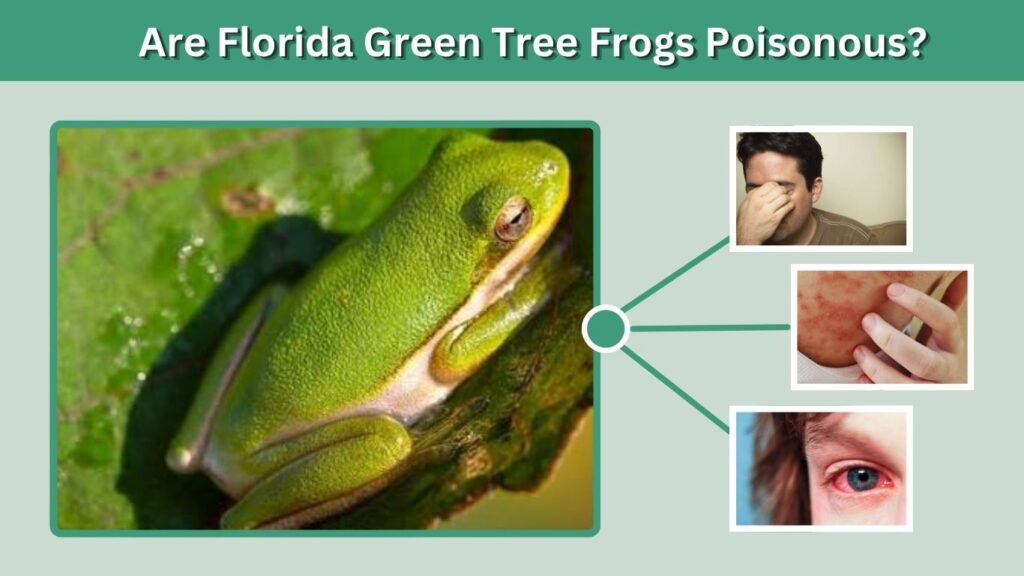
Native green treefrogs are generally considered harmless to people. They may release normal protective skin mucus when stressed, so unnecessary handling should be avoided.
Cuban treefrogs require greater caution because their defensive secretions can irritate human skin, eyes, and nasal tissues. They may also cause excessive salivation when taken into a dog’s or cat’s mouth. Wear protective gloves when handling a suspected Cuban treefrog and avoid touching your face.
Frogs and other amphibians can carry Salmonella even when they appear healthy. Wash your hands thoroughly with soap and water after touching a frog or anything from its environment.
What to Do When You Find a Tree Frog
A native treefrog found outdoors usually needs no assistance. Leave it near its original location unless it is trapped or in immediate danger. Reducing pesticide use, preserving shrubs, and maintaining clean, fish-free garden water features can support native frogs.
Avoid taking wild frogs as pets or relocating them over long distances. Never release a captive frog outdoors because it may introduce diseases or parasites to wild populations.
FAQs
What is the most common green tree frog in Florida?
The American green treefrog is one of Florida’s best-known native green frogs. It has smooth skin, a slender body, rounded toe pads, and usually a pale stripe running from the jaw along each side. It occurs statewide near ponds, marshes, swamps, and other reliable water sources.
Are tiny green frogs in Florida babies?
Not necessarily. Adult squirrel and pinewoods treefrogs may measure only 1 to 1.5 inches. A tiny frog could therefore be a fully grown adult rather than a juvenile. Side stripes, facial markings, skin texture, thigh colors, and calls provide better identification clues than size alone.
Why is a Florida tree frog in my house?
Tree frogs climb walls and windows to hunt insects attracted to outdoor lights. Buildings also provide cool, protected cracks where frogs can rest during daylight. Native green and squirrel treefrogs commonly appear around homes, although Cuban treefrogs are especially associated with buildings in peninsular Florida.
Do Florida tree frogs eat mosquitoes?
Florida treefrogs consume mosquitoes, flies, moths, beetles, and many other small invertebrates. Their exact diet depends on the frog’s size and which prey is available. They can contribute to natural insect control, but they should not be viewed as a complete solution to mosquito problems.
How can I identify a Florida tree frog by sound?
Listen to the call’s rhythm and tone. Green treefrogs make nasal honks, barking treefrogs produce dog-like calls, squirrel treefrogs chatter, pinewoods treefrogs make Morse-code-like notes, and bird-voiced treefrogs repeat whistle-like sounds. Comparing recordings is often more reliable than identifying variable color patterns.
