
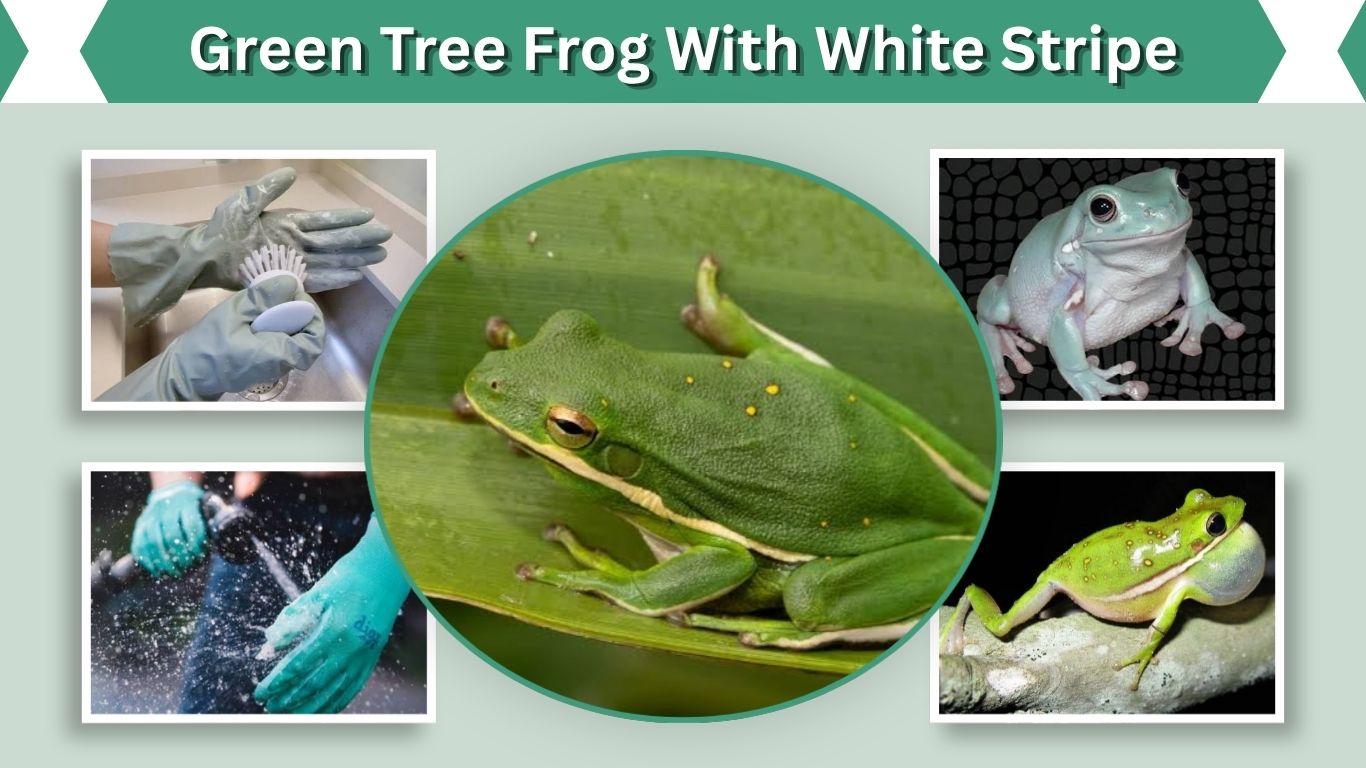
A green tree frog with a white stripe is usually an American green treefrog, a small native frog recognized by the pale line running from its upper lip along each side. However, names such as White’s tree frog and white-lipped tree frog often cause confusion. White bellies, color changes, and small white spots can also make identification difficult.
What Is the Green Tree Frog With a White Stripe?
In the United States, this description most often refers to the American green treefrog, currently classified as Dryophytes cinereus and also widely listed under the older name Hyla cinerea. Its main feature is a cream, yellowish-white, or bright white stripe beginning near the upper lip and extending along the side. The belly is normally white or cream.
Not every individual has an equally long or bold stripe. In some frogs, the line reaches the groin; in others, it fades near the shoulder. Body color may range from lime green to olive or brownish green, but smooth skin and the pale lateral stripe remain useful clues.
| Feature | American Green Treefrog | White’s Tree Frog | White-Lipped Tree Frog |
| Body | Small and slender | Broad and heavy-bodied | Large and robust |
| White marking | Stripe along each side | Pale belly; possible small flecks | Bold line along lower lip |
| Native range | Southeastern United States | Australia and New Guinea | Northern Australia and New Guinea |
| Common context | Wetlands, gardens and porches | Popular pet frog | Wild or specialized exotic pet |
How to Identify an American Green Treefrog
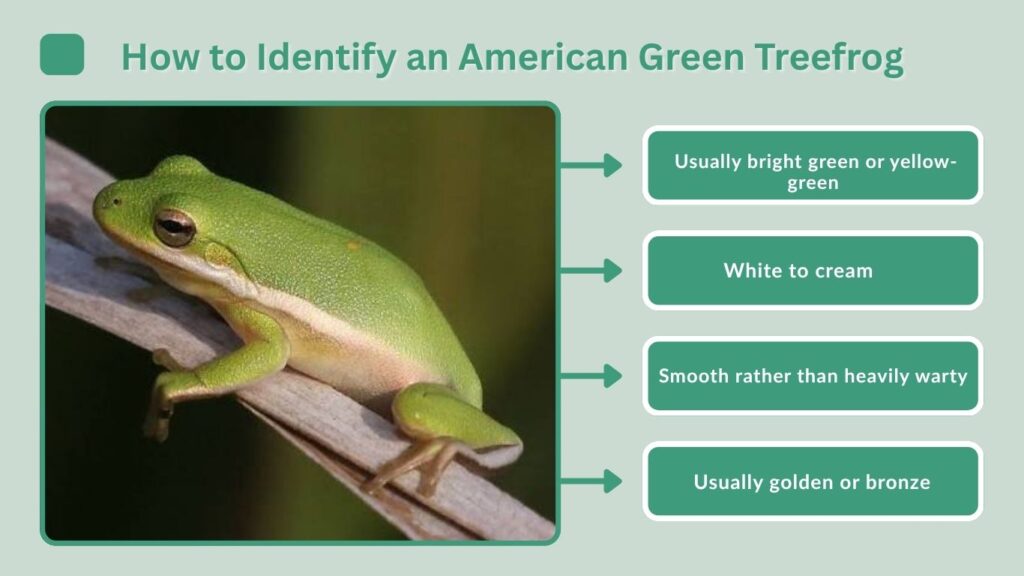
American green treefrogs are small climbing frogs commonly associated with warm, wet habitats. They often rest on leaves, reeds, windows, fences and buildings near water. Enlarged toe pads help them grip vegetation and smooth surfaces.
Key Identification Features
- Color: Usually bright green or yellow-green, although some appear olive or brownish.
- White stripe: A distinct pale line normally runs from the jaw down each side.
- Belly: White to cream.
- Skin: Smooth rather than heavily warty.
- Shape: Slender, with long legs and rounded toe pads.
- Eyes: Usually golden or bronze.
The clearly defined white side stripe is one of the most reliable ways to distinguish this frog from lookalikes such as squirrel and Cuban treefrogs.
Habitat and Range
These frogs inhabit marshes, ponds, swamps, wet meadows, lake edges and vegetation around drainage areas. They also appear around homes where outdoor lights attract insects.
Their range is centered in the southeastern United States. A bright green frog with a clean side stripe in Florida, Texas, Louisiana, Georgia, Alabama, South Carolina or North Carolina is therefore likely to be an American green treefrog.
Calls and Behavior
Males call from vegetation near water during warm, humid weather. These frogs are mainly active after sunset, when they hunt insects and other small invertebrates. During daylight, they often remain still on leaves or sheltered surfaces.
Green Tree Frog vs. White’s Tree Frog
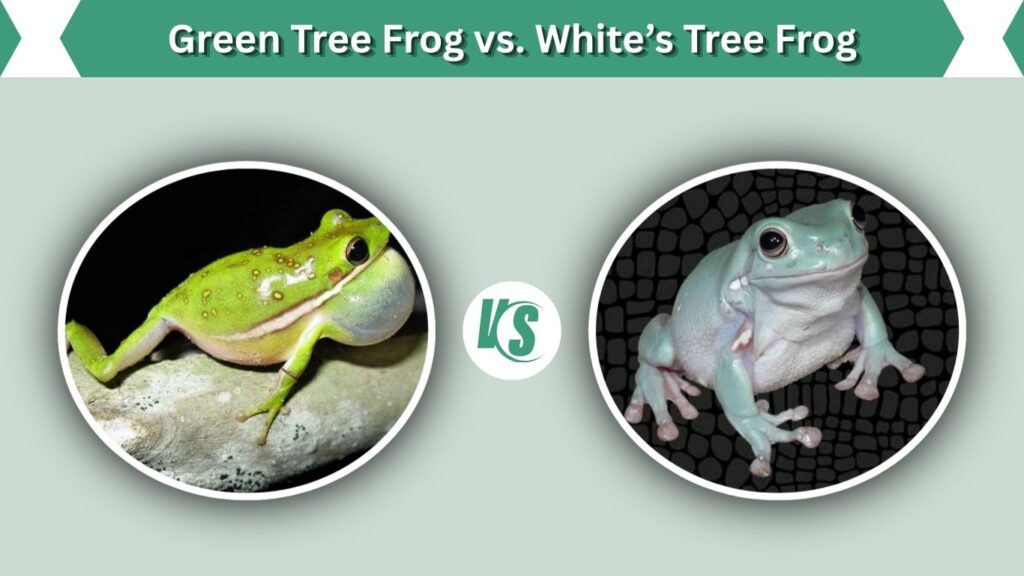
A White’s tree frog is not a white-colored American green tree frog. The name honors John White. This species is also called the Australian green tree frog or dumpy tree frog and is commonly classified as Ranoidea caerulea, although Litoria caerulea is still widely used.
Appearance
White’s tree frogs are broader and heavier than American green treefrogs. They have rounded heads, thick bodies and large toe pads. Their color may be green, blue-green, gray-green or brownish.
Their underside is pale, but they normally lack the long, sharply defined white stripe seen on an American green treefrog. The heavier build and rounded facial appearance are usually the easiest differences to notice.
White Spots on White’s Tree Frogs
A few small, flat and stable pale flecks may be natural. However, spreading discoloration, raised nodules, sores, redness, excessive shedding, swelling, appetite loss or unusual inactivity should not automatically be treated as harmless.
Changes in the spots’ number, texture or size are more concerning than spots that remain unchanged.
Can Green Tree Frogs and White’s Tree Frogs Live Together?
They should generally be housed separately. They differ in adult size, origin and environmental requirements. Mixing amphibian species may also increase stress and the possibility of disease or parasite transmission.
Quarantine is an important preventive measure for newly acquired amphibians because an apparently healthy frog may introduce disease into an established collection.
Why Is a Green Tree Frog Turning White?
A paler frog is not necessarily sick. Frogs can adjust the lightness of their skin as their surroundings and physiological conditions change. Background, lighting, temperature and activity may contribute to these shifts.
Normal Pale Coloration
A resting frog may look mint green, gray-green or unusually pale, especially against a light enclosure surface. It may return to a deeper green later.
A naturally white belly and side stripe should not be mistaken for spreading discoloration. Compare the frog’s current appearance with older photographs taken under similar lighting before deciding that its markings have changed.
Shedding Skin
Frogs regularly shed the outermost layer of their skin. Before or during shedding, the skin may appear cloudy, dull or temporarily pale. A healthy frog usually removes the loosened skin before returning to its typical appearance.
Occasional normal shedding is different from repeated, excessive shedding accompanied by weakness or appetite loss.
When White Color May Signal a Problem
Opaque gray-white skin combined with excessive shedding, appetite loss, lethargy, poor coordination, redness or difficulty righting itself can occur with serious amphibian disease. Raised white, brown or dark nodules may also indicate a fungal infection.
Appearance alone cannot identify the cause. An affected captive frog should be isolated and examined by a veterinarian experienced with amphibians.
Do not use fish medication, antifungal cream, salt, oils or household chemicals without veterinary direction. Frogs readily absorb substances through their skin, and an unsuitable treatment can cause further injury.
What Do White Spots on a Green Tree Frog Mean?
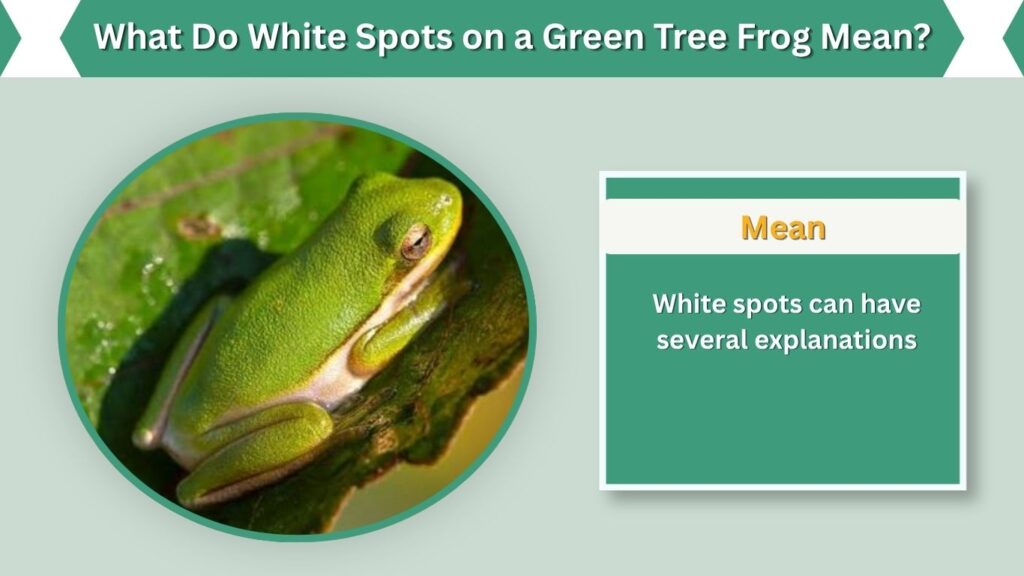
White spots can have several explanations. Their texture, number and progression usually matter more than their color alone.
Normal Markings
A few flat, unchanged pale specks may be part of the frog’s natural coloration. Photographing the frog under similar lighting every few days can help determine whether the markings are stable or spreading.
Natural markings should not be raised, fuzzy, bleeding or surrounded by inflamed skin.
Environmental Residue
Minerals from misting water or small substrate particles can temporarily remain on a captive frog’s skin. Never scrub the frog or attempt to remove the material with chemicals.
Provide clean, dechlorinated water and observe whether the material disappears naturally during normal movement or shedding.
Possible Skin Disease
Seek veterinary help when spots are:
- Raised, fuzzy or crusted
- Rapidly increasing in number
- Bleeding or ulcerated
- Surrounded by red or dark skin
- Accompanied by swelling
- Associated with appetite or weight loss
Poor grip, abnormal posture, unusual soaking and repeated shedding are additional signs that the frog may require professional care.
White-Lipped Green Tree Frog
The white-lipped tree frog is a separate, very large species native to northern Australia and New Guinea. Its signature marking is a conspicuous white line along the lower lip rather than a stripe extending down the entire side.
It has a long head, robust body, large toe pads and green-to-olive coloration. Because several unrelated species share the “green tree frog” name, location, size, body shape and the exact position of the white marking are important for identification.
What Should You Do After Finding One?

A wild green treefrog found outdoors usually does not need help. Leave it where it is unless it faces immediate danger from traffic, pets, chemicals or machinery. Avoid unnecessary handling because frogs have delicate, absorbent skin.
When relocation is necessary, use clean, moistened, powder-free gloves and move it only a short distance to nearby sheltered vegetation. Handling should be brief to limit stress and prevent potentially harmful materials from contacting the frog’s skin.
Do not take a wild frog as a pet, and never release a captive frog outdoors.
FAQs
Why does a green tree frog have a white stripe?
The white or cream stripe is a normal feature of the American green treefrog. It usually begins near the upper lip or beneath the eye and continues along the side, helping distinguish the species from similar small green frogs.
Is a green tree frog with white spots sick?
Not always. Flat, stable spots may be natural markings or temporary residue. Concern increases when spots spread, become raised or fuzzy, or occur with lethargy, redness, poor appetite, swelling or abnormal shedding.
Why is my green tree frog changing from green to pale?
Tree frogs may become lighter or darker as environmental and physiological conditions change. Temporary paleness can be normal. Persistent discoloration accompanied by behavioral or physical symptoms should be evaluated by an amphibian-experienced veterinarian.
Is a White’s tree frog the same as an American green treefrog?
No. White’s tree frog is a large, heavy-bodied species from Australia and New Guinea. The American green treefrog is smaller, slimmer, native to the southeastern United States and usually has a clear pale stripe along each side.
Can I touch a green tree frog?
Handling should be minimal. Products on human skin may harm a frog, while handling itself can cause stress. When contact is necessary, use clean, moistened, powder-free gloves and keep the interaction brief.
