
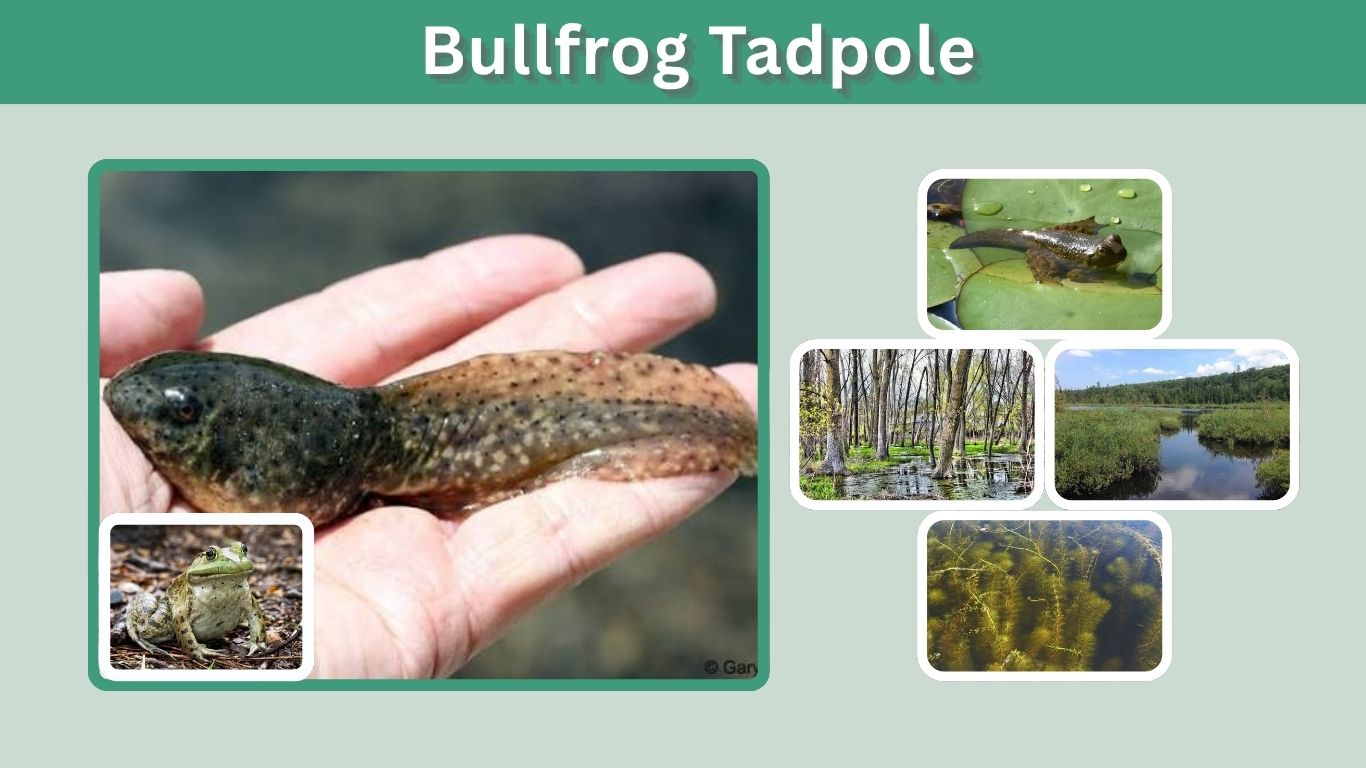
A bullfrog tadpole is the aquatic larval stage of the American bullfrog (Lithobates catesbeianus). Unlike many smaller frog tadpoles, bullfrog tadpoles can grow remarkably large and may remain in water for months or even years before completing metamorphosis. They typically have an olive-green or brownish body, scattered dark spots, and a long, powerful tail. Bullfrog tadpoles mainly graze on algae and aquatic vegetation. Their size, slow development, distinctive markings, and preference for permanent water make them relatively easy to recognize.
What Does a Bullfrog Tadpole Look Like?
Bullfrog tadpoles become much larger than the larvae of many familiar frogs and toads. Their appearance changes as they develop, but mature tadpoles generally have a thick, rounded body with an elongated tail. Color and spotting are particularly useful identification clues when distinguishing them from other large tadpoles living in the same pond.
Bullfrog Tadpole Identification
Common identifying characteristics include:
- Olive-green to brownish body
- Scattered small black spots
- Dark speckling on the tail
- Large, rounded body
- Long tail with a broad fin
- Eyes positioned toward the upper sides of the head
- No clearly visible intestinal coil through the body
- Much larger size than many common tadpoles
USGS describes American bullfrog tadpoles as approximately 15 cm long, olive green, and marked with scattered black dots. Small black spots on the tail fin are another useful feature.
How Big Do Bullfrog Tadpoles Get?
A mature American bullfrog tadpole can reach approximately 15–16 cm, or around 6 inches, in total length. That includes the tail, which accounts for much of the animal’s overall length.
Their unusually large size is one of the easiest ways to recognize mature bullfrog larvae. A USGS regional identification guide depicts an American bullfrog larva at approximately 16.2 cm total length.
Bullfrog Tadpole vs. Smaller Tadpoles
Young bullfrog tadpoles can be difficult to distinguish from other frog larvae because they have not yet reached their characteristic large size.
As they mature, their combination of olive coloration, dark spotting, robust body, and considerable length becomes much more distinctive.
Bullfrog Tadpole Stages and Life Cycle
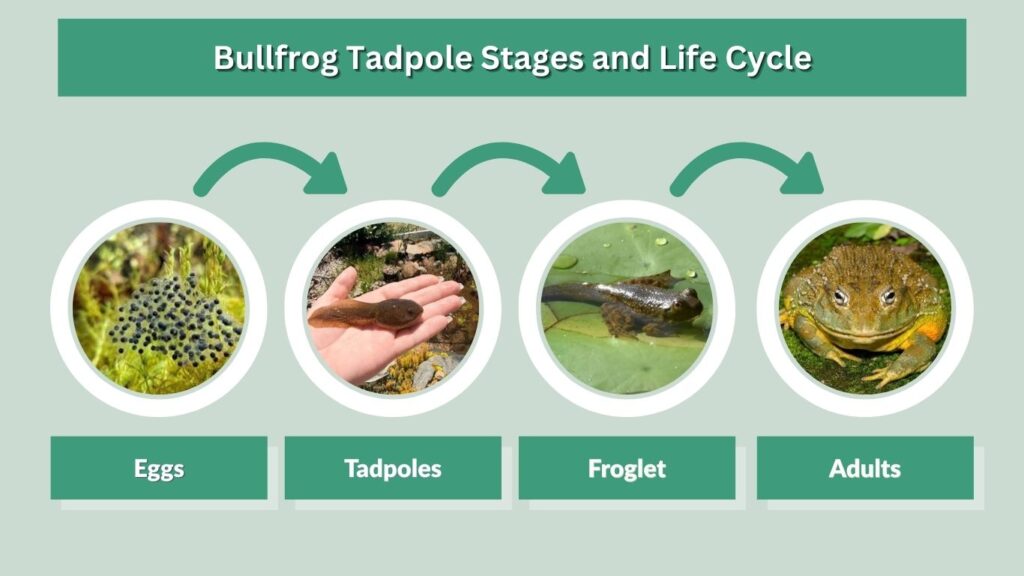
The bullfrog life cycle begins when a female deposits thousands of eggs in water. After hatching, larvae remain completely aquatic and gradually increase in size before developing legs and transforming into froglets. Bullfrog development is unusually slow compared with many amphibians, particularly in northern climates where tadpoles may overwinter before metamorphosis.
1. Egg Stage
Female American bullfrogs can produce very large egg masses containing thousands of eggs. USGS reports roughly 6,000–20,000 eggs in a reproductive event.
Eggs float near the water’s surface in broad masses and generally hatch within several days under suitable conditions.
2. Early Tadpole Stage
Newly hatched tadpoles have small bodies, tails, and gills. They remain in water and begin feeding as they develop.
At this stage, they look much less like adult frogs and may be difficult to identify without knowing the species that produced the egg mass.
3. Growing Tadpole
The tadpole becomes substantially larger while remaining aquatic. It grazes on available plant material and algae and stores energy necessary for further development.
Bullfrog tadpoles can spend a surprisingly long period at this stage.
4. Tadpole With Legs
Hind legs appear first. Front legs later emerge as metamorphosis progresses.
At the same time, the animal’s internal anatomy begins changing to support a more terrestrial and carnivorous frog lifestyle.
5. Froglet
The tail gradually shrinks as its stored material is absorbed. Eventually, the animal resembles a miniature bullfrog with four developed legs and only a small remaining tail.
Once metamorphosis is complete, its diet and behavior change substantially.
How Long Do Bullfrogs Stay Tadpoles?
One remarkable characteristic of American bullfrogs is the length of their larval period. Unlike species that transform within a few weeks, bullfrog tadpoles may remain aquatic through one or more winters. Temperature, latitude, food supply, water permanence, and other environmental conditions strongly influence how quickly metamorphosis occurs.
Bullfrog Tadpole to Frog Timeline
USGS reports that bullfrog eggs hatch in approximately 2–5 days, while metamorphosis may take anywhere from about four months to two years. Other references report that tadpoles in colder conditions can remain in the larval stage even longer.
Development generally involves:
- Egg hatching
- Early larval growth
- Several months of feeding
- Possible overwintering
- Hind-leg development
- Front-leg emergence
- Tail absorption
- Transition into a froglet
Why Does Development Take So Long?
Temperature is especially important because bullfrogs are ectothermic. Cooler conditions slow metabolism and growth.
Permanent ponds are therefore important for bullfrog reproduction. Tadpoles that require more than one growing season need water that remains available long enough for them to complete metamorphosis.
Do Bullfrog Tadpoles Overwinter?
Yes. In many regions, tadpoles remain underwater during winter and continue developing when conditions become favorable again.
This extended aquatic phase is one reason mature bullfrog tadpoles can become so large.
What Do Bullfrog Tadpoles Eat?
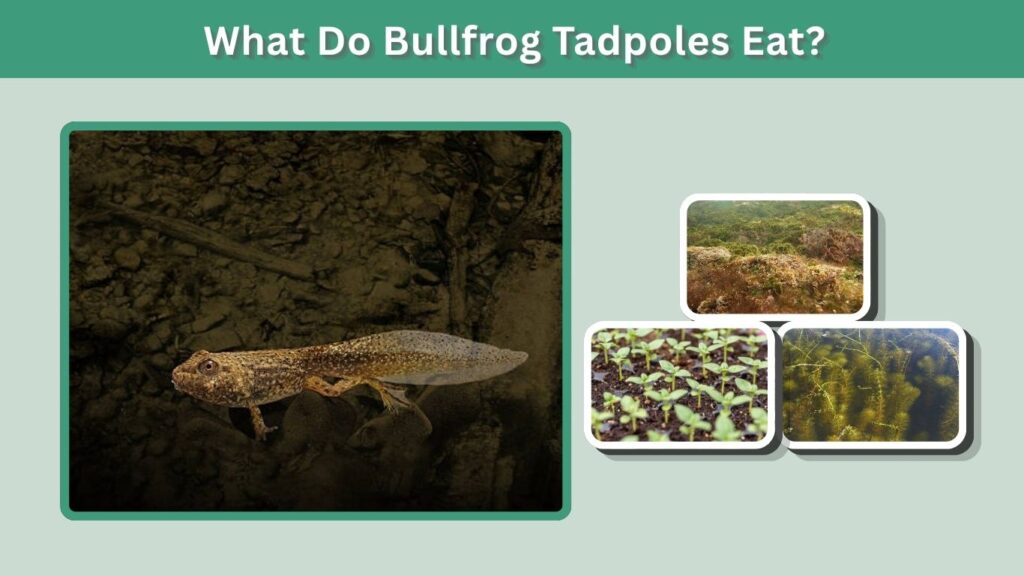
Bullfrog tadpoles eat very differently from adult bullfrogs. Adults are opportunistic predators capable of eating insects, fish, frogs, and other animals, while tadpoles mainly graze on plant material. This dietary change is one of the most significant transformations that occurs as a bullfrog progresses from an aquatic larva into an adult predator.
Natural Bullfrog Tadpole Food
Wild bullfrog tadpoles commonly consume:
- Algae
- Aquatic vegetation
- Plant material
- Biofilm on underwater surfaces
- Decaying organic matter
- Microscopic material associated with plants and pond surfaces
Animal Diversity Web describes bullfrog tadpoles as primarily grazing on aquatic plants.
Do Bullfrog Tadpoles Eat Mosquito Larvae?
A bullfrog tadpole should not be considered a specialized mosquito-larvae predator. Its normal feeding behavior is primarily grazing on algae and plant material.
Other aquatic animals may be far more active predators of mosquito larvae.
Do Bullfrog Tadpoles Eat Other Tadpoles?
Cannibalism is well documented in post-metamorphic bullfrogs, but vegetation and algae make up the primary diet of typical bullfrog tadpoles. Therefore, feeding them or identifying them as mainly predatory larvae would be inaccurate.
Bullfrog Tadpole Habitat
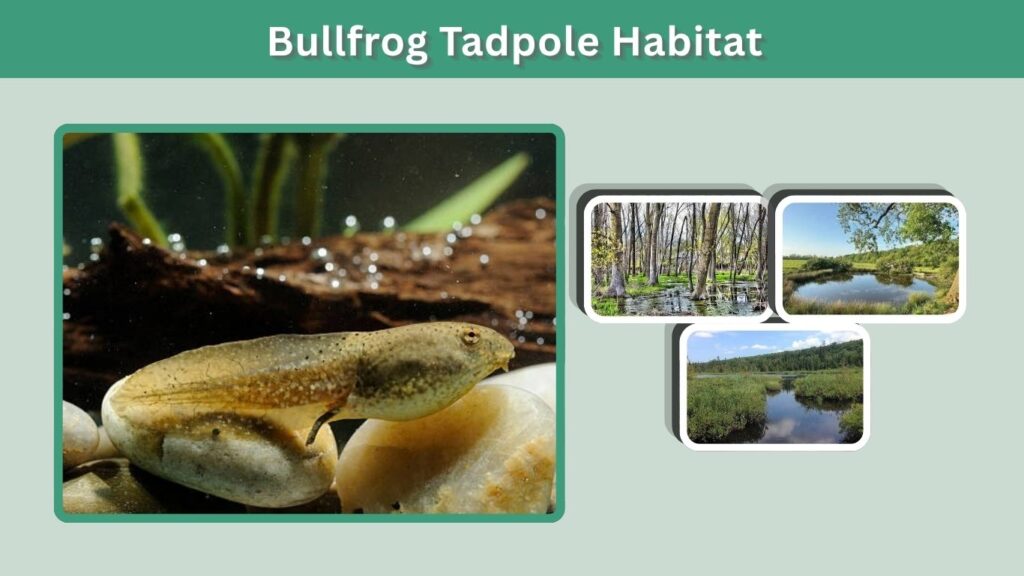
Bullfrog tadpoles are strongly associated with water that remains available long enough for their unusually long development. American bullfrogs are habitat generalists, but successful breeding often occurs in permanent or semi-permanent freshwater environments with vegetation, food, and relatively calm water.
Common Bullfrog Tadpole Habitats
They may occur in:
- Ponds
- Lakes
- Marshes
- Swamps
- Reservoirs
- Slow river backwaters
- Irrigation canals
- Ditches
- Cattle ponds
- Other permanent freshwater habitats
USGS notes that the persistence of aquatic habitat is particularly important because bullfrog tadpoles may need to overwinter before metamorphosis.
Why Permanent Water Matters
A species that can remain a tadpole for a year or more cannot rely entirely on pools that disappear shortly after the breeding season.
Permanent ponds give larvae time to grow, overwinter, and eventually complete their transition into young frogs.
How to Care for a Bullfrog Tadpole
Keeping a bullfrog tadpole requires more preparation than keeping a tiny short-lived tadpole because the animal can grow to several inches and remain aquatic for a long period. Before collecting or keeping one, check local wildlife regulations; American bullfrogs are invasive in some regions and moving or releasing them can harm native ecosystems.
Basic Care Considerations
If keeping bullfrog tadpoles is legal where you live, important requirements include:
- Plenty of clean, dechlorinated water
- Adequate swimming space
- Stable water conditions
- Avoiding overcrowding
- Plant-based and appropriate tadpole foods
- Gradual access to land as metamorphosis begins
- Secure housing for the developing froglet
Avoid making dramatic changes to water temperature or chemistry.
Feeding Captive Tadpoles
Food should reflect their naturally herbivorous grazing behavior. Suitable prepared tadpole foods and plant-based options are preferable to feeding them as though they were adult carnivorous bullfrogs.
Remove excess food before it decomposes and harms water quality.
Preparing for Metamorphosis
Once the front and hind legs are developing and the tail begins shrinking, the animal needs easy access to a place where it can leave the water.
The newly transformed froglet is entering a completely different stage of life and will eventually require an appropriately designed enclosure and animal-based diet.
Bullfrog Tadpole vs. Green Frog Tadpole
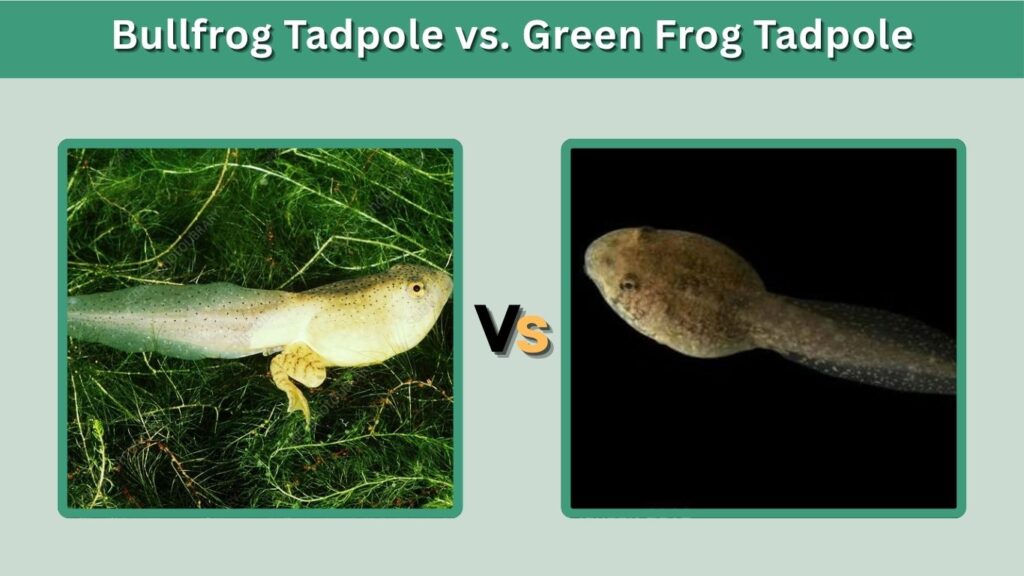
Bullfrog and green frog tadpoles can occur in similar habitats, making identification challenging. Size provides an important clue once larvae mature, but young individuals may still look alike. Color, spotting, body proportions, local species distribution, and careful examination are more useful when considered together than any single characteristic.
Size and Appearance
Bullfrog tadpoles become particularly large and commonly show an olive body covered with small dark spots. Mature individuals may approach six inches.
A very large, dark-spotted tadpole in a permanent pond is therefore a strong candidate for an American bullfrog, although identification should ideally use several physical characteristics rather than size alone.
Do Not Rely Only on Color
Lighting, water quality, age, and individual variation can change how a tadpole appears.
When accurate species identification matters, photographs of the body and tail or examination by someone familiar with local amphibians is more reliable.
FAQs
Bullfrog tadpoles stand out because they can become remarkably large and spend much longer in the larval stage than many familiar frogs. Their slow development also means they depend strongly on stable aquatic environments. The following questions address the most common concerns about their identification, growth, diet, and transformation.
1. How big can a bullfrog tadpole get?
An American bullfrog tadpole can grow to approximately 15–16 cm, or about 6 inches, in total length before metamorphosis.
2. What do bullfrog tadpoles eat?
They mainly graze on algae and aquatic plant material, although they may also consume other organic material available on submerged surfaces.
3. How long does a bullfrog stay a tadpole?
Development varies considerably. USGS reports that metamorphosis can take approximately four months to two years, with longer larval periods possible under cooler conditions.
4. What do bullfrog tadpoles look like?
They generally have a large olive-green body, scattered black spots, and a long spotted tail. Mature larvae are much larger than many other common frog tadpoles.
5. Can bullfrog tadpoles survive winter?
Yes. Bullfrog tadpoles can overwinter underwater when development is not completed during their first warm season. Permanent aquatic habitats allow them to survive and continue development later.
