

How big can a bullfrog get? The American bullfrog (Lithobates catesbeianus) is the largest frog native to much of North America. Adults commonly measure about 3.5–6 inches from snout to vent, while exceptionally large individuals can exceed 8 inches when measured more broadly and may weigh over 2 pounds. Their powerful legs make them appear even larger when fully extended. Sex, age, food availability, habitat, and health all influence size. This guide explains bullfrog length, weight, growth, lifespan, and how males and females compare.
How Big Can a Bullfrog Get?
American bullfrogs are exceptionally large compared with most frogs found in the United States. Measurements can differ depending on whether a source reports snout-to-vent length or a broader overall measurement, so published maximum sizes vary. USGS lists adult snout-to-vent lengths of approximately 9–15.2 cm, or about 3.5–6 inches.
Bullfrog Size at a Glance
A mature American bullfrog can reach impressive proportions:
- Typical adult body length: About 3.5–6 inches
- Large individuals: Can exceed 8 inches by some measurements
- Maximum weight: Exceptional adults can exceed 2 pounds
- Tadpole length: Large tadpoles may reach about 6 inches
- Body shape: Broad head, heavy body, and muscular hind legs
California’s Department of Fish and Wildlife reports that adult bullfrogs can exceed 8 inches in length and weigh more than 2 pounds.
Why Do Size Estimates Differ?
Frogs are commonly measured using snout-to-vent length (SVL), which runs from the tip of the nose to the rear end of the body and excludes the legs.
That explains why USGS gives a maximum adult SVL of about 15.2 cm, while other wildlife agencies describe bullfrogs as reaching around 8 inches using different measurements or exceptionally large specimens.
How Large Do Their Legs Make Them Look?
A bullfrog’s folded hind legs account for a substantial portion of its overall appearance. When those legs are extended during swimming or jumping, the frog’s total nose-to-toe length is much greater than its official body measurement.
This is why a six-inch-bodied bullfrog can look enormous when it leaps.
Male vs. Female Bullfrog Size
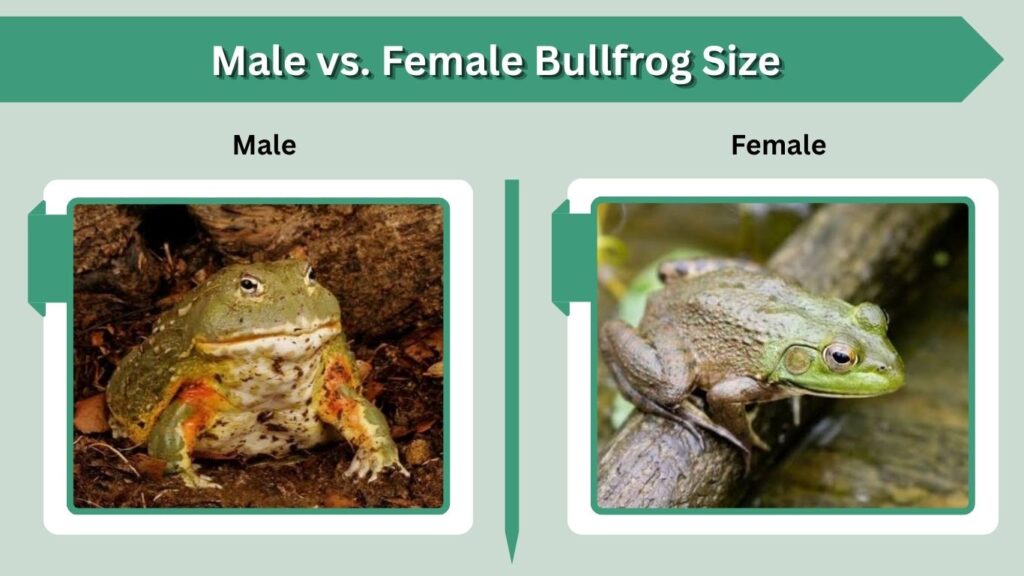
Male and female bullfrogs share the same heavy-bodied appearance, but sex can influence overall size and proportions. Identifying sex from size alone is unreliable because age and individual variation also matter. The tympanum—the circular external eardrum behind the eye—and throat coloration provide more useful identification clues in mature animals.
Are Male or Female Bullfrogs Bigger?
Adult females often attain greater body length, although large males can also become impressive. Individual size depends heavily on age, food availability, genetics, and environmental conditions.
Males can be recognized by their proportionally large tympanums. USGS notes that a male’s tympanum can be roughly twice the diameter of its eye, whereas a female’s is approximately the same size as the eye.
Other Male and Female Differences
When examining an adult bullfrog, look for:
- Male throat: Commonly yellow during breeding season
- Female throat: Usually pale or whitish
- Male tympanum: Larger than the eye
- Female tympanum: Approximately equal to the eye
- Body size: Females can become particularly large
The National Park Service also describes the yellow throat as a characteristic of male American bullfrogs.
How Fast Do Bullfrogs Grow?
Bullfrog growth starts with an aquatic tadpole stage that can last much longer than many people expect. Growth rate varies according to temperature, food availability, water conditions, and geographic location. Tadpoles in warmer environments may develop differently from individuals living where cold winters shorten the annual growing season.
From Tadpole to Adult
The basic growth sequence includes:
- Eggs are deposited in water.
- Eggs hatch into aquatic tadpoles.
- Tadpoles grow and develop hind and front legs.
- The tail is gradually absorbed during metamorphosis.
- Juvenile frogs leave the tadpole stage.
- Young bullfrogs continue growing toward adult size.
Large bullfrog tadpoles themselves can reach approximately 6 inches, according to California wildlife authorities.
When Are Bullfrogs Fully Grown?
There is no single exact age at which every bullfrog reaches maximum size. Growth continues after metamorphosis, and older animals generally have had more time to reach large dimensions.
American bullfrogs reach reproductive maturity at roughly three to five years according to Animal Diversity Web, although development varies with climate and local conditions.
What Makes a Bullfrog Grow So Large?

Bullfrogs are opportunistic predators with broad diets. Their large mouths, muscular bodies, and sit-and-wait hunting strategy allow adults to capture surprisingly substantial prey. Good aquatic habitat also gives them access to abundant food while providing vegetation and deep water where they can hide from predators.
What Do Large Bullfrogs Eat?
Adult bullfrogs may consume:
- Insects
- Crayfish
- Snails
- Small fish
- Other frogs
- Small reptiles
- Occasionally small birds or other vertebrates
The National Park Service reports that bullfrogs eat prey including crayfish, water beetles, snails, dragonfly larvae, small fish, and occasionally small birds.
Can a Bullfrog Eat a Bird?
Yes, sufficiently large bullfrogs can occasionally capture very small birds, although birds are not their primary food.
Bullfrogs are opportunistic ambush predators. If an appropriately sized animal moves close enough to the frog and can be swallowed, the bullfrog may attempt to capture it.
Do Bullfrogs Eat Other Frogs?
Large bullfrogs can consume smaller frogs. Their willingness to prey on other amphibians is one reason introduced American bullfrogs can create problems for native wildlife.
Their large adult size, broad diet, and adaptability allow them to become formidable predators outside their native range.
Where Do the Biggest Bullfrogs Live?

American bullfrogs thrive around permanent freshwater where food and protective vegetation are plentiful. They are native to central and eastern portions of North America but have been introduced widely elsewhere. Their ability to occupy both natural and human-made water bodies contributes to their extensive distribution.
Preferred Bullfrog Habitat
Common habitats include:
- Ponds
- Lakes
- Marshes
- Swamps
- Slow-moving streams
- River edges
- Canals
- Ditches
- Vegetated wetlands
Bullfrogs generally favor warm, slow-moving or still water with abundant vegetation.
Does Habitat Affect Size?
Habitat quality can influence growth. A bullfrog living where prey is abundant and suitable water persists throughout the year may have better opportunities for growth than one facing food shortages, drought, heavy competition, or disease.
However, genetics, age, sex, and local climate also contribute to individual size.
American Bullfrog vs. African Bullfrog Size
The word bullfrog does not always refer to the American bullfrog. The African bullfrog (Pyxicephalus adspersus) is a completely different species. Both are unusually large frogs, but African bullfrogs have an even heavier, rounder appearance, while American bullfrogs are closely associated with permanent aquatic habitats.
They Are Different Species
An American bullfrog is Lithobates catesbeianus and is native to eastern North America. It has a relatively streamlined aquatic body, extensively webbed hind feet, and a conspicuous tympanum.
The African bullfrog is native to parts of Africa and has a more massive, broad-bodied appearance.
Therefore, exceptionally large photographs labeled simply “bullfrog” should not automatically be assumed to show an American bullfrog.
How Long Can a Bullfrog Live?

Large adult sizes take time to develop, and American bullfrogs can live for several years. Their longevity varies greatly because wild frogs face predation, disease, habitat changes, weather extremes, and other hazards that captive animals may avoid.
Average Bullfrog Lifespan
Animal Diversity Web reports that American bullfrogs generally live around 7–9 years in the wild, while a recorded captive individual reached about 16 years.
Older frogs have more time to attain substantial size, although age cannot be accurately determined simply by looking at how large a bullfrog is.
Does a Giant Bullfrog Mean It Is Old?
Not necessarily. A particularly big frog is likely mature, but size is not a reliable age calculator.
Two bullfrogs of the same age can differ substantially because of sex, genetics, prey availability, habitat quality, disease history, and environmental conditions.
FAQs
Bullfrogs attract attention because mature individuals are dramatically larger than many familiar backyard frogs. Body measurements can also be confusing because scientific sources usually measure only from snout to vent, whereas casual measurements may include other portions of the animal. These answers clarify several common questions about their maximum size.
1. How big can an American bullfrog get?
American bullfrogs typically reach about 3.5–6 inches in snout-to-vent length, although exceptionally large frogs may be described as exceeding 8 inches depending on how they are measured.
2. How much can a bullfrog weigh?
Very large American bullfrogs can weigh more than 2 pounds, although most adults are considerably lighter.
3. How big can a bullfrog tadpole get?
American bullfrog tadpoles can grow remarkably large, sometimes reaching approximately 6 inches long before completing metamorphosis.
4. What is the biggest frog in North America?
The American bullfrog is the largest native true frog in eastern North America and the largest frog species commonly recognized in the United States.
5. How long can a bullfrog live?
American bullfrogs generally live around 7–9 years in the wild, while captive individuals can live considerably longer; Animal Diversity Web reports a captive record of 16 years.
