
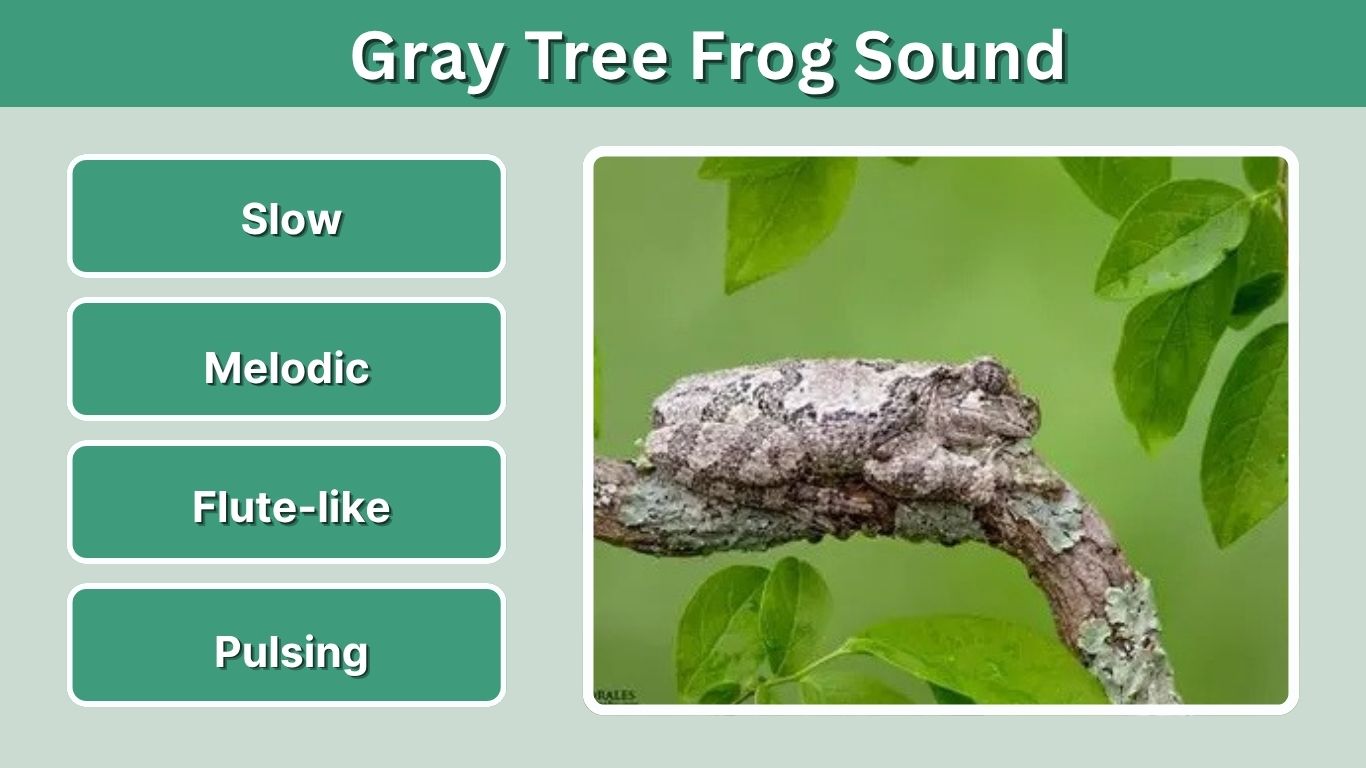
The sound of a gray tree frog is a short, powerful trill commonly heard from wooded ponds, wetlands and suburban yards during warm spring and summer nights. The familiar breeding call is produced by males trying to attract females. Two nearly identical species—the eastern gray treefrog and Cope’s gray treefrog—make similar sounds, but their speed and tone differ. Learning these differences is often the most reliable way to identify which gray treefrog lives nearby.
What Does a Gray Tree Frog Sound Like?
A gray tree frog sounds like a musical, vibrating trill. People sometimes compare it to a ringing telephone, a rapidly shaken metal object or a birdlike whistle.
The call generally has these characteristics:
- A short, pulsing trill
- A loud, resonant quality
- Repetition several times each minute
- A duration of roughly 0.5–3 seconds
- A speed that changes with temperature
- A sound commonly heard after dark
The eastern gray treefrog produces a slower, more melodic trill. Cope’s gray treefrog makes a faster, harsher and more mechanical-sounding call. Their appearance is almost identical, making sound the easiest field identification method.
Eastern Gray Tree Frog Sound
The eastern gray treefrog, Dryophytes versicolor, produces a slow, musical trill. It usually sounds smoother and more flute-like than the call of Cope’s gray treefrog.
Call Description
The eastern species’ call may be described as:
- Slow
- Melodic
- Flute-like
- Pulsing
- Resonant
- Slightly birdlike
Each trill is relatively short, followed by a quiet interval before the frog calls again. Several males calling around the same wetland can create a continuous chorus.
The call rate is affected by temperature. A frog generally produces faster pulses during warm conditions and slower pulses on cooler nights. Therefore, comparing recordings made at different temperatures can sometimes cause confusion.
Cope’s Gray Tree Frog Sound
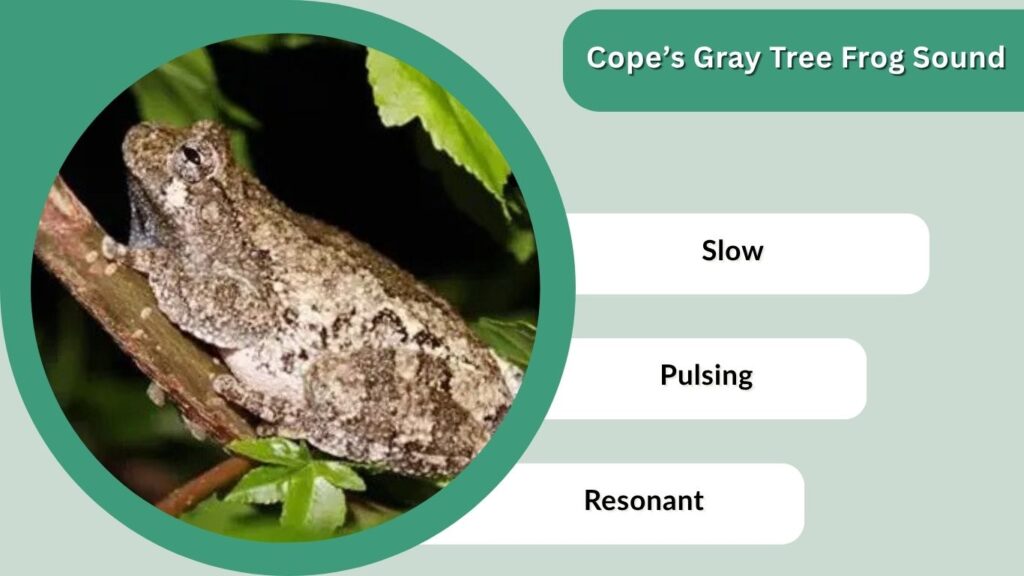
Cope’s gray treefrog, Dryophytes chrysoscelis, produces a faster and rougher trill. It may sound buzzy, raspy or more mechanical than the eastern gray treefrog.
Its call is often:
- Faster
- Harsher
- More rapid
- Less musical
- Short and forceful
The Indiana Department of Natural Resources describes Cope’s call as a loud, flute-like trill lasting approximately one to three seconds. Although it remains somewhat musical, it contains more pulses per second than the eastern species’ call.
Eastern vs. Cope’s Gray Tree Frog Calls
The two species overlap across parts of their ranges and cannot usually be separated by color or body markings. Their breeding calls provide the clearest difference.
| Feature | Eastern gray treefrog | Cope’s gray treefrog |
| Scientific name | Dryophytes versicolor | Dryophytes chrysoscelis |
| Call speed | Slower | Faster |
| Sound quality | Smooth and melodic | Harsher and raspier |
| Pulse rate | Fewer pulses per second | More pulses per second |
| Call duration | Usually 0.5–3 seconds | Commonly 1–3 seconds |
| Best description | Slow musical trill | Fast mechanical trill |
Temperature must be considered when comparing calls because an eastern gray treefrog on a warm night may call faster than expected. Recordings or specialized analysis may be needed when only one species is present and the temperature is unknown.
Why Do Gray Tree Frogs Make Sounds?
Most of the loud trills heard during spring and summer are advertisement calls. Males use these sounds to announce their presence and attract breeding females.
Attracting Females
Females listen to competing males and approach the individual whose call they prefer. Research shows that females can evaluate differences in male calling effort, including call length, pulse production and repetition. Longer or more persistent calls may be attractive because producing them requires considerable energy.
When a female approaches, a male may produce a longer and more emphatic courtship call. This helps maintain her attention as she moves closer.
Defending Calling Space
Males may also use aggressive calls when another male comes too close. These calls help maintain spacing between frogs and reduce direct physical conflict.
A male’s vocal repertoire can include:
- Advertisement calls
- Courtship calls
- Aggressive calls
- Release calls
Advertisement trills are the sounds people hear most frequently from ponds and wooded yards. Researchers have documented distinct advertisement, aggressive and release calls in male eastern gray treefrogs.
Release Sounds
A frog that is grabbed by another frog, predator or human may make a different release or distress-like sound. This is not the regular musical trill used to attract a mate.
Avoid handling wild frogs to make them vocalize. Amphibians have delicate, absorbent skin and should be observed without unnecessary disturbance.
Do Female Gray Tree Frogs Make Sounds?
The familiar breeding chorus is produced by males. Female gray treefrogs mainly listen to the calls and move toward a selected mate rather than joining the repeated advertisement chorus.
A female may remain near a breeding site for several minutes while evaluating different males. Once she selects a caller, she approaches him for mating. Females can detect and compare calls even within a noisy chorus, and field research shows that they can orient toward breeding choruses from considerable distances.
Therefore, a repeated trilling sound labeled as a “female gray tree frog sound” is most likely a calling male. A brief noise made while a frog is handled or threatened would have a different purpose from the male’s breeding call.
Why Do Gray Tree Frogs Call at Night?
Gray treefrogs are primarily nocturnal. Calling after dark helps them communicate when they are naturally active and when humidity is usually higher.
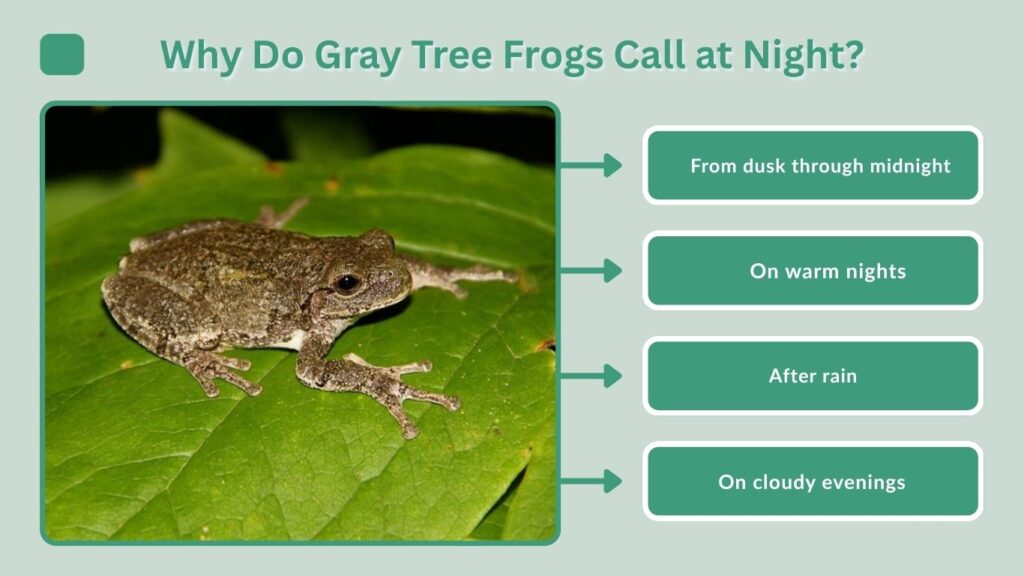
The strongest choruses generally occur:
- From dusk through midnight
- On warm nights
- During humid weather
- After rain
- On cloudy evenings
- During the breeding season
Warm, cloudy nights often produce especially intense calling. A period of cold weather may temporarily silence a chorus, even during the breeding season.
Calling after dark may also reduce exposure to some daytime predators. However, the call itself can reveal the male’s location to snakes, birds, mammals and larger frogs.
When Is Gray Tree Frog Calling Season?
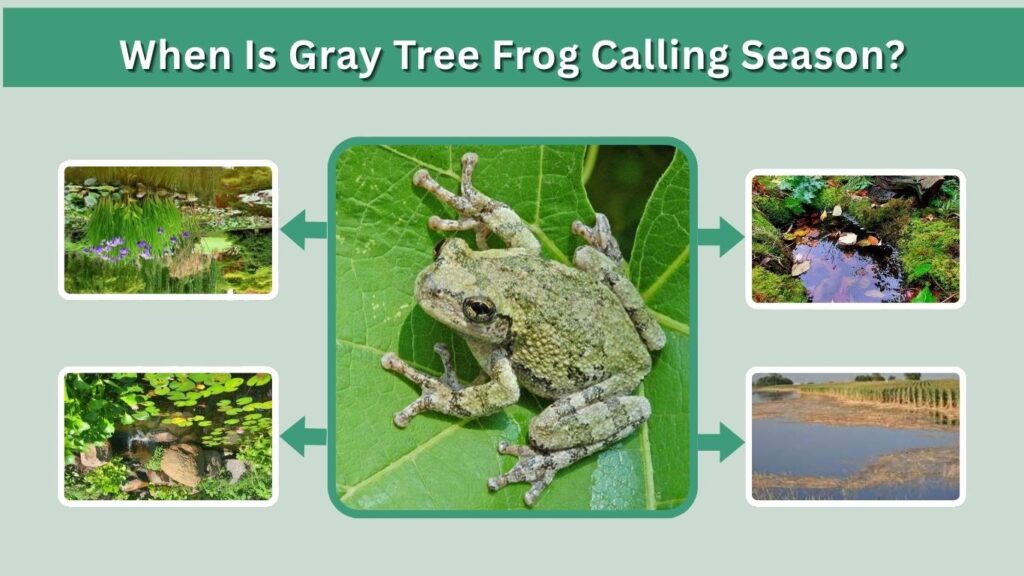
The exact season varies with latitude, temperature and weather. Across much of the range, calling begins during April or May and continues through June or July.
Indiana reports a general breeding season extending from mid-April through the end of July. Farther north, activity may begin later because spring temperatures rise more slowly.
Spring Breeding Chorus
The main chorus begins when nighttime temperatures become warm enough and frogs move toward shallow breeding water.
Common breeding locations include:
- Temporary woodland pools
- Marshes
- Shallow ponds
- Flooded fields
- Roadside ditches
- Wetland edges
Males usually call from low branches, shrubs or vegetation beside or above the water.
Calls Outside the Breeding Season
Occasional gray treefrog calls may be heard after the main breeding period. Males sometimes call from trees during humid weather, rain or warm late-summer conditions.
These isolated sounds are usually less intense than the large breeding choruses heard around ponds during spring and early summer.
Is the Gray Tree Frog Sound Loud?
Gray treefrogs are small, but their calls can be surprisingly loud. The male expands a vocal sac beneath his throat, which amplifies the sound.
One frog calling near a bedroom window, porch or rain gutter may sound much larger than it actually is. A group beside a pond can create a dense chorus that carries across a neighborhood.
The sound may appear to come from several directions because it reflects from buildings, trees and water. The frog’s camouflage also makes the caller difficult to locate, even when it is only a few feet away.
Sounds Commonly Confused With Gray Tree Frogs
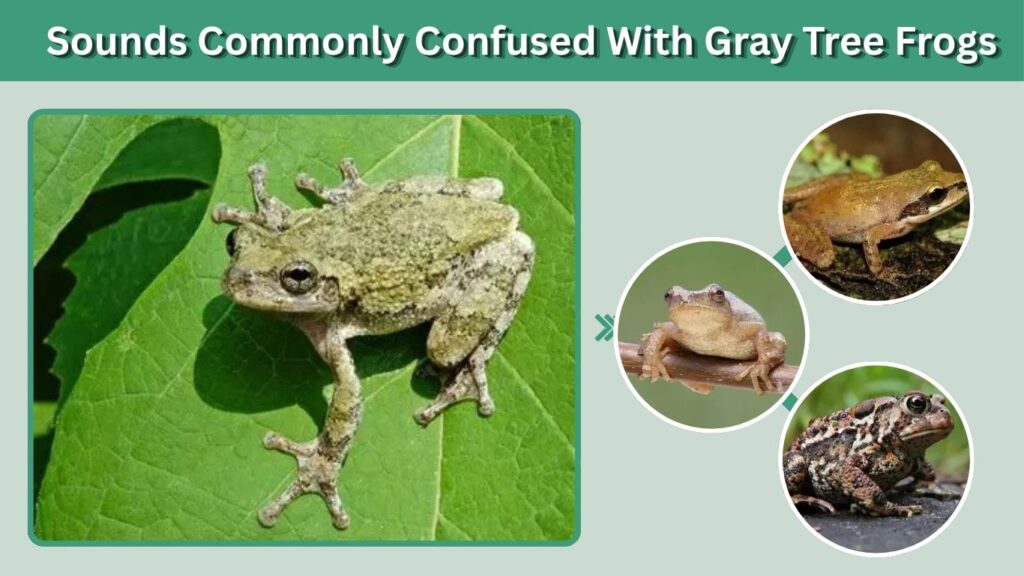
Several animals produce trills or repeated nighttime sounds that may be mistaken for gray treefrogs.
American Toad
The American toad makes a long, sustained musical trill. Its call generally lasts much longer than the short trill of a gray treefrog.
Spring Peeper
Spring peepers make clear, high-pitched “peep” notes rather than a vibrating trill. A large chorus can produce an almost continuous sound.
Chorus Frogs
Chorus frogs often sound like someone running a fingernail over the teeth of a comb. Their calls are usually more creaky than the musical eastern gray treefrog trill.
Insects
Crickets, katydids and cicadas can produce pulsing or buzzing sounds. Insect calls generally continue for longer periods, while gray treefrog trills are separated into distinct short bursts.
How to Identify a Gray Tree Frog by Sound
Follow these steps when listening outdoors:
- Notice whether the sound is a trill or a single note.
- Estimate whether each trill is short or sustained.
- Listen for a smooth or harsh quality.
- Observe the temperature and weather.
- Check whether the sound comes from trees near shallow water.
- Compare several calls rather than relying on one trill.
- Use a trusted frog-call recording for confirmation.
The University of Michigan’s Animal Diversity Web and Indiana wildlife resources provide verified recordings that can be used for comparison.
FAQs
What does a gray tree frog sound like?
A gray treefrog makes a short, loud trill. The eastern species sounds slow and musical, while Cope’s gray treefrog has a faster, harsher and more mechanical trill.
Do gray tree frogs make sounds during the day?
They call mainly at night, particularly during warm and humid breeding conditions. Occasional daytime or evening calling may occur after rain or during periods of high humidity.
Why is a gray tree frog calling near my house?
It may be attracting a mate, responding to humid weather or living near a suitable breeding pond. Outdoor lights can attract insects, making nearby walls and trees useful feeding locations.
Do female gray tree frogs call?
Females do not produce the familiar repeated advertisement chorus. They listen to calling males, compare their sounds and approach a preferred mate.
How can I tell eastern and Cope’s gray treefrogs apart?
Listen to the speed and quality of the trill. The eastern gray treefrog has a slower, more melodic call, while Cope’s produces a faster and rougher trill.
