
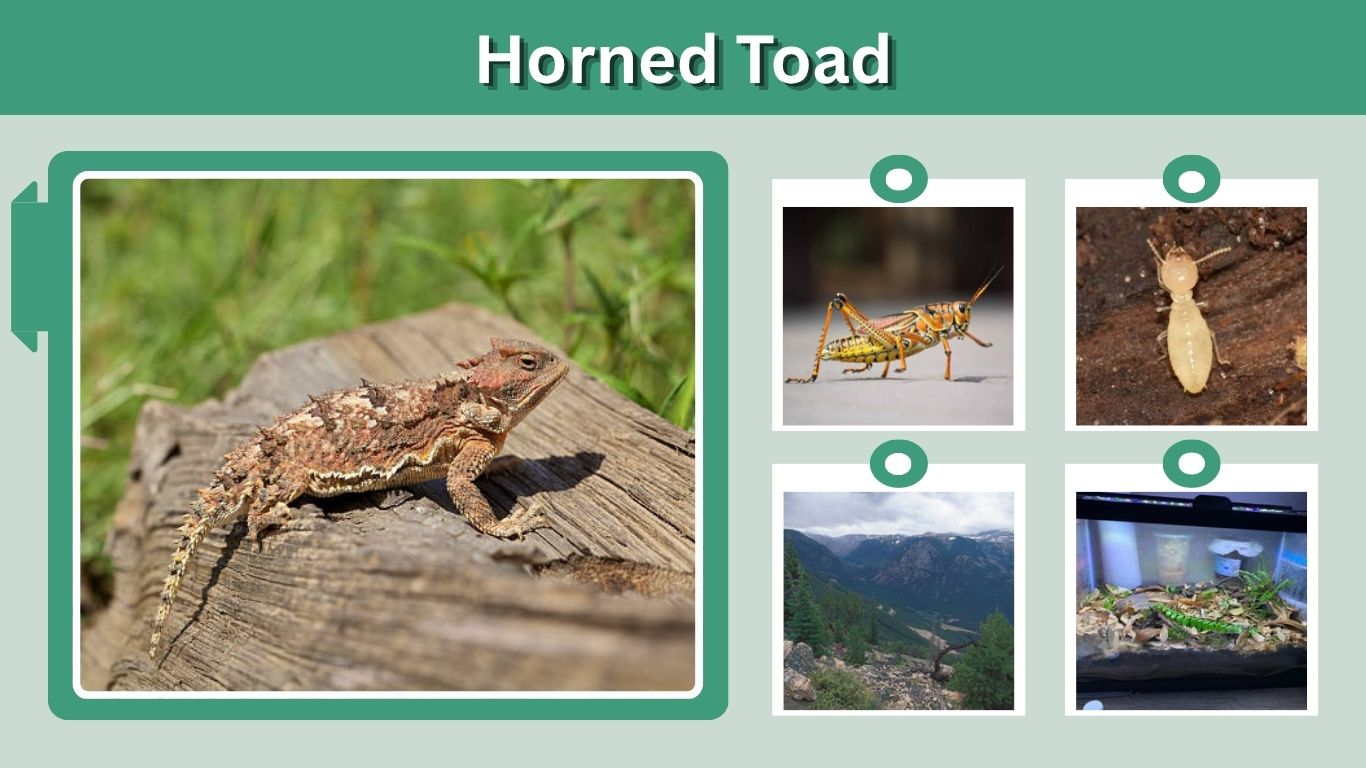
The horned toad is one of North America’s most unusual reptiles, recognized by its flattened body, spiny scales, and crown-like horns. Despite its common name, it is not a toad or frog—it is a true lizard belonging to the genus Phrynosoma. Horned lizards live mainly in dry and semi-dry environments and feed heavily on ants. Some species are especially famous for an extraordinary defense: squirting blood from around their eyes when threatened. Their camouflage, diet, habitat, and survival adaptations make horned toads fascinating desert animals.
What Is a Horned Toad?
Horned toad is a common name used for several species of horned lizards in the genus Phrynosoma. Their short, wide bodies make them look somewhat toad-like, which explains the nickname “horned toad” or “horny toad.” However, they are reptiles with scales, claws, lungs, and other characteristics typical of lizards rather than amphibians.
Horned Toad Identification
Horned lizards are commonly recognized by:
- A broad and flattened body
- Horn-like projections behind the head
- Rough, spiny scales
- Short legs
- A relatively short tail
- Brown, gray, reddish, or sandy coloration
- Dark spots or markings across the back
- Excellent camouflage against soil and rocks
The Texas horned lizard, Phrynosoma cornutum, has two particularly prominent central horns at the rear of its head and usually has dark markings extending from the eyes.
Is a Horned Toad Really a Toad?
No. A horned toad is a lizard, not a true toad.
True toads are amphibians that generally have moist or glandular skin and undergo an aquatic tadpole stage. Horned lizards are reptiles covered with scales and spend their lives on land.
Their wide, rounded body and tendency to remain motionless probably helped inspire the misleading “toad” name.
Horned Toad Scientific Name
There is no single scientific name for every horned toad because several species share the common name.
They belong to the genus Phrynosoma. Well-known species include the Texas horned lizard (Phrynosoma cornutum), desert horned lizard (Phrynosoma platyrhinos), greater short-horned lizard (Phrynosoma hernandesi), and round-tailed horned lizard (Phrynosoma modestum).
Horned Toad Habitat and Range
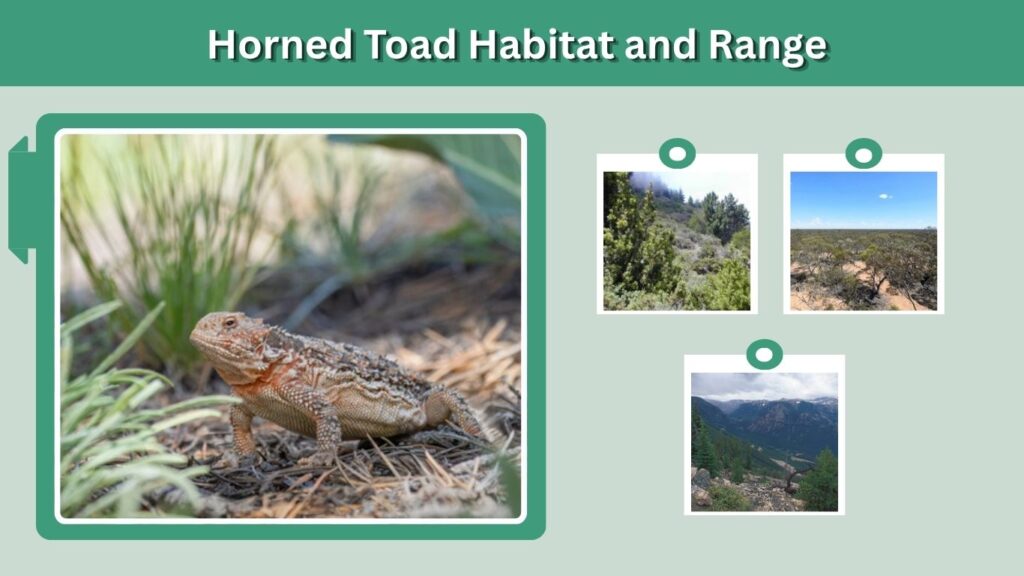
Horned lizards are strongly associated with the dry landscapes of western North America. Depending on the species, they occur in deserts, grasslands, shrublands, open woodlands, and rocky mountain environments. Loose soil is especially useful because many horned lizards partially bury themselves to hide, regulate temperature, lay eggs, or survive periods of inactivity.
Where Do Horned Toads Live?
Horned lizards may inhabit:
- Deserts
- Semi-arid grasslands
- Sandy plains
- Open scrubland
- Rocky areas
- Dry woodland edges
- Sagebrush habitats
- High-elevation grasslands
- Areas with loose or loamy soil
Different species occur across parts of the United States, Canada, and Mexico.
Texas horned lizards range through much of Texas and into Oklahoma, Kansas, New Mexico, and northern Mexico. They favor open arid or semi-arid habitats with sparse vegetation and soils suitable for digging.
Desert Horned Toad Adaptations
Living in hot and dry environments requires several useful adaptations.
A horned lizard’s coloration closely matches surrounding sand, soil, and stones. Its flattened body can be pressed against the ground, making its outline difficult for predators to distinguish.
Horned lizards can also burrow into loose soil to escape temperature extremes. Because they are ectothermic, they rely on environmental heat to regulate body temperature and may bask in sunlight before becoming fully active.
What Does a Horned Toad Eat?
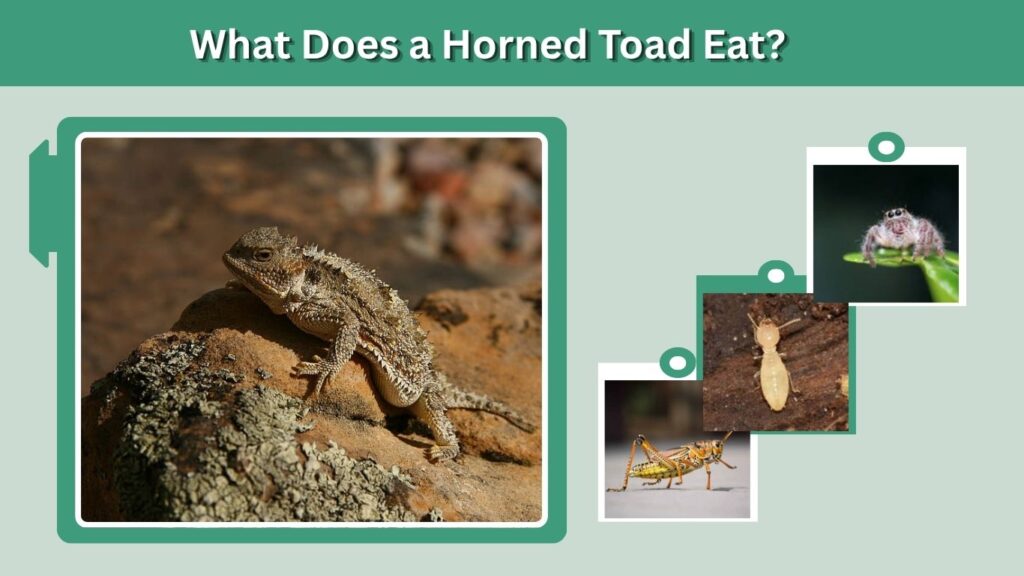
Horned toads are primarily insect-eating reptiles. Ants are particularly important to many species, and some horned lizards are highly specialized for eating large quantities of them. They often position themselves near ant trails and wait for insects to pass before quickly capturing them with their tongues.
Horned Toad Diet
Depending on the species, their diet can include:
- Harvester ants
- Other ants
- Beetles
- Grasshoppers
- Termites
- Spiders
- Sowbugs
- Beetle larvae
- Other small invertebrates
Texas horned lizards depend heavily on harvester ants. Texas Parks and Wildlife notes that an individual may consume roughly 70–100 harvester ants in a day, although they also eat other small invertebrates.
How Do Horned Toads Hunt?
Horned lizards often use a sit-and-wait strategy rather than actively chasing prey for long distances.
Their camouflage allows them to remain nearly invisible while watching for passing insects. When an ant or other small prey comes within reach, the lizard quickly grabs and swallows it.
This feeding strategy conserves energy, which is useful in hot environments where food and water can sometimes be limited.
Why Do Horned Toads Shoot Blood From Their Eyes?
One of the most famous horned toad behaviors is its ability to squirt blood from around the eyes. This dramatic defense is real, although it is associated with certain horned lizard species rather than being something every individual necessarily uses in every threatening situation.
The animal increases pressure in blood vessels around its head until tiny vessels near the eyes rupture, allowing a stream of blood to be directed toward an attacker.
Horned Toad Defense Mechanisms
Horned lizards have several defenses:
- Remaining completely still
- Blending into surrounding soil
- Flattening themselves against the ground
- Inflating the body to appear larger
- Using sharp horns and spines
- Running short distances when threatened
- Burrowing or hiding
- Squirting blood from around the eyes in some species
These defenses are used in different combinations depending on the predator and situation.
How Far Can a Horned Toad Shoot Blood?
Some horned lizards can reportedly project blood several feet toward an attacker. The greater short-horned lizard, for example, is described by the National Park Service as capable of directing blood as far as about three feet.
The blood defense appears particularly useful against canine predators such as coyotes and foxes because compounds in the blood can make it unpleasant to them.
A horned lizard does not constantly shoot blood, however. It normally relies first on camouflage, remaining still, inflation, and its protective spines.
Horned Toad Species
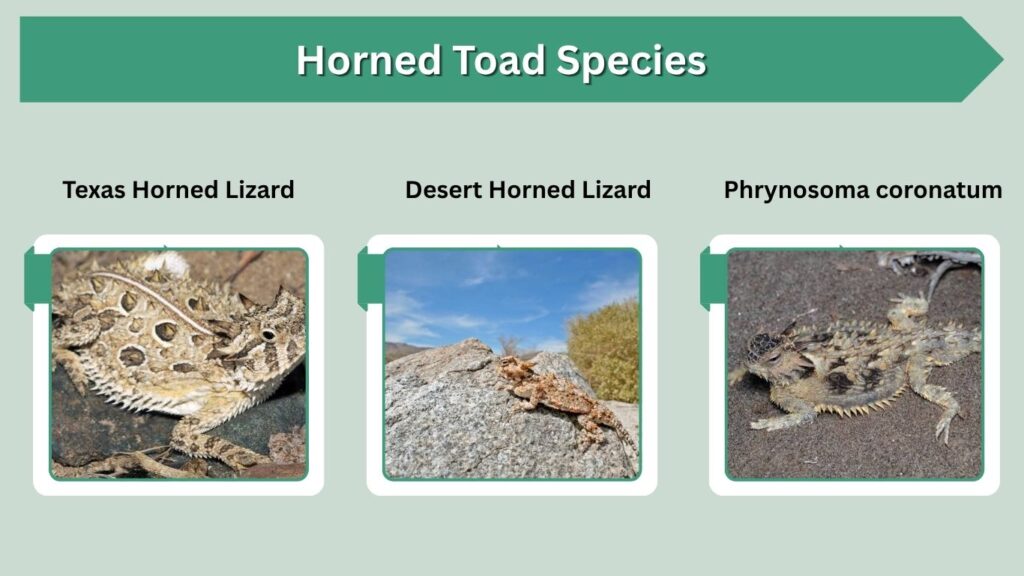
There are multiple species of Phrynosoma, and their sizes, horn arrangements, coloration, habitats, and reproductive strategies differ. This is why descriptions of a “horned toad” can vary depending on which species is being discussed.
Common Types of Horned Toads
Some well-known species include:
- Texas Horned Lizard – Phrynosoma cornutum
- Desert Horned Lizard – Phrynosoma platyrhinos
- Greater Short-Horned Lizard – Phrynosoma hernandesi
- Round-Tailed Horned Lizard – Phrynosoma modestum
- Regal Horned Lizard – Phrynosoma solare
- – Phrynosoma coronatum
- Flat-Tailed Horned Lizard – Phrynosoma mcallii
Head horns are particularly useful for distinguishing some species.
Texas Horned Toad
The Texas horned lizard is perhaps the best-known member of the group. Adults are broad, flattened reptiles with prominent horns and brownish coloration that blends into dry soil.
Texas designated this species as its official state reptile. However, it has declined substantially in portions of its historical Texas range and is currently listed as threatened by the state.
Short-Horned Toad
Short-horned lizards have smaller head horns than species such as the Texas horned lizard.
The greater short-horned lizard occurs across a broad range of western North America, including some cooler and higher-elevation environments. Unlike many horned lizards that lay eggs, females of the greater short-horned species give birth to live young.
Horned Toad Predators and Survival
Despite their intimidating appearance, horned lizards face numerous predators. Camouflage provides an important first line of defense, which is why remaining motionless can sometimes be more effective than immediately running away.
Common Horned Toad Predators
Potential predators include:
- Hawks
- Owls
- Roadrunners
- Snakes
- Larger lizards
- Coyotes
- Foxes
- Domestic cats
- Other carnivorous animals
Their horns make swallowing them difficult for some predators. When necessary, a horned lizard can also inflate its body, making itself appear wider and harder to consume.
Can You Keep a Horned Toad as a Pet?
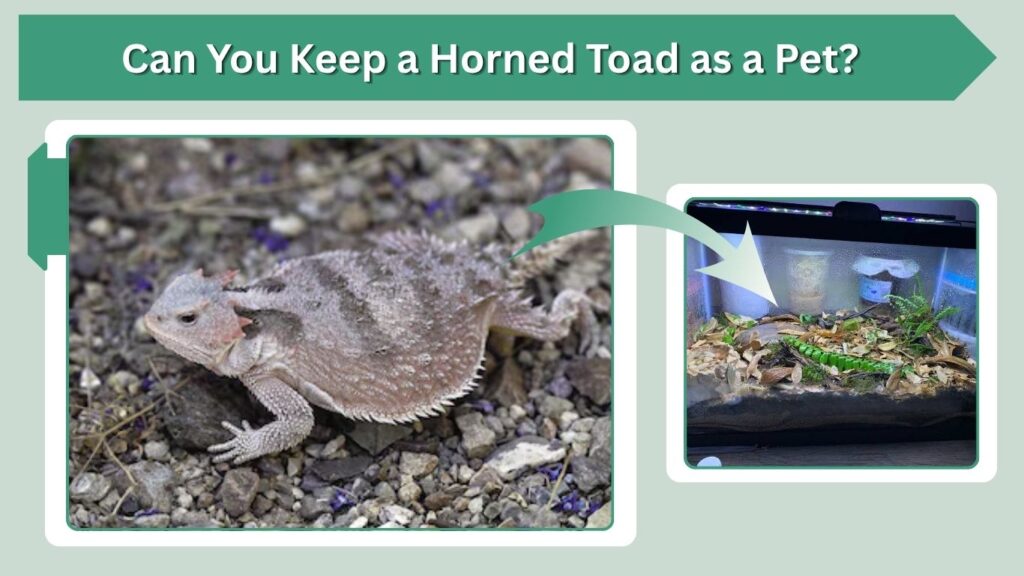
Horned lizards may look suitable for a desert terrarium, but they can be challenging captive animals. Their specialized diet is one of the biggest difficulties because some species require large numbers of suitable ants.
Collecting wild horned lizards may also be prohibited or restricted depending on the species and location.
Why Horned Toads Can Be Difficult Pets
Before considering one, important issues include:
- Specialized ant-heavy diet
- Large supply of appropriate live prey
- Correct UVB lighting
- Proper temperature gradients
- Dry but species-appropriate humidity
- Loose substrate for burrowing
- Stress from excessive handling
- Local wildlife regulations
- Conservation status of some populations
Wild horned lizards should never be collected without checking local wildlife laws.
Are Horned Toads Endangered?
The conservation situation varies between species and locations, so it is incorrect to describe every horned toad as endangered.
The Texas horned lizard, for example, is listed as threatened in Texas. Habitat alteration and changes affecting its preferred harvester-ant prey are among the concerns surrounding its decline.
Protecting native grasslands, maintaining suitable soil, preserving harvester-ant communities, and reducing unnecessary pesticide use can help maintain appropriate horned-lizard habitat.
FAQs
1. Is a horned toad a frog or lizard?
A horned toad is a lizard. The name “toad” comes from its wide, flattened, somewhat toad-like body.
2. What do horned toads eat?
Most eat ants and other small invertebrates. Texas horned lizards are especially dependent on harvester ants but can also eat beetles, spiders, grasshoppers, and other insects.
3. Do horned toads really shoot blood from their eyes?
Yes. Certain horned lizard species can increase blood pressure around their eyes and eject blood as a defensive response to predators.
4. Where do horned toads live?
They occur mainly in western North America and Mexico. Depending on species, they inhabit deserts, grasslands, shrublands, rocky areas, and other dry or semi-dry environments.
5. Are horned toads dangerous to humans?
No. Horned lizards are not considered dangerous to people. Their intimidating horns and unusual blood-squirting behavior are primarily defenses against natural predators rather than mechanisms for attacking humans.
