
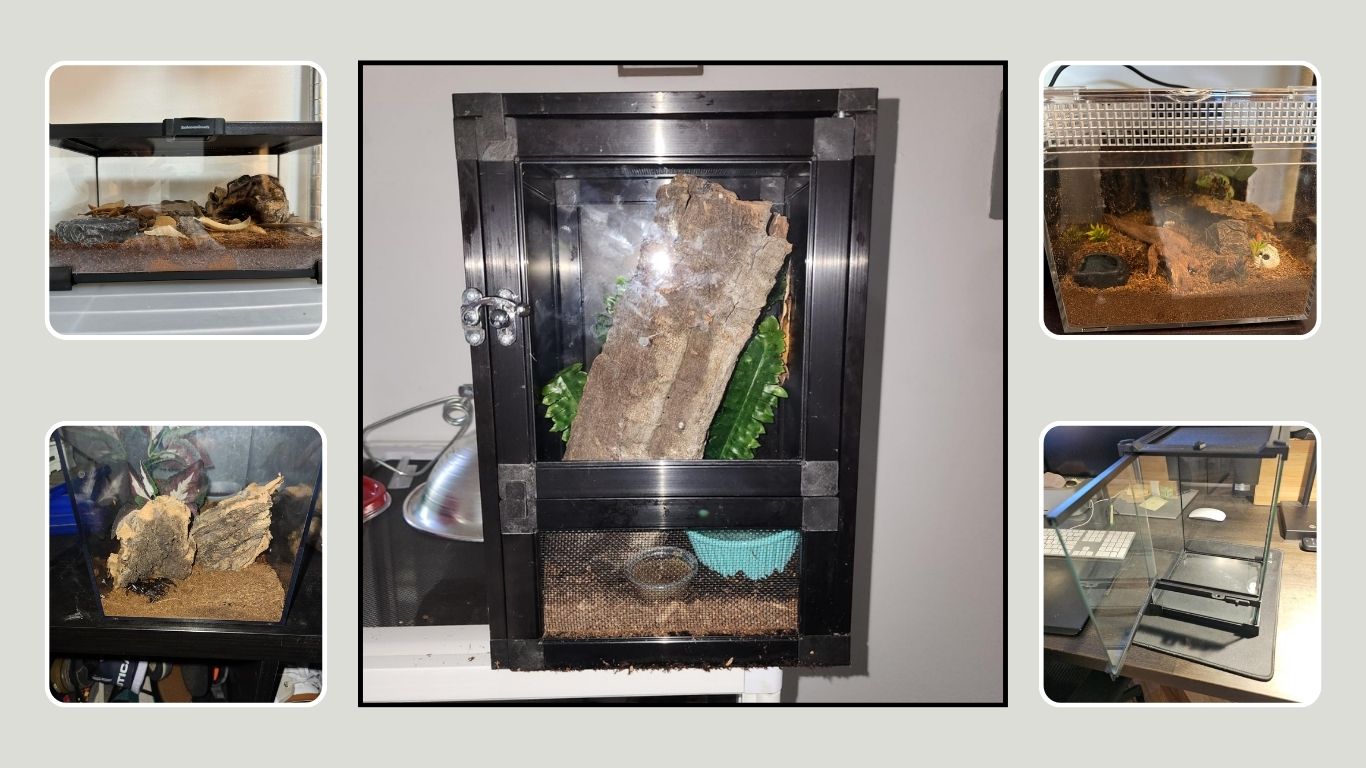
Choosing a frog enclosure starts with understanding your pet’s species, adult size, and habitat needs. Secure doors, suitable ventilation, and space for an appropriate setup all deserve attention. This guide compares ten enclosure options, including compact acrylic terrariums, vertical glass tanks, and PVC habitats. We explore their construction, accessibility, and practical limitations to help you narrow your choices. Some small terrariums are unsuitable for permanent adult frog housing, so matching the enclosure to your particular frog’s requirements matters more than appearance, convenience, or the species pictured in a product listing.
1. MYGIIKAKA Acrylic Jumping Spider Enclosure
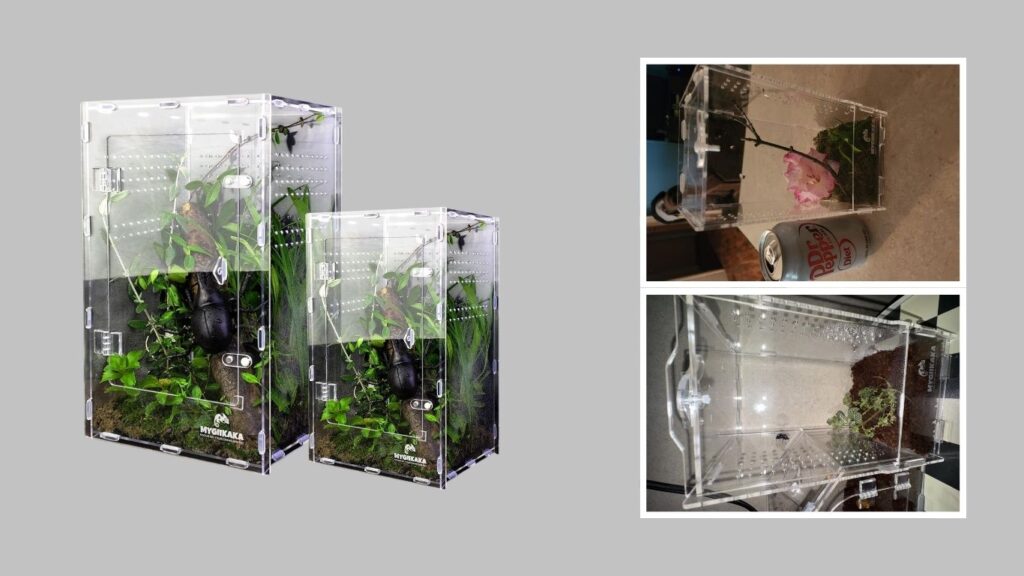
The MYGIIKAKA Acrylic Jumping Spider Enclosure offers clear viewing, top access, and a compact footprint. Its simple construction makes it interesting for small-animal keepers, but its limited dimensions require careful consideration before including it in a frog habitat setup.
Key Features
- Transparent acrylic panels for all-around viewing.
- Listed dimensions of 13.78 × 7.48 × 7.87 inches.
- Clamshell-style top with a locking handle.
- Ventilation holes on two sides.
- Assembly using included instructions and rubber-band fasteners.
- Disassembles for storage when empty.
Clear Panels Make Observation Easier
Visibility is this enclosure’s strongest feature. The transparent panels allow you to check the interior from several angles without repeatedly opening the lid. That can make locating an animal, inspecting decorations, and spotting leftover food more convenient.
However, clear walls are not a substitute for appropriate shelter. Any suitable inhabitant still needs a species-appropriate arrangement of hides and furnishings. The useful benefit is easier observation—not keeping the interior exposed or overcrowded for display.
Accessible Design With Practical Assembly
The clamshell top provides access for arranging the interior and carrying out routine maintenance. The locking handle adds a closure mechanism, although panel alignment, seams, and ventilation openings should still be inspected before introducing an animal.
Assembly requires removing the protective film and securing the panels. Its ability to come apart is convenient for storage, but the listed construction should not be assumed watertight. Side ventilation supports air exchange; it does not automatically maintain the humidity a particular species requires.
Best for Carefully Matched Small-Animal Setups
This model is better considered a compact invertebrate enclosure than a general-purpose frog vivarium. At under eight inches tall, it does not provide suitable permanent housing for an adult White’s tree frog. Substrate and furnishings further reduce usable space.
For an appropriately matched inhabitant, the viewing access and storage-friendly construction are appealing. For frog owners, however, adequate adult living space must remain the deciding factor—not the enclosure’s small footprint or broad marketing claims.
2. Zilla Tropical Vertical Terrarium Starter Kit
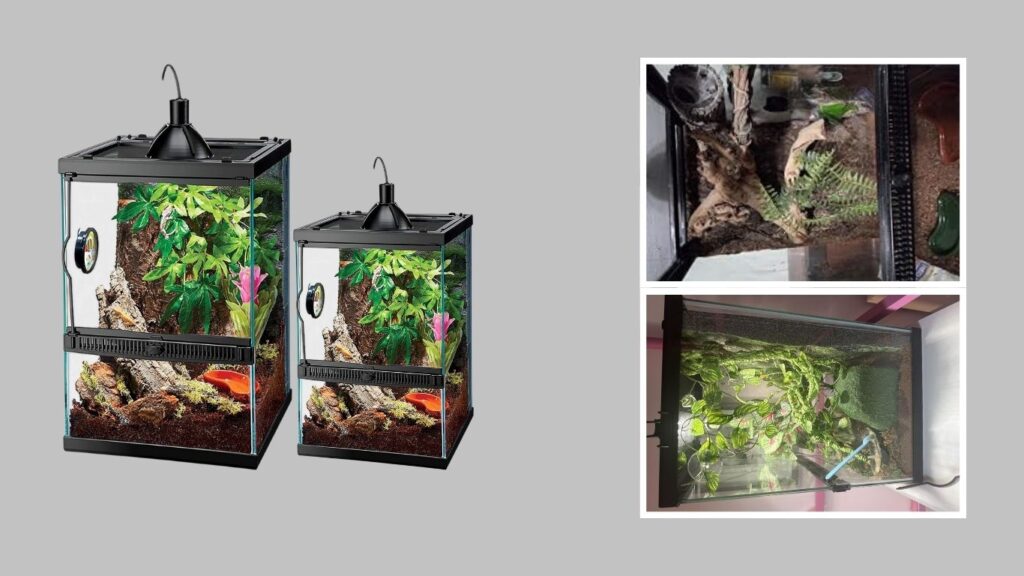
The Zilla Tropical Vertical Terrarium Starter Kit combines a front-opening glass enclosure with several setup accessories. Its main attraction is convenience: the background, lighting fixture, substrate, and monitoring equipment arrive together. However, its compact size means the intended frog species must be chosen carefully.
Key Features
- Glass terrarium measuring 12 × 12 × 18 inches.
- Front-opening door and hinged screen top.
- Locking components for enclosure security.
- Water-tight base.
- Included rock-style background, substrate, and feeding dish.
- Mini halogen dome with bulb and temperature/humidity gauge.
A Convenient Foundation for Habitat Planning
Compared with an empty enclosure, this kit reduces the number of separate components needed to begin planning a habitat. The background provides a starting point for the interior, while the dish and monitoring gauge cover additional setup tasks.
That convenience should not be mistaken for a complete, species-ready environment. Branches, shelter, appropriate lighting, and environmental controls may still be needed. Included accessories are useful only when they match the animal’s requirements, so the kit works best as a foundation rather than a finished habitat.
Accessible Doors and a Moisture-Friendly Base
Front access makes reaching dishes and maintaining the interior more straightforward, particularly when decorations occupy the upper section. The screen top provides another access point and supports ventilation.
The water-tight base offers flexibility for suitable substrate or drainage arrangements. It does not mean that deep standing water is appropriate for every frog. Likewise, the included halogen lamp should only be used when its heat output suits the intended setup. Temperature monitoring and any necessary controls remain essential.
Best for Carefully Planned Compact Habitats
This kit is most appealing when its dimensions already satisfy the requirements of the intended inhabitant. It is not an appropriate permanent enclosure for an adult White’s tree frog.
Its strongest advantage is the coordinated accessory package and convenient access. For keepers planning a compatible compact habitat, those features can simplify preparation without removing the need for species-specific decisions.
3. waazoorep Vertical Glass Reptile Terrarium
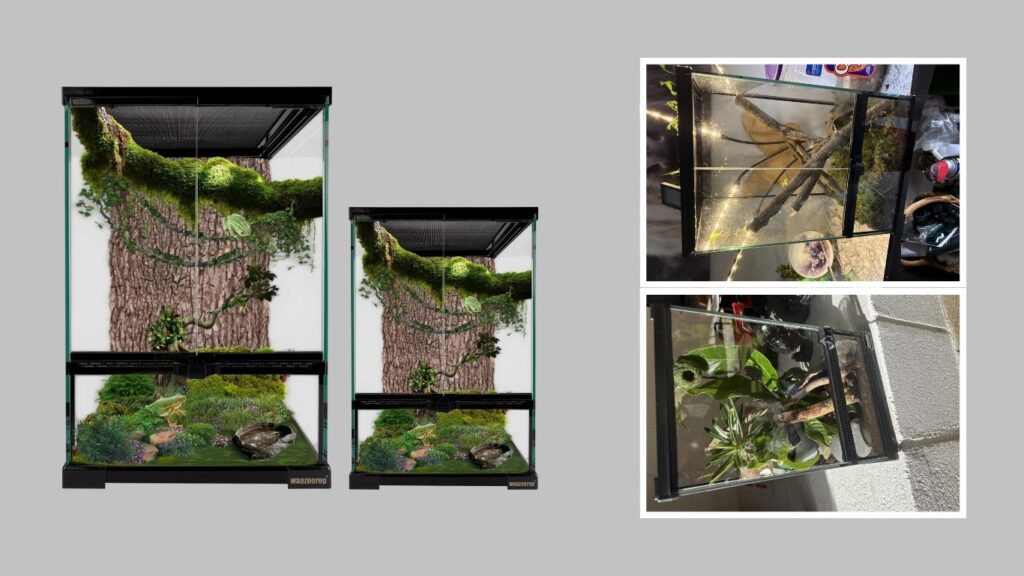
The waazoorep Vertical Glass Reptile Terrarium offers a compact, front-access layout for a custom habitat. Its clear panels, opening doors, and ventilated top emphasize visibility and maintenance. The enclosure is an appealing starting point only when its dimensions match the animal’s long-term needs.
Key Features
- Listed dimensions of 12 × 12 × 18 inches.
- Glass panels for viewing the interior.
- Double front-opening doors.
- Door locks to help prevent accidental opening.
- Removable metal mesh top with cable provision.
- Sealed base and raised bottom design.
Front Access Supports Easier Maintenance
The double-door arrangement is the most useful everyday feature. Feeding, replacing a dish, and removing waste can be handled from the front rather than requiring access through the top every time.
That layout also helps when planning decorations. Branches and foliage can occupy the upper area while a clear service route remains available below. Leaving room around the doors is important: an attractive arrangement becomes frustrating if every maintenance task requires moving plants or disturbing furnishings.
The clear panels make checking that arrangement easier from several angles.
Ventilation Without Automatic Climate Control
The removable mesh top provides airflow and accommodates an appropriate overhead equipment arrangement. Its cable provision can help organize wiring, but unused openings and spaces around cables should be checked for escape risks.
The sealed base is useful for moisture-containing substrate setups, although any intended water-holding section should be tested before introducing an animal. Neither the glass construction nor the ventilation maintains suitable humidity automatically.
Actual conditions depend on the room, substrate, water, ventilation, and equipment used. Monitoring the completed enclosure matters more than assuming a tropical-looking display will function correctly.
Best for a Customized Small-Space Setup
This model suits keepers who prefer choosing their own accessories rather than purchasing a starter kit. Its practical strengths are access, visibility, and a defined space for a tailored interior.
The limitation is its narrow footprint. Adult size, activity level, and usable room after decoration must guide the decision. For a compatible setup, the front-opening design offers a useful balance between display quality and maintenance access.
4. FixHaven Fully Assembled Glass Reptile Enclosure
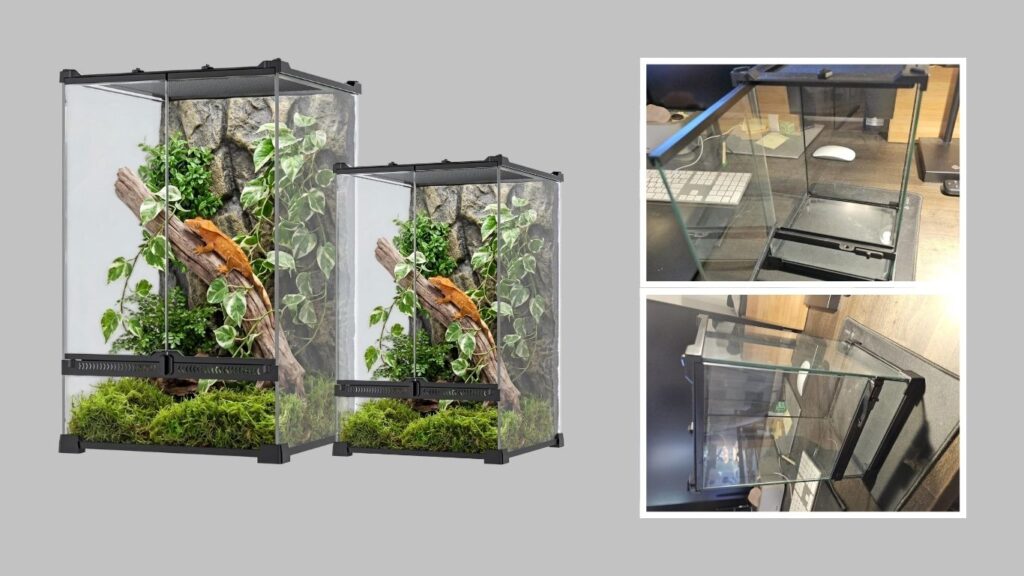
The FixHaven Glass Reptile Enclosure stands out for arriving fully assembled. Its front-opening doors, screened top, and transparent panels provide the familiar features of a vertical terrarium without a panel-building stage. That convenience makes it worth considering once the required enclosure size has been established.
Key Features
- Measures 12 × 12 × 18 inches.
- Delivered fully assembled.
- Dual front-opening doors with a built-in lock.
- Tempered-glass panels.
- Opening metal mesh top with latch and cable access.
- Raised base advertised as waterproof.
Less Assembly, More Attention to Setup
A preassembled enclosure removes the need to connect panels and align the main structure. This lets the keeper concentrate on inspection, cleaning, and habitat planning.
It still needs checking before use. Glass edges, door movement, seams, locks, and the top closure should be inspected after delivery. Any base intended to retain water should be tested before substrate and decorations are added.
The useful distinction is reduced construction work—not an enclosure that becomes suitable for an animal immediately after unpacking.
Practical Access From the Front and Above
The front doors provide access to dishes and lower furnishings, while the opening top helps with larger maintenance tasks. That combination can be convenient when arranging branches or repositioning decorations.
The glass panels also make it easier to inspect areas that might otherwise remain hidden. Shelter should still be included wherever the chosen species needs it; visibility is for the keeper’s convenience, not a reason to leave an animal constantly exposed.
The screened top supports airflow, but equipment placement must preserve safe clearances and prevent the animal from reaching hot surfaces.
Best for Keepers Prioritizing Setup Convenience
FixHaven’s strongest appeal is its assembled construction combined with everyday access features. It suits a keeper who wants to avoid building the enclosure while retaining control over its interior.
However, the 12-inch-square footprint remains a meaningful restriction. This size should not be selected as permanent adult White’s tree frog housing. Where a species-specific plan genuinely fits, the enclosure offers a straightforward starting point with fewer assembly tasks and accessible maintenance points.
5. ADVINCI Aluminum-Frame Glass Reptile Terrarium
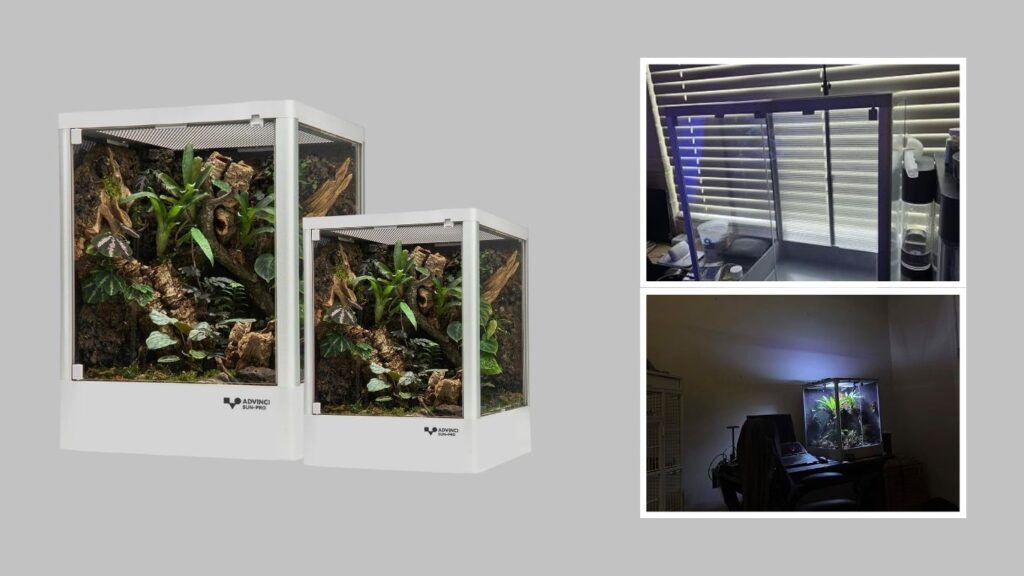
The ADVINCI Glass Reptile Terrarium combines an aluminum frame with a knock-down design. It is aimed at keepers who value a compact display that can be assembled and dismantled. Its construction is the main attraction, while its relatively small interior is the most important limitation.
Key Features
- External dimensions of 12 × 12 × 16 inches.
- Aluminum frame with clear glass panels.
- Tool-free knock-down assembly.
- Dual-locking latches.
- Top-mounted mesh ventilation.
- Interior floor space is smaller than the external measurements.
A Flexible Structure for Setup and Storage
The knock-down design is useful when an empty enclosure needs to be stored or moved. Detachable components also provide access during initial cleaning and assembly.
This flexibility is most valuable before the habitat is established. A planted enclosure containing substrate and furnishings should not be treated like an empty, portable frame. Dismantling or relocating an occupied habitat requires a separate plan.
The aluminum frame gives the product a defined structure, while the glass panels preserve visibility. Together, they create a neat display without making decorative appearance the only consideration.
Security and Usable Space Deserve Attention
Dual-locking latches provide a deliberate closing mechanism, but their presence does not eliminate the need to inspect panel alignment and gaps. Every opening must be appropriate for both the inhabitant and its feeder insects.
ADVINCI explicitly notes that its measurements describe the outside of the enclosure. The molded base reduces interior floor space further. This matters when comparing the product against care requirements: external dimensions can overstate the room actually available.
Substrate, backgrounds, and furnishings reduce usable space again, so the interior should be planned before selecting an animal.
Best for Compact Displays With Verified Suitability
This model is most convincing as a small, customizable display where the inhabitant’s requirements have already been checked. Its dismantling capability and locking system are practical strengths.
For adult frogs needing generous floor area or climbing height, this particular size is restrictive. The enclosure’s construction may be appealing, but it cannot compensate for insufficient living space. Its value depends on a genuinely compatible habitat plan.
6. Reptile Growth Mini Reptile Terrarium
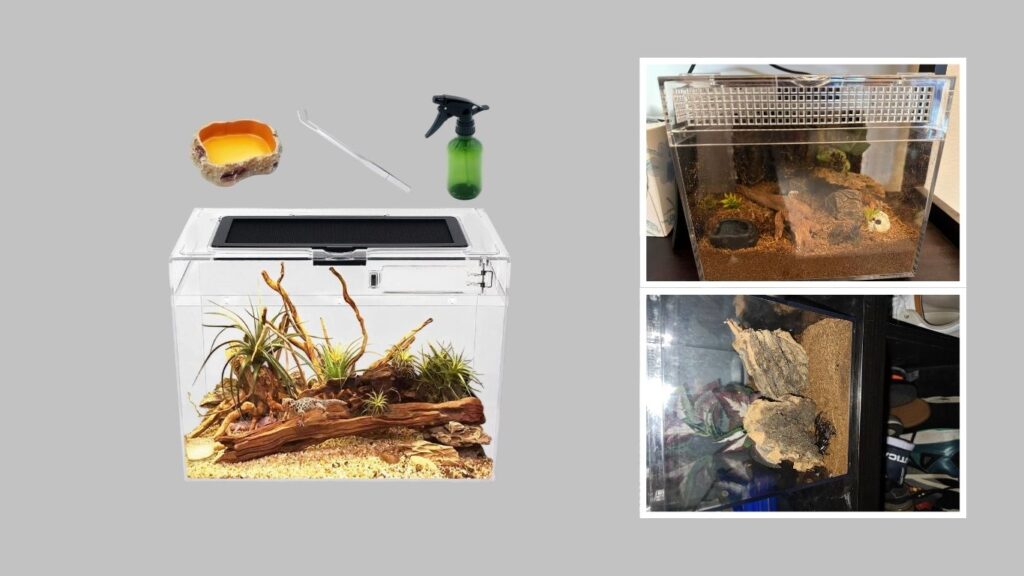
The Reptile Growth Mini Terrarium focuses on easy viewing and convenient feeding access. Its compact body and separate feeding opening distinguish it from basic containers. For a frog-focused shortlist, however, the small dimensions are more significant than the broad range of animals mentioned in its marketing.
Key Features
- Listed dimensions of 12 × 7 × 9 inches.
- Transparent enclosure body.
- Metal screen top.
- Separate feeding port with a closing mechanism.
- The base is advertised as water-tight.
- Supplied without a main enclosure assembly requirement.
Feeding Access Is the Main Convenience
A separate feeding port can reduce the need to remove the main lid for every feeding task. For an appropriately matched inhabitant, that offers a more controlled access point than opening the whole enclosure.
The transparent body also helps with checking where the animal is before opening anything. This is useful when an inhabitant rests close to the lid or hides near decorations.
Neither feature guarantees escape prevention. The feeding opening, main closure, and any cable spaces should be inspected for gaps suitable for a small animal to pass through.
Useful Features With Specifications to Confirm
The screened top provides airflow, while the advertised water-tight base gives some flexibility in arranging the interior. Any water-holding claim should be checked through an empty-enclosure leak test before use.
Listings differ in how they describe the body material, so the current version should be confirmed if glass or a particular plastic is important to the setup. Avoid relying on exaggerated durability claims.
The presence of a screen also does not establish that every heat lamp is appropriate. Equipment compatibility and safe temperatures require separate assessment.
Best for Suitable Microhabitats, Not Adult Tree Frogs
At only nine inches tall with a narrow base, this terrarium is not suitable permanent housing for an adult White’s tree frog. Its dimensions also leave limited room after substrate and furnishings are installed.
Its stronger role is a carefully matched invertebrate microhabitat or an animal-free miniature display. The feeding access and visibility are useful conveniences, but they should be evaluated within the enclosure’s genuine space limitations.
7. AWXZOM Mini Reptile Glass Terrarium
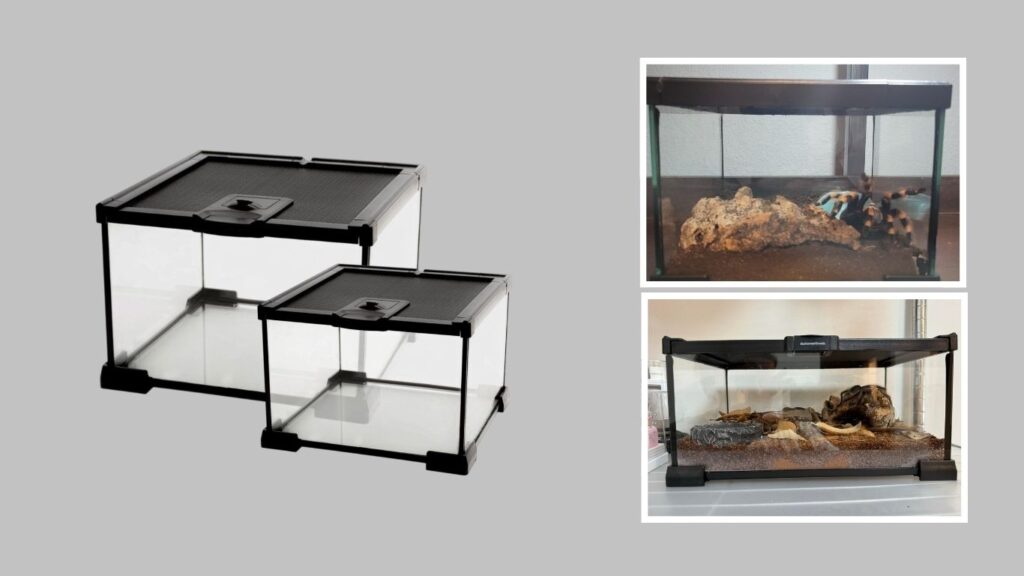
The AWXZOM Mini Glass Terrarium is a very small enclosure built around visibility and simple top access. Its ready-assembled construction offers convenience, but the listed size makes it a specialized microhabitat rather than a broadly suitable frog enclosure. That distinction is essential when assessing its value.
Key Features
- Measures approximately 7.9 × 7.9 × 5.7 inches.
- Transparent glass construction.
- Top-opening access.
- Locking closure.
- No main assembly required.
- Compact square footprint.
Clear Viewing in a Small Display
The glass walls allow the interior to be inspected from multiple angles. For a suitable microhabitat, this can help with checking furnishings and locating an inhabitant without opening the enclosure.
Its small footprint also makes the physical container easy to accommodate on an appropriately supported surface. However, fitting a shelf is not the same as meeting an animal’s space requirements.
A display should leave adequate usable room after any substrate, shelter, or other furnishings are added. In a container this small, even modest decorations occupy a substantial proportion of the interior.
Simple Access With Important Checks
The top-opening design offers direct access for arranging and maintaining the enclosure. The locking closure provides a way to secure that opening after use.
Before introducing an animal, the fit of the lid and the size of any gaps need close inspection. Ventilation and lighting compatibility should also be confirmed rather than inferred from the transparent construction.
Ready-assembled does not mean ready for occupancy. The enclosure still requires an appropriate setup, environmental checks, and confirmation that its physical design suits the intended inhabitant.
Best for Carefully Selected Invertebrate Microhabitats
The 5.7-inch height is a decisive limitation for frog keeping. This should not be presented as permanent housing for adult tree frogs, and a frog merely fitting inside does not establish suitability.
Its clearest appeal is as a small glass microhabitat for an appropriately selected invertebrate, subject to that species’ needs. The visibility and uncomplicated access are useful features. For a permanent frog home, however, a substantially more suitable enclosure should be selected around verified adult housing requirements.
8. waazoorep Tall PVC Reptile Enclosure
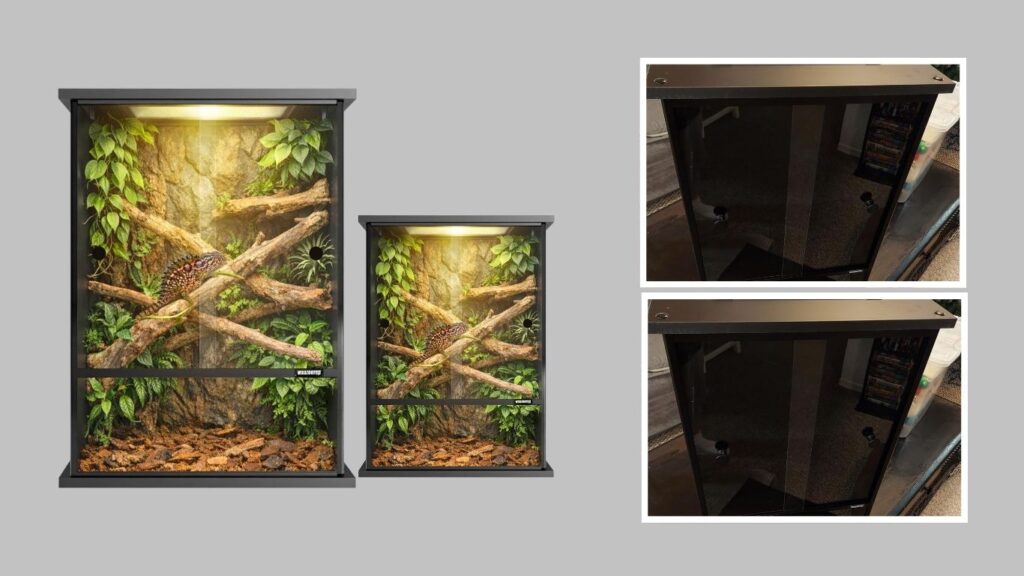
The waazoorep Tall PVC Enclosure offers substantially more room than the compact models in this list. Its 18 × 18 × 24-inch format, solid panels, and sliding glass doors make it a more credible starting point for a planned arboreal habitat, subject to species-specific requirements.
Key Features
- Listed dimensions of 18 × 18 × 24 inches.
- PVC body panels.
- Sliding tempered-glass front doors with a lock.
- Removable metal mesh top.
- Rear cable opening.
- Knock-down construction and an advertised waterproof base.
More Space for a Functional Interior
The larger footprint and additional height provide more flexibility when arranging branches, shelter, and foliage. Compared with a 12 × 12-inch base, there is also more room to preserve access around dishes and lower furnishings.
That flexibility matters because usable habitat is not simply empty volume. Branch placement, hiding opportunities, and accessible resting areas determine how effectively an animal can use the enclosure.
A sensible layout would retain open movement routes and maintenance access rather than filling every available space with decorative material.
Solid Panels With Accessible Front Doors
The PVC sides and back create visual barriers, while the glass front preserves a viewing area. Solid panels may also help with environmental management, but they do not maintain temperature or humidity automatically.
Sliding doors allow access without swinging outward into the room. Their tracks and meeting edges should remain clean and be checked for secure closure.
The screened top supplies ventilation, and the cable opening supports equipment routing. Any unused opening needs securing. The base’s advertised waterproof construction should be verified before planning standing water or a moisture-heavy substrate arrangement.
Best for a Larger, Species-Matched Arboreal Setup
Among these options, this model offers a more useful amount of space for evaluating an adult arboreal frog habitat. The exact species, number of animals, and finished interior still determine suitability.
Its strongest combination is increased room, solid-sided construction, and accessible front doors. For keepers whose care plan fits these dimensions, it provides more scope for a functional enclosure than the miniature alternatives, without relying on a generic “frog-friendly” label.
9. Oiibo Knock-Down Glass Reptile Terrarium
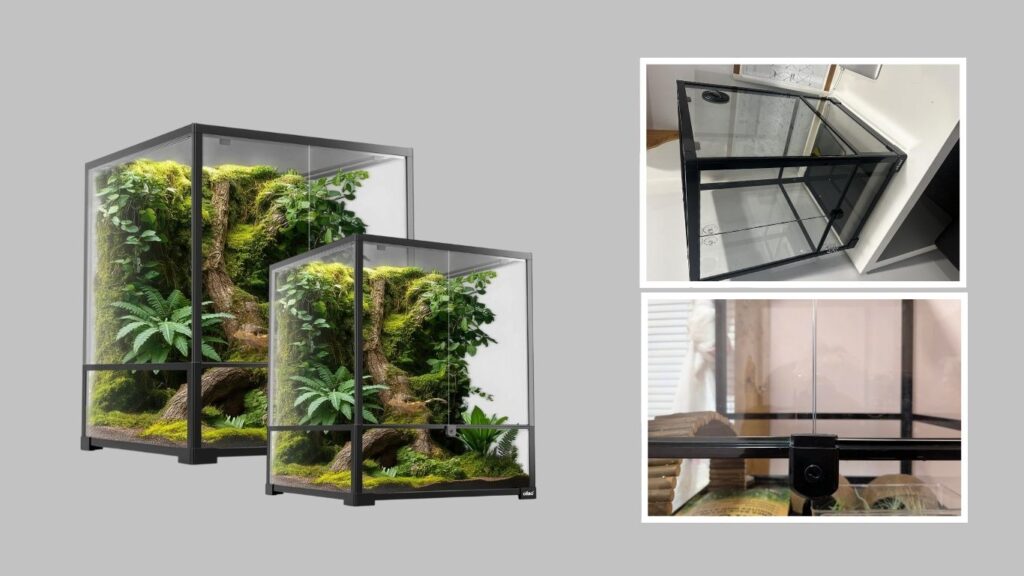
The Oiibo Knock-Down Glass Terrarium combines an 18 × 18 × 24-inch format with front access and broad visibility. Its larger dimensions give it a stronger role in a frog-enclosure comparison than the smallest tanks, while its dismantling design requires careful assembly before habitat preparation.
Key Features
- Measures 18 × 18 × 24 inches.
- Glass-panel construction.
- Front-opening doors.
- Screened top for ventilation.
- Knock-down assembly design.
- Advertised waterproof base with a raised bottom frame.
Glass Panels Support an Open Display
The glass construction is appealing for keepers who want to observe a planted habitat from several angles. The larger dimensions also provide more room for arranging foliage and suitable resting structures without immediately consuming the entire interior.
Visibility still needs balancing with shelter. A frog should have appropriate opportunities to remain concealed rather than being exposed simply to improve the display.
Planning the enclosure from the animal’s perspective first usually produces a more practical arrangement: usable climbing routes, accessible resting areas, and a clear location for water and maintenance.
Front Access Helps Preserve the Layout
Front-opening doors make it easier to reach dishes, remove waste, and maintain plants while leaving upper decorations in place. That can be particularly useful once a habitat becomes more established.
The knock-down design adds flexibility before installation, but assembly quality deserves attention. Panels, door alignment, closures, and seams should be checked carefully.
The advertised waterproof base should be leak-tested before adding substrate or animals. Its raised frame is a construction feature, not permission to use heating equipment without checking compatibility, placement, and the intended species’ needs.
Best for a Larger Glass Habitat Build
Oiibo is worth considering when the care plan calls for a glass enclosure in this size range and the keeper is comfortable with assembly. Its strongest advantages are visibility, front access, and greater layout flexibility than the miniature options.
It is not automatically suitable for every frog or group. Species requirements and the finished usable space remain decisive. Where those match, the enclosure provides a practical foundation for a carefully designed planted or arboreal habitat.
10. Toxirium Hybrid PVC Reptile Terrarium
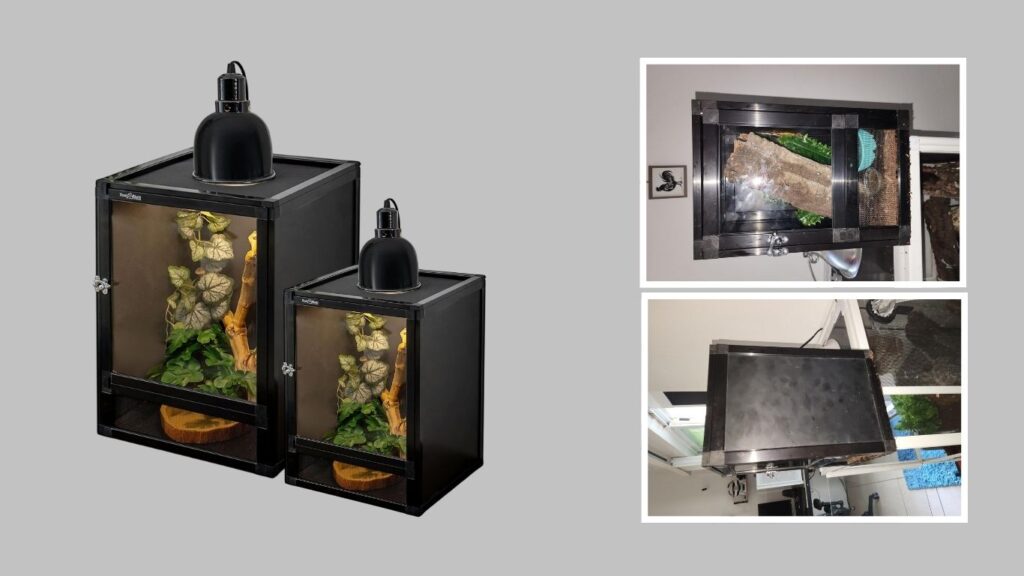
The Toxirium Hybrid Terrarium combines solid PVC panels with interchangeable front-door options. That adaptability is its distinguishing feature. However, its removable floor is explicitly described as non-waterproof, making it a less straightforward choice for the wet substrate and misting arrangements used in many frog habitats.
Key Features
- Listed dimensions of 12 × 12 × 18 inches.
- Aluminum frame with PVC side and rear panels.
- Interchangeable clear acrylic and ventilated screen doors.
- Tool-free assembly.
- Removable, non-waterproof bottom panel.
- Manufacturer cautions against some fine-particle substrates.
Door Options Offer Environmental Flexibility
The alternative front doors let the keeper prioritize clearer viewing or increased airflow. That is a useful design distinction from an enclosure with one fixed front configuration.
The appropriate choice depends on measured conditions and the intended species. More ventilation is not automatically better, just as retaining more moisture does not necessarily create a suitable environment.
The solid side and rear panels provide visual separation from the surrounding room. This may be useful when arranging neighboring enclosures, although it should not be treated as a guarantee of reduced stress.
The Removable Floor Changes Its Practical Role
The non-waterproof floor is the most important feature to understand before planning a frog setup. This enclosure should not be treated as a ready-made container for standing water, wet drainage layers, or an unrestricted moisture-heavy build.
The removable panel may simplify access during cleaning, but that convenience comes with different substrate constraints from a sealed glass base. The listing also warns that fine particles may be unsuitable.
For many conventional humid frog habitats, an appropriately sized enclosure with a sealed base is a simpler starting point.
Best for Specialized, Carefully Managed Setups
Toxirium’s appeal lies in its interchangeable doors, visual barriers, and dismantling convenience. It is better viewed as a configurable enclosure for a verified application than as a universal tropical frog tank.
The compact dimensions add another limitation, particularly for adult tree frogs needing more room. Its flexible construction is useful when the habitat plan genuinely accommodates both the size and non-waterproof floor. Otherwise, those restrictions outweigh the convenience of the hybrid design.
FAQs
The right frog enclosure depends on the species, its adult size, and the environment it needs. These answers address common questions about choosing and setting up a suitable habitat.
1. What Size Enclosure Does a Frog Need?
There is no single enclosure size suitable for every frog. Consider the species, adult size, activity level, and number of animals. Check usable interior dimensions rather than advertised capacity alone, since substrate, backgrounds, and decorations reduce available space.
2. Are Mini Terrariums Suitable for Pet Frogs?
Mini terrariums should not automatically be considered suitable frog housing. Very small, shallow containers are inappropriate as permanent homes for adult tree frogs. An animal fitting inside does not mean it has enough living space. Always check species-specific requirements before selecting a compact enclosure.
3. Is Glass or PVC Better for a Frog Enclosure?
Either material can work in an appropriately designed habitat. Glass offers clear viewing, while solid PVC panels provide visual barriers. More important considerations include dimensions, ventilation, secure access, and moisture management. Check the floor construction carefully, because some PVC enclosures have non-waterproof removable bottoms.
4. How Do You Balance Humidity and Ventilation?
Follow humidity guidance for the particular frog species and monitor conditions with a hygrometer. Ventilation allows air exchange, while substrate, water, and misting influence moisture levels. Do not assume that maximum humidity is always desirable or seal every ventilation opening to retain moisture.
5. Do Frog Enclosure Starter Kits Include Everything Needed?
Not necessarily. A starter kit may include an enclosure, substrate, a dish, and basic lighting, but these components might not suit every frog. Additional shelter, climbing structures, environmental controls, or species-appropriate lighting may be necessary. Confirm the complete setup requirements before introducing an animal.
