
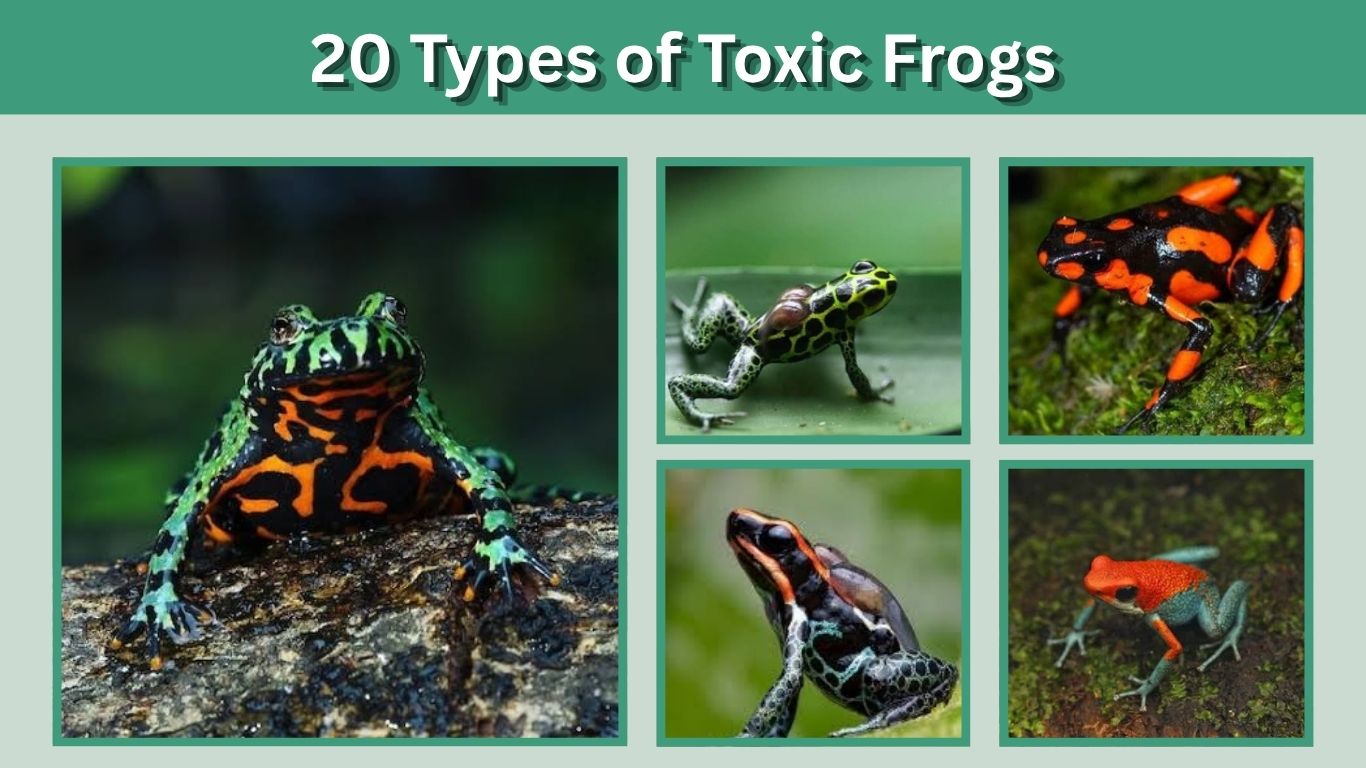
Toxic frogs are some of the most colorful and fascinating amphibians in the world. Many species use bright red, yellow, blue, green, or orange markings to warn predators about defensive chemicals in their skin. Most of the best-known toxic frogs belong to the poison frog family Dendrobatidae and live in tropical regions of Central and South America. Their toxicity varies widely between species, and many captive-bred frogs lose much of their natural toxicity because their diet changes. Here are 20 remarkable types of toxic frogs and their key characteristics.
1. Golden Poison Frog
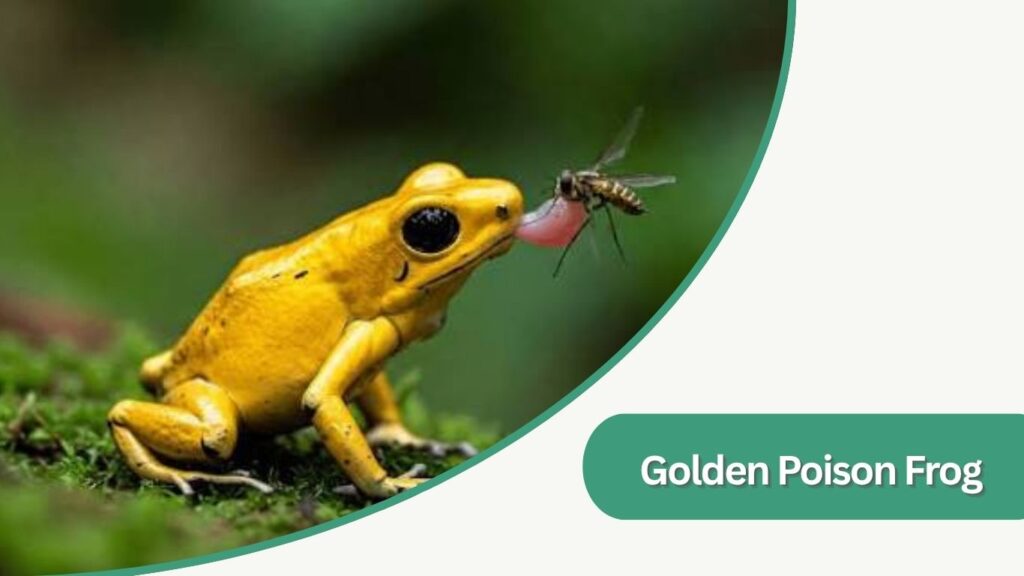
The golden poison frog is one of the most famous poison frogs in the world. Native to humid rainforests of western Colombia, this small amphibian is known for its brilliant coloration and exceptionally potent skin toxins in the wild. Despite its tiny size, it has few natural predators and relies heavily on warning coloration for protection.
Identification
- Scientific name: Phyllobates terribilis
- Bright yellow, golden, orange, or pale green coloration
- Smooth skin with a compact body
- Dark eyes
- Adults usually measure about 1.5–2 inches long
- Toes have small adhesive pads
- Usually lacks the dark spots seen on many other poison frogs
Habitat and Distribution
Golden poison frogs inhabit warm, extremely humid lowland rainforests along Colombia’s Pacific coast. They live mainly on the forest floor among leaf litter, fallen branches, and dense vegetation. Constant moisture is important because their skin must remain damp, and they rely on small forest pools and wet environments during reproduction.
Diet and Toxicity
Wild golden poison frogs eat tiny insects and other arthropods, particularly ants and mites. Their powerful skin toxins are believed to be derived from compounds obtained through their natural diet. Captive-bred frogs fed common feeder insects generally do not retain the same dangerous toxicity.
Behavior and Life Cycle
These frogs are active mainly during daylight. Males use calls to attract females and establish territories. Eggs are deposited in moist locations, and after hatching, a parent transports tadpoles to water where they continue their development.
2. Blue Poison Dart Frog
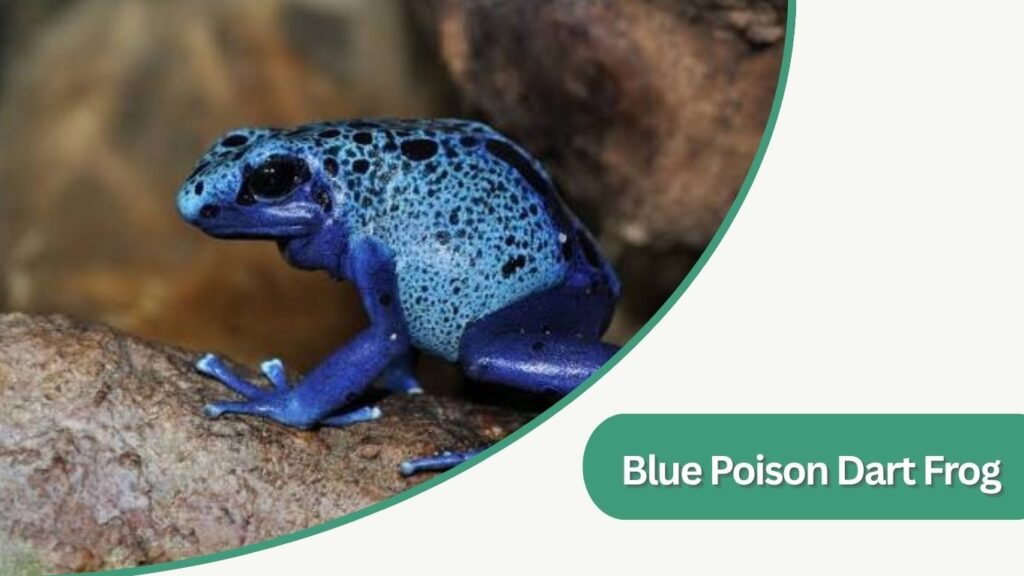
The blue poison dart frog is famous for its brilliant blue coloration covered with irregular black spots. It is generally considered a color form of the dyeing poison dart frog rather than a completely separate species. It occurs naturally in a relatively restricted area of South America and spends most of its time near the rainforest floor.
Identification
- Scientific name: Dendrobates tinctorius
- Bright blue or cobalt-colored body
- Numerous irregular black spots
- Dark blue legs and feet
- Rounded body with smooth skin
- Adults commonly reach around 1.5–2 inches
- Each individual has a slightly different spot pattern
Habitat and Distribution
Wild blue poison dart frogs occur in forested areas of southern Suriname and nearby regions. They favor humid rainforest environments near streams and rocky areas where moisture remains high throughout the year.
Most activity takes place close to the ground among leaves, roots, and fallen vegetation.
Diet and Toxicity
They feed on tiny ants, mites, beetles, springtails, and other small invertebrates. Wild individuals obtain defensive alkaloids through their diet, which makes their skin unpleasant or harmful to predators.
Captive-bred individuals generally lose this toxicity when raised on ordinary feeder insects.
Behavior and Reproduction
Blue poison dart frogs are active during the day and may defend small territories. During reproduction, eggs are deposited in moist protected areas. A parent later carries newly hatched tadpoles to small bodies of water where they continue growing.
3. Strawberry Poison Dart Frog
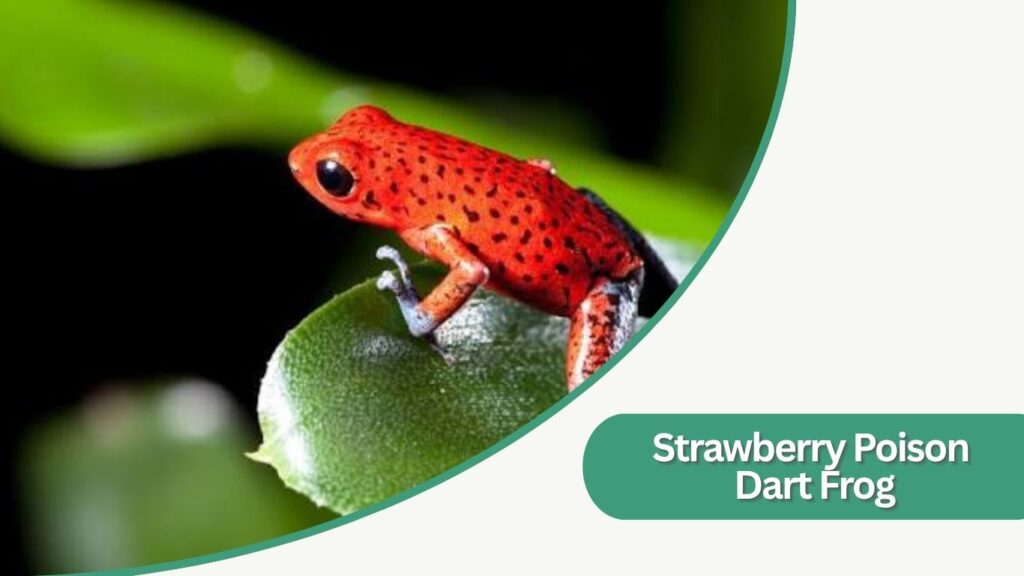
The strawberry poison dart frog is a small but exceptionally colorful rainforest amphibian. Although red with dark markings is one of its best-known appearances, populations display an extraordinary variety of colors, including orange, yellow, green, blue, and combinations of these shades. It occurs primarily in Central American tropical forests.
Identification
- Scientific name: Oophaga pumilio
- Small, compact body
- Usually around 0.7–1 inch long
- Often bright red with dark or blue legs
- Color varies greatly between populations
- Smooth skin
- Rounded snout and noticeable eyes
Habitat and Distribution
Strawberry poison dart frogs occur from Nicaragua through Costa Rica into Panama. They inhabit humid lowland rainforests, plantations, forest edges, and other damp environments.
They frequently move through leaf litter and low vegetation, where they can find both food and suitable breeding sites.
Diet and Toxicity
Their diet consists mainly of tiny ants and mites along with other small arthropods. These food sources provide compounds that contribute to their skin toxins in the wild.
Their bright coloration acts as a warning to predators that they may be unpleasant or dangerous to eat.
Parental Care
This species has remarkable parental behavior. After eggs hatch, the female transports individual tadpoles to tiny water-filled plant cavities, often bromeliads. She later returns and provides unfertilized eggs that serve as food for the developing tadpoles.
4. Dyeing Poison Dart Frog
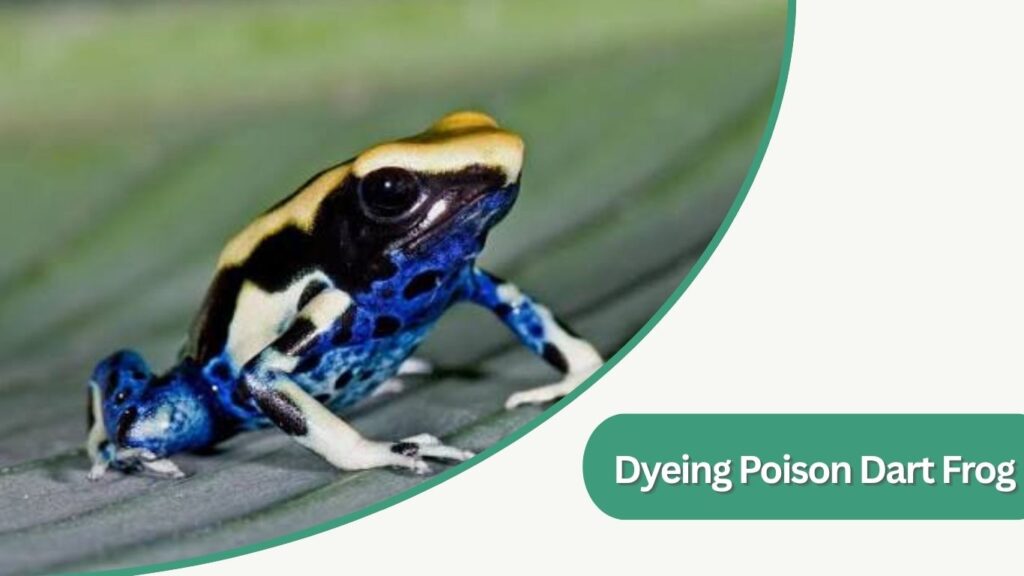
The dyeing poison dart frog is one of the largest and most variable poison frogs. Its striking patterns can combine black with yellow, white, blue, or other colors. Different populations may look so different that inexperienced observers could mistake them for separate species. It is native to tropical forests of northeastern South America.
Identification
- Scientific name: Dendrobates tinctorius
- Medium to relatively large poison frog
- Black body with bright contrasting patterns
- Colors can include yellow, white, blue, or cream
- Strong hind legs
- Smooth skin
- Individual patterns vary greatly between populations
Habitat and Distribution
The species occurs mainly in Guyana, Suriname, French Guiana, and parts of northern Brazil. It favors humid tropical rainforest, particularly forest-floor environments containing abundant leaf litter, fallen trees, and small pools.
Humidity is essential for both adults and developing eggs.
Diet and Toxicity
Dyeing poison dart frogs consume ants, mites, termites, beetles, and other tiny arthropods. Wild frogs store defensive alkaloids obtained from certain prey.
Captive individuals generally lack significant toxicity because their diet does not contain the same alkaloid-producing organisms.
Behavior and Breeding
These frogs are diurnal and often territorial. Males advertise with calls and may compete over favorable locations. Eggs are laid in moist sites, and after hatching, tadpoles are transported to water.
Adults can be surprisingly bold because their coloration provides effective warning to potential predators.
5. Black-Legged Poison Frog
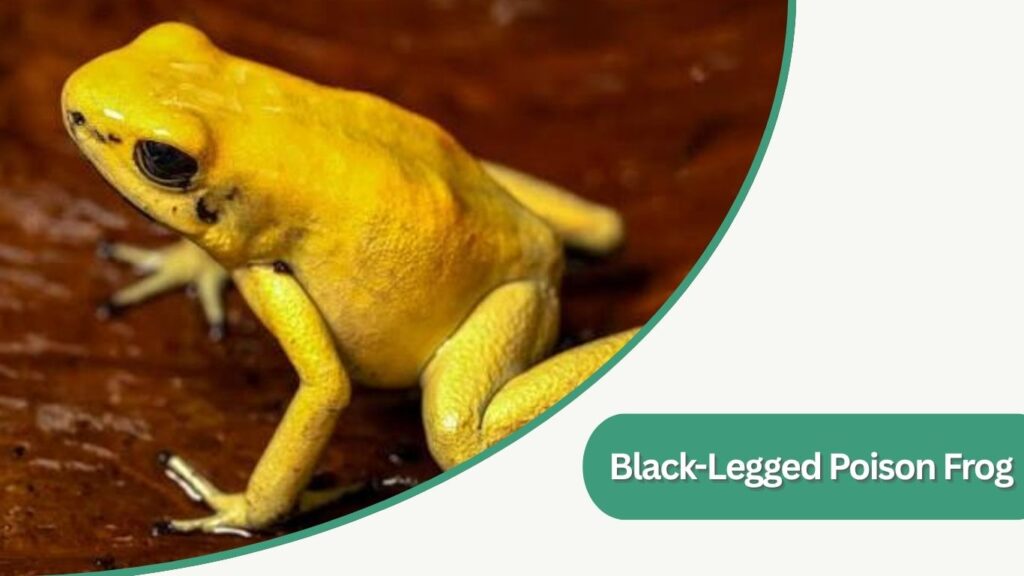
The black-legged poison frog is a highly toxic species closely related to the golden poison frog. It has bright body coloration contrasted by darker legs, creating an obvious warning pattern. The species is native to western Colombia and depends on warm, wet rainforest environments for survival.
Identification
- Scientific name: Phyllobates bicolor
- Bright yellow, orange, or golden body
- Darker brown or black legs
- Smooth skin
- Compact body shape
- Adults can approach about 2 inches long
- Dark eyes and small adhesive toe pads
Habitat and Distribution
Black-legged poison frogs inhabit humid tropical forests on the western slopes of Colombia. They usually stay near the forest floor, where dense vegetation and leaf litter provide hiding places.
Reliable moisture and relatively stable temperatures are important because amphibians can lose water rapidly through their permeable skin.
Diet and Toxicity
Their diet includes ants, mites, beetles, and other tiny invertebrates. Wild individuals can carry powerful batrachotoxin-type compounds in their skin.
These toxins discourage predators from attempting to eat them. As with several poison frogs, individuals raised in captivity generally become far less toxic because their diet lacks the necessary chemical sources.
Behavior and Reproduction
Black-legged poison frogs are active during daylight and communicate through vocalizations. Eggs are placed in humid environments on land. After the tadpoles hatch, adults transport them to water, where metamorphosis continues until juvenile frogs emerge.
6. Kokoe Poison Frog
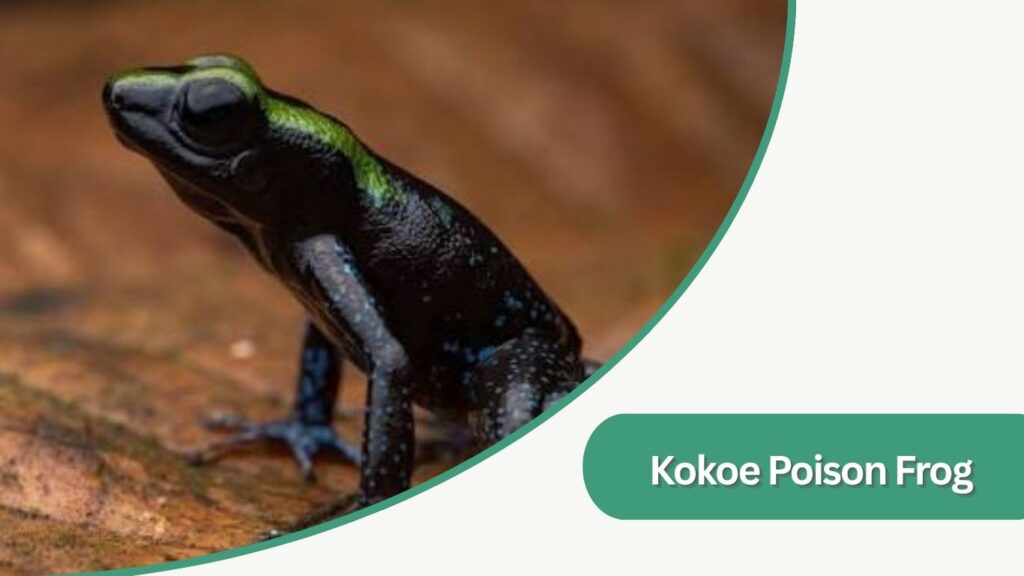
The Kokoe poison frog is a striking Colombian poison frog recognized for its contrasting dark body and bright colored stripes. Like other members of the genus Phyllobates, it possesses powerful defensive toxins in the wild. Its bold coloration makes it highly visible against dark rainforest vegetation.
Identification
- Scientific name: Phyllobates aurotaenia
- Dark brown or black body
- Bright yellow, orange, or greenish stripes
- Stripes extend along the sides of the back
- Dark limbs with colored markings
- Slender body
- Adults generally around 1–1.5 inches long
Habitat and Distribution
Kokoe poison frogs inhabit wet tropical forests of western Colombia and neighboring parts of Panama. They live near the forest floor in extremely humid environments.
Leaf litter, small streams, fallen branches, and dense vegetation provide important shelter and breeding habitat.
Diet and Toxicity
The frog feeds on ants, mites, termites, and other tiny forest invertebrates. Wild individuals can contain potent alkaloid toxins in their skin, helping protect them against predators.
Their bright stripes serve as warning coloration, advertising that attacking or swallowing the frog could be harmful.
Behavior and Life Cycle
Kokoe poison frogs are active during daylight. Males establish territories and use calls during the breeding season. Eggs develop in damp locations outside open water.
After hatching, tadpoles are carried by a parent to suitable aquatic sites. They remain there while developing into juvenile frogs.
7. Phantasmal Poison Frog
The phantasmal poison frog is a small, brightly patterned species from western Ecuador. Although tiny, it is notable because some wild populations contain powerful alkaloid toxins. Its attractive combination of red, orange, white, and dark markings also makes it one of the more visually distinctive poison frogs.
Identification
- Scientific name: Epipedobates tricolor
- Small and slender body
- Red to reddish-brown base coloration
- Pale white, cream, or turquoise stripes
- Dark legs or markings
- Adults generally around 0.8–1 inch long
- Smooth skin with prominent eyes
Habitat and Distribution
Phantasmal poison frogs are native to western Ecuador, where they occur in humid forests and vegetation near streams.
They may occupy forest-floor environments as well as low vegetation. Their populations depend on moisture, suitable breeding areas, and an abundance of tiny arthropods.
Diet and Toxicity
They feed on ants, mites, flies, and other small invertebrates. Wild individuals can accumulate alkaloid compounds through their diet.
One compound associated with this species, epibatidine, became scientifically notable because of its powerful effects on nervous-system receptors. The frog does not manufacture such defensive compounds in the same way regardless of diet; captive animals generally lose much of their natural toxicity.
Behavior and Reproduction
Males call to attract females and defend suitable breeding areas. Eggs are laid in moist terrestrial locations. Once the tadpoles hatch, a parent carries them on its back to water.
After completing metamorphosis, the young leave the aquatic environment and begin living as small terrestrial frogs.
8. Green-and-Black Poison Dart Frog
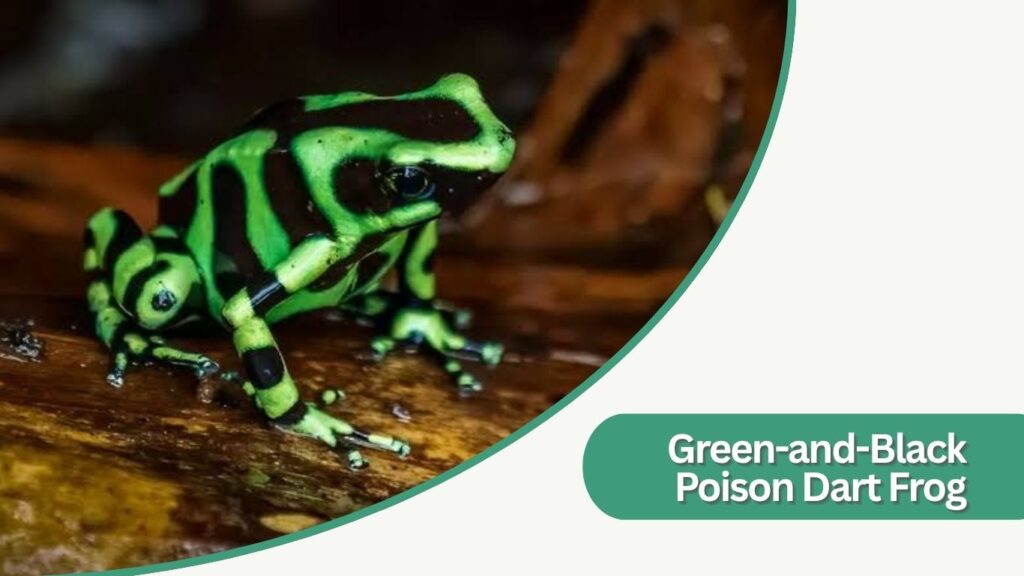
The green-and-black poison dart frog is a brightly colored tropical species recognized by its contrasting green or turquoise markings against a dark background. Scientifically known as Dendrobates auratus, it occurs naturally in parts of Central and South America. Its striking coloration warns potential predators of the defensive chemicals present in the skin of wild individuals.
Identification
- Scientific name: Dendrobates auratus
- Black or dark brown base coloration
- Bright green, turquoise, or bluish markings
- Irregular spots, bands, or patches
- Smooth skin
- Compact body
- Adults usually around 1–1.7 inches long
- Rounded toe pads adapted for climbing
Color and pattern vary considerably among different populations.
Habitat and Distribution
Green-and-black poison dart frogs inhabit humid tropical forests from parts of Central America into northwestern South America. They are particularly associated with Costa Rica, Panama, Colombia, and Nicaragua.
They spend much of their time near the forest floor among leaf litter, fallen logs, rocks, roots, and low vegetation. Consistently high humidity provides suitable conditions for their skin and reproduction.
Diet and Toxicity
These frogs feed on ants, mites, beetles, termites, and other tiny arthropods. Wild individuals obtain defensive alkaloids from components of their natural diet.
Captive-bred frogs fed ordinary feeder insects usually lack the same skin toxicity. Their bold colors remain even when the defensive chemicals are absent.
Behavior and Life Cycle
The species is active mainly during daylight. Males use calls to attract females and defend small territories.
Eggs are deposited in damp terrestrial locations. After hatching, an adult transports tadpoles to small pools or water-filled plant structures, where they continue developing until metamorphosis.
9. Yellow-Banded Poison Dart Frog
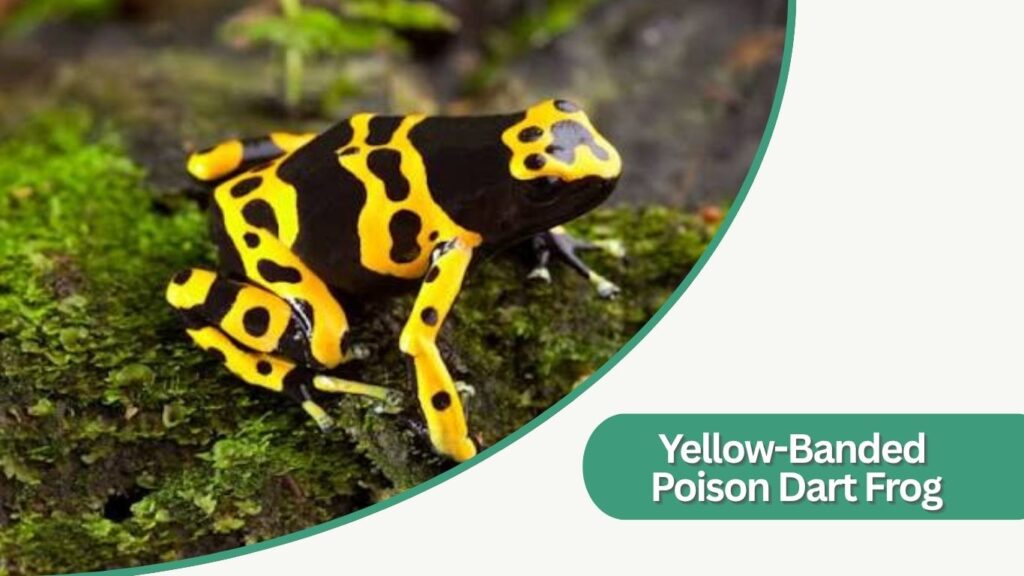
The yellow-banded poison dart frog is one of the most easily recognizable poison frogs because of its bright yellow bands against a black body. Also known as the bumblebee poison frog, Dendrobates leucomelas inhabit tropical forests in northern South America. Its bold pattern functions as warning coloration and helps discourage potential predators.
Identification
- Scientific name: Dendrobates leucomelas
- Black body
- Bright yellow or orange-yellow bands
- Dark spotting within yellow areas
- Compact, muscular appearance
- Smooth to slightly textured skin
- Adults commonly around 1.2–1.6 inches long
- Small adhesive toe pads
Individuals can vary in how much yellow or black appears on the body.
Habitat and Distribution
Yellow-banded poison dart frogs occur in Venezuela and neighboring areas of northern South America, including parts of Brazil, Colombia, and Guyana.
They occupy humid tropical and seasonal forest environments. During drier periods, they may become less active and remain in protected, moist hiding places.
Diet and Toxicity
Their diet includes ants, mites, termites, beetles, and other tiny invertebrates.
Wild frogs accumulate defensive alkaloids through their food. These chemicals make them distasteful or harmful to many potential predators.
Captive-bred animals generally lack significant toxicity because their diets do not contain the same alkaloid-bearing prey.
Behavior and Reproduction
Males are known for their relatively loud calls, particularly during breeding periods.
Eggs are deposited in humid protected locations. After hatching, tadpoles are carried to water by an adult. Development continues in aquatic environments until the young complete metamorphosis and begin terrestrial life.
10. Splash-Back Poison Frog
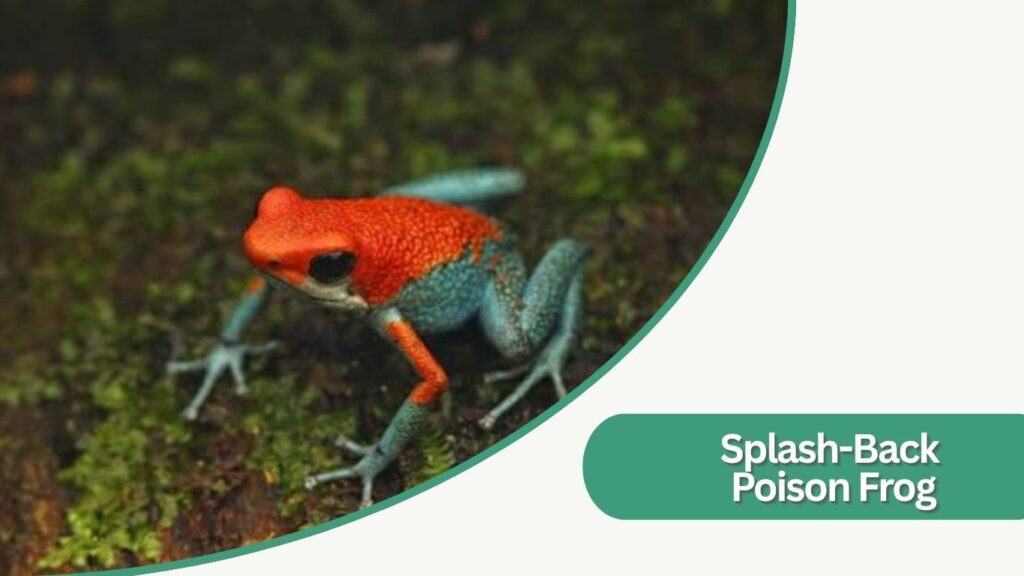
The splash-back poison frog is a colorful Amazonian species known for its dramatic contrast between a dark body and bright orange, yellow, or reddish coloration across the back. Scientifically known as Adelphobates galactonotus, it is native to Brazil and is strongly associated with humid tropical forests south of the Amazon River.
Identification
- Scientific name: Adelphobates galactonotus
- Dark brown or black lower body
- Bright yellow, orange, red, or cream back
- Color may appear as a broad “splash”
- Smooth skin
- Dark legs in many individuals
- Adults usually around 1.2–1.6 inches
- Compact body with rounded toe pads
Some populations display almost entirely yellow or orange upper bodies.
Habitat and Distribution
Splash-back poison frogs are native to Brazil, particularly forests south of the Amazon River.
They are terrestrial frogs that spend much of their time among leaves, fallen branches, roots, and other debris on the rainforest floor.
Dense forest cover provides shade and moisture, while temporary pools and water-filled cavities offer sites for developing tadpoles.
Diet and Toxicity
Wild frogs consume tiny arthropods such as ants, mites, termites, and small beetles.
Their natural diet contributes to the alkaloid-based chemical defenses stored in their skin.
As with many poison frogs, captive individuals raised without these specialized prey generally lose or fail to develop significant toxicity.
Behavior and Reproduction
Adults are primarily active during daylight.
Males call to attract females, and eggs are placed in moist sites above or near the ground. A parent later carries hatched tadpoles to suitable water, where they feed and develop until metamorphosis is complete.
11. Granular Poison Frog
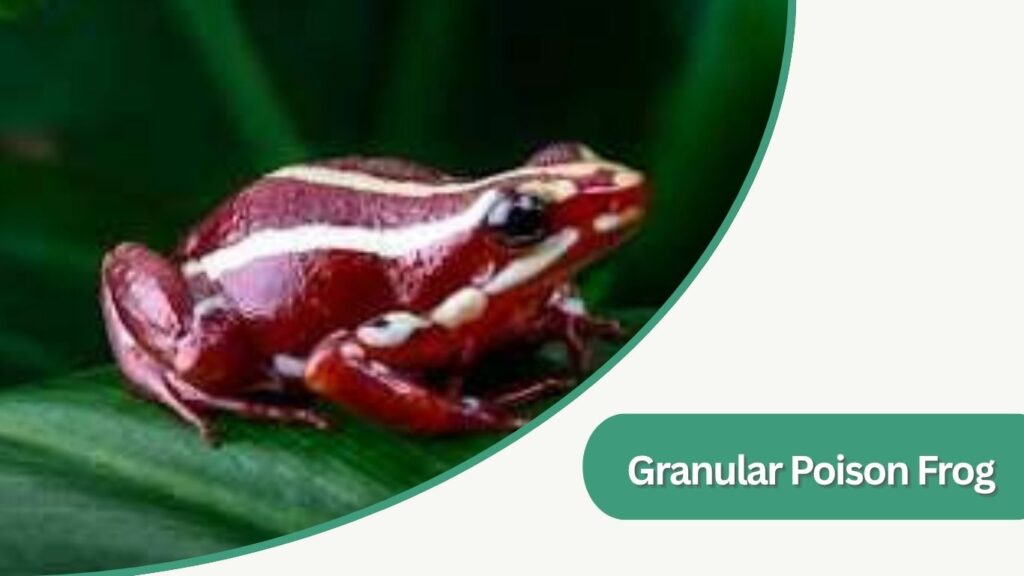
The granular poison frog is a small Central American species distinguished by its textured skin and vivid coloration. Its scientific name is Oophaga granulifera. Depending on the population, individuals can range from bright red or orange to greenish coloration. These frogs inhabit humid forests along the Pacific side of Costa Rica and neighboring Panama.
Identification
- Scientific name: Oophaga granulifera
- Small body
- Granular or textured skin
- Red, orange, or greenish upper coloration
- Darker legs and lower body
- Rounded snout
- Small adhesive toe pads
- Adults generally around 0.7–1 inch long
Geographic populations can differ dramatically in color.
Habitat and Distribution
Granular poison frogs occur mainly in southwestern Costa Rica and adjacent western Panama.
They prefer humid lowland and foothill forests with heavy leaf litter, dense vegetation, and abundant small water-holding plants.
They are frequently associated with moist ground-level environments but can climb vegetation when searching for food or breeding sites.
Diet and Toxicity
Their diet consists primarily of small ants, mites, and other tiny arthropods.
Wild frogs obtain alkaloids from their prey and store these chemicals in their skin as protection against predators.
Bright coloration provides an additional warning signal that helps discourage attacks.
Parental Care
Granular poison frogs have specialized parental behavior. Females transport tadpoles to small water-filled locations, including plant structures.
Like several Oophaga species, mothers can return to provide unfertilized eggs as food for their developing tadpoles.
This intensive parental investment helps young frogs survive in very small aquatic nurseries.
12. Anthony’s Poison Arrow Frog
Anthony’s poison arrow frog is a small, colorful species native to southwestern Ecuador and northwestern Peru. Scientifically known as Epipedobates anthonyi, it is characterized by reddish or brownish coloration with pale longitudinal stripes. It lives in humid environments near streams and is known for active daytime behavior and distinctive breeding calls.
Identification
- Scientific name: Epipedobates anthonyi
- Red, reddish-brown, or dark brown body
- Pale cream or turquoise stripes
- Stripe usually runs along each side of the back
- Small and slender build
- Dark legs
- Adults generally around 0.8–1 inch long
- Smooth skin
Color intensity can vary between individuals and populations.
Habitat and Distribution
The species inhabits southwestern Ecuador and parts of northwestern Peru.
It commonly lives near streams, moist ravines, forest edges, and humid vegetation. Unlike species restricted to pristine rainforest, it can sometimes occur in disturbed habitats when sufficient moisture and vegetation remain.
Diet and Toxicity
Anthony’s poison arrow frog consumes ants, mites, small flies, beetles, and other tiny invertebrates.
Wild individuals may carry defensive alkaloids obtained from their prey. These compounds help reduce predation.
Captive animals generally become far less toxic because their feeder insects do not provide the same alkaloid sources.
Behavior and Reproduction
Males call repeatedly from suitable territories to attract females.
Eggs are deposited on moist surfaces outside open water. Once the tadpoles hatch, a parent transports them on its back to streams or pools.
The tadpoles remain aquatic until metamorphosis produces small terrestrial juveniles.
13. Harlequin Poison Frog
The harlequin poison frog is a striking Colombian species famous for its highly variable patterns. Scientifically called Oophaga histrionica, it may display combinations of black with red, orange, yellow, or other bright colors. Different populations can look remarkably different, but all share warning coloration associated with their chemical defenses.
Identification
- Scientific name: Oophaga histrionica
- Dark black or brown base color
- Bright red, orange, yellow, or cream markings
- Highly variable patterns
- Compact body
- Smooth to slightly textured skin
- Adults usually around 1–1.5 inches
- Prominent adhesive toe pads
Color patterns can differ significantly between geographically separated populations.
Habitat and Distribution
Harlequin poison frogs are native to the humid forests of western Colombia.
They live primarily on the forest floor and low vegetation, where leaf litter provides shelter and feeding opportunities.
The region’s high rainfall supports the moist microhabitats required for reproduction and helps maintain water-filled plants used by developing tadpoles.
Diet and Toxicity
These frogs consume ants, mites, and other small arthropods.
Wild individuals can accumulate potent alkaloid compounds in their skin. Their bright colors function as aposematic signals warning potential predators of these chemical defenses.
Captive-bred frogs without access to natural alkaloid-containing prey generally lose much of this toxicity.
Parental Care
Females show specialized parental behavior. Tadpoles are transported to small water-filled cavities, commonly in plants.
The mother later returns and deposits unfertilized eggs for the tadpoles to eat. This unusual feeding strategy gives the genus Oophaga its name, which refers to egg eating.
14. Lovely Poison Frog
The lovely poison frog is a small Central American poison frog scientifically known as Phyllobates lugubris. Despite its delicate appearance, wild individuals can possess defensive alkaloids in their skin. Its dark body is typically marked with bright stripes that provide effective warning coloration while also distinguishing it from many neighboring frog species.
Identification
- Scientific name: Phyllobates lugubris
- Dark brown or black body
- Yellow, orange, or pale stripes along the sides
- Slender build
- Dark limbs
- Small rounded toe pads
- Adults generally around 0.8–1 inch long
- Smooth skin
The bright lateral stripes usually run from near the head toward the rear of the body.
Habitat and Distribution
Lovely poison frogs occur in parts of Central America, particularly Costa Rica, Panama, and nearby regions.
They favor humid lowland forests, especially locations near streams and other consistently damp environments.
Adults spend considerable time among leaf litter, roots, rocks, and low vegetation where they search for tiny prey.
Diet and Toxicity
Their natural diet includes ants, mites, termites, beetles, and other small arthropods.
Wild individuals may carry defensive alkaloids, although they are not considered as chemically potent as the golden poison frog.
As with related species, captive frogs generally lack significant toxicity when fed diets without the necessary alkaloid-containing prey.
Behavior and Life Cycle
Lovely poison frogs are active primarily during daylight. Males call to advertise territories and attract females.
Eggs are laid in damp terrestrial locations. After hatching, one of the parents transports tadpoles to aquatic sites.
The tadpoles continue developing in water before completing metamorphosis and emerging as miniature terrestrial frogs.
15. Golfodulcean Poison Frog
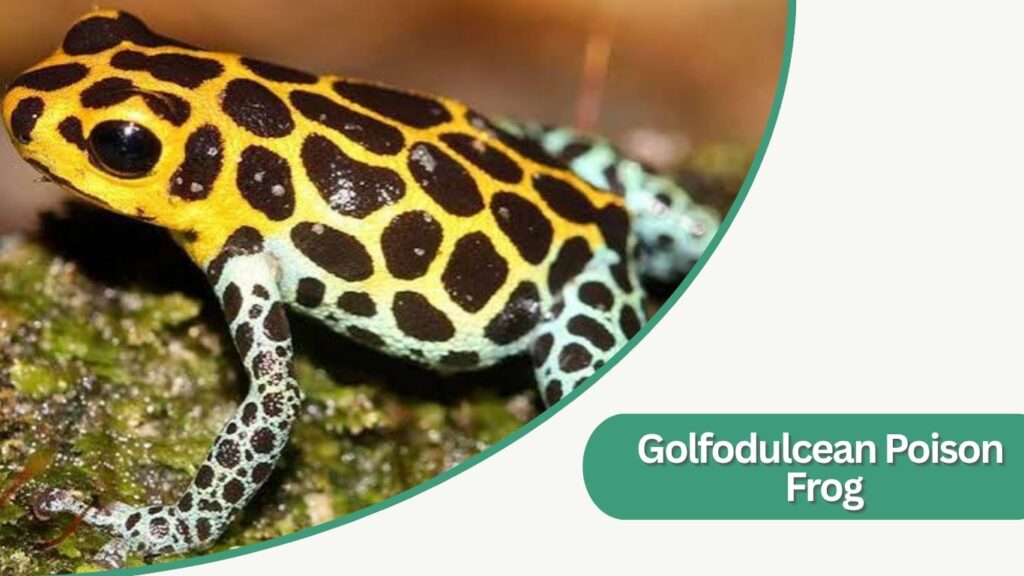
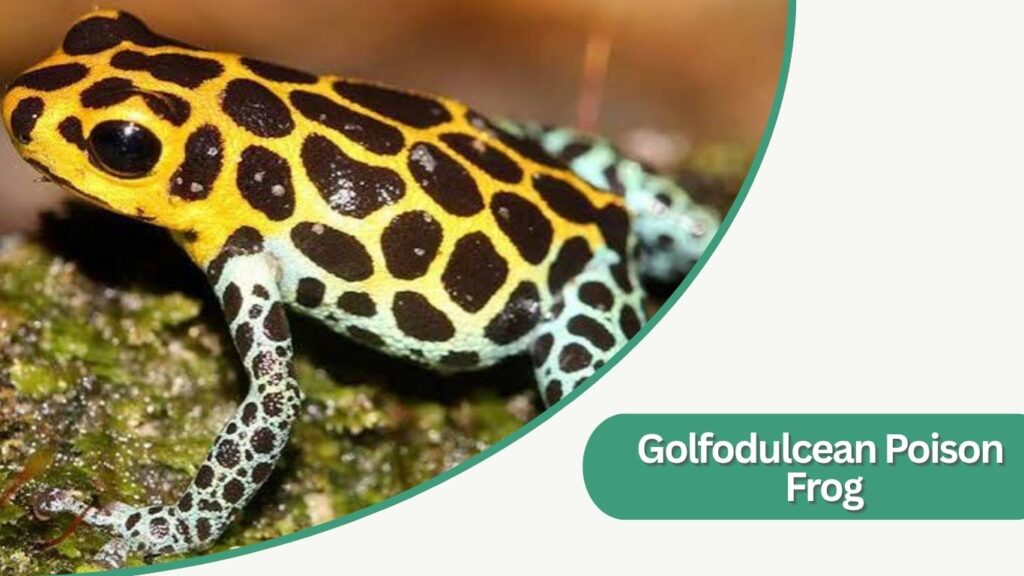
The Golfodulcean poison frog is a striking species native to the Pacific forests of Costa Rica. Scientifically known as Phyllobates vittatus, it has a dark body marked by bright yellow or orange stripes. Like other Phyllobates frogs, wild individuals possess defensive alkaloids obtained through their natural diet. It is primarily a ground-dwelling frog associated with moist tropical forest.
Identification
- Scientific name: Phyllobates vittatus
- Black or very dark brown body
- Bright yellow or orange longitudinal stripes
- Blue-green mottling on the legs
- Slender body shape
- Smooth skin
- Adults generally around 1–1.3 inches long
- Small adhesive toe pads
Its bright stripes provide warning coloration that helps discourage potential predators.
Habitat and Distribution
The Golfodulcean poison frog has a relatively restricted distribution in southwestern Costa Rica, particularly around the Golfo Dulce region.
It inhabits humid lowland and foothill forests where heavy rainfall maintains consistently damp conditions. Adults spend much of their time among leaf litter, roots, rocks, and fallen branches.
Streams and temporary pools are important during reproduction because tadpoles require water to complete their development.
Diet and Toxicity
These frogs eat ants, mites, termites, beetles, and other tiny arthropods.
Wild individuals can accumulate defensive alkaloids from their prey. Their bright body colors advertise this chemical defense to predators.
Captive-bred individuals generally lack the same toxicity when raised on conventional feeder insects.
Behavior and Life Cycle
Males call during the breeding season to attract females. Eggs are laid on moist surfaces on land.
After hatching, a parent carries the tadpoles on its back to water. They continue growing there until metamorphosis transforms them into small terrestrial frogs.
16. Mimic Poison Frog
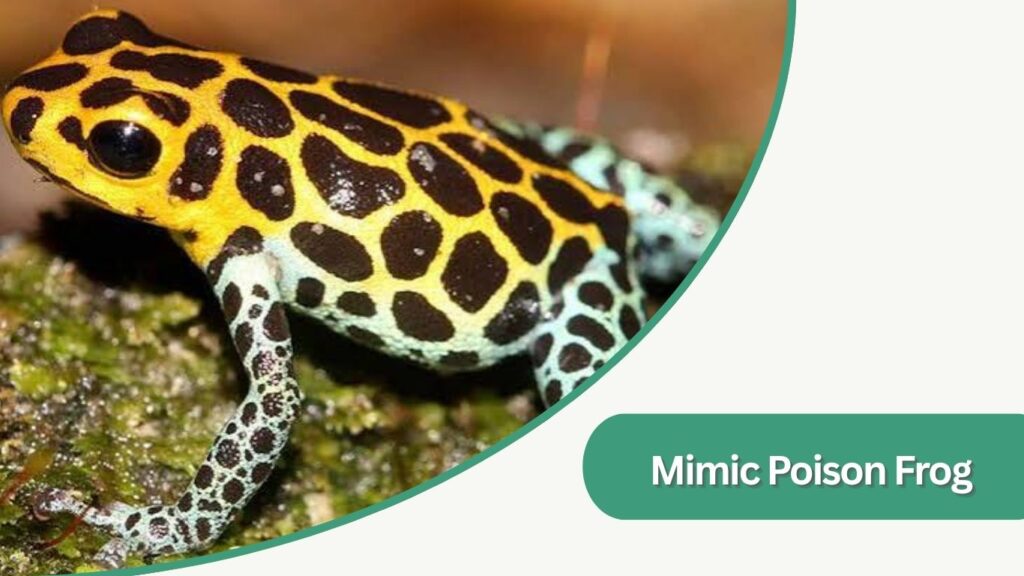
The mimic poison frog is a tiny but remarkably variable species from Peru. Its scientific name, Ranitomeya imitator, reflects its ability to resemble other poison frog species living in the same geographic areas. Different populations display yellow, orange, green, or striped patterns. It is also notable for unusually strong parental cooperation between males and females.
Identification
- Scientific name: Ranitomeya imitator
- Very small body
- Black base coloration
- Yellow, orange, green, or cream markings
- Patterns may include stripes, bands, or spots
- Slender legs
- Prominent adhesive toe pads
- Adults generally around 0.6–0.8 inch long
Its exact appearance depends strongly on geographic population.
Habitat and Distribution
Mimic poison frogs are native to tropical forests of Peru.
They inhabit humid vegetation from near the forest floor into low trees and shrubs. Bromeliads and other plants capable of holding small pools of rainwater are particularly important.
The species often occupies relatively small territories surrounding suitable breeding sites.
Diet and Toxicity
Adults feed on extremely small ants, mites, springtails, and other arthropods.
Wild frogs obtain alkaloids through their diet and use these compounds for chemical defense.
Their conspicuous coloration provides an additional warning to predators.
Parental Care
Mimic poison frogs show unusually cooperative parental care. Both parents can contribute to raising offspring.
A male may guard or transport tadpoles, while the female returns to provide unfertilized eggs that tadpoles consume.
17. Variable Poison Frog
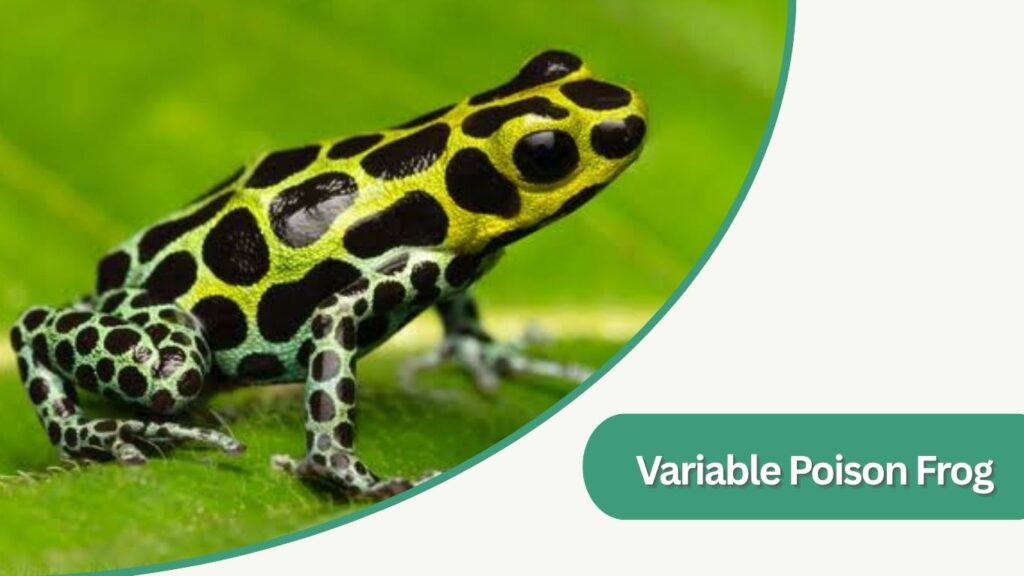
The variable poison frog, Ranitomeya variabilis, is a tiny Amazonian poison frog known for its highly variable coloration. Individuals may show combinations of yellow, green, blue, and black arranged in spotted or patterned designs. Its small size allows it to use water-filled plant structures for breeding, particularly in humid tropical forest environments.
Identification
- Scientific name: Ranitomeya variabilis
- Very small body
- Bright yellow or green upper coloration
- Dark spots or irregular markings
- Blue-green or patterned legs
- Smooth skin
- Prominent toe pads
- Adults usually less than 1 inch long
Patterns can differ considerably between populations and sometimes between individual frogs.
Habitat and Distribution
Variable poison frogs occur in parts of the western Amazon Basin, particularly Peru and nearby areas.
They frequently occupy humid forest vegetation rather than remaining exclusively on the ground.
Bromeliads and other plants that collect rainwater provide important locations for tadpole development. High humidity and dense vegetation also protect adults from drying out.
Diet and Toxicity
Their diet consists of mites, ants, springtails, tiny beetles, and other minute invertebrates.
Some of these prey provide alkaloids that wild frogs can store in their skin.
These chemicals combine with bright warning coloration to help reduce predation.
Behavior and Reproduction
Males call from vegetation to attract females and advertise breeding sites.
Eggs are placed in humid protected areas. Tadpoles are eventually transported to small pools of water held in plants.
18. Reticulated Poison Frog
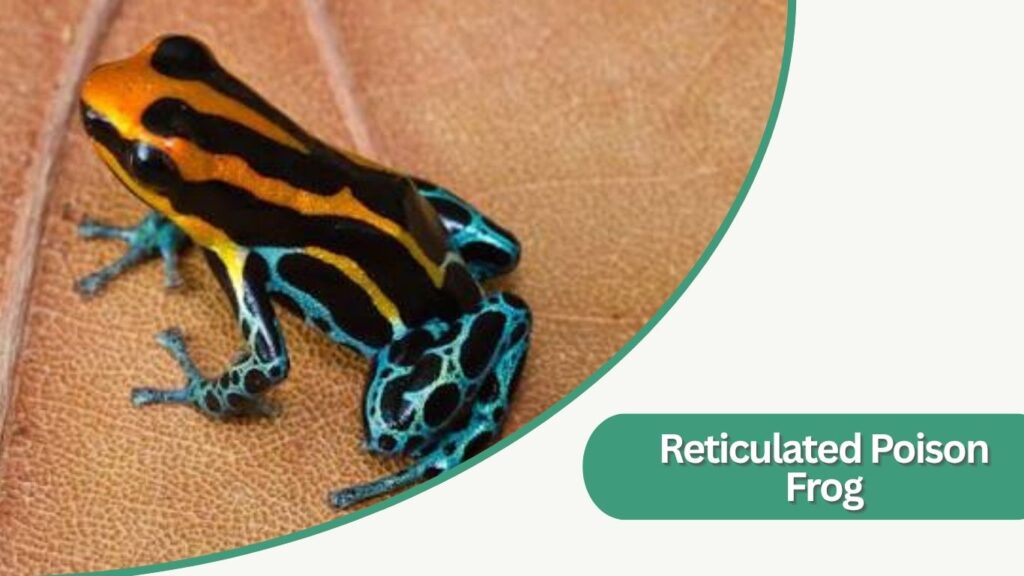
The reticulated poison frog is a tiny rainforest frog recognized by its complex network of contrasting colors. Several closely related Ranitomeya frogs have historically been associated with the “reticulated” name, and their taxonomy has changed over time. These miniature frogs occupy humid Amazonian forests and depend heavily on small water-filled plant cavities for reproduction.
Identification
- Very small body size
- Dark base coloration
- Bright red, orange, or yellow markings
- Blue or gray net-like patterns on the limbs
- Slender legs
- Rounded adhesive toe pads
- Smooth skin
- Strongly contrasting warning coloration
Their intricate markings can make them appear much more colorful than their tiny size suggests.
Habitat and Distribution
Reticulated poison frogs occur in humid tropical areas of the Amazon Basin.
They use leaf litter, low vegetation, tree roots, and plants containing small pools of rainwater.
Because these frogs lose moisture readily through their skin, they depend on environments with consistently high humidity.
Diet and Toxicity
Adults feed on tiny mites, ants, springtails, and other miniature arthropods.
Wild frogs can accumulate defensive alkaloids from their food. These compounds make them less attractive to predators.
As with most poison frogs, captive individuals generally have greatly reduced toxicity when their natural alkaloid-rich diet is absent.
Behavior and Life Cycle
Adults remain active mainly during daylight.
After courtship, eggs are deposited in protected humid locations. Tadpoles are transported to tiny water-filled cavities where they grow separately from many large aquatic predators.
19. Red-Backed Poison Frog
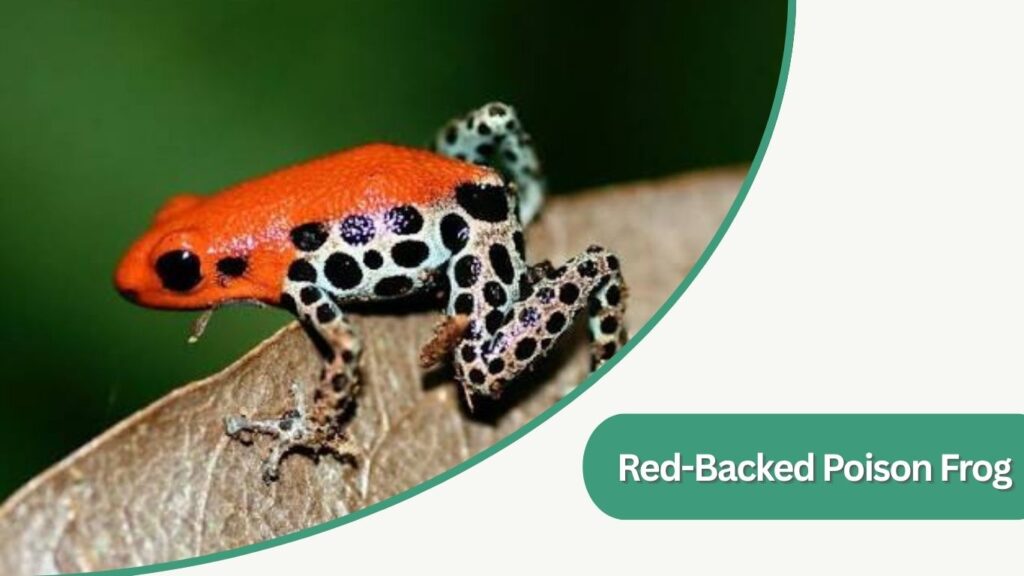
The red-backed poison frog is a tiny but brilliantly colored Amazonian species scientifically known as Ranitomeya reticulata. Its bright red or orange back contrasts dramatically with dark and blue-patterned legs. Despite measuring less than an inch long, its warning coloration makes it conspicuous against rainforest leaves.
Identification
- Scientific name: Ranitomeya reticulata
- Bright red or orange upper body
- Dark lower body
- Blue, gray, or black net-like leg pattern
- Very small size
- Slender limbs
- Enlarged toe pads
- Adults generally around 0.5–0.8 inch long
Its red back is one of the easiest features to recognize.
Habitat and Distribution
Red-backed poison frogs occur primarily in rainforest areas of Peru.
They inhabit humid forest floors and low vegetation, frequently remaining near fallen leaves, roots, and plants capable of holding water.
Their small size enables them to exploit tiny ecological niches inaccessible to larger frogs.
Diet and Toxicity
These frogs eat extremely small ants, mites, springtails, and similar arthropods.
Wild individuals obtain alkaloids from their prey and use them as a chemical defense.
The combination of toxicity and brilliant red coloration serves as a strong warning signal to potential predators.
Reproduction and Parental Care
Breeding occurs in humid locations where eggs are protected from drying.
After hatching, tadpoles are transported to tiny water-filled sites. Parents select suitable nurseries carefully because water quality, food, and predator presence can strongly influence tadpole survival.
20. Spotted Poison Frog
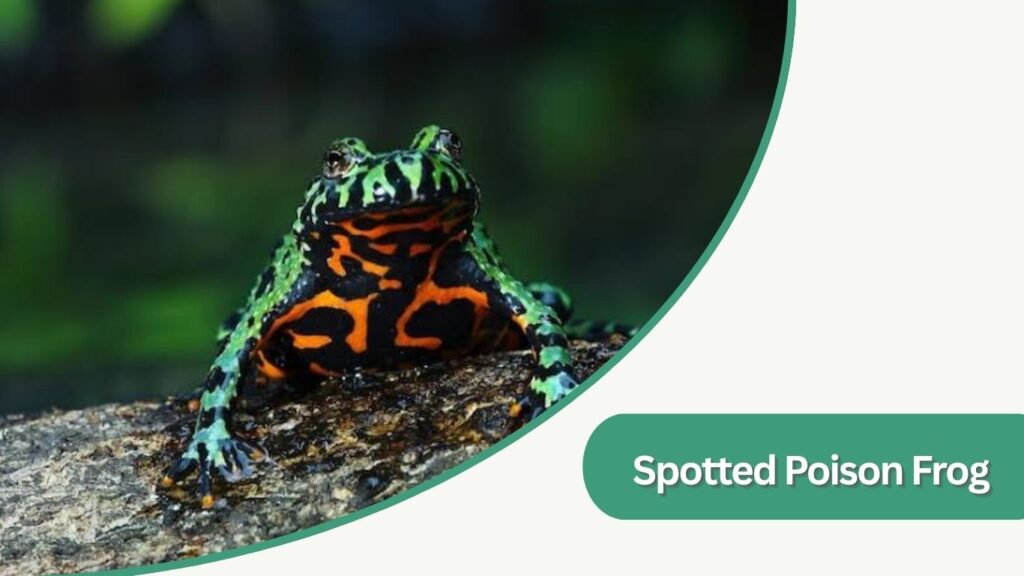
The spotted poison frog is a colorful South American amphibian associated with humid tropical environments. The common name has been applied to frogs with contrasting spotted or patterned coloration, including species within the poison frog family Dendrobatidae. These frogs use vivid colors as warning signals while relying on tiny arthropods for both nutrition and, in wild populations, defensive alkaloids.
Identification
- Small to medium-sized poison frog
- Dark background coloration
- Contrasting pale or colorful spots
- Slender hind legs
- Smooth to slightly granular skin
- Noticeable toe pads
- Bright warning pattern
- Active primarily during daylight
Color and pattern can vary considerably depending on the species and geographic population referred to by the common name.
Habitat and Distribution
Spotted poison frogs are associated with warm, humid tropical forests of South America.
They usually remain close to moist leaf litter, streams, roots, fallen logs, and low vegetation.
Forest humidity is essential for preventing dehydration and maintaining suitable conditions for egg and tadpole development.
Diet and Toxicity
Their diet consists mainly of tiny ants, mites, beetles, termites, and other small arthropods.
Wild poison frogs may obtain defensive alkaloids through this diet. The compounds are stored in skin glands and can discourage predators.
Captive-bred frogs usually lose much of their defensive toxicity when they no longer consume natural alkaloid-containing prey.
Behavior and Life Cycle
Adults are generally diurnal and spend much of the day searching for small prey.
Males may call from territories during breeding periods. Eggs develop in moist terrestrial locations before tadpoles are transferred to water.
After several stages of aquatic development, tadpoles grow limbs, absorb their tails, and emerge as juvenile frogs.
FAQs
What is the most toxic poison frog?
The golden poison frog, Phyllobates terribilis, is considered among the most toxic known poison frogs. Wild individuals can carry extremely powerful batrachotoxins in their skin.
Are all poison frogs dangerous to humans?
No. Toxicity varies greatly among species and populations. Captive-bred poison frogs generally lack the dangerous levels of skin toxins found in wild individuals because they do not eat the same alkaloid-containing prey.
Why are poison frogs so brightly colored?
Their bright colors are primarily warning coloration, known as aposematism. The colors tell potential predators that attacking or eating the frog may have unpleasant or harmful consequences.
What do poison frogs eat?
Most eat tiny arthropods such as ants, mites, termites, springtails, beetles, and small flies. Certain prey species also provide the chemical compounds used in their skin defenses.
Do poison frogs produce their own poison?
Many poison frogs obtain important defensive alkaloids through their natural diet rather than producing all of those compounds entirely on their own. This is why captive frogs raised on ordinary feeder insects usually become much less toxic.
