
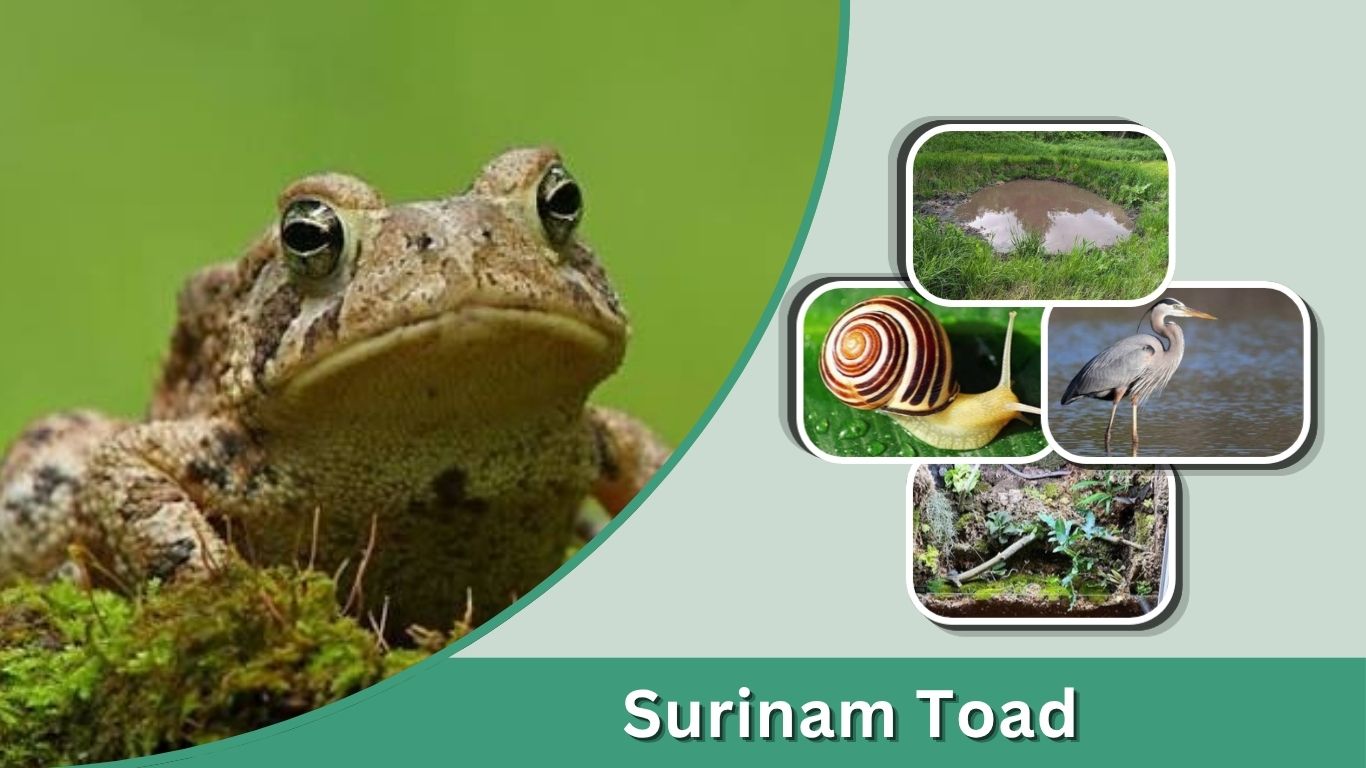
The Surinam toad is a fully aquatic South American frog famous for carrying developing young inside pockets on its back. Scientifically known as Pipa pipa, it has a flat, leaf-like body, tiny eyes, star-shaped fingertips, and an unusual reproductive process. Instead of releasing free-swimming tadpoles, the female protects fertilized eggs within her skin until fully formed toadlets emerge. This guide explains Surinam toad birth, eggs, habitat, diet, adaptations, lifespan, behavior, predators, and essential captive-care requirements.
What Is a Surinam Toad?
Despite its name, the Surinam toad is an aquatic frog belonging to the family Pipidae. It rarely leaves the water and possesses many adaptations for life along the muddy bottoms of tropical waterways. Its rough skin, flattened shape, and muted coloration make it resemble a dead leaf rather than a typical frog.
Physical Characteristics
- Broad, extremely flattened body
- Flat, triangular head
- Brown, gray, olive, or mottled skin
- Tiny eyes without obvious eyelids
- No visible tongue
- Star-shaped sensory structures on the fingertips
- Strong, fully webbed hind feet
- Rough projections along the sides of the body
- Adult length of approximately 4–8 inches
Females are generally larger than males. Males may have thicker forearms, although distinguishing the sexes outside the breeding period can be difficult.
Size and Lifespan
The common Surinam toad can reach approximately 4–8 inches long, making it one of the larger members of its genus. Size varies with sex, age, genetics, and available food.
Captive individuals may live for around six to eight years with appropriate care. San Diego Zoo records an incubation period of 12–20 weeks, a lifespan of up to eight years, and adult lengths reaching approximately eight inches.
Sound and Communication
A Surinam toad does not produce the familiar croaking call associated with many frogs. Males create metallic clicking sounds underwater, especially during courtship and territorial encounters.
The sound is produced through structures in the throat and can resemble metal tapping against glass. These clicks help individuals locate potential partners in dark, muddy water where vision is of limited use.
Surinam Toad Habitat and Distribution
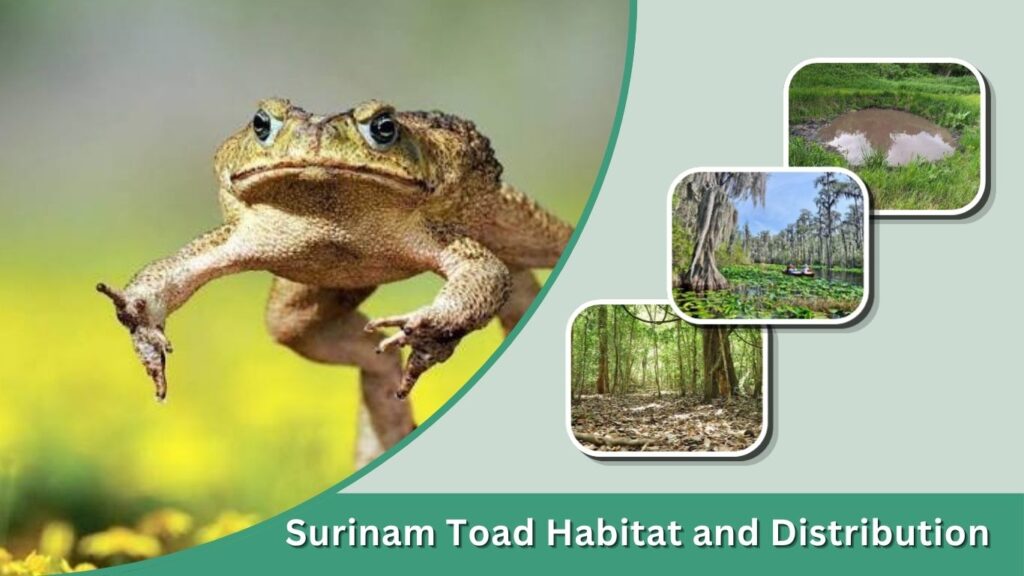
Surinam toads inhabit tropical South America, including parts of Suriname, Brazil, Colombia, Bolivia, Ecuador, Venezuela, Guyana, and French Guiana. They also occur on Trinidad. They favor warm, slow-moving or still water where mud, submerged leaves, and plant debris provide camouflage.
Natural Habitat
Typical habitats include:
- Rainforest streams
- Swamps and marshes
- Muddy ponds
- Slow-moving rivers
- Flooded forests
- Temporary pools
- Vegetated backwaters
- Leaf-covered aquatic bottoms
The water may be soft, acidic, and stained with tannins from decomposing vegetation. These frogs normally remain near the bottom and periodically swim to the surface to breathe.
Survival Adaptations
The flattened body allows a Surinam toad to rest against the bottom with a low profile. Brown or olive coloration helps it disappear among dead leaves and submerged wood.
Its sensitive star-shaped fingertips detect movements and potential prey. Because it lacks a tongue, it uses rapid suction and movements of its front limbs to capture food. Powerful webbed feet provide effective propulsion when the frog needs to surface or escape danger.
Surinam Toad Birth and Reproduction
Surinam toad reproduction is one of the most unusual parental-care strategies among amphibians. The female does not give live birth in the mammalian sense. She lays eggs, but the fertilized eggs become embedded in specialized tissue on her back and remain protected there throughout development.
Mating and Egg Placement
During courtship, a male grasps a receptive female in amplexus. The pair performs repeated underwater loops or somersaults. As the female releases eggs, the male fertilizes them and helps position them across her back.
The process involves these stages:
- The male produces clicking courtship sounds.
- He holds the female while the pair swims in loops.
- The female releases eggs during each rotation.
- The male fertilizes and presses the eggs onto her back.
- Her skin gradually grows around each egg.
- Individual honeycomb-like brood chambers form.
- Young develop inside these protected pockets.
- Fully formed toadlets emerge into the water.
A female may carry dozens of eggs, with some accounts reporting approximately 60–100 developing young. However, clutch size and survival can vary.
Eggs and Development
Each egg develops inside a separate chamber covered by a protective cap. The embryos temporarily develop tails, but they complete metamorphosis before leaving their mother.
Unlike many frogs, Pipa pipa does not release ordinary free-swimming tadpoles. Fully formed young emerge after approximately three to four months, measuring about two centimeters long.
Is Surinam Toad Birth Painful?
It is not possible to determine exactly how the female experiences the process, and there is no strong evidence showing that normal emergence causes severe pain. Her back skin is naturally specialized for carrying eggs and releasing the young.
The process may look disturbing to people, especially those sensitive to clusters of holes. However, it is a normal reproductive adaptation rather than a disease, injury, or parasitic infection.
Does the Mother Die After Giving Birth?
No, a Surinam toad does not normally die after its young emerge. The female sheds the temporary outer layer of skin containing the empty brood chambers. Her back then returns to its usual appearance, and she may reproduce again during a later breeding period.
The skin does grow back. Empty holes are not permanent wounds, although the back may appear uneven until shedding is complete.
Why Does It Trigger Trypophobia?
Images of young emerging from tightly grouped chambers may trigger discomfort in people who experience trypophobia, an aversion to clusters of holes or repeated patterns. Close-up photographs and videos often exaggerate the visual effect.
The chambers are real biological structures, but some viral images may be digitally altered, mislabeled, or presented without context. People who find these patterns distressing may prefer text-based descriptions instead of birth videos.
Surinam Toad Diet and Feeding Behavior
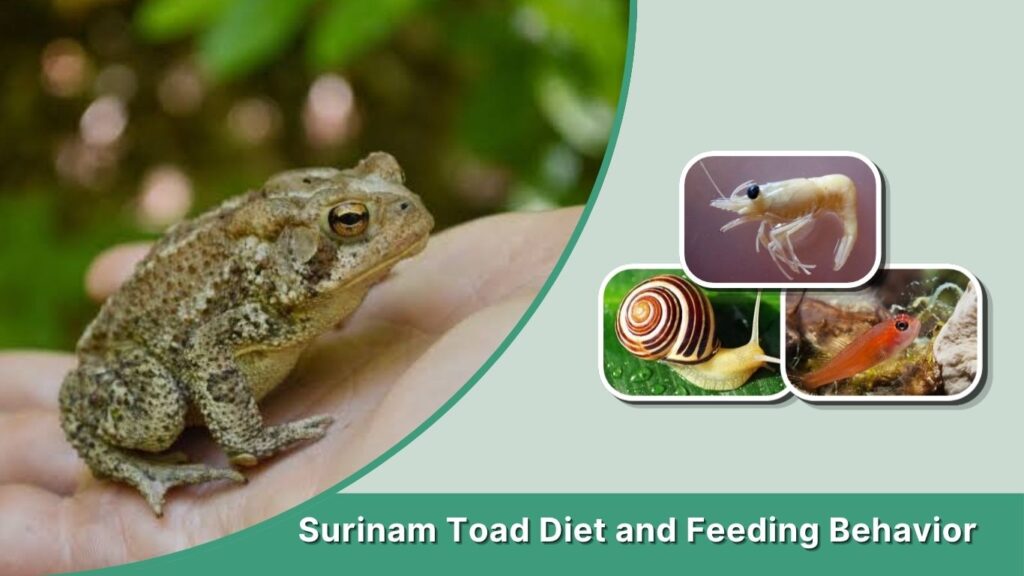
The Surinam toad is an aquatic predator that waits along the bottom for prey to approach. Its coloration and body shape help it remain unnoticed. When food comes within range, the frog rapidly expands its mouth and throat, drawing prey inward with water.
What Do Surinam Toads Eat?
Their natural diet can include:
- Aquatic insects
- Insect larvae
- Worms
- Small crustaceans
- Mollusks
- Small fish
- Other suitable aquatic animals
Young toads consume smaller prey, including tiny worms and aquatic invertebrates. Adult animals can take larger food but should not be overfed.
How Do They Catch Food?
Surinam toads lack a protrusible tongue. They detect prey using sensory fingertips and disturbances in the surrounding water. A rapid suction-feeding action pulls both water and prey into the mouth.
The front feet may help guide food inward. This hunting method is particularly useful in dark, murky environments where relying only on sight would be ineffective.
Predators and Ecological Role
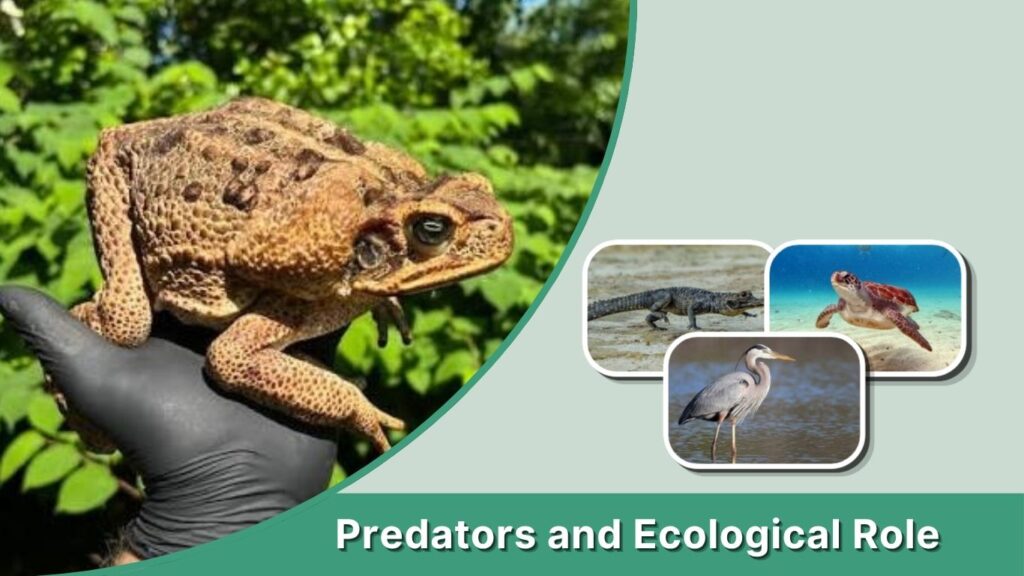
Surinam toads occupy both predator and prey positions in aquatic food webs. They help control populations of insects, worms, crustaceans, and small aquatic animals. Their own eggs, young, and adults may be eaten by larger predators.
Natural Predators
Potential predators include:
- Large fish
- Aquatic snakes
- Wading birds
- Turtles
- Caimans
- Larger amphibians
Camouflage is the toad’s primary defense. Its flattened, motionless body resembles leaf litter, making it difficult for predators to detect. Sudden swimming and hiding beneath debris provide additional protection.
Surinam Toad Care
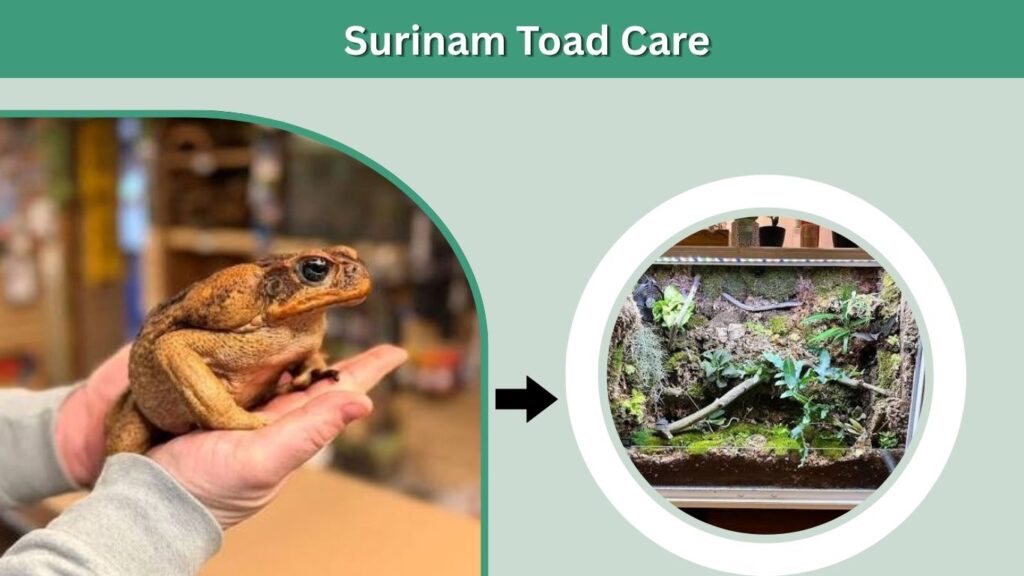
A Surinam toad is a specialized amphibian rather than a beginner pet. It requires a spacious, fully aquatic enclosure with excellent filtration and carefully maintained water. Prospective owners should locate a captive-bred animal, confirm local laws, and prepare the entire aquarium before purchasing one.
Aquarium Requirements
A suitable setup should provide:
- At least 30–40 gallons for one adult
- Additional space for multiple animals
- Water temperature around 75–82°F
- Gentle filtration without powerful currents
- Soft to moderately hard water
- Slightly acidic to neutral pH
- Smooth sand or a bare tank bottom
- Rounded hides and submerged wood
- A secure lid with air space above the water
- Frequent testing for ammonia and nitrite
Avoid sharp rocks because the frog’s skin can be damaged. It must be able to reach the surface easily, so the aquarium should not be excessively deep or filled with obstacles.
Captive Diet
Offer earthworms, night crawlers, insect larvae, appropriately sized crustaceans, and quality carnivorous amphibian foods. Occasional pieces of suitable seafood may add variety.
Avoid relying on feeder fish because they can introduce parasites and may not provide balanced nutrition. Remove uneaten food before it spoils. Adults are prone to obesity when fed excessively.
Handling and Tank Mates
Handling should be avoided except when necessary. Amphibians have delicate, absorbent skin that can be affected by soap, lotion, chemicals, and rough contact. If movement is unavoidable, use clean, wet, powder-free gloves.
A species-only aquarium is usually safest. Small fish may be eaten, while large fish can injure the frog or compete for food. Axolotls require different conditions and should not share the tank.
Other Surinam Toad Species
The common Surinam toad, Pipa pipa, is only one member of the genus. Related species differ in size, distribution, habitat, and developmental pattern.
Related Species
Myers’ Surinam toad, Pipa myersi, is a small species associated with Panama. Carvalho’s Surinam toad, Pipa carvalhoi, is native to eastern Brazil. The Sabana or dwarf Surinam toad, Pipa parva, occurs mainly in parts of Colombia and Venezuela.
Some smaller Pipa species release tadpoles from the female’s back rather than fully formed toadlets. The “Surinam cane toad” or “giant marine toad” usually refers to the cane toad, Rhinella marina, which is an entirely different terrestrial species.
FAQs
Does a Surinam toad lay eggs?
Yes. The female lays eggs that are fertilized and positioned on her back, where skin grows around them to create protective chambers.
How long are Surinam toads pregnant?
“Pregnant” is not technically accurate because they lay eggs. The developing young generally remain in the female’s back for approximately three to four months.
Do Surinam toads have tadpoles?
The common Surinam toad completes its tadpole-like development inside the egg chamber. It emerges as a fully formed miniature toad rather than a free-swimming tadpole.
Are Surinam toads poisonous?
They are not generally regarded as dangerously poisonous to humans. However, they should not be handled unnecessarily, and normal hygiene is essential after contact with any amphibian or aquarium water.
How do you pronounce Surinam toad?
“Surinam” is commonly pronounced SOO-ri-nam or SUR-i-nam, depending on regional usage. The scientific name Pipa pipa is commonly pronounced PEE-pah PEE-pah.
