
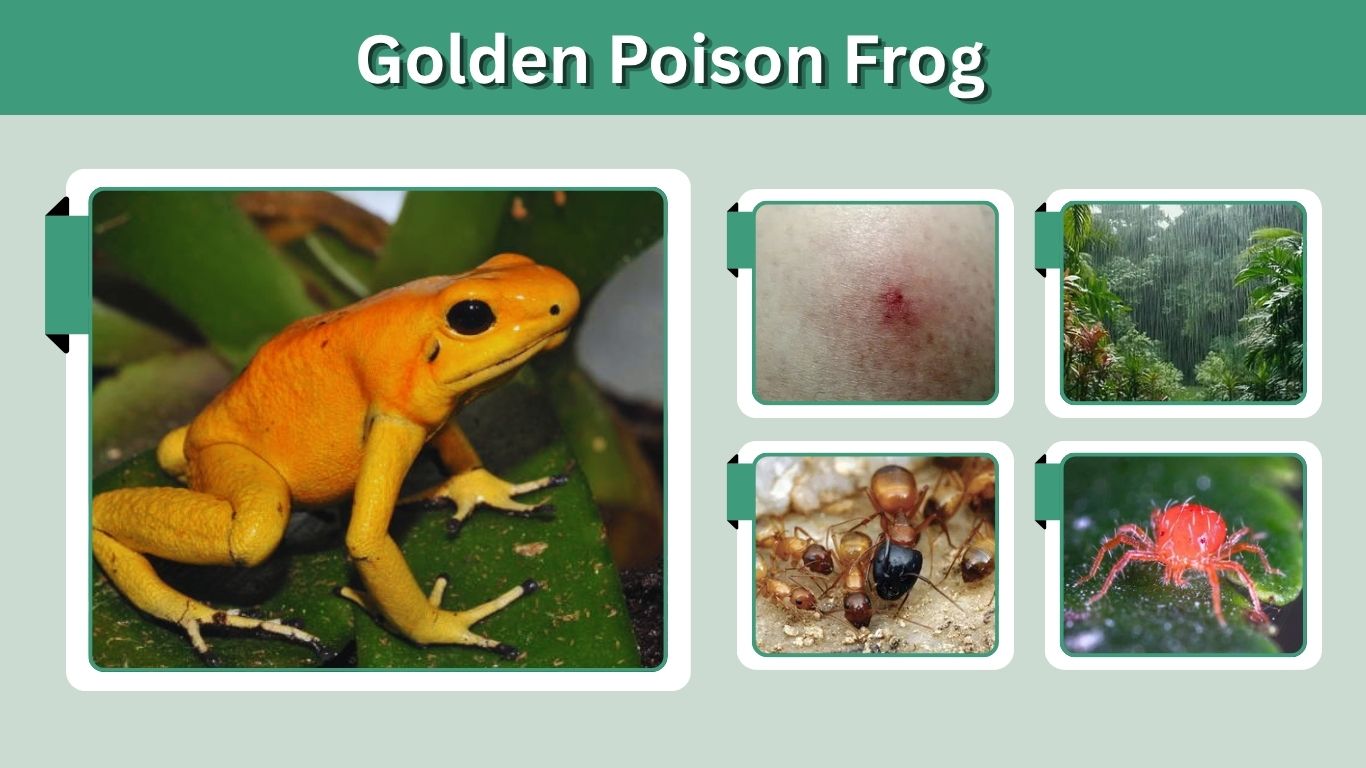
The golden poison frog is a small, brightly colored amphibian famous for carrying one of nature’s most powerful skin toxins. Its scientific name is Phyllobates terribilis, and it lives naturally only in a limited area of Colombia’s humid Pacific forests. Despite its dangerous reputation, the frog does not chase, bite or inject venom into people. Its toxicity is a defensive adaptation, while its vivid yellow, orange or pale green skin warns predators to stay away.
What Is a Golden Poison Frog?
The golden poison frog is a member of the poison frog family Dendrobatidae. It is also called the golden poison dart frog, golden dart frog and golden poison arrow frog.
The species was formally described in 1978. Its scientific name, Phyllobates terribilis, refers to its exceptionally powerful toxic defense. Current taxonomic sources recognize it as a distinct species endemic to Colombia.
| Feature | Description |
| Scientific name | Phyllobates terribilis |
| Family | Dendrobatidae |
| Order | Anura |
| Natural range | Pacific lowland forests of Colombia |
| Adult size | Commonly about 4.5–5.5 cm |
| Main colors | Yellow, orange, mint green or pale cream |
| Diet | Ants, mites, beetles and other tiny invertebrates |
| Activity | Mainly active during the day |
| Conservation status | Endangered |
| Population trend | Decreasing |
Appearance and Identification
Adult golden poison frogs usually have smooth skin and nearly uniform coloration. Yellow is the best-known form, but wild and captive populations may also appear orange, metallic green, mint-colored or pale cream.
Identification Features
A golden poison frog generally has:
- A bright, mostly uniform body color
- Smooth, moist skin
- Large black eyes
- A broad head and rounded snout
- Strong hind legs
- Small adhesive toe pads
- Few dark markings on most adults
- A compact but relatively large poison-frog body
Young frogs look different from adults. Juveniles usually have dark bodies with pale or golden stripes. Their bodies become more uniformly colored as they mature. Adult females are commonly larger and heavier than males.
Golden Poison Frog Size
Adults commonly measure approximately 4.5–5.5 centimetres from snout to vent, although exceptionally large individuals may approach 6 centimetres. This makes P. terribilis one of the largest species commonly described as a poison dart frog.
Where Does the Golden Poison Frog Live?
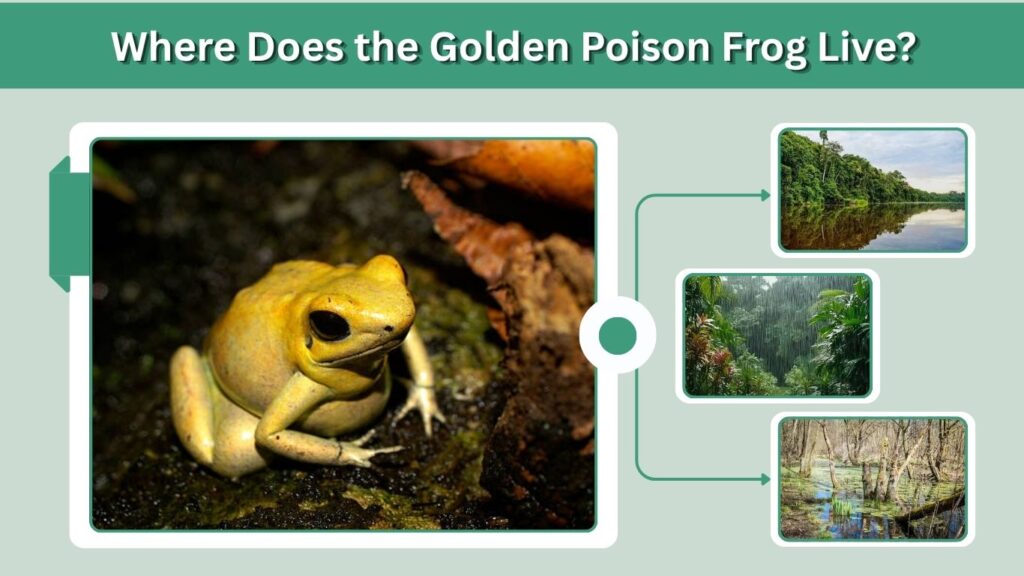
The golden poison frog is found naturally only in Colombia. Its known distribution includes lowland forest in Cauca and extends north into Valle del Cauca, generally at elevations of approximately 100–200 metres.
Natural Habitat
Its habitat consists of extremely wet tropical forest with:
- High annual rainfall
- Warm, stable temperatures
- Very high humidity
- Small streams and pools
- Dense low vegetation
- Damp soil and forest-floor cover
- Abundant small invertebrates
Although it can climb low plants, the golden poison frog is mainly terrestrial and spends much of its time on or close to the forest floor. Freshwater is especially important during reproduction because the tadpoles must complete their development in water.
How Poisonous Is a Golden Poison Frog?
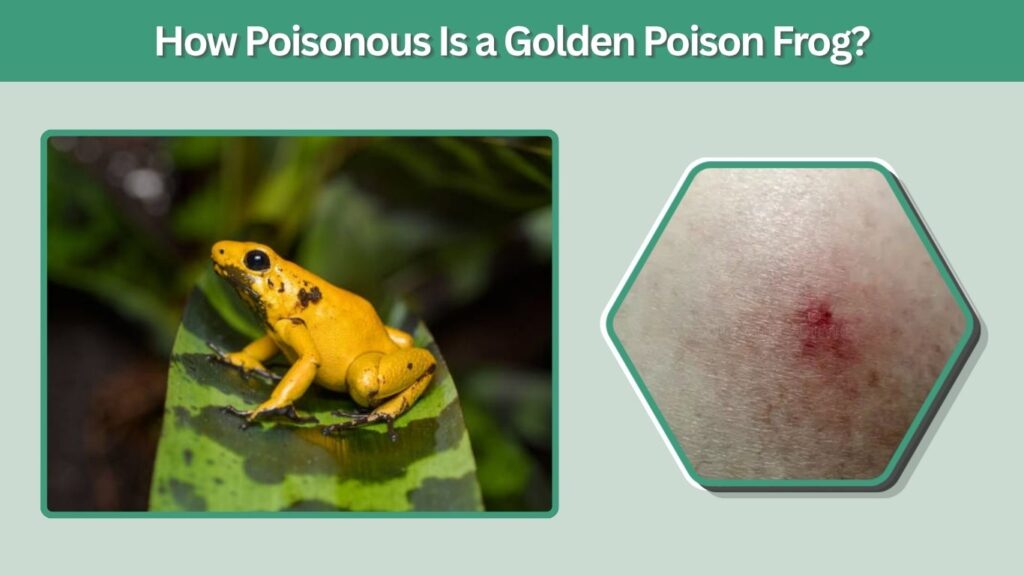
Wild golden poison frogs store batrachotoxins in glands in their skin. Batrachotoxin interferes with voltage-gated sodium channels, preventing nerve, muscle and heart cells from functioning normally. Severe poisoning can cause weakness, paralysis, abnormal heart rhythms and death.
The species is often described as capable of carrying enough toxin to kill several adult humans. However, these estimates are based on toxin quantity and experimental lethal doses—not documented cases of one frog killing a specific number of people. The amount of toxin varies among individuals, locations and diets.
How Fast Can a Golden Poison Frog Kill You?
There is no reliable universal answer measured in seconds or minutes. The outcome would depend on the toxin dose, exposure route, skin condition, body size and how quickly medical treatment begins.
Simply being near the frog is not dangerous. The greatest concern is toxin entering the body through damaged skin, the mouth, eyes or another vulnerable route. Wild frogs should never be handled.
Is It Poisonous or Venomous?
The golden poison frog is poisonous, not venomous. Venomous animals actively inject toxins through fangs, stingers or similar structures. The frog carries toxin on its skin and does not inject it.
It does not normally bite people, and its small mouth is not its primary defense. Bright coloration and toxic skin discourage predators from attacking.
Why Are Captive Golden Poison Frogs Not Toxic?
Scientists believe poison frogs obtain or manufacture their defensive alkaloids from compounds found in their natural prey. Wild frogs eat particular ants, mites and other arthropods that are unavailable in standard captive diets.
Frogs raised on fruit flies, springtails and ordinary crickets do not retain the extreme toxicity associated with wild individuals. Smithsonian guidance explains that poison frogs maintained on non-toxic captive insects are not poisonous themselves.
Captive frogs should still be handled as little as possible. Oils, soap, chemicals and salt from human skin can harm their highly absorbent skin.
What Do Golden Poison Frogs Eat?
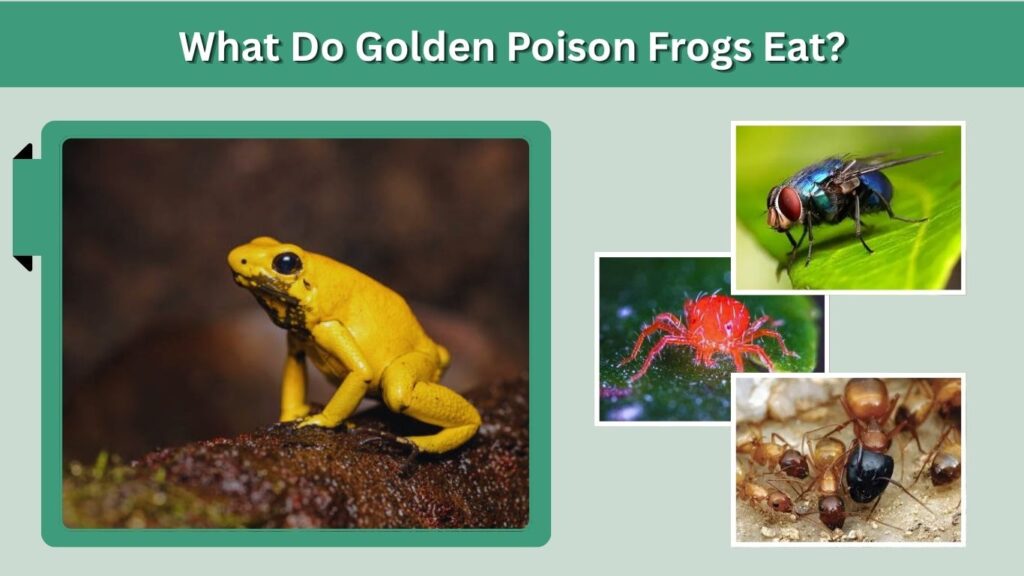
Golden poison frogs are active daytime hunters that feed on very small invertebrates found among vegetation and on the forest floor.
Their natural diet includes:
- Ants
- Mites
- Small beetles
- Termites
- Tiny flies
- Other small arthropods
They catch prey with a fast, sticky tongue. Ants and mites are considered especially important because they may provide the alkaloids used in the frog’s chemical defense.
Life Cycle and Reproduction
Golden poison frogs undergo the same basic developmental process as other frogs:
- Adults perform courtship and mate.
- The female lays eggs in a damp place on land.
- The male guards or attends the developing clutch.
- Tadpoles hatch from the eggs.
- A parent transports the tadpoles on its back.
- Tadpoles are released into a suitable body of water.
- They develop legs, absorb their tails and become froglets.
Males attract females with a trilling call. After hatching, tadpoles climb onto the adult’s back and are carried to water, where they complete metamorphosis.
Adaptations and Predators
The frog’s bright skin is an example of aposematic coloration—a visible warning that an animal is dangerous or unpleasant to eat. This warning allows the frog to remain active during daylight without relying entirely on camouflage.
Its main adaptations include powerful skin toxins, warning coloration, strong jumping legs, adhesive toe pads and parental transport of tadpoles. Most predators avoid adult frogs, although young or less-toxic individuals may remain vulnerable to snakes, birds and other forest animals.
Are Golden Poison Frogs Endangered?
The golden poison frog is listed as Endangered, and its population trend is decreasing. Its restricted distribution makes it particularly vulnerable to forest loss and degradation.
Major threats include:
- Forest clearing
- Agricultural expansion
- Illegal mining
- Water pollution
- Habitat fragmentation
- Collection for the wildlife trade
- Amphibian diseases
Protecting Colombia’s remaining lowland rainforest is essential because the species cannot simply move to distant habitats outside its narrow natural range.
How Many Golden Poison Frogs Are Left?
There is no dependable published count of every golden poison frog remaining in the wild. The frogs are small, their forests can be difficult to survey and their populations are divided among limited localities.
It is therefore more accurate to say that the total population is unknown but decreasing, rather than provide an unsupported number. The IUCN assessment identifies continuing declines in habitat extent and quality.
Can Golden Poison Frogs Be Kept as Pets?
Captive-bred golden poison frogs are kept by experienced amphibian enthusiasts. They need a secure tropical vivarium, consistently high humidity, clean conditions, safe temperatures and a steady supply of tiny live prey.
Buying wild-caught frogs should be avoided. Anyone considering captive-bred frogs must check wildlife laws, ask for proof of legal origin and understand that amphibians are sensitive display animals rather than handling pets.
FAQs
Can a golden poison frog kill a human?
A wild frog can carry an extremely dangerous quantity of batrachotoxin. However, risk depends on how much toxin enters the body and through which route. Captive-bred frogs maintained on standard feeder insects generally lack the wild frog’s toxicity.
Does a golden poison frog bite?
It is not an aggressive biting animal and does not use its mouth to inject poison. Its primary defense is the toxic secretion carried on its skin.
What is the golden poison frog’s scientific name?
Its scientific name is Phyllobates terribilis. It belongs to the family Dendrobatidae and the order Anura.
How long does a golden poison frog live?
Its exact wild lifespan is not well documented. In protected captive environments, poison frogs can live for several years when provided with appropriate nutrition, humidity and veterinary care.
What is the golden poison frog’s main threat?
Habitat loss and degradation are its most important threats. Because the species occupies a very small region of Colombia, damage to that rainforest can affect a substantial portion of its total population.
