
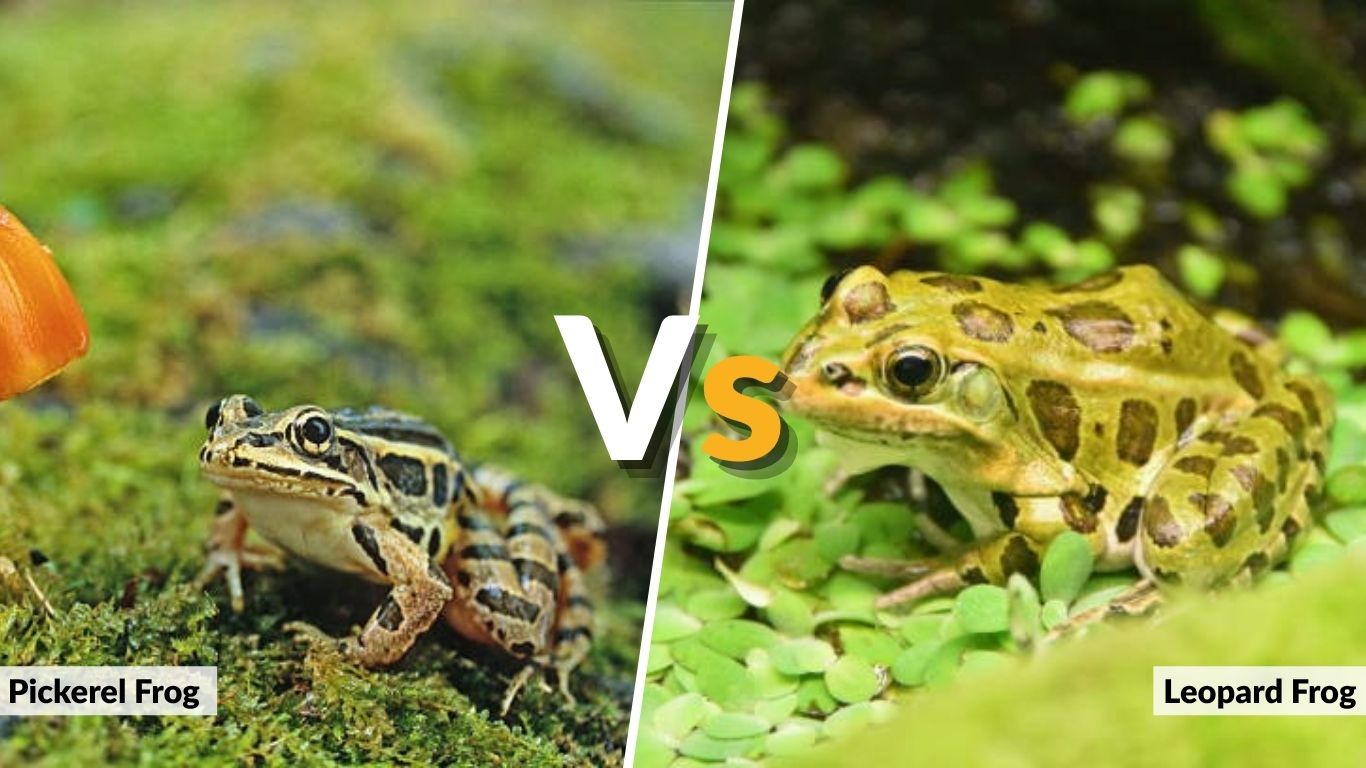
Pickerel frogs and leopard frogs are closely related North American amphibians with smooth skin, long hind legs, and dark markings. Their similar appearance often makes identification difficult. However, spot shape, pattern arrangement, inner-thigh color, habitat, and defensive secretions provide reliable clues. A pickerel frog normally has rectangular spots arranged in rows and yellow-orange thighs. Leopard frogs have rounded, randomly scattered spots. This comparison also explains how pickerel frogs differ from northern and southern leopard frogs.
Pickerel Frog vs Leopard Frog: Quick Comparison
Both frogs belong to the true frog family, Ranidae. Although their ranges sometimes overlap, several physical and behavioral features separate them.
Main differences
| Feature | Pickerel Frog | Leopard Frog |
| Scientific group | Lithobates palustris | Several Lithobates species |
| Spot shape | Square or rectangular | Round or oval |
| Spot arrangement | Usually two orderly rows | Randomly scattered |
| Body color | Tan, brown, bronze, or muted greenish | Green, brown, tan, or yellow-green |
| Inner thighs | Bright yellow or orange | Usually white, cream, or lightly mottled |
| Skin secretion | Strong and irritating | Milder defensive secretion |
| Typical habitat | Cool springs, streams, and wooded wetlands | Ponds, marshes, fields, and open wetlands |
| Call | Low, steady snore | Snoring, grunting, chuckling, or clucking |
Identification and Appearance
Spot shape is usually the fastest way to distinguish a pickerel frog from a leopard frog. Color alone is less dependable because both frogs vary according to age, location, temperature, and environmental conditions.
Pickerel frog identification
- Two rows of square or rectangular spots
- Spots often outlined with darker borders
- Tan, bronze, copper-brown, or greenish-brown body
- Light dorsolateral ridges running along the back
- Bright yellow or orange coloring under the thighs
- White or cream belly, sometimes with yellow near the rear
- Body normally measuring 1.75–3.5 inches
The rectangular spots can occasionally merge, creating longer dark markings. The yellow-orange area beneath the hind legs is especially helpful when the back pattern is unclear. However, avoid capturing a frog merely to inspect its legs.
Leopard frog identification
- Rounded or oval dark spots
- Spots distributed irregularly across the back
- Light borders surrounding many spots
- Green, brown, tan, or yellow-green body
- Pale dorsolateral ridges
- White or cream underside
- Long, muscular legs with extensive webbing
Leopard frogs often appear more athletic and streamlined than pickerel frogs. Their rounded spots resemble the markings of a leopard, which explains their common name.
Why color is not enough
A green spotted frog is more likely a leopard frog, especially when the green is bright. However, some leopard frogs are entirely brown, while pickerel frogs occasionally have a muted greenish tint. Examine spot shape, arrangement, thigh color, and location together rather than depending on body color.
Northern Leopard Frog vs Pickerel Frog
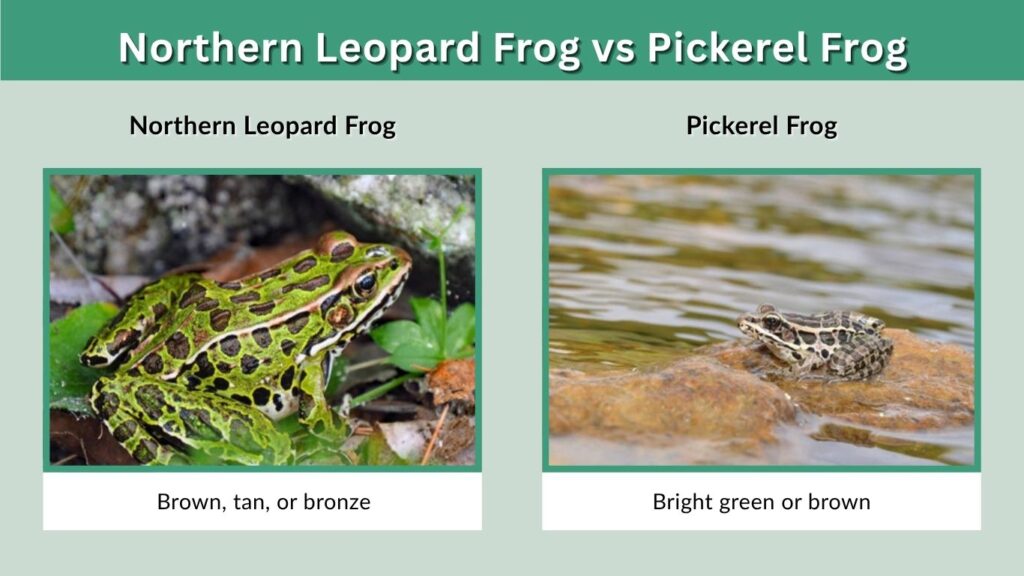
The northern leopard frog, Lithobates pipiens, is the leopard frog most frequently confused with the pickerel frog in northern and central North America.
Physical differences
| Characteristic | Pickerel Frog | Northern Leopard Frog |
| Back spots | Angular and organized in rows | Large, rounded, and scattered |
| Common color | Brown, tan, or bronze | Bright green or brown |
| Inner thighs | Yellow to orange | White or pale |
| Spot borders | Often dark-edged | Commonly surrounded by light halos |
| Maximum size | Usually about 3.5 inches | Occasionally about 4.5 inches |
| Belly | White with possible yellow near rear | White to cream |
The northern leopard frog has continuous pale ridges extending from behind its eyes toward the groin. It also commonly has a light stripe along the upper jaw. Its large, oval spots usually have distinct pale outlines. These characteristics are confirmed by the U.S. Fish and Wildlife Service.
Habitat differences
Pickerel frogs favor cooler environments, including forested streams, spring-fed pools, bogs, and shaded wetland edges. They remain more closely associated with cool, clean water than many leopard frogs.
Northern leopard frogs occupy marshes, ponds, wet meadows, grasslands, and open fields. They may travel considerable distances from water during summer. For winter, they return to well-oxygenated water that does not freeze completely.
Call differences
A pickerel frog produces a quiet, steady snore lasting one or two seconds. It can be difficult to hear among louder spring peepers and chorus frogs.
The northern leopard frog also makes a snoring sound, but it is often followed by several low grunts or chuckles. Some observers compare it to rubbing a finger across a wet balloon.
Southern Leopard Frog vs Pickerel Frog
The southern leopard frog, Lithobates sphenocephalus, occurs primarily in the southeastern United States. Its range overlaps with that of the pickerel frog in several areas.
Physical differences
Southern leopard frogs have randomly scattered, rounded spots rather than two organized rows of rectangular markings. They also tend to have a longer, more pointed snout.
One of their most useful identification marks is a small, pale spot in the center of the tympanum—the circular eardrum located behind each eye. Pickerel frogs typically lack this central white mark. The feature is described by the North Carolina Wildlife Resources Commission.
Habitat and distribution
Southern leopard frogs inhabit warm ponds, marshes, swamps, wet fields, roadside ditches, and floodplains. They are commonly seen resting near the shoreline before jumping into the water when disturbed.
Pickerel frogs are more strongly associated with cool springs, wooded streams, and vegetated wetlands. In the southern portion of their range, they may also occupy marshes and shallow ponds, making physical markings important for identification.
Comparison with both leopard frogs
| Feature | Pickerel Frog | Northern Leopard Frog | Southern Leopard Frog |
| Spots | Rectangular, arranged in rows | Rounded, randomly placed | Rounded, randomly placed |
| Inner thighs | Bright yellow or orange | Pale or white | Pale or mottled |
| Tympanum spot | Normally absent | Usually absent | Small white center spot |
| Snout | Moderately pointed | Pointed | Long and distinctly pointed |
| Preferred climate | Cool, shaded environments | Northern temperate habitats | Warmer southeastern habitats |
Behavior and Diet
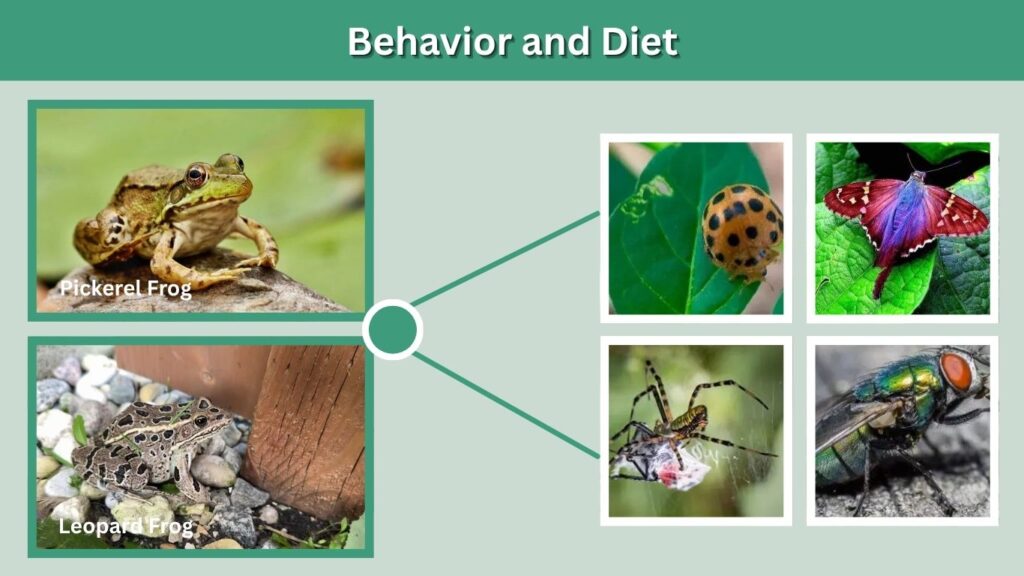
Pickerel and leopard frogs are insect-eating predators that also serve as food for snakes, birds, mammals, fish, and larger amphibians.
What they eat
Both frogs consume beetles, flies, moths, spiders, grasshoppers, crickets, ants, worms, and other small invertebrates. Large leopard frogs may occasionally capture smaller frogs, fish, or other tiny vertebrates.
They usually remain motionless until prey approaches. The frog then lunges forward and catches the animal with its sticky tongue.
Escape behavior
When threatened near water, both frogs use their powerful hind legs to leap into the water. They may dive to the bottom, hide beneath vegetation, or remain motionless in mud and debris.
Leopard frogs frequently make long, rapid jumps across open ground. Pickerel frogs are generally more secretive and may remain concealed around vegetation, rocks, leaf litter, and shaded stream banks.
Are Pickerel Frogs Poisonous?
Pickerel frogs produce stronger defensive skin secretions than most North American frogs. This chemical protection is their most important biological difference from leopard frogs.
Effects of the secretion
When stressed, a pickerel frog can release a sour-smelling substance that discourages predators. The secretion may irritate a person’s eyes, mouth, nose, broken skin, or other sensitive tissue. It can also harm some amphibians confined in the same container.
The secretion is defensive rather than something the frog injects through a bite. Pickerel frogs are not normally dangerous to people, but hands should be washed after accidental contact. The Kentucky Department of Fish and Wildlife Resources recommends recognizing the potentially irritating effects of this secretion.
Are leopard frogs poisonous?
Leopard frogs have natural skin secretions, but they are not known for the comparatively potent defense of pickerel frogs. Neither frog should be handled unnecessarily. Human skin oils, soap, insect repellent, and other chemicals can damage an amphibian’s permeable skin.
Breeding and Life Cycle
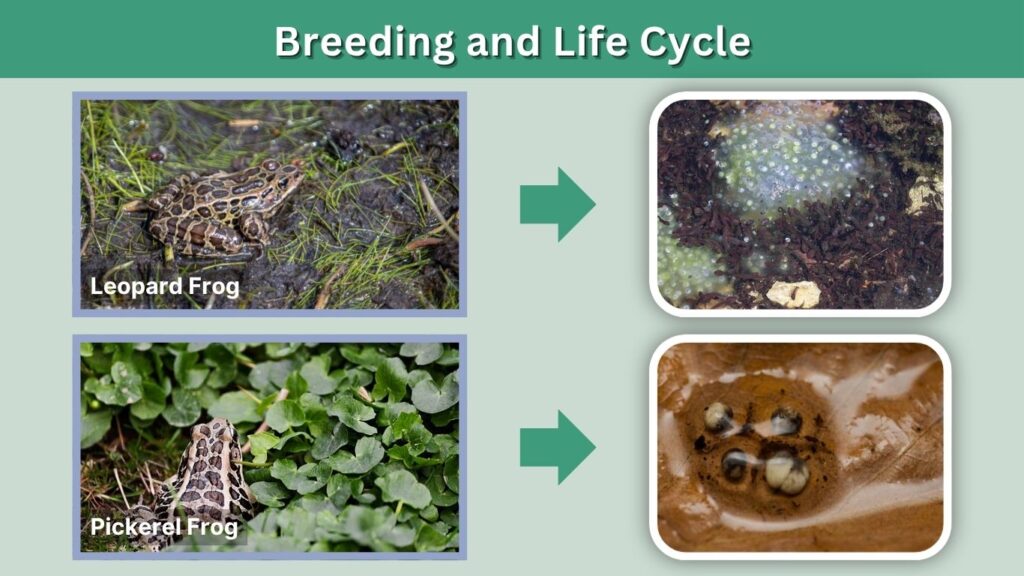
Both species breed in water and pass through an aquatic tadpole stage. Breeding time varies according to climate, latitude, and weather.
Pickerel frog breeding
Pickerel frogs generally breed during early spring. Males call from ponds or slow-moving water, and females attach spherical egg masses to submerged branches or aquatic plants. A mass may contain approximately 1,000–3,000 eggs.
The eggs hatch within several days or weeks, depending on water temperature. Tadpoles normally require about two or three months to transform into young frogs.
Leopard frog breeding
Northern leopard frogs usually breed during spring after wetlands begin thawing. Southern leopard frogs may breed for a longer period because of their warmer climate.
Females deposit large clusters of eggs in shallow water among submerged vegetation. Tadpoles feed largely on algae, microorganisms, and decaying plant material before developing legs and leaving the water.
FAQs
These frequently asked questions cover the simplest ways to separate pickerel frogs from northern and southern leopard frogs.
Are pickerel frogs and leopard frogs the same?
No. Pickerel frogs and leopard frogs are separate species, although they belong to the same family and genus. Pickerel frogs have rectangular spots arranged in rows and yellow-orange inner thighs. Leopard frogs have round or oval spots scattered randomly across their backs.
What is the easiest way to identify a pickerel frog?
Examine the back pattern from a respectful distance. A pickerel frog generally has two orderly rows of square or rectangular brown spots. Its hidden inner thighs are yellow or orange, but the frog should not be captured solely to check this feature.
Which is more poisonous, a pickerel frog or leopard frog?
The pickerel frog has the stronger defensive secretion. It can irritate human mucous membranes and may be harmful to certain predators or other amphibians. Leopard frogs possess skin secretions but are not known for producing the same strong, sour-smelling chemical defense.
Can you touch pickerel frogs and leopard frogs?
Brief accidental contact is unlikely to cause serious harm, but handling should be avoided. Pickerel frog secretions can irritate sensitive tissue, while chemicals and oils on human hands can injure either frog. If contact occurs, wash your hands without touching your face first.
Do pickerel frogs and leopard frogs live together?
Their ranges and habitats sometimes overlap, particularly around vegetated ponds, marshes, and streams in eastern North America. Pickerel frogs generally prefer cooler, shaded, spring-fed environments, while leopard frogs more frequently use open ponds, fields, wet meadows, and warmer shallow wetlands.
