
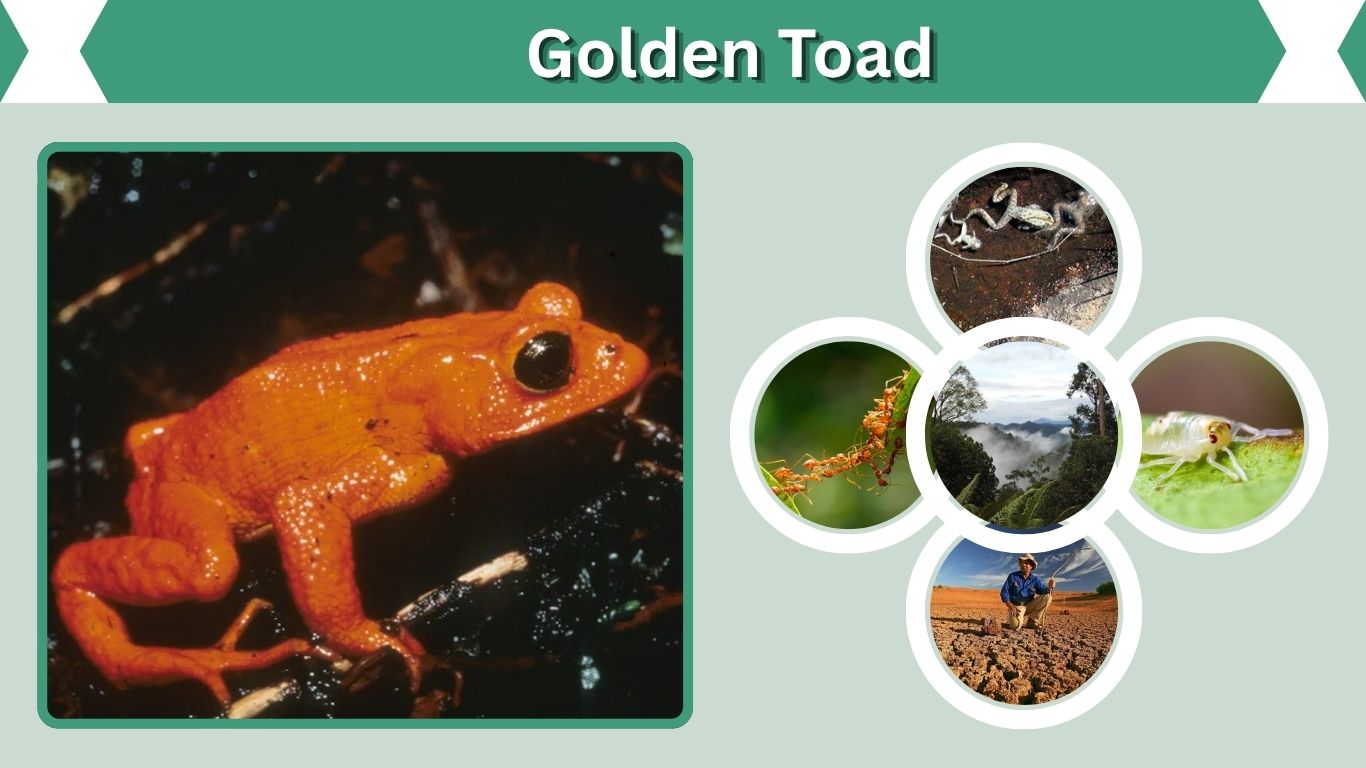
The golden toad (Incilius periglenes) was a brilliantly colored amphibian once found only in a tiny area of Costa Rica’s Monteverde cloud forest. Adult males were famous for their vivid orange-gold skin, while females looked strikingly different, with dark bodies covered in yellow, red, and orange markings. Once locally abundant during brief breeding periods, the species declined suddenly in the late 1980s. The last confirmed golden toad was seen in 1989, and the species is now officially classified as extinct.
What Was the Golden Toad?
The golden toad was a true toad belonging to the family Bufonidae. It was previously known scientifically as Bufo periglenes but is now classified as Incilius periglenes. Scientists formally described the species in the 1960s, and its remarkable coloration quickly made it one of Costa Rica’s best-known amphibians.
Golden Toad Identification
Important characteristics included:
- Scientific name: Incilius periglenes
- Former scientific name: Bufo periglenes
- Family: Bufonidae
- Male color: Brilliant orange or golden-orange
- Female color: Dark with red, yellow, or orange blotches
- Male size: About 39–48 mm
- Female size: About 42–56 mm
- Habitat: High-elevation cloud forest
- Native country: Costa Rica
- Conservation status: Extinct
The dramatic difference between males and females made the species an extreme example of sexual dimorphism among amphibians.
Was the Golden Toad a Frog or a Toad?
The golden toad was a true toad, although searches often refer to it as the “golden toad frog.”
Toads and frogs both belong to the amphibian order Anura, so the terms are sometimes loosely mixed in everyday language. Taxonomically, however, the golden toad belonged to Bufonidae, the true-toad family.
Where Did the Golden Toad Live?
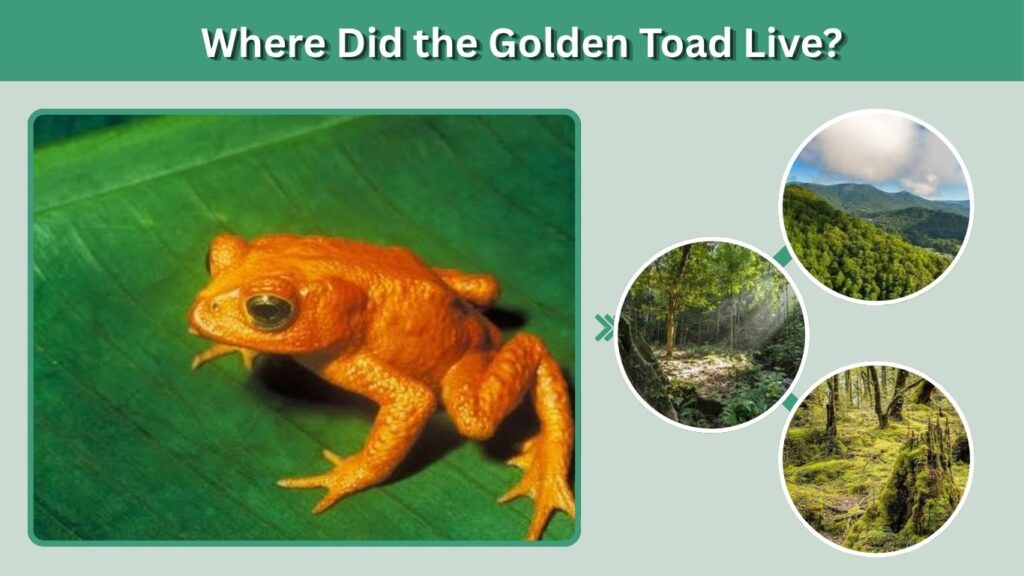
The golden toad had an exceptionally restricted range. It was known only from humid montane forest around Monteverde in Costa Rica’s Cordillera de Tilarán. This tiny geographic distribution made the species vulnerable because any major environmental change affecting its breeding habitat could potentially influence nearly the entire population.
Golden Toad Habitat
The species occupied:
- Tropical montane cloud forest
- Wet forest floor
- Dense mossy vegetation
- Cool, humid mountain environments
- Temporary rain-filled pools during breeding
The IUCN reports that it was known only from the Monteverde Biological Reserve at elevations of approximately 1,500–1,620 meters.
Golden Toad in Costa Rica
Monteverde is famous for its cloud forest, where persistent mist and high humidity support an extraordinary diversity of plants and animals.
Golden toads spent much of their lives hidden from observers. They became conspicuous during a short breeding period when large numbers emerged and gathered around temporary pools.
This secretive lifestyle meant scientists knew relatively little about their behavior outside the breeding season.
What Did Golden Toads Eat?
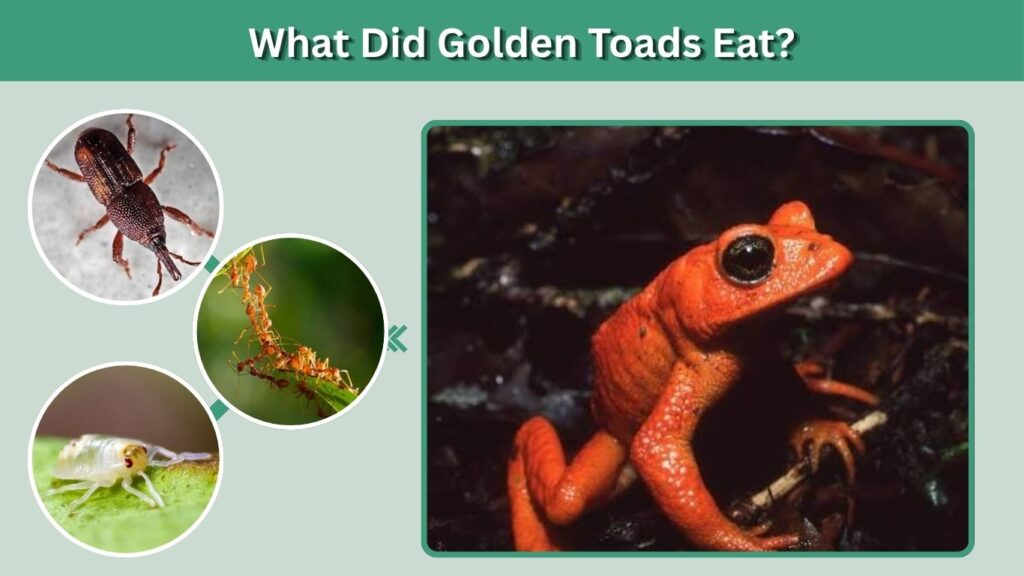
The precise diet of the golden toad was never studied extensively before the species disappeared. Scientists observed the animals mainly during their short breeding season, so much of their normal feeding behavior remained undocumented.
Based on their body size and similarities to other terrestrial toads, they were probably predators of small invertebrates.
Golden Toad Diet
Probable foods included:
- Small insects
- Tiny beetles
- Ants
- Mites
- Small arthropods
- Other forest-floor invertebrates
It is important not to describe a detailed diet as certain because historical observations of feeding were limited.
How Did They Find Food?
Golden toads probably searched through damp forest-floor vegetation for small prey, much like related terrestrial toads.
Their small size would have limited them primarily to tiny invertebrates.
Because they spent much of the year hidden and appeared in large numbers mainly for reproduction, scientists never developed the detailed understanding of their feeding ecology that exists for many living amphibian species.
Golden Toad Breeding and Life Cycle
One of the most remarkable features of the golden toad was its brief and intense breeding season. During heavy rains, adults emerged and gathered around temporary pools. These pools were essential because eggs and tadpoles required water to complete early development.
Golden Toad Reproduction
The breeding cycle included:
- Heavy seasonal rains created temporary pools.
- Adult golden toads emerged in large numbers.
- Males greatly outnumbered females.
- Males competed intensely for mates.
- Pairs entered amplexus.
- Females deposited roughly 200–400 eggs.
- Tadpoles developed inside temporary pools.
- Metamorphosis could take about five weeks.
- Young toads left the water for terrestrial life.
Because the pools were temporary, successful reproduction depended heavily on rainfall lasting long enough for tadpoles to complete development.
Male and Female Golden Toads
Males were the famous bright orange individuals commonly shown in photographs.
Females looked completely different. They were larger and had dark backgrounds covered with scarlet, yellow, and orange markings.
During breeding gatherings, males could greatly outnumber females. Historical observations reported intense competition, including groups of males clasping one another while attempting to secure mates.
When Did the Golden Toad Go Extinct?
The population declined dramatically during the late 1980s. Although golden toads had previously appeared in large breeding aggregations, numbers collapsed rapidly.
The final confirmed observation occurred in 1989, when a single male was recorded. Extensive searches afterward failed to find another individual. The IUCN now lists Incilius periglenes as Extinct.
Golden Toad Extinction Timeline
Key events include:
- 1960s: Species scientifically described
- 1980s: Still observed breeding at Monteverde
- 1987: Severe population crash occurred
- 1988: Very few individuals remained
- 1989: Last confirmed male observed
- Later searches: No surviving population found
- Current status: Extinct
The disappearance became one of the world’s best-known examples of modern amphibian extinction.
Why Did the Golden Toad Go Extinct?
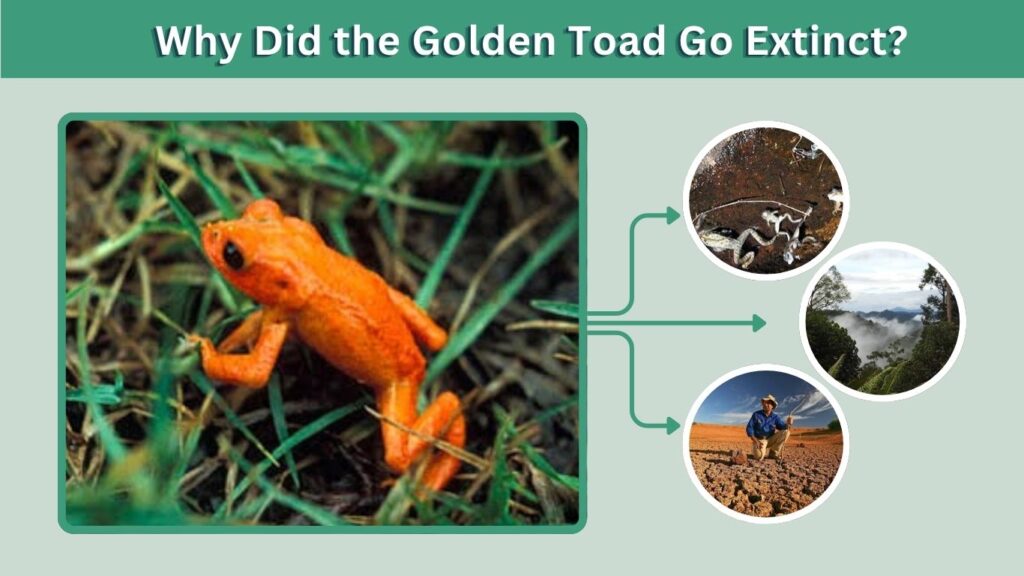
There is no single completely proven explanation. Scientists have investigated disease, unusual weather, climate variability, and interactions among these factors. Importantly, its protected forest habitat remained largely intact, making straightforward habitat destruction an inadequate explanation for the sudden disappearance.
Chytrid Fungus
One leading explanation involves chytridiomycosis, a disease caused by the fungus Batrachochytrium dendrobatidis (Bd).
Historical research found evidence that Bd spread southward through Central America and reached Monteverde around the period when amphibian populations there collapsed. The IUCN describes chytridiomycosis as the most likely explanation for the golden toad’s disappearance, though other environmental stresses may have contributed.
Climate, Drought and El Niño
Climate also appears important, but the details remain debated.
A 2010 study reconstructed Monteverde’s historical climate and found that the golden toad’s collapse coincided with an exceptionally dry period associated with the 1986–1987 El Niño. Temporary breeding pools dried rapidly, which could have caused severe reproductive failure. The study did not find evidence that this particular dry period was itself outside natural climatic variability because of global warming.
Other research has proposed that warming may have altered environmental conditions in ways that favored chytrid disease. Therefore, scientists generally treat the extinction as a complex event rather than attributing it confidently to one factor alone.
Golden Toad Adaptations
The golden toad was specialized for a cool, humid mountain environment. Specialization can be successful when environmental conditions remain stable, but species with extremely small ranges and narrow breeding requirements may have difficulty adapting rapidly to major environmental changes.
Important Adaptations
Golden toads had:
- Small bodies suited to forest-floor life
- Bright male breeding coloration
- Strong sexual dimorphism
- Seasonal breeding synchronized with rain
- Development in temporary pools
- Terrestrial adult lifestyle
- Explosive breeding behavior
Their dependence on short-lived breeding pools may also have increased vulnerability when rainfall patterns became unfavorable.
Are Golden Toads Still Alive?
There is currently no verified evidence that golden toads survive.
Despite searches after 1989, scientists have not confirmed another specimen. The IUCN officially considers the species extinct.
Reports or online claims that a golden toad has been rediscovered should therefore be treated cautiously unless supported by verified scientific evidence.
Were Golden Toads Poisonous?
The golden toad belonged to a family in which many species possess defensive skin glands. However, the species was not known as a dangerously poisonous amphibian in the way that some poison frogs are.
Because the animal became extinct before its biology was thoroughly investigated, detailed information about its skin chemistry is limited. Its brilliant orange male coloration should not automatically be interpreted as evidence of extreme toxicity.
Golden Toad Facts
The golden toad remains important because its disappearance helped draw worldwide attention to amphibian declines.
Interesting Golden Toad Facts
- Its scientific name is Incilius periglenes.
- It lived only in Costa Rica.
- Its range was extremely small.
- Males were brilliant orange.
- Females looked dramatically different from males.
- Females were usually larger.
- Breeding occurred in temporary rain pools.
- Females produced hundreds of eggs.
- Tadpoles could metamorphose in roughly five weeks.
- Its population crashed in the late 1980s.
- The last confirmed individual was seen in 1989.
- Its forest habitat was largely protected.
- Disease and unusual climatic conditions are leading extinction explanations.
- It is officially classified as extinct.
- The species became a symbol of the global amphibian conservation crisis.
FAQs
What Was the Scientific Name of the Golden Toad?
The scientific name is Incilius periglenes. Older sources often use Bufo periglenes.
Where Did the Golden Toad Live?
It lived only in a small area of cloud forest around the Monteverde Biological Reserve in Costa Rica.
When Did the Golden Toad Go Extinct?
The last confirmed golden toad was observed in 1989. The species is now officially classified as extinct.
Why Did Golden Toads Go Extinct?
No single cause has been conclusively demonstrated. Chytrid fungal disease is a leading explanation, while extreme drought, El Niño conditions, and broader climate-related factors may also have contributed.
What Did Golden Toads Eat?
Their diet was poorly documented, but scientists believe they mainly consumed small invertebrates found on the cloud-forest floor.
