
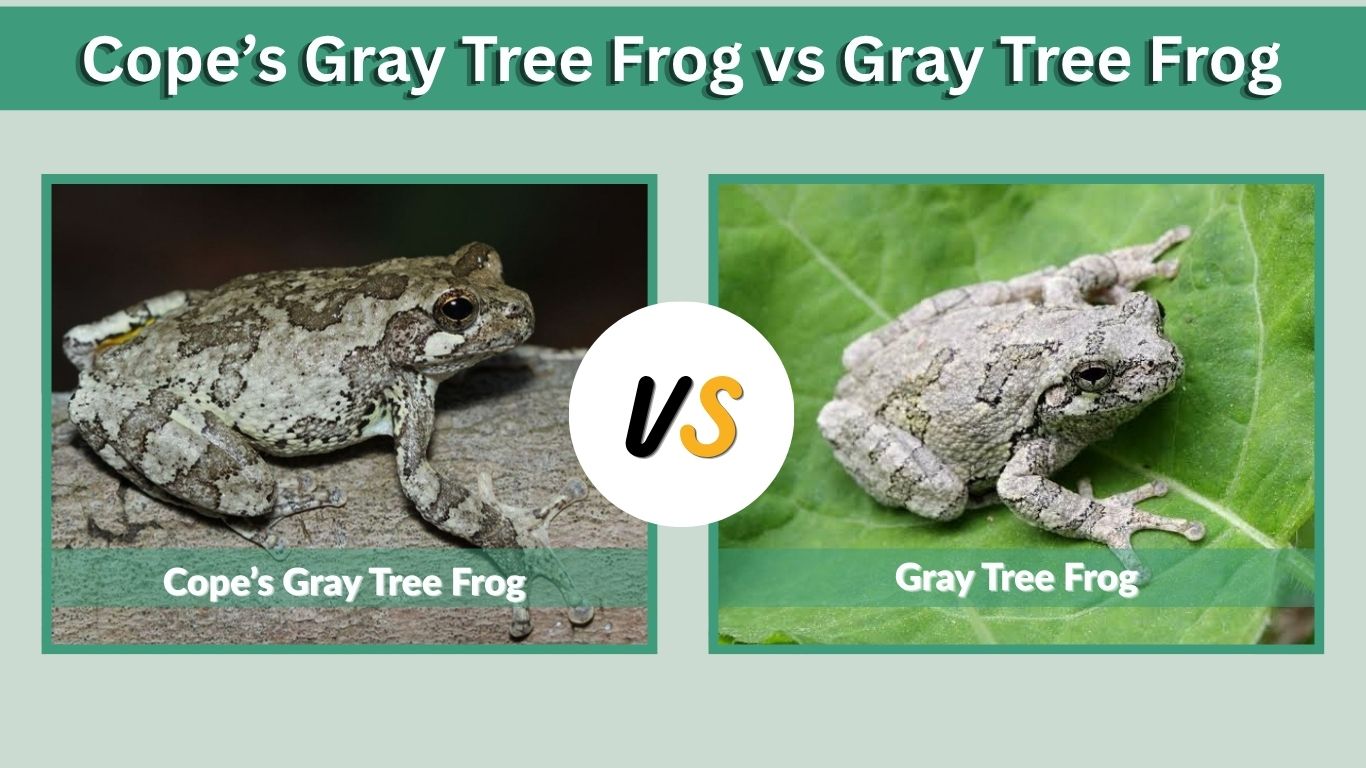
Cope’s gray tree frog and the eastern gray tree frog are two separate North American species that look almost identical. Both can change between gray, brown and green, possess large toe pads and display bright yellow or orange coloring inside their hind legs. Because their size, markings and habitats overlap, appearance alone rarely provides a dependable identification. The most useful field difference is the male breeding call, while chromosome testing offers scientific confirmation.
Quick Comparison
Modern taxonomy places these species in the genus Dryophytes, although many field guides and government resources still use their older Hyla names. Cope’s gray tree frog is Dryophytes chrysoscelis, while the eastern gray tree frog is Dryophytes versicolor.
| Feature | Cope’s gray tree frog | Eastern gray tree frog |
| Scientific name | Dryophytes chrysoscelis | Dryophytes versicolor |
| Older scientific name | Hyla chrysoscelis | Hyla versicolor |
| Appearance | Virtually identical | Virtually identical |
| Male call | Faster, harsher and higher-pitched | Slower, smoother and more musical |
| Typical pulse rate | About 34–69 pulses per second | About 17–35 pulses per second |
| Chromosomes | Diploid: two chromosome sets | Tetraploid: four chromosome sets |
| General distribution | More common in southern and western portions of the combined range | More common in northern and eastern portions |
| Best field clue | Advertisement call | Advertisement call |
Government and research sources consistently describe these frogs as externally indistinguishable. Their breeding calls and chromosome numbers provide the clearest differences.
Difference in Their Calls
Listening to a calling male is the most practical way to separate the two species without genetic or chromosome testing.
Cope’s gray tree frog call
The Cope’s gray tree frog produces a relatively fast, harsh and buzzy trill. Its individual pulses are packed closely together, making the call sound almost mechanical. Illinois wildlife resources report approximately 34–69 pulses per second, although temperature affects the exact speed.
A simple description is:
Cope’s gray tree frog: fast, dry and buzzy.
Eastern gray tree frog call
The eastern gray tree frog has a slower and more musical trill. Its individual pulses are easier to distinguish because they are spaced farther apart. The call generally contains approximately 17–35 pulses per second.
A simple description is:
Eastern gray tree frog: slow, smooth and musical.
Temperature can affect identification
Frog calls become faster in warmer conditions and slower in cooler conditions. Therefore, a warm eastern gray tree frog may sound more rapid than expected, while a cold Cope’s gray tree frog may call unusually slowly.
When possible, compare frogs calling at the same pond and at approximately the same temperature. At around 20°C, research commonly records Cope’s calls at roughly 35–50 pulses per second and eastern gray tree frog calls at roughly 18–24 pulses per second.
Can You Tell Them Apart by Appearance?
Usually, no. Both species possess the same general body shape, markings and color-changing ability.
Shared identification features
Both frogs commonly have:
- Rough, slightly warty skin
- Large, rounded toe pads
- Irregular dark markings across the back
- A pale patch beneath each eye
- A light-colored underside
- Bright yellow or orange inner thighs
- Gray, brown or green body coloration
- Excellent bark-like camouflage
Their colors can change with surroundings, moisture, temperature and activity. A green frog is therefore not automatically one species, and a gray individual is not automatically the other. Cope’s gray tree frogs alone can occur in both gray and green forms.
Size difference
Cope’s gray tree frogs commonly measure roughly 3.2–5.1 centimeters, while eastern gray tree frogs may reach approximately 3.5–6 centimeters. However, these ranges overlap substantially, and age, sex and body condition influence the apparent size. Size cannot confirm the species.
| Identification clue | Reliability |
| Body color | Very low |
| Back pattern | Very low |
| Yellow inner thighs | Identifies the gray tree frog group, not the exact species |
| Adult size | Low because ranges overlap |
| Geographic location | Moderate outside overlapping areas |
| Male breeding call | High when recorded clearly |
| Chromosome or genetic testing | Highest |
Chromosome Difference
The most important biological difference is their number of chromosome sets.
Cope’s gray tree frog is diploid
Cope’s gray tree frog has two complete sets of chromosomes. Biologists describe this condition as diploid.
Eastern gray tree frog is tetraploid
The eastern gray tree frog has four sets of chromosomes and is therefore tetraploid. Scientific evidence indicates that the eastern gray tree frog originated through complex polyploid evolutionary events involving diploid ancestors related to Cope’s gray tree frog.
This chromosome difference helps maintain the frogs as separate species. Their call differences also act as a mating barrier because females generally respond to the pulse pattern of males belonging to their own species.
Range and Habitat Differences
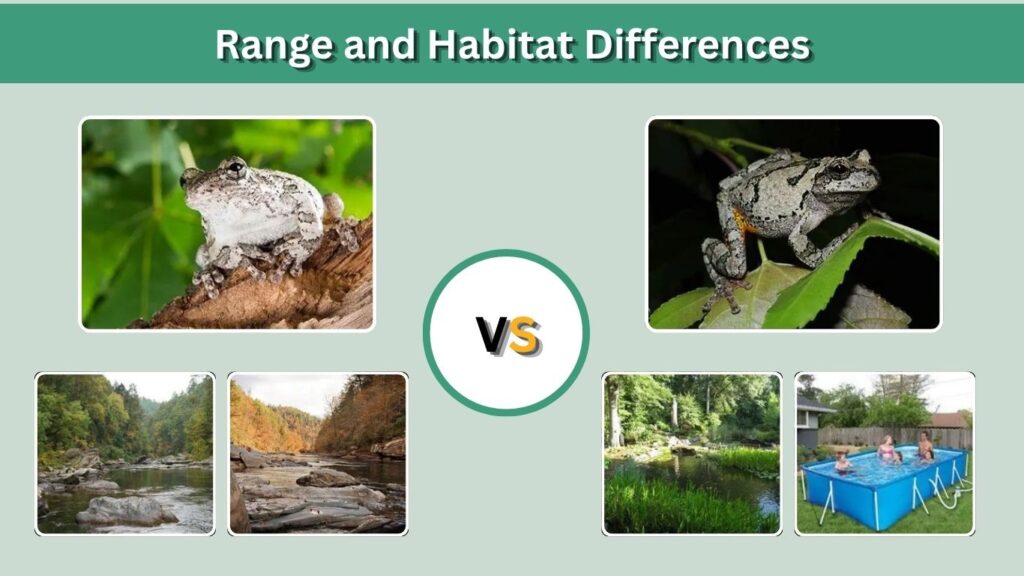
Together, the two gray tree frog species occupy much of eastern and central North America, extending through parts of southern Canada and the eastern United States.
Where Cope’s gray tree frogs live
Cope’s gray tree frogs are generally more common in southern and western portions of the combined range. They occur across many central, southeastern and eastern states, although their exact distribution can be difficult to map because they resemble eastern gray tree frogs.
Where eastern gray tree frogs live
Eastern gray tree frogs are generally associated more strongly with northern and eastern portions of the shared range, including parts of the Great Lakes and northeastern regions. However, both species occur together in several areas and may even use the same breeding ponds.
Their habitats overlap
Both species inhabit wooded landscapes near suitable breeding water. They may be found around:
- Deciduous and mixed forests
- Woodland ponds
- Temporary pools
- Swamps and wetlands
- Farm woodlots
- Forest edges
- Tree-filled suburban yards
- Vegetation surrounding lakes
Because their environmental requirements are similar, habitat alone is rarely enough to identify one of these frogs.
Male vs Female Gray Tree Frogs
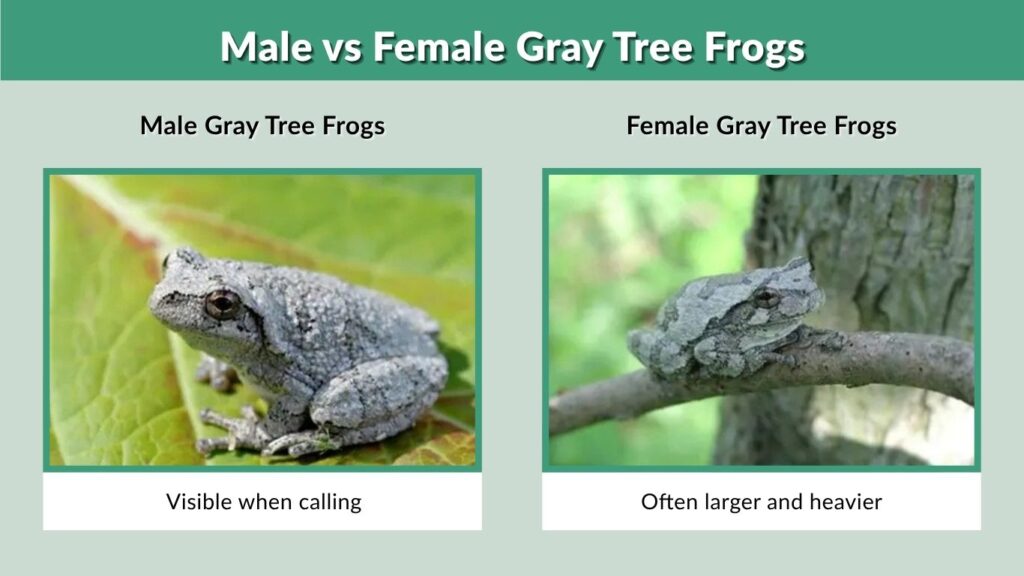
Sex differences are broadly similar in Cope’s and eastern gray tree frogs. These traits can help determine whether a frog is male or female, but they do not reveal which of the two species it belongs to.
| Feature | Male | Female |
| Calling | Produces the breeding advertisement call | Normally does not advertise |
| Throat | Often dark gray or blackish during breeding | Usually pale or whitish |
| Vocal sac | Visible when calling | Absent |
| Average build | Usually smaller and slimmer | Often larger and heavier |
| Breeding behavior | Calls and clasps the female | Selects a male and lays eggs |
A dark throat is one of the most useful signs of an adult male, particularly during breeding season. Females are generally larger than males, but size alone remains unreliable because frogs of different ages overlap.
Gray Tree Frogs vs Similar Frogs
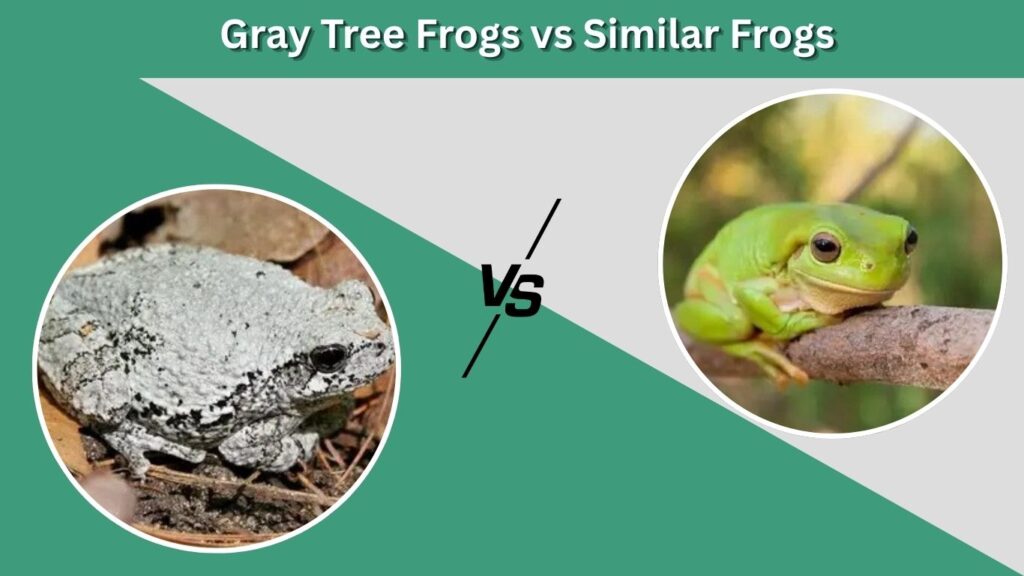
Several other tree frogs can be confused with members of the gray tree frog group.
| Frog | Main difference from gray tree frogs |
| Spring peeper | Much smaller, smoother and usually has a dark X on its back |
| Green tree frog | Usually smooth, bright green and has a pale stripe along each side |
| Bird-voiced tree frog | Often smaller, with a greenish inner-thigh pattern rather than bright yellow-orange |
| American toad | Heavier-bodied, more terrestrial and lacks enlarged climbing pads |
| Squirrel tree frog | Smaller, smoother and lacks the gray frogs’ bright orange-yellow thigh patches |
The spring peeper’s call is a short, high whistle rather than a sustained trill. A green tree frog produces an individual nasal note, while bird-voiced tree frogs make a prolonged birdlike call.
FAQs
What is the main difference between Cope’s and eastern gray tree frogs?
The male breeding call is the most useful field difference. Cope’s gray tree frog has a faster, harsher trill, while the eastern gray tree frog produces a slower and more musical trill. They also differ genetically: Cope’s is diploid, whereas the eastern species is tetraploid.
Can you identify the species from a photograph?
Usually not with confidence. Their colors, markings, size and body shape overlap almost completely. A photograph may identify the animal as belonging to the gray tree frog group, but a clear recording of its advertisement call is normally needed to determine the exact species.
Are Cope’s gray tree frogs smaller?
Cope’s gray tree frogs may average slightly smaller in some populations, but their size range overlaps that of eastern gray tree frogs. A young eastern gray tree frog can easily be smaller than an adult Cope’s, so size should never be treated as proof.
Do both species change color?
Yes. Both can shift among gray, green and brown shades depending on their surroundings and environmental conditions. They do not change instantly like a chameleon, but their appearance can become noticeably different over several hours.
Can Cope’s and eastern gray tree frogs live in the same area?
Yes. Their ranges overlap in several parts of North America, and both species may use the same breeding wetlands. In these areas, listening to the male’s call—or conducting laboratory testing—is usually the only dependable way to identify the species.
