
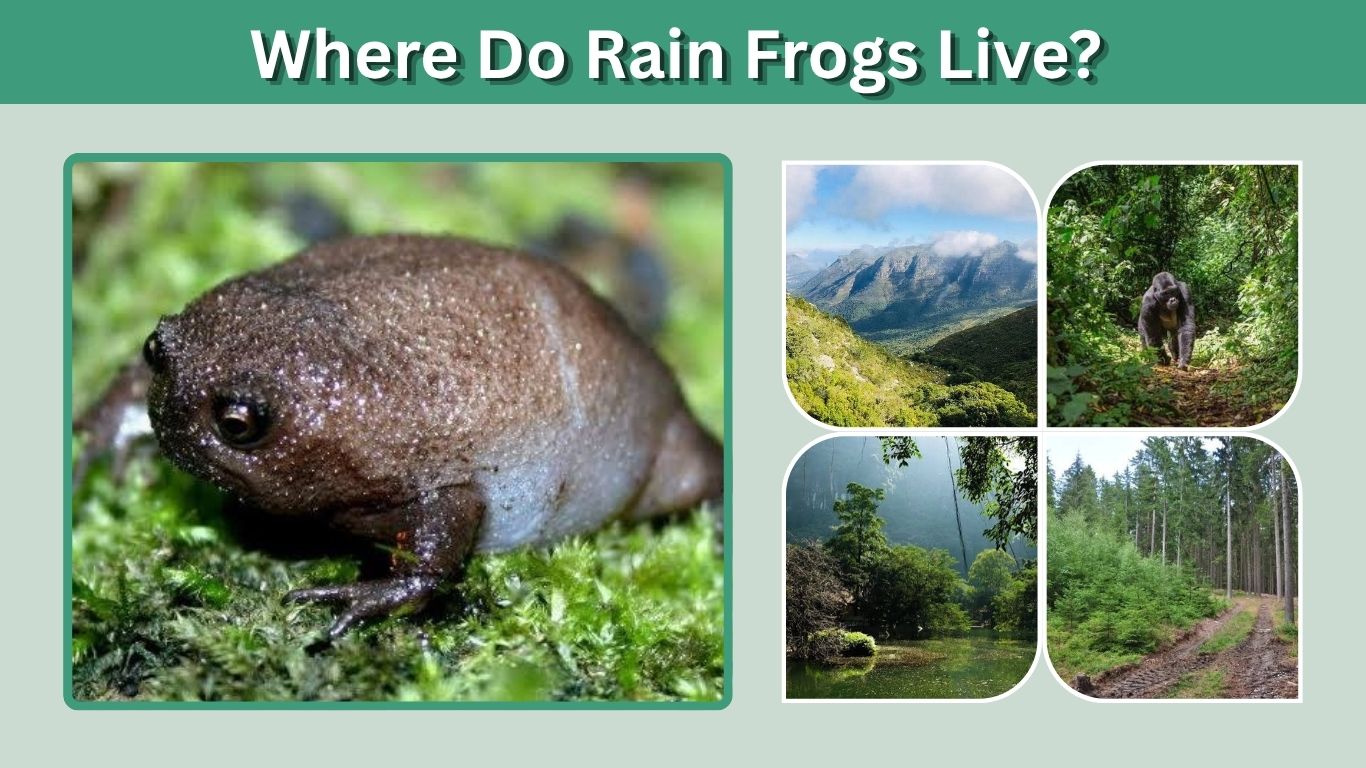
Rain frogs are small, round-bodied burrowing amphibians found mainly in southern and eastern Africa. Unlike the tree frogs associated with tropical rainforests, true rain frogs in the genus Breviceps spend much of their lives underground in soil, sand, grassland, savanna, or forest-floor habitats. Different species occupy remarkably different environments, from foggy coastal dunes to mountain forests and open woodland. Their secretive lifestyle makes them difficult to study, especially when estimating lifespan. This guide explains where rain frogs live, how they survive dry periods, and how long different species may live.
Where Do Rain Frogs Live?
True rain frogs belong primarily to the genus Breviceps. They are native to Africa, especially southern and eastern parts of the continent. Although their common name suggests constantly wet environments, many species actually inhabit grasslands, savannas, scrublands, coastal dunes, and relatively dry areas.
Main Rain Frog Habitats
Rain frogs can be found in:
- Sandy coastal dunes
- Grasslands
- Savannas
- Open woodland
- Shrubland
- Mountain forests
- Forest edges
- Moist soil beneath vegetation
- Leaf litter
- Underground burrows
Their short legs and compact bodies are designed more for digging than swimming or long-distance jumping.
Instead of remaining beside ponds, most rain frogs spend much of their lives underground. Moist soil protects their sensitive skin from dehydration and provides shelter from high temperatures and predators.
Where Do Desert Rain Frogs Live?
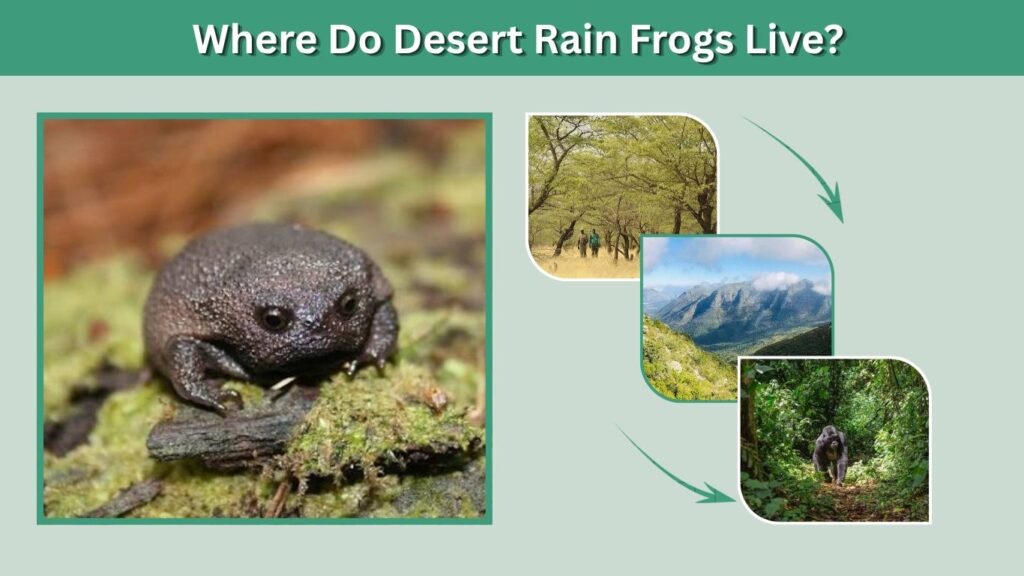
The Desert Rain Frog (Breviceps macrops) has one of the most specialized habitats of any rain frog. It occurs along a narrow coastal strip spanning extreme western South Africa and southwestern Namibia.
Its documented range extends from just south of Kleinsee in South Africa northward to around Lüderitz in Namibia.
Desert Rain Frog Habitat
Despite the word “desert,” these frogs do not simply live in extremely dry inland sand.
They inhabit coastal sand dunes influenced by moisture from Atlantic fog. The sand beneath the surface can remain damp enough for the frogs even when rainfall is scarce.
Desert Rain Frogs spend much of their time buried in sand and generally become active above ground at night when conditions are cool and humid.
Their environment includes sparse coastal vegetation and small vegetated dune hummocks. This combination of loose sand and moisture allows them to burrow while avoiding dehydration.
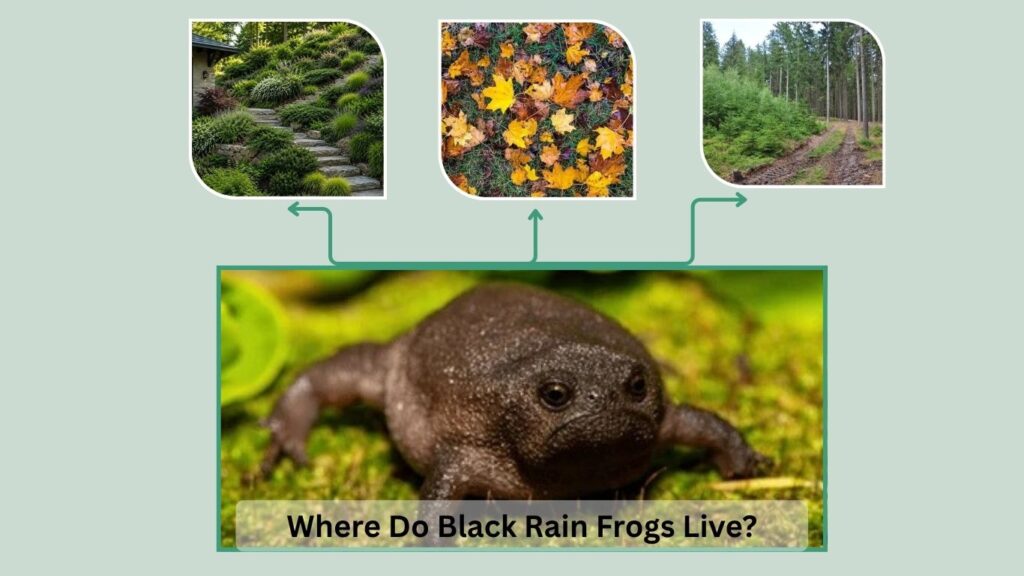
Where Do Black Rain Frogs Live?
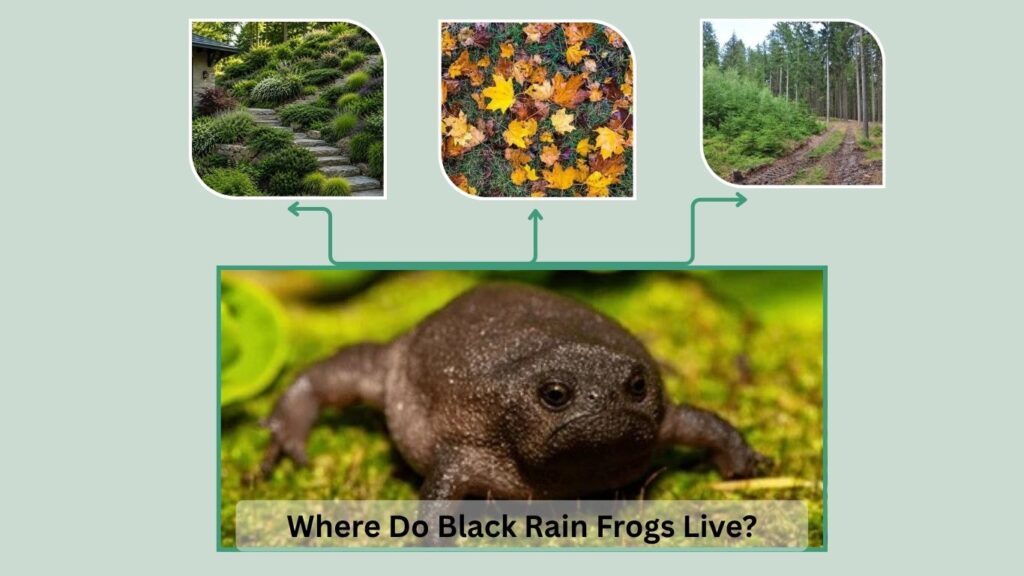
The Black Rain Frog (Breviceps fuscus) has a very different habitat from the Desert Rain Frog.
It is endemic to South Africa and occurs on forested slopes and plateaus associated with the southern Cape Fold Mountains.
Black Rain Frog Habitat
Black Rain Frogs favor:
- Mountain forests
- Forest margins
- Moist slopes
- Leaf litter
- Loose forest soil
- Underground burrows
Their dark brown to nearly black coloration and rounded bodies make them very different in appearance from pale Desert Rain Frogs.
Black Rain Frogs are strongly terrestrial. They do not need to spend their adult lives around ponds because reproduction occurs on land.
Where Do Common Rain Frogs Live?
The Common Rain Frog (Breviceps adspersus), also called the Bushveld Rain Frog, has a much larger range.
It occurs from parts of Angola through Namibia, Botswana, Zambia, Zimbabwe, southern Mozambique and Eswatini into northern South Africa.
Common Rain Frog Habitat
Common Rain Frogs occupy environments such as savanna, grassland, bushveld, open woodland, and other areas containing soil suitable for burrowing.
They often remain underground until rainfall or increased humidity makes surface activity safer.
This behavior explains their common name: people frequently notice them immediately before, during, or after rainy weather.
Where Do Mozambique Rain Frogs Live?
The Mozambique Rain Frog (Breviceps mossambicus) has one of the broadest distributions among rain frogs.
Its range extends from eastern Tanzania south through Mozambique and into eastern South Africa, with populations also occurring in Eswatini, Zimbabwe, Zambia, Malawi, and the southeastern Democratic Republic of the Congo.
Mozambique Rain Frog Habitat
These frogs can occupy savanna, open woodland, grassland, bushy country, and other terrestrial environments where suitable soil and moisture are available.
Like other members of the genus, they are highly adapted to digging. Most activity occurs at or below ground level rather than in trees or permanent water.
Where Do Forest Rain Frogs Live?
The Forest Rain Frog (Breviceps sylvestris) is restricted to South Africa.
It occurs in montane forests and mountain grasslands of eastern and northern Limpopo Province. Its populations are geographically separated, making its natural range much smaller than that of the Common or Mozambique Rain Frog.
Life on the Forest Floor
Forest Rain Frogs remain close to the ground, hiding beneath leaf litter or burrowing into moist soil.
They are not rainforest canopy frogs and lack the enlarged adhesive toe pads associated with many tree frogs.
Their body shape instead reflects a life spent digging and moving through vegetation close to the soil.
Where Do Frogs Live When It Is Not Raining?
Rain frogs do not disappear when rainfall stops. They simply become much harder to see.
Underground Burrows
Most rain frogs are fossorial, meaning they are adapted for burrowing.
During dry or hot conditions, a rain frog can remain beneath the surface, where temperatures fluctuate less dramatically and humidity is higher than in exposed air.
When rainfall increases soil moisture, frogs can move closer to the surface and begin calling, feeding, and breeding.
Cape Rain Frogs, for example, are seldom noticed except during and after substantial rainfall, even though the frogs remain present in the habitat throughout other periods.
Do Rain Frogs Live in Water?
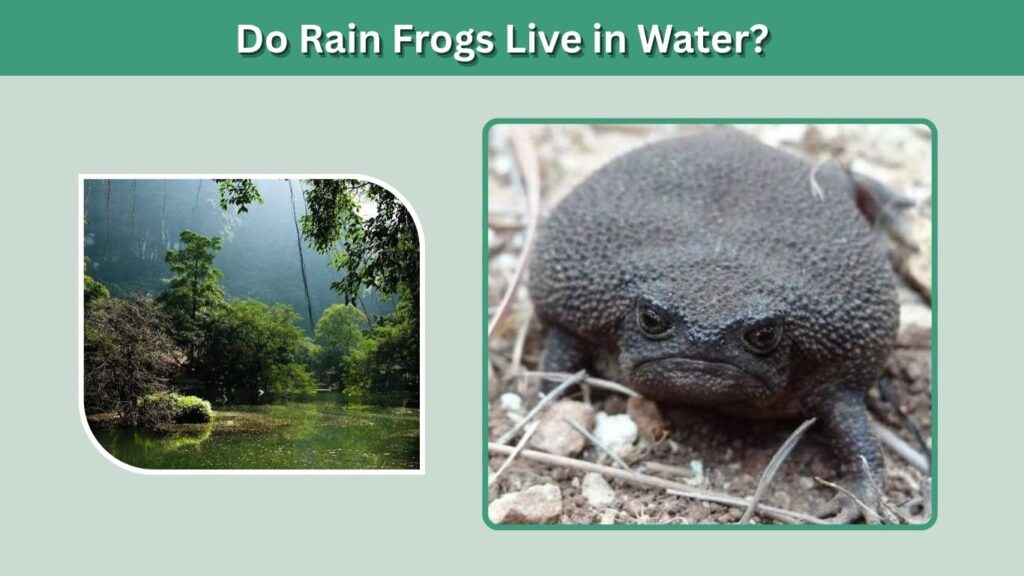
Rain frogs are unusual because they are far more terrestrial than the classic image of a frog living beside a pond.
They Are Poor Swimmers
Their short legs and rounded bodies are specialized for digging rather than swimming. Many Breviceps species can reproduce without entering a pond.
Instead, eggs are deposited in underground chambers.
The embryos develop inside the eggs and eventually emerge as fully formed miniature frogs. This process is known as direct development.
Because there is no free-swimming tadpole stage, rain frogs can occupy habitats without permanent ponds or streams.
Do Rain Frogs Live in the Amazon Rainforest?
No true Breviceps rain frogs naturally live in the Amazon.
The Amazon rainforest contains an enormous diversity of frogs, including poison dart frogs, glass frogs, tree frogs, and horned frogs, but these should not be confused with African rain frogs.
True rain frogs are African amphibians.
How Long Do Rain Frogs Live?
Determining rain frog lifespan is difficult because these animals spend so much of their time underground.
Scientific longevity information is surprisingly limited for many Breviceps species.
Desert Rain Frog Lifespan
One field study of Desert Rain Frogs suggested that individuals live approximately 3–4 years in the wild and specifically noted that longevity information for other Breviceps species was poorly known.
This is more cautious than some popular online claims that give much longer maximum lifespans.
Environmental conditions, food availability, predation, disease, and drought can all influence how long an individual survives.
Black Rain Frog Lifespan
The precise average lifespan of the Black Rain Frog has not been well established through detailed long-term population studies.
Claims of exact maximum ages should therefore be treated cautiously. Its underground lifestyle makes tracking individual wild frogs over many years particularly difficult.
Mozambique and Common Rain Frog Lifespan
The same problem applies to Mozambique and Common Rain Frogs. There is not enough robust species-specific research to give a confident universal lifespan.
Rain frogs should therefore be described as potentially multi-year amphibians rather than assigning every species the same lifespan.
How Long Do Rain Frogs Live in Captivity?
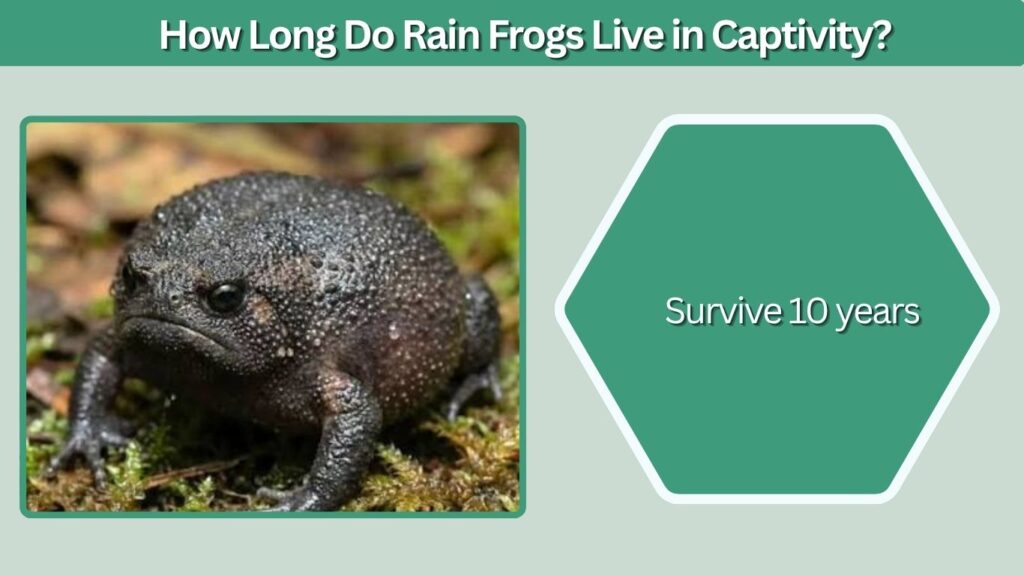
Captive longevity is also poorly documented scientifically.
Some specialist husbandry reports suggest that certain Breviceps may potentially survive 10 years or more under good captive conditions, but these figures are based largely on husbandry experience rather than large, controlled longevity studies. One captive-care reference suggests potential longevity of 10–15 years for Mozambique Rain Frogs.
Wild and captive lifespans should therefore not be treated as identical.
Why Do Rain Frogs Come Out After Rain?
Rain creates conditions that make surface activity safer.
Rain Helps Them
Moist conditions reduce water loss through the skin, soften the soil for digging, stimulate insect activity, and provide suitable conditions for reproduction.
Males may begin calling as humidity rises, sometimes even before heavy rainfall begins.
This behavior gave the group its familiar name. The frogs do not arrive with the rain—they were usually hidden underground all along.
How Do Rain Frogs Survive Dry Habitats?
Rain frogs have several adaptations that allow them to live surprisingly far from permanent water.
Their most important strategy is burrowing.
Underground soil provides more stable temperatures and humidity than exposed surfaces. A compact body reduces exposed surface area, while specialized feet help the frog dig backward rapidly.
The Desert Rain Frog takes this adaptation even further by occupying coastal dunes where ocean fog provides crucial moisture despite very limited rainfall.
FAQs
1. Where are rain frogs found?
True rain frogs occur mainly in southern and eastern Africa, including South Africa, Namibia, Mozambique, Tanzania, Zimbabwe, Zambia, Botswana, Eswatini, Malawi, and neighboring regions.
2. Where does the Desert Rain Frog live?
It lives in a narrow coastal dune region from western South Africa into southwestern Namibia, where Atlantic fog helps keep the sand moist.
3. Where does the Black Rain Frog live?
The Black Rain Frog is endemic to South Africa and inhabits forested slopes and plateaus of the southern Cape Fold Mountains.
4. How long does a rain frog live?
There is no single lifespan for every species. Field research on Desert Rain Frogs suggests roughly 3–4 years, while longevity remains poorly documented for many other rain frogs.
5. Do rain frogs need ponds to survive?
Most Breviceps rain frogs do not require ponds for reproduction. Their eggs develop on land, and young emerge as froglets rather than passing through a free-swimming tadpole stage.
